• Home
  • Health Topics
  • Human Body
  • Diagnostics
  • Conditions
  • Treatments
  • Foods
  • Herbs
  • Supplements
  • Weight Loss
  • Longevity
Search
VitaLibrary
  • Home
  • Health Topics
  • Human Body
  • Diagnostics
  • Conditions
  • Treatments
  • Foods
  • Herbs
  • Supplements
  • Weight Loss
  • Longevity
  • Blood Tests and Blood Biomarkers
  • Brain, Cognitive, and Mental Health Tests and Diagnostics
  • Genetic and Molecular Biomarkers
  • Hormone Tests
  • Inflammation and Immune Markers
  • Tumor Markers
    Latest
    • Latest
    • Featured posts
    • Most popular
    • 7 days popular
    • By review score
    • Random
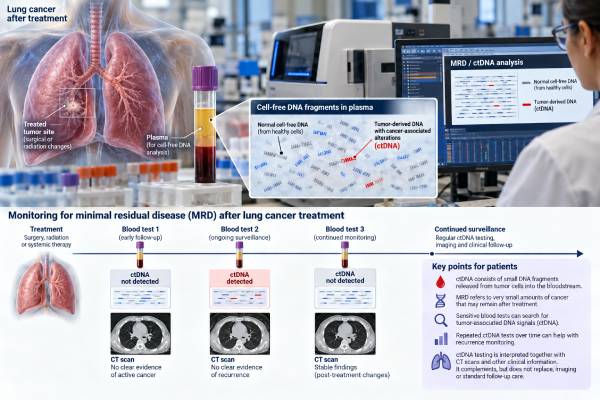
    Learn how lung cancer MRD ctDNA testing detects molecular residual disease, what positive and negative results mean, how it can precede recurrence on scans, and why treatment decisions still require clinical context.

    Minimal Residual Disease ctDNA Test for Lung Cancer: Recurrence Monitoring, MRD, and Tumor DNA

    Learn what MSI testing means in lung cancer, how MSI-H, MSS, dMMR, and pMMR results differ, how NGS, PCR, and IHC are used, and why this rare biomarker can matter for immunotherapy and hereditary evaluation.

    MSI Test for Lung Cancer: Microsatellite Instability, Mismatch Repair, and Result Meaning

    Learn how Napsin A IHC supports lung adenocarcinoma diagnosis, what positive granular cytoplasmic staining means, why negative results do not exclude lung cancer, and when other tumor origins must be considered.

    Napsin A IHC Test for Lung Cancer: Adenocarcinoma Marker, Tumor Origin, and Positive...

    Understand NSCLC biomarker testing for driver mutations, gene fusions, PD-L1 TPS, molecular profiling, liquid biopsy, negative results, resistance testing, and treatment-related next steps.

    Non-Small Cell Lung Cancer Biomarker Test: Driver Mutations, PD-L1, and Molecular Profile

    Learn what an NSE blood test means in small cell lung cancer, why levels can be high, how hemolysis causes false elevations, and how serial NSE trends may support treatment and recurrence monitoring.

    NSE Test for Lung Cancer: Small Cell Lung Cancer Marker, High Levels, and...

    Understand NTRK fusion testing in lung cancer, including tumor-agnostic meaning, RNA NGS, pan-TRK IHC, positive results, negative-result limits, and next steps.

    NTRK Fusion Test for Lung Cancer: Gene Fusion, Tumor-Agnostic Marker, and Molecular Meaning

    Diagnostics

    Home Diagnostics Page 92
    A high PHQ-9 score usually signals clinically important depressive symptoms, but the real meaning depends on severity range, item 9, functioning, diagnosis, and what happens next in assessment and treatment.

    What Does a High PHQ-9 Score Mean?

    A low MoCA score can suggest cognitive impairment, but it can also reflect sleep, mood, medical issues, or testing factors. Learn how doctors interpret the score and what usually comes next.

    What Does a Low MoCA Score Mean?

    Learn what a positive bipolar screening result can and cannot tell you, why false positives happen, how clinicians confirm bipolar disorder, and when a positive screen needs urgent follow-up.

    What Does a Positive Bipolar Screen Mean?

    Understand what a positive PTSD screen actually means, why it is not a diagnosis, what follow-up usually involves, and when trauma-related symptoms need faster support.

    What Does a Positive PTSD Screen Mean?

    Learn what a positive mental health screen usually leads to, how follow-up evaluation works, when scores are not the same as diagnosis, and when urgent help is needed.

    What Happens After a Positive Mental Health Screen?

    Learn what doctors usually do after abnormal brain imaging or cognitive test results, including urgent warning signs, repeat testing, specialist referrals, and how follow-up decisions are made.

    What Happens After Abnormal Brain Scan or Cognitive Test Results?

    A cognitive assessment usually includes history, daily-function questions, brief memory and thinking tasks, and follow-up planning to clarify whether cognitive changes are normal, reversible, or a sign of a larger neurological problem.

    What Happens During a Cognitive Assessment?

    A mental health evaluation usually includes symptom review, history, observation, a mental status exam, safety assessment, and planning for diagnosis, treatment, or medical rule-outs so you know what to expect before the visit.

    What Happens During a Mental Health Evaluation?

    Learn what a neuropsychological evaluation includes, how testing is done, how long it takes, what cognitive domains are measured, and how results are used for diagnosis and care planning.

    What Happens During a Neuropsychological Evaluation?

    Learn which mental health and neurological symptoms call for emergency care, which red flags should never be watched at home, and when urgent follow-up may be enough.

    When to Go to the ER for Mental Health or Neurological...

    Learn what the Y-BOCS test measures, how OCD severity is scored, what the numbers usually mean, and how clinicians use the scale in diagnosis, treatment planning, and follow-up.

    Y-BOCS Test for OCD: What It Measures and How It Is...

    1...909192Page 92 of 92
    • Disclaimer
    • Privacy Policy
    • About Us
    © 2026 Vita Library. All rights reserved.
    Contact us: contact@vitalibrary.com