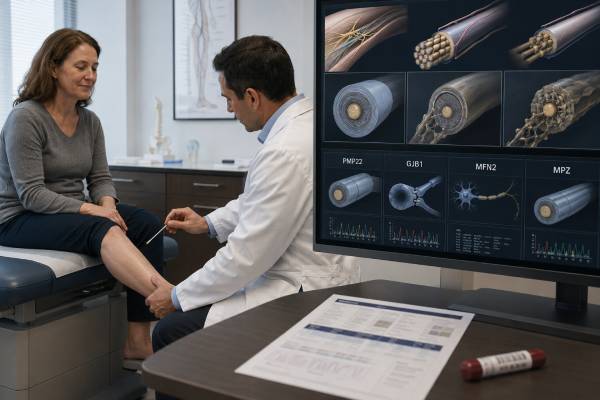
Charcot-Marie-Tooth disease genetic testing searches for an inherited cause of a slowly progressive peripheral neuropathy. The most frequent findings involve PMP22, GJB1, MFN2, or MPZ, but more than 100 genes can produce overlapping weakness, sensory loss, foot deformity, and reduced reflexes. The best test is chosen after a neurologic examination and nerve conduction studies because demyelinating, axonal, and intermediate patterns point toward different genetic possibilities. Testing often starts with PMP22 copy-number analysis, since a duplication causes CMT1A and a deletion causes hereditary neuropathy with liability to pressure palsies. If that test is negative or the phenotype suggests another subtype, a multigene panel is usually more efficient than testing genes one by one. A positive result can confirm the subtype, clarify inheritance, guide testing for relatives, and support trial eligibility. A negative or uncertain result does not exclude CMT, especially when the laboratory did not assess copy-number changes, repeat expansions, mitochondrial DNA, or newly recognized genes.
- Most common first test: PMP22 duplication and deletion analysis, especially for a demyelinating neuropathy.
- A pathogenic result confirms a genetic subtype: it does not precisely predict disability, walking ability, or age at progression.
- Nerve conduction studies guide test selection: they help separate demyelinating, axonal, and intermediate forms.
- A negative panel does not rule out inherited neuropathy: broader sequencing or reanalysis may find a cause later.
- No fasting is needed: testing usually uses blood or saliva, and medications generally do not affect the DNA result.
Table of Contents
- How CMT Affects Peripheral Nerves
- PMP22, GJB1, MFN2, and MPZ
- Choosing the Right Genetic Test
- How to Read the Results
- Inheritance and Testing Relatives
- Care After a Genetic Diagnosis
- Why Testing Can Remain Inconclusive
How CMT Affects Peripheral Nerves
Charcot-Marie-Tooth disease, or CMT, is a group of inherited disorders that damage peripheral nerves—the nerves outside the brain and spinal cord. These nerves carry movement signals to muscles and return information about touch, vibration, pain, temperature, and joint position.
The classic pattern is symmetric, slowly progressive weakness that starts in the feet and lower legs. Common findings include:
- frequent ankle sprains or tripping;
- foot drop and a high-stepping gait;
- high arches, curled toes, or other cavovarus foot changes;
- thin lower legs from muscle loss;
- reduced or absent ankle reflexes;
- numbness or reduced vibration in the feet;
- hand weakness that develops later; and
- difficulty with buttons, handwriting, jars, or fine hand tasks.
Symptoms often begin in childhood, adolescence, or early adulthood, but mild forms may not be recognized until later. Some children appear clumsy, avoid running, or wear out shoes unevenly before anyone suspects neuropathy. Severity varies widely, including among relatives with the same variant.
CMT is commonly grouped by what nerve conduction studies show. In demyelinating CMT, the insulating myelin sheath is primarily affected, so electrical signals travel slowly. In axonal CMT, the nerve fiber itself is mainly damaged, and signal amplitude is reduced while conduction speed may be relatively preserved. Intermediate CMT falls between these patterns.
These categories are useful but not absolute. GJB1 and MPZ variants, for example, can produce intermediate or mixed findings. Age, limb temperature, technical factors, and advanced axonal loss can also affect nerve conduction results. A neurologist interprets the full pattern rather than relying on one velocity number.
CMT can resemble acquired neuropathies caused by diabetes, vitamin deficiency, immune disease, toxins, medications, kidney disease, or alcohol. A family history supports inherited disease, but its absence does not exclude it. A new variant can arise in one person, recessive disease may appear in only siblings, and mild relatives may never have been diagnosed.
PMP22, GJB1, MFN2, and MPZ
Four genes account for a large share of molecular diagnoses, but each causes disease through a different mechanism.
PMP22
PMP22 makes a protein important for peripheral myelin. The most common CMT finding is a duplication of a roughly 1.4- to 1.5-megabase region on chromosome 17 that includes PMP22. Having three copies instead of the usual two raises PMP22 dosage and causes CMT1A, typically a demyelinating neuropathy.
The reciprocal deletion of the same region leaves one PMP22 copy and usually causes hereditary neuropathy with liability to pressure palsies, or HNPP. People with HNPP tend to develop recurrent focal numbness or weakness after pressure, stretching, or repetitive use of a nerve. A wrist drop after leaning on an arm or foot drop after prolonged squatting are examples. Some people have a more continuous generalized neuropathy.
Rare single-letter or small insertion/deletion variants in PMP22 can cause CMT, HNPP-like disease, or severe early-onset neuropathy. Therefore, a normal copy-number result does not exclude every PMP22 disorder; sequencing may still be appropriate.
GJB1
GJB1 encodes connexin 32, a gap-junction protein that helps Schwann cells support myelinated nerves. Pathogenic variants cause CMTX1, the most common X-linked form of CMT.
Males with one altered X chromosome often have earlier or more pronounced weakness because they have no second GJB1 copy. Females with one altered copy may have mild, moderate, severe, or no obvious symptoms because X-chromosome inactivation varies among cells. This variability means that “female carrier” does not necessarily mean unaffected.
Some people with GJB1-related disease develop temporary episodes of slurred speech, weakness, imbalance, or other central nervous system symptoms, sometimes after fever, high altitude, or intense exertion. These episodes require medical assessment because stroke and other urgent conditions must be excluded.
MFN2
MFN2 helps mitochondria join, move, and function within long nerve cells. Pathogenic variants commonly cause CMT2A, an axonal neuropathy. Onset can range from early childhood with marked disability to a milder adult presentation.
Certain MFN2 variants are associated with optic atrophy, meaning damage to the optic nerve and reduced vision. Hearing loss, upper motor neuron signs, or other features may occur in some individuals. Most MFN2-related CMT is autosomal dominant, but recessive inheritance is possible with particular variants and families.
MPZ
MPZ encodes myelin protein zero, a major structural component of peripheral myelin. MPZ variants can cause several patterns: severe congenital or childhood demyelinating neuropathy, typical CMT1B, intermediate disease, or late-onset axonal neuropathy.
This broad range makes the exact variant and clinical context important. Two people with different MPZ variants may have very different ages at onset and nerve conduction findings. A laboratory classification alone cannot replace gene-specific interpretation.
Other relevant genes include SORD, GDAP1, SH3TC2, NEFL, HSPB1, MPZL2, FIG4, and many others. A modern neurologic genetic panel may cover dozens or hundreds of inherited neuropathy genes.
Choosing the Right Genetic Test
Testing works best as a sequence of targeted decisions rather than an indiscriminate search.
Step 1: Confirm the neuropathy pattern
The evaluation usually includes medical and family history, neurologic examination, and nerve conduction studies with electromyography when needed. Clinicians look for symmetrical distal weakness, sensory loss, foot shape, reflex changes, and the distribution of nerve involvement.
Blood tests may check for common acquired causes, such as diabetes, vitamin B12 deficiency, thyroid disease, monoclonal proteins, kidney or liver dysfunction, and selected autoimmune or infectious conditions. Genetic and acquired neuropathies can coexist, so finding one risk factor should not automatically end the evaluation.
Step 2: Perform PMP22 copy-number testing when appropriate
PMP22 duplication/deletion analysis remains a common first-tier test, particularly when nerve conduction studies show demyelination or the phenotype resembles classic CMT1A or HNPP. Methods may include multiplex ligation-dependent probe amplification, chromosomal microarray, quantitative PCR, or a validated sequencing-based copy-number assay.
This is a deletion/duplication test, not ordinary sequencing. A panel that lists PMP22 may still miss the common duplication if its copy-number method is weak or absent. The order and report should explicitly state whether PMP22 dosage was analyzed.
Step 3: Use a phenotype-informed multigene panel
If PMP22 copy number is normal—or if the clinical pattern points elsewhere—a multigene panel is often the next test. A strong panel should include genes for demyelinating, axonal, intermediate, X-linked, dominant, and recessive neuropathies. It should also detect small sequence variants and, when possible, exon-level deletions and duplications.
The phenotype still matters. For example:
- male-to-male transmission argues against X-linked GJB1 disease;
- affected males related through females may support X-linked inheritance;
- severe childhood axonal disease can raise suspicion for MFN2 or recessive genes;
- recurrent pressure palsies point strongly toward a PMP22 deletion;
- very slow conduction with early onset broadens the severe demyelinating differential; and
- optic atrophy may increase attention to MFN2 and other optic-neuropathy genes.
A multigene panel reduces repeated testing, but broader coverage also increases the chance of uncertain findings.
Step 4: Escalate when the panel is negative
Whole-exome or whole-genome sequencing may find variants outside the panel, newly established genes, structural changes, deep intronic variants, or unusual copy-number events. Genome sequencing can offer broader coverage, but analysis and reporting remain important limitations. A technically present variant may be missed if the gene was not prioritized or if the variant type was difficult to call.
Some neuropathy causes need separate assays. Examples include repeat expansions, mitochondrial variants, RFC1-associated disease, or complex structural rearrangements. A negative whole-exome sequencing test cannot exclude every one of these mechanisms.
How to Read the Results
CMT reports should be interpreted in relation to the phenotype, inheritance pattern, and laboratory method.
| Report result | Meaning | Typical follow-up |
|---|---|---|
| Pathogenic or likely pathogenic variant | A recognized disease-causing finding that fits a dominant, recessive, or X-linked subtype | Confirm phenotype, review inheritance, and offer appropriate family testing |
| Variant of uncertain significance | Evidence is insufficient to call the variant disease-causing or benign | Do not use alone for diagnosis; consider segregation, phenotype review, and future reanalysis |
| Negative | No reportable cause was found with the genes and methods used | Verify PMP22 copy-number coverage and consider broader or different testing |
| Carrier finding | One pathogenic variant was found in a recessive gene, without a second disease-causing variant | Assess whether a second variant could have been missed and clarify reproductive implications |
Pathogenic and likely pathogenic results
A pathogenic PMP22 duplication in a person with a compatible neuropathy confirms CMT1A. A pathogenic GJB1 variant can establish CMTX1. A disease-causing MFN2 or MPZ variant can define a gene-specific subtype.
“Likely pathogenic” is also considered clinically actionable when the evidence and phenotype fit. It reflects a high probability of disease causation, not a weaker degree of illness.
The result does not provide a precise prognosis. Variant-specific studies may reveal broad trends, but walking ability, pain, hand function, foot deformity, and progression vary. Treatment plans should follow the individual’s actual function.
Variant of uncertain significance
A variant of uncertain significance, or VUS, is not a confirmed diagnosis. CMT panels often find rare variants because many genes are tested and population data remain incomplete.
Useful evidence may include whether the variant tracks with neuropathy in the family, whether it is absent from unaffected older relatives, whether the nerve conduction pattern matches the gene, and whether functional or published data support an effect. Testing relatives solely to generate evidence should be coordinated by genetics professionals. A VUS should not be used for prenatal or predictive testing as though it were pathogenic.
Negative result
A negative result means only that the laboratory did not identify a reportable cause within the test’s scope. It may reflect a true unknown cause, a gene not included, a structural or repeat variant not detected, low-level mosaicism, incomplete coverage, or a variant that science cannot yet interpret.
Ask for the test’s gene list, coverage statement, copy-number capability, mitochondrial analysis, and policy for reanalysis. A negative result is more informative after appropriate PMP22 copy-number testing than after sequencing alone.
Inheritance and Testing Relatives
CMT can follow autosomal dominant, autosomal recessive, X-linked, or mitochondrial inheritance. The gene and exact variant determine the family risk.
In autosomal dominant CMT, an affected person usually has one altered gene copy. Each child has a 50% chance of inheriting it. PMP22 duplication, many MPZ variants, and many MFN2 variants follow this pattern. Symptoms may vary enough that an apparently unaffected parent has subtle signs.
In autosomal recessive CMT, a person generally has pathogenic variants in both copies of a gene. Parents are often unaffected carriers. When both parents carry variants in the same gene, each pregnancy has a 25% chance of an affected child, a 50% chance of a carrier child, and a 25% chance of a child with neither familial variant.
In X-linked CMT, such as GJB1-related CMTX1, transmission depends on the parent and child’s sex chromosomes. A male with a pathogenic GJB1 variant passes it to all daughters and no sons. A heterozygous female has a 50% chance of passing the variant in each pregnancy; sons who inherit it are often more affected, while daughters can range from asymptomatic to clearly affected.
Once a pathogenic family variant is known, relatives can use a targeted variant test. This is usually faster, less expensive, and easier to interpret than repeating a broad panel.
Testing children may be reasonable because CMT can begin in childhood and early recognition can support physical therapy, orthotics, safety, and school accommodations. The decision should consider the expected age of onset and whether the result will change care. Genetic counseling can also address reproductive options, including prenatal testing and preimplantation genetic testing, without assuming that every family wants testing.
Care After a Genetic Diagnosis
A molecular diagnosis helps name the subtype, but current care remains based on symptoms and function. As of 2026, no disease-modifying treatment has received broad approval for CMT, although gene- and subtype-specific therapies are under study.
Management may include:
- physical therapy focused on safe strength, endurance, balance, and flexibility;
- ankle-foot orthoses for foot drop or ankle instability;
- occupational therapy and adaptive tools for hand weakness;
- properly fitted footwear and regular skin checks when sensation is reduced;
- podiatry or orthopedic review for progressive foot deformity;
- pain assessment that distinguishes neuropathic, musculoskeletal, and overuse pain;
- hearing or vision evaluation when the genetic subtype raises those risks; and
- surgical consultation when deformity causes pain, instability, ulcers, or loss of function.
Exercise is generally encouraged when it is individualized and avoids repeated injury. Severe fatigue, prolonged muscle pain, or functional decline after activity may signal that intensity needs adjustment. Immobilization can worsen weakness, so recovery plans after surgery or injury should account for the underlying neuropathy.
Medication review is important. Vincristine can cause severe neurotoxicity in people with CMT and should be discussed urgently with the treating oncology team if proposed. Other drugs may worsen neuropathy in susceptible people, but long “avoid” lists often overstate weak evidence. A neurologist and pharmacist should balance the necessity of a drug against the specific risk rather than stopping essential treatment without advice.
A confirmed genotype can support enrollment in natural-history studies or trials designed for CMT1A, CMTX1, CMT2A, or another subtype. Trial eligibility depends on age, function, variant, location, and study criteria. Genetic confirmation does not guarantee that an investigational treatment will help.
Regular follow-up is usually clinical rather than based on repeated genetic tests. DNA results generally do not change over time. Clinicians track walking distance, falls, ankle range of motion, hand function, pain, sensation, foot shape, and the fit of braces or shoes. Children may need growth-related orthotic adjustments more often than adults. Repeat nerve conduction studies are not automatically necessary at every visit unless a new diagnostic question arises or the course changes unexpectedly.
The gene result can also prevent misleading labels. For example, a person with a PMP22 duplication and a typical slow course may avoid repeated immune treatments for an assumed inflammatory neuropathy. Conversely, rapid decline, marked asymmetry, prominent autonomic failure, or a sudden stepwise change should not be attributed to CMT without investigating an additional acquired problem. People with inherited neuropathy can still develop nerve compression, diabetes, vitamin deficiency, radiculopathy, or an immune neuropathy.
Documentation helps with practical support. A clinic letter can describe foot drop, hand weakness, fatigue, sensory loss, fall risk, and the need for braces, mobility aids, workplace changes, or school accommodations. The genetic diagnosis may strengthen the explanation, but eligibility for services should be based on function. Families should keep both the laboratory report and a concise medical summary, since variant naming and classification may be updated while the underlying DNA finding remains the same.
Why Testing Can Remain Inconclusive
Even extensive testing leaves some families without a molecular diagnosis. Axonal, motor-predominant, and complex neuropathies are particularly difficult because many genes and non-genetic conditions overlap.
A careful next review should ask:
- Was the clinical diagnosis reconsidered after testing?
- Was PMP22 duplication and deletion tested with a validated copy-number method?
- Did the panel include current neuropathy genes and exon-level copy-number analysis?
- Could a repeat expansion, mitochondrial disorder, amyloidosis, leukodystrophy, ataxia syndrome, or motor neuron disorder better explain the findings?
- Would testing an affected relative provide a clearer sample than testing an unaffected family member?
- Is reanalysis available after one to three years, or when new symptoms appear?
- Could genome sequencing, RNA studies, long-read sequencing, or a research program add value?
Do not assume that every inherited neuropathy must produce an obvious family tree. Recessive inheritance, variable severity, small families, and de novo variants commonly obscure the pattern.
At the same time, avoid treating every rare variant as the answer. A convincing diagnosis aligns the gene, variant mechanism, nerve conduction pattern, age at onset, clinical features, and family segregation. When those pieces conflict, the uncertainty should remain visible in the medical record.
The most useful genetic report is one that states exactly what was tested, identifies the variant using standard nomenclature, explains classification evidence, lists inheritance, and offers a plan for relatives and reanalysis. Keeping the original report makes future reinterpretation far easier than relying on a summary in a clinic note.
References
- Clinical practice guidelines for the diagnosis and management of Charcot-Marie-Tooth disease 2025 (Guideline)
- Whole genome sequencing increases the diagnostic rate in Charcot-Marie-Tooth disease 2024 (Research Study)
- Charcot-Marie-Tooth Hereditary Neuropathy Overview 2025 (GeneReviews)
- PMP22-Related Neuropathies: A Systematic Review 2025 (Systematic Review)
- Clinical practice guideline for the management of paediatric Charcot-Marie-Tooth disease 2022 (Guideline)
Disclaimer
CMT genetic testing should be selected and interpreted by qualified neurology and genetics professionals alongside examination and nerve conduction findings. A positive result does not predict exact severity, while a negative or uncertain result does not exclude inherited neuropathy. Seek prompt medical assessment for sudden weakness, new breathing or swallowing difficulty, rapidly progressive symptoms, or stroke-like episodes.