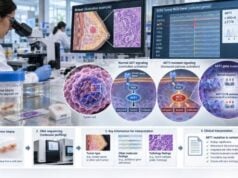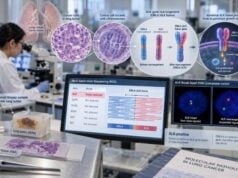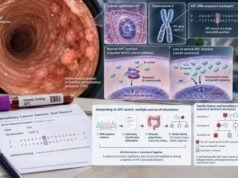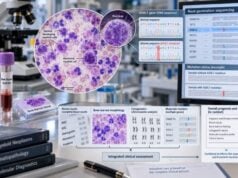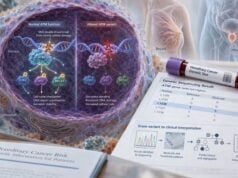
A CHEK2 mutation test looks for inherited changes in the CHEK2 gene that can increase susceptibility to cancer, most clearly female breast cancer and, to a lesser extent, prostate cancer. CHEK2 is considered a moderate-penetrance cancer-predisposition gene, which means risk is increased but is usually lower and more variable than with high-penetrance genes such as BRCA1 or BRCA2. The exact risk depends on the specific variant, family history, sex, age, and other genetic and non-genetic factors. Not every CHEK2 variant has the same effect. Truncating variants such as c.1100delC generally carry more established risk than some missense variants, while a variant of uncertain significance should not be treated as a positive hereditary-cancer result. The relationship between CHEK2 and colorectal cancer has been debated, and recent guidance does not support automatic intensified colon screening for every carrier without considering family history. A confirmed germline pathogenic variant can also matter for relatives because CHEK2 susceptibility is typically inherited in an autosomal dominant pattern.
- A pathogenic or likely pathogenic CHEK2 germline variant usually means moderately increased cancer susceptibility, especially for female breast cancer.
- CHEK2 is not equivalent to BRCA2: cancer risks are generally lower and more dependent on family history and the exact variant.
- Colon cancer risk is not uniform: current guidance emphasizes personal and family history rather than assuming every CHEK2 carrier needs intensified colorectal screening.
- A CHEK2 VUS is not a positive result: uncertain variants should not drive preventive surgery or predictive testing of relatives.
- Each child of a carrier has a 50% chance of inheriting the variant, but inheriting it does not mean cancer is inevitable.
Table of Contents
- What CHEK2 testing measures
- Who may benefit from testing
- How the test is done
- How to interpret CHEK2 results
- Breast, colon, and prostate cancer risk
- Family risk and cascade testing
- Medical management and next steps
What CHEK2 testing measures
CHEK2 encodes checkpoint kinase 2, a protein in the DNA-damage response pathway. When DNA is damaged, CHEK2 helps coordinate cell-cycle arrest and repair. A pathogenic germline variant can weaken that protective checkpoint and increase the chance that cells accumulate cancer-promoting changes.
Hereditary CHEK2 testing usually looks for sequence variants and, depending on the laboratory, larger deletions or duplications. It may be ordered as a single-gene test but is more commonly included on a multigene hereditary-cancer panel.
The exact variant matters. c.1100delC is a well-studied truncating founder variant associated with an increased breast-cancer risk. Other loss-of-function variants may have similar implications. Some missense variants have lower or uncertain penetrance, and a few historically reported CHEK2 variants are now considered low risk or not clinically actionable in the same way as truncating variants.
CHEK2 is also sometimes found on tumor sequencing. A tumor-only CHEK2 alteration does not prove hereditary risk. If the result could be germline, confirmatory testing on a normal-tissue source is needed.
For breast-cancer evaluation, CHEK2 is commonly analyzed alongside BRCA1, BRCA2, PALB2, and ATM on a hereditary breast cancer gene panel.
Who may benefit from testing
CHEK2 testing can be useful when the personal or family history suggests hereditary breast or prostate cancer, especially when a multigene panel is appropriate. Testing criteria vary by guideline and clinical setting.
Examples include people with breast cancer at a young age, bilateral or multiple primary breast cancers, a strong family history of breast cancer, male breast cancer in the family, multiple relatives with prostate cancer, or a family with a known CHEK2 pathogenic variant.
Testing may also be found incidentally when a broad hereditary panel is ordered for another reason. Because CHEK2 is a moderate-risk gene, the value of the result often depends more heavily on family history than with a high-penetrance gene.
When possible, testing an affected relative first can make a negative result more informative. If no affected relative is available, testing an unaffected person may still be reasonable, but the interpretation of a negative panel requires caution.
How the test is done
Germline CHEK2 testing usually uses blood or saliva and does not require fasting or medication changes. The laboratory extracts DNA and performs sequencing, often together with deletion/duplication analysis.
Turnaround time is commonly a few weeks. The report should list the exact DNA and protein change and classify it as pathogenic, likely pathogenic, uncertain, likely benign, or benign.
A result around 50% variant allele frequency on tumor testing can raise suspicion for a germline variant, but this is not definitive because tumor purity and copy-number changes affect allele fractions. Confirmation in a normal sample is required.
How to interpret CHEK2 results
| Result | Meaning | Usual next step |
|---|---|---|
| Pathogenic or likely pathogenic | A disease-associated germline variant was identified | Personalized cancer-risk assessment and discussion of family testing |
| Variant of uncertain significance | Evidence is insufficient to determine whether the change increases risk | Do not change major medical management based on the VUS alone |
| Negative for a known family variant | True negative for that familial CHEK2 risk | Screen based on remaining personal and family factors |
| No pathogenic variant found, no family variant known | Uninformative negative | Family history may still justify enhanced screening |
A VUS should not be used to recommend preventive mastectomy or targeted testing of healthy relatives. Variant classifications can change as new data become available.
A negative result is most reassuring when the family already has a known pathogenic CHEK2 variant and the person tested does not carry it. A negative broad panel in a strongly affected family does not prove there is no inherited susceptibility.
Breast, colon, and prostate cancer risk
The best-established association is with female breast cancer. CHEK2 is a moderate-penetrance gene, and lifetime breast-cancer risk often falls in a range where enhanced surveillance may be appropriate, but the exact estimate varies. Family history can shift risk substantially upward or downward.
ACMG guidance emphasizes personalized estimates rather than one fixed lifetime number for every carrier. A woman with a truncating CHEK2 variant and several close relatives with early breast cancer may cross thresholds for annual breast MRI, while another carrier with little family history may have a lower absolute risk.
Prostate cancer risk is also increased for some CHEK2 carriers, particularly with truncating variants, although the magnitude is less certain than the breast-cancer association. Screening discussions should consider family history and national recommendations.
The link with colorectal cancer is more complicated. Older studies suggested a modest increase, especially for c.1100delC, but newer datasets and professional guidance have led to more cautious recommendations. ACMG advises basing colorectal surveillance on family history rather than automatically intensifying colonoscopy solely because of CHEK2 carrier status.
A 2024 family study of CHEK2 c.1100delC reported a modestly increased colorectal-cancer incidence in that cohort, illustrating why the literature is not completely uniform. The practical approach is individualized risk assessment rather than treating all variants and all families as identical.
CHEK2 has been reported in association with thyroid, kidney, hematologic, and other cancers, but evidence is not strong enough to justify routine organ-specific surveillance for every carrier.
Family risk and cascade testing
A confirmed germline CHEK2 pathogenic variant is usually inherited in an autosomal dominant pattern. Each biological child has a 50% chance of inheriting the variant, and full siblings often have a 50% chance if one parent carries it.
Cascade testing means offering relatives targeted testing for the known familial variant. This is usually simpler and less expensive than repeating a broad panel. Relatives who test positive can receive risk assessment tailored to their sex, age, and family history. Those who test negative for the known familial variant generally do not need CHEK2-specific management from that branch of the family.
Risk is not identical even among relatives who carry the same variant. Other genes, reproductive factors, lifestyle, and chance influence whether cancer develops.
Biallelic CHEK2 pathogenic variants—one inherited from each parent—are uncommon and may carry higher or broader cancer susceptibility than a single pathogenic variant. These situations deserve specialist genetics review.
Medical management and next steps
After a pathogenic CHEK2 result, the most useful next step is a personalized risk calculation. Breast surveillance often includes annual mammography beginning earlier than average-risk screening, and MRI may be recommended when estimated lifetime risk crosses the relevant threshold.
Risk-reducing mastectomy is not automatically recommended for every CHEK2 carrier. It can be discussed when family history, calculated risk, prior breast cancer, imaging burden, and patient preferences support it.
For colon and prostate screening, family history matters strongly. The result should be combined with the person’s existing screening indications rather than applied as a one-size-fits-all rule.
There is currently no standard CHEK2-specific targeted therapy simply because a germline variant is present. Treatment for an established cancer follows tumor-specific evidence, and the clinical significance of CHEK2 for drug selection is less established than BRCA1/2 homologous-recombination defects.
A related prostate cancer HRR gene panel can place CHEK2 alongside other DNA-repair genes when the clinical question is prostate cancer treatment or hereditary risk.
CHEK2 risk is personalized, not a single lifetime percentage
CHEK2 is generally considered a moderate-penetrance cancer predisposition gene. That means a pathogenic variant can raise cancer risk, but the increase is usually less deterministic than with high-penetrance genes such as BRCA1 or BRCA2. The most useful estimate is therefore individualized. Variant type, sex, age, family history, reproductive factors, breast density, prior cancer, ancestry, and other genetic or clinical factors can shift absolute risk.
Truncating variants such as c.1100delC have the strongest evidence base for increased breast cancer risk. Some missense variants have lower or uncertain penetrance and should not automatically be managed as though they carry the same risk as a truncating pathogenic variant. The laboratory classification and the evidence for the exact variant matter. A pathogenic or likely pathogenic result is clinically different from a variant of uncertain significance.
For a person who has already had breast cancer, CHEK2 can also be relevant to the risk of a new primary cancer in the opposite breast. That risk is not identical for every carrier and should be discussed alongside age at first diagnosis, family history, treatment history, and competing health risks. A positive result does not automatically mean bilateral mastectomy is required. Screening and risk-reducing surgery decisions should be individualized.
Colon and prostate risk require careful wording
CHEK2 has been associated with colorectal cancer in some studies, but estimates have varied by population and variant. Recent professional guidance has moved away from assuming that every CHEK2 carrier needs intensified colonoscopy solely because of the gene result. Personal history of polyps or colorectal cancer and family history remain important. Screening recommendations can change as evidence develops, so patients should use current guidance rather than older internet summaries that assign one rule to every carrier.
Evidence also supports an association between some CHEK2 pathogenic variants and prostate cancer risk. For male carriers, the practical question is whether the genetic result plus family history justifies earlier or more individualized prostate screening. There is no single CHEK2-only screening schedule that fits every person. Shared decision-making should consider age, family history, ancestry, life expectancy, and current professional recommendations.
Tumor CHEK2 findings are not automatically inherited
CHEK2 can appear on tumor sequencing reports. A pathogenic-looking variant in a tumor may be germline, but it may also be confined to the cancer. Tumor testing is designed primarily to characterize the tumor and often cannot determine inheritance on its own. Variant allele frequency can raise suspicion for a germline finding but is not definitive because tumor purity, copy-number changes, loss of heterozygosity, and clonal structure can distort the percentage.
When a tumor result suggests a possible inherited CHEK2 pathogenic variant, confirmatory germline testing from an appropriate normal specimen may be recommended. That confirmation matters before changing lifelong screening or testing relatives. The reverse is also true: a negative tumor panel does not reliably exclude an inherited CHEK2 variant if the tumor assay did not provide adequate germline coverage.
Family planning and cascade testing
A confirmed germline CHEK2 pathogenic variant is usually inherited in an autosomal dominant manner, so each biological child and each full sibling has a 50% chance of carrying the familial variant, subject to which parent carries it. Cascade testing is most efficient when relatives are tested specifically for the known familial variant. A relative who tests negative for that exact variant has not inherited that particular familial risk, although ordinary population and family-history screening may still apply.
Rare people carry pathogenic CHEK2 variants on both copies of the gene. Biallelic CHEK2 findings can be associated with a different or more pronounced cancer phenotype than a typical single-variant result, so they merit specialist genetics review. Reproductive counseling can also clarify partner testing and family-planning options when relevant.
The central point is that CHEK2 should guide a risk conversation, not replace one. The strongest management plan combines the exact variant, the person’s own history, a three-generation family history when available, and up-to-date professional guidance.
What a negative CHEK2 result means
A negative CHEK2 test does not mean cancer risk is zero. If a known familial CHEK2 pathogenic variant was tested and the person does not carry it, that result is a true negative for that specific inherited variant and can substantially change the family’s risk assessment. If there is no known familial variant and only CHEK2 was tested, however, other hereditary cancer genes may still explain a strong personal or family history. In that setting, a multigene panel may be more informative than repeatedly testing CHEK2 alone.
A negative result also cannot erase risk created by age, breast density, prior biopsies, lifestyle factors, or a strong family history that remains unexplained. Screening should therefore be based on the complete risk profile.
Why a VUS should not drive surgery or family testing
A variant of uncertain significance is a DNA change for which there is not enough evidence to call it disease-causing or benign. Most VUS findings should not be used to recommend risk-reducing mastectomy, intensified screening, or predictive testing of healthy relatives. Management should be based on the person’s cancer history and family history while the laboratory continues to accumulate evidence.
VUS classifications can change over time. The ordering clinic or laboratory can advise how reclassification updates are communicated. Until a variant is upgraded to pathogenic or likely pathogenic, it should not be treated as though a hereditary CHEK2 syndrome has been proven.
Screening plans should be revisited over time
A CHEK2 management plan made at age 30 may not be the right plan at age 55. Breast-imaging choices, prostate-screening discussions, colonoscopy indications, and decisions about risk-reducing surgery can change with age, new family diagnoses, new personal health information, and updated professional guidance. Periodic genetics follow-up is especially useful when the original testing was performed years ago or when the family history becomes more informative.
Risk models may also incorporate CHEK2 status alongside family history and other factors. Their purpose is to estimate absolute risk more realistically, not to replace clinical judgment. The final plan should remain understandable to the patient and tied to specific actions and intervals.
References
- ACMG PRACTICE RESOURCE: Management of individuals with germline pathogenic/likely pathogenic variants in CHEK2: A clinical practice resource of the American College of Medical Genetics and Genomics (ACMG) 2023 (Guideline)
- CHEK2-Related Cancer Predisposition 2025 (Review)
- Cancer risks for other sites in addition to breast in CHEK2 c.1100delC families 2024
- The heterogeneous cancer phenotype of individuals with biallelic germline pathogenic variants in CHEK2 2024
- Selection of Germline Genetic Testing Panels in Patients With Cancer: ASCO Guideline 2024 (Guideline)
Disclaimer
CHEK2 cancer risk varies by the exact variant, family history, sex, and other modifiers, so a pathogenic result should be reviewed with a genetics professional or clinician experienced in hereditary cancer. A VUS should not be managed as a positive result. This article is educational and does not replace individualized screening or prevention advice.