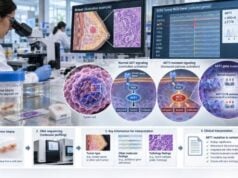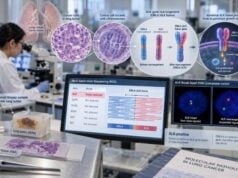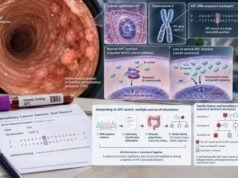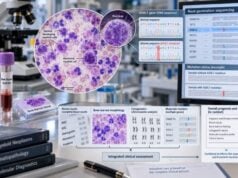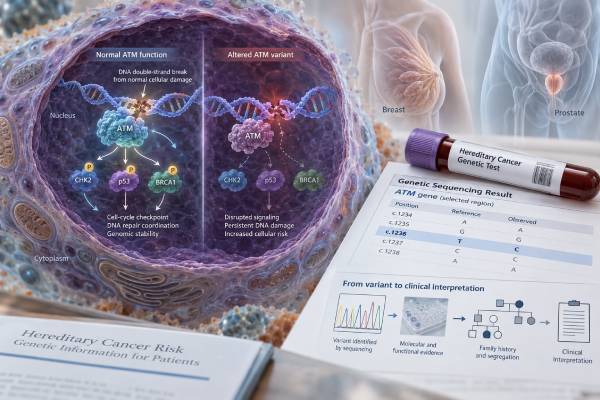
An ATM mutation test looks for harmful changes in the ATM gene, which helps cells detect and respond to DNA double-strand breaks. A pathogenic germline ATM variant can increase the risk of several cancers, especially female breast cancer, pancreatic cancer, and prostate cancer. The level of risk is generally moderate rather than as high as the classic risks associated with BRCA1 or BRCA2, and the exact risk can vary by the specific ATM variant and family history. ATM can also be mutated only inside a tumor, so the meaning of a result depends on whether testing was done on blood or saliva for inherited risk, or on tumor tissue or circulating tumor DNA for cancer profiling. A positive germline result can change screening recommendations and may prompt targeted testing for relatives. In prostate cancer, ATM is also part of homologous recombination repair panels used for treatment planning, but responses to PARP inhibitors are less consistent in ATM-altered tumors than in BRCA1/2-altered disease.
- A pathogenic germline ATM variant usually indicates a moderate increase in breast cancer risk and increased risks of prostate and pancreatic cancer.
- Female breast cancer risk to age 80 is estimated at about 21%–24% for many ATM pathogenic-variant carriers, with some specific variants carrying higher risk.
- A tumor ATM mutation is not automatically inherited; confirmatory germline testing may be needed when hereditary risk is possible.
- A variant of uncertain significance does not establish hereditary ATM cancer predisposition and should not be managed like a pathogenic variant.
- Most heterozygous ATM carriers can receive standard radiation therapy when clinically indicated; the genetic result alone is not a reason to avoid radiation.
Table of Contents
- What the ATM Gene Does
- When ATM Mutation Testing Is Used
- Germline vs. Somatic ATM Results
- How to Interpret an ATM Variant
- ATM and Breast Cancer Risk
- ATM and Prostate Cancer Risk
- Screening, Treatment, and Family Follow-Up
What the ATM Gene Does
ATM is a DNA-damage response gene that helps cells pause, repair serious DNA breaks, or trigger cell death when damage cannot be repaired safely. ATM stands for ataxia-telangiectasia mutated. The gene encodes a protein kinase that activates many downstream proteins involved in DNA repair, cell-cycle checkpoints, and genomic stability.
When one inherited copy of ATM carries a pathogenic variant, the person is an ATM heterozygote. That can increase susceptibility to several cancers. When both copies are severely affected, the result can be the rare recessive disorder ataxia-telangiectasia, which is very different from the usual hereditary cancer finding of a single pathogenic ATM variant.
ATM is part of a larger DNA-repair network that includes BRCA1, BRCA2, PALB2, CHEK2, and other homologous recombination repair genes. A breast cancer gene panel often evaluates these genes together because different hereditary syndromes can produce overlapping family histories.
The ATM protein responds particularly to DNA double-strand breaks. Loss of normal ATM function can allow genetically damaged cells to survive and accumulate additional changes. That helps explain both cancer predisposition in germline carriers and the appearance of ATM loss or mutation as a somatic event in established tumors.
Not every ATM variant disrupts gene function. The gene is large and contains many rare missense changes, so careful classification is essential. A laboratory should distinguish pathogenic and likely pathogenic variants from benign changes and variants of uncertain significance.
A reproductive point can also matter. If two partners both carry pathogenic ATM variants, a child could inherit a pathogenic variant from each parent and be at risk for ataxia-telangiectasia, a serious childhood-onset condition involving neurologic problems, immune dysfunction, radiosensitivity, and elevated cancer risk. This situation is uncommon, but it is different from the cancer-predisposition state of carrying one ATM pathogenic variant. People planning a pregnancy who know they carry an ATM pathogenic variant can ask a genetics professional whether partner testing or reproductive counseling is appropriate.
When ATM Mutation Testing Is Used
ATM testing is used for both hereditary cancer evaluation and tumor profiling, but the clinical question should determine the type of test. Germline testing usually uses blood or saliva. Tumor testing uses cancer tissue or circulating tumor DNA.
Germline ATM testing may be included when a person has:
- Breast cancer at a young age or a family history suggestive of hereditary breast cancer.
- Multiple relatives with breast, prostate, pancreatic, or related cancers.
- Prostate cancer meeting criteria for hereditary cancer testing.
- Pancreatic cancer or a strong family history of pancreatic cancer.
- A tumor sequencing result that shows an ATM variant that could be inherited.
- A known familial pathogenic ATM variant.
Because several genes can explain these patterns, a multigene panel is often more informative than ATM testing alone. For breast cancer, a BRCA1 and BRCA2 test may be part of the same hereditary evaluation. For prostate cancer, a prostate cancer HRR gene panel can assess ATM alongside BRCA1, BRCA2, CHEK2, PALB2, and other repair genes.
Tumor ATM testing is used in advanced cancers when genomic profiling could affect therapy or clinical-trial selection. In prostate cancer, homologous recombination repair status can be relevant to PARP-inhibitor strategies. In other cancers, ATM loss may be studied as a biomarker for DNA-damage response therapies, although not every ATM alteration has an established treatment implication.
No fasting is required. Germline testing usually involves a blood draw or saliva sample. Tumor profiling may use a stored biopsy, surgical specimen, or liquid biopsy. Turnaround often ranges from about one to several weeks depending on the assay.
Insurance authorization and genetic counseling workflows can also affect how quickly hereditary results are finalized.
Germline vs. Somatic ATM Results
A germline ATM variant can affect lifelong cancer risk and relatives, while a somatic ATM variant may be limited to the tumor. This distinction is central to interpreting the report.
| Feature | Germline testing | Tumor testing |
|---|---|---|
| Typical sample | Blood or saliva | Tumor tissue or plasma ctDNA |
| Main purpose | Assess inherited cancer predisposition | Characterize the cancer and identify possible treatment biomarkers |
| Family implications | Yes, if pathogenic or likely pathogenic | Not unless germline origin is confirmed |
| Typical inheritance | Autosomal dominant cancer predisposition for a single pathogenic variant | Acquired change in the cancer clone |
Tumor-only sequencing cannot always tell whether an ATM variant is inherited. A high variant allele fraction may raise suspicion, but it is not proof because tumor purity, copy-number loss, and clonal structure affect the number. When a pathogenic ATM variant is found on tumor profiling, clinicians may recommend confirmatory germline testing if the result or personal history makes hereditary disease plausible.
This issue is especially relevant in prostate cancer. Studies of tumor-only sequencing show that a meaningful fraction of DNA-repair variants found in tumors are ultimately confirmed in the germline. Germline confirmation matters because it affects both family counseling and long-term cancer-risk management.
A negative tumor result also does not rule out a germline ATM variant if the tumor assay had limited coverage or sample quality. Likewise, a negative germline result does not rule out somatic ATM loss in a cancer.
How to Interpret an ATM Variant
The laboratory classification is more important than the simple word “mutation.” Clinically, ATM findings are usually grouped as pathogenic, likely pathogenic, uncertain, likely benign, or benign.
A pathogenic or likely pathogenic germline variant establishes ATM-related cancer predisposition in the appropriate setting. These variants often include nonsense changes, frameshifts, splice-disrupting variants, or large deletions that reduce normal ATM function. Some missense variants are also pathogenic.
A variant of uncertain significance, or VUS, means the evidence is not sufficient to determine whether the change causes disease. A VUS should not trigger prophylactic surgery, intensified screening, or predictive testing of relatives as though it were a confirmed pathogenic result. The laboratory may later reclassify it as more data become available.
A negative germline result means no pathogenic or likely pathogenic ATM variant was found by that test. If the family history remains strongly suggestive of inherited cancer risk, clinicians may look at other genes or review whether the panel had appropriate deletion/duplication coverage.
Not all ATM pathogenic variants carry the same risk
ATM is a moderate-penetrance gene overall, but risk can vary by variant. The missense variant c.7271T>G is a well-known example associated with substantially higher breast cancer risk than many truncating ATM variants. This means a personalized risk estimate should consider the exact variant, family history, age, and other risk factors rather than treating every ATM carrier as identical.
The same principle applies to tumor biomarkers. Some assays report monoallelic ATM mutation, biallelic loss, or loss of protein expression differently. Complete loss of ATM function may have different treatment biology from a single heterozygous tumor mutation. A report should be reviewed carefully before assuming that any ATM alteration predicts drug sensitivity.
ATM and Breast Cancer Risk
Women with a heterozygous germline pathogenic ATM variant have a moderately increased breast cancer risk. Current GeneReviews estimates put risk to age 80 at roughly 21%–24% for many ATM carriers, compared with about 12% in the general female population, while c.7271T>G may carry a considerably higher risk.
That level of risk is important enough to change screening, but it is generally lower than the risk associated with high-penetrance BRCA1, BRCA2, PALB2, or TP53 syndromes. Family history and other modifiers can move an individual’s practical risk above or below a population average.
Enhanced screening commonly includes annual mammography beginning earlier than routine population screening and consideration of annual breast MRI. The exact age varies by country and guideline. In the United States, current hereditary-risk guidance commonly considers MRI beginning around age 30–35 and mammography around age 40 for ATM pathogenic-variant carriers.
Risk-reducing bilateral mastectomy is not routinely recommended solely because of an ATM pathogenic variant. It may be considered in selected people after a personalized assessment that includes family history, calculated lifetime risk, breast density, prior biopsies, personal preferences, and the exact ATM variant.
Another common question is radiation safety. Heterozygous ATM carriers do not have the profound radiosensitivity of people with biallelic ataxia-telangiectasia. Current ACMG guidance states that radiation treatment decisions generally should not be changed solely because a person carries one pathogenic ATM variant. Individual radiation planning still depends on age, anatomy, prior treatment, and the specific cancer.
ATM and Prostate Cancer Risk
Men with pathogenic germline ATM variants have an increased risk of prostate cancer, including evidence for earlier-onset and more aggressive disease in some studies. Large case-control data have reported odds ratios of roughly three- to fourfold for pathogenic ATM variants, although the exact lifetime risk remains less precisely defined than for female breast cancer.
Current hereditary cancer resources support considering prostate cancer surveillance for ATM carriers. U.S. guidance summarized in the 2026 ATM GeneReviews includes annual PSA-based screening beginning at about age 40, while recommendations differ internationally and may be modified by family history.
ATM also matters after prostate cancer develops. A metastatic prostate cancer biomarker panel may assess ATM and other HRR genes to determine eligibility for targeted strategies and clinical trials.
ATM and PARP inhibitors
PARP inhibitors exploit defects in DNA repair, but the strongest and most consistent benefit in prostate cancer is seen in BRCA1/2-altered tumors, especially BRCA2. ATM-altered prostate cancers show more heterogeneous and often lower response rates. This distinction is clinically important because a treatment label may include a group of HRR genes even when the amount of evidence differs substantially by gene.
A BRCA1 and BRCA2 test for prostate cancer therefore should not be treated as interchangeable with ATM testing. Both involve DNA repair, but they do not predict identical sensitivity to PARP inhibition.
If a tumor has an ATM alteration, the oncology team may consider the exact variant, whether there is biallelic loss, prior androgen-receptor therapy, disease stage, approved treatment combinations, and available clinical trials. An ATM result should be used as one part of a larger therapeutic decision rather than as a guarantee of response.
Screening, Treatment, and Family Follow-Up
A confirmed germline ATM pathogenic variant should lead to individualized surveillance and cascade testing for biological relatives. Because ATM-related cancer predisposition is usually inherited in an autosomal dominant pattern, each child of a heterozygous carrier has a 50% chance of inheriting the variant.
Adult relatives can usually receive targeted testing for the exact familial ATM variant. A positive result allows screening to begin based on that person’s sex, age, family history, and country-specific recommendations. A negative result for the known family variant generally means that relative did not inherit the ATM-associated risk from that branch of the family.
Cancer screening may include:
- Breast: earlier annual mammography and consideration of MRI for women.
- Prostate: PSA-based surveillance beginning earlier than average-risk screening in some guidelines.
- Pancreas: surveillance may be considered in selected carriers, often depending on family history and local recommendations, using MRI/MRCP and/or endoscopic ultrasound at experienced centers.
- Other cancers: evidence is still evolving, and routine intensified screening is not established for every reported association.
A pathogenic ATM variant does not mean cancer is inevitable. It changes probability, not certainty. Lifestyle measures such as avoiding tobacco, maintaining a healthy weight, and following recommended population screening still matter, but they do not replace gene-specific surveillance.
For people already diagnosed with cancer, standard treatment should not be changed simply because ATM is present in the germline. The tumor’s own biology, stage, receptor status, other mutations, and treatment evidence remain central. In prostate cancer, ATM may affect targeted-therapy discussions; in breast cancer, the germline result mainly guides risk management and family counseling rather than dictating one specific systemic therapy.
Useful questions after testing include:
- Is this ATM variant pathogenic, likely pathogenic, or a VUS?
- Was the result found in germline DNA or only in tumor tissue?
- What is my estimated breast, prostate, or pancreatic cancer risk based on this exact variant and family history?
- When should enhanced screening start?
- Does the result change treatment for my current cancer, or only future risk management?
- Should my children, siblings, or parents have targeted testing?
- If the result came from tumor sequencing, do I need confirmatory germline testing?
ATM testing is most useful when it is interpreted with the exact variant, specimen type, cancer history, and family history. A single word such as “positive” cannot capture all of those differences.
ATM risk estimates should be applied to the exact variant whenever possible. Most pathogenic loss-of-function variants are managed using gene-level guidance, but a few missense variants have evidence for substantially different risks. The well-studied c.7271T>G variant, for example, has been associated with higher breast-cancer penetrance than many other heterozygous ATM variants. This is why a report that only says “ATM positive” is not enough: the exact variant classification, personal history, and family pattern can change counseling and surveillance discussions.
References
- ATM: Functions of ATM Kinase and Its Relevance to Hereditary Tumors 2022 (Review)
- Cancer risks associated with heterozygous ATM loss of function and missense pathogenic variants based on multigene panel analysis 2022
- Gene-based Confirmatory Germline Testing Following Tumor-only Sequencing of Prostate Cancer 2023
- Management of individuals with heterozygous germline pathogenic variants in ATM: A clinical practice resource of the American College of Medical Genetics and Genomics (ACMG) 2025 (Guideline)
- PARP inhibitors in prostate cancer: clinical applications 2024 (Review)
- ATM-Related Cancer Predisposition 2026 (Review)
Disclaimer
This article is for general education and does not replace genetic counseling, cancer screening advice, or treatment recommendations from qualified clinicians. ATM risk varies by the exact variant, personal and family history, sex, age, and local guidelines. Do not change screening, surgery, radiation, or cancer treatment based on an ATM result without individualized medical review.