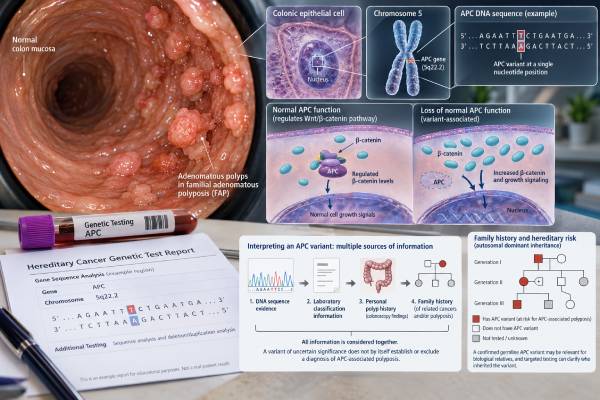
An APC mutation test looks for harmful changes in the APC gene, a tumor-suppressor gene that helps control cell growth through the Wnt/beta-catenin pathway. Germline pathogenic variants in APC cause familial adenomatous polyposis (FAP) and related APC-associated polyposis conditions, which can lead to dozens, hundreds, or thousands of colorectal adenomas and a very high lifetime risk of colorectal cancer without effective surveillance and treatment. APC changes are also common inside ordinary, nonhereditary colorectal tumors, so the meaning of an APC result depends heavily on where the DNA came from. A pathogenic variant found in blood or saliva can indicate inherited risk, while an APC variant found only in tumor tissue may be a somatic cancer change. Testing is most useful when paired with the number and type of polyps, age at diagnosis, family history, and a genetics evaluation. A positive hereditary result can change colon surveillance, surgical planning, upper gastrointestinal screening, and testing recommendations for relatives.
- A pathogenic germline APC variant can diagnose APC-associated polyposis and usually carries a 50% chance of being passed to each child.
- Classic FAP often causes hundreds to thousands of adenomas; colorectal cancer risk is essentially inevitable without preventive management.
- A tumor-only APC mutation does not automatically mean FAP because somatic APC mutations are common in sporadic colorectal tumors.
- A negative blood or saliva test does not completely exclude APC-related disease, especially when mosaicism or hard-to-detect variants are possible.
- A variant of uncertain significance should not be used by itself to diagnose FAP or to trigger predictive testing in healthy relatives.
Table of Contents
- What the APC Gene Does
- When an APC Mutation Test Is Ordered
- Germline vs. Tumor APC Testing
- How to Interpret APC Test Results
- APC Mutations, FAP, and Colorectal Cancer Risk
- What a Positive APC Result Means for Family Members
- Follow-Up After APC Testing
What the APC Gene Does
APC is a tumor-suppressor gene that helps prevent uncontrolled cell growth in the intestinal lining. The APC protein is part of a complex that regulates beta-catenin, an important messenger in the Wnt signaling pathway. When APC function is lost, beta-catenin can accumulate and switch on genes that promote cell division.
This biology explains why APC is central to both hereditary polyposis and common colorectal tumor development. In a person with an inherited pathogenic APC variant, one altered copy is present from birth in many or all cells. If the second functioning copy is later lost in a colon cell, that cell can gain a strong growth advantage and form an adenoma. Repeated events across the colon can produce the dense polyp burden seen in FAP.
APC is also frequently altered somatically during the development of sporadic colorectal adenomas and cancers. Those tumor-specific mutations help drive the cancer but usually do not indicate that the person was born with an APC mutation.
APC-related hereditary disease is different from Lynch syndrome, which involves mismatch-repair genes. A mismatch repair gene test evaluates MLH1, MSH2, MSH6, PMS2, and related causes of Lynch syndrome rather than the polyposis mechanism caused by APC.
Several APC-associated phenotypes are recognized. Classic FAP usually involves more than 100 adenomas and often hundreds to thousands. Attenuated FAP tends to produce fewer adenomas and a later average age of colorectal cancer. Certain regulatory-region APC variants can also cause gastric adenocarcinoma and proximal polyposis of the stomach, or GAPPS.
When an APC Mutation Test Is Ordered
APC germline testing is considered when a person’s polyp burden, cancer history, or family history suggests an inherited adenomatous polyposis syndrome. Testing may be ordered as a single-gene test, but a multigene hereditary cancer panel is often more efficient because several genes can cause overlapping polyposis patterns.
Reasons to consider testing include:
- Numerous colorectal adenomas, especially 10–20 or more cumulative adenomas.
- Hundreds of adenomas or a clinical picture strongly suggestive of classic FAP.
- Colorectal cancer at an unusually young age together with adenomatous polyposis.
- A known pathogenic APC variant in a biological relative.
- A family history of multiple adenomas, early colorectal cancer, or FAP-associated features.
- Desmoid tumors, characteristic retinal findings, certain thyroid cancers, osteomas, or other features that may occur in APC-associated disease.
People with a smaller number of adenomas may need evaluation of several genes rather than APC alone. For example, a MUTYH mutation test assesses another important cause of adenomatous polyposis, usually inherited in an autosomal recessive pattern.
Tumor profiling may also report APC in someone already diagnosed with colorectal cancer. A colorectal cancer biomarker panel may include genes and markers used for treatment decisions, tumor classification, and hereditary-risk assessment. An APC tumor finding in that context should not be interpreted as a hereditary diagnosis without appropriate germline evaluation.
Genetic counseling is particularly useful before or after testing because APC results can affect relatives who may not yet have symptoms. Counseling also helps choose the right assay. A test that sequences only the coding region may miss certain deletions, duplications, promoter variants, or low-level mosaic changes.
Germline vs. Tumor APC Testing
The source of the DNA is one of the most important details on an APC report. Germline testing and tumor testing answer different questions.
| Feature | Germline APC testing | Tumor APC testing |
|---|---|---|
| Typical sample | Blood or saliva | Colon tumor or adenoma tissue |
| Main question | Was a hereditary APC variant present from conception or early development? | Did the tumor acquire an APC alteration as part of cancer development? |
| Family implications | Can indicate risk to biological relatives | Usually no family implication unless germline origin is suspected and confirmed |
| Typical clinical use | Diagnosis of FAP or related APC-associated conditions | Tumor characterization and broader genomic profiling |
A standard germline test should generally evaluate the APC sequence and include deletion/duplication analysis. Large deletions or duplications account for a meaningful minority of pathogenic findings and can be missed by sequencing alone. Some panels also evaluate regulatory regions associated with specific phenotypes.
Why mosaicism matters
Mosaicism means the APC mutation arose after fertilization, so it is present in only a proportion of the body’s cells. A person with APC mosaicism can still develop substantial polyposis, but the variant may be present at a low level in blood and therefore harder to detect.
When the clinical picture strongly suggests FAP but blood testing is negative, specialists may consider high-depth sequencing, testing another tissue, or comparing multiple adenomas. Detecting the same pathogenic APC variant in separate adenomas can support mosaic APC disease even when routine blood testing is unrevealing.
Mosaicism also complicates family counseling. The chance of passing the variant to a child depends on whether reproductive cells carry the mutation. Some people with mosaicism can transmit a fully heterozygous APC variant to a child, who may then have a more typical FAP phenotype.
How to Interpret APC Test Results
The key categories are pathogenic, likely pathogenic, uncertain, likely benign, and benign. Only pathogenic and likely pathogenic germline variants generally establish a molecular diagnosis of APC-associated polyposis.
A pathogenic or likely pathogenic germline variant means there is strong evidence that the change disrupts APC function in a disease-causing way. The report should identify the exact variant, such as a frameshift, nonsense change, splice-site variant, or deletion. Many FAP-causing APC variants truncate the protein.
A negative germline result means the laboratory did not find a reportable pathogenic APC variant using the methods applied. It does not automatically erase a strong clinical diagnosis. Possible explanations include:
- The polyposis is caused by a different gene.
- APC mosaicism is present below the test’s detection threshold.
- A structural or regulatory variant was not covered.
- The clinical condition is not hereditary adenomatous polyposis.
A variant of uncertain significance, or VUS, is not proof of disease. A VUS may later be reclassified, but until evidence is stronger, management should rely on the person’s polyps, cancer history, family history, and any clearly pathogenic findings. Healthy relatives generally should not undergo predictive testing for a VUS as though it were a known FAP mutation.
One APC finding deserves special caution: p.I1307K. This variant is not the same as a classic FAP-causing truncating mutation. It is most common in people of Ashkenazi Jewish ancestry and is associated with a modestly increased colorectal cancer risk in that population, but it does not usually cause hundreds of polyps or the classic FAP phenotype. Risk estimates and screening recommendations outside Ashkenazi Jewish populations remain less certain. A report that lists I1307K should therefore be discussed using the laboratory classification, ancestry, personal history, and current guideline recommendations rather than being interpreted simply as “FAP positive.”
A tumor report may show one or more APC mutations, sometimes at substantial variant allele fractions. That still does not prove germline disease. If tumor testing raises hereditary concern, confirmation should use a germline specimen and a laboratory designed for inherited cancer testing.
APC is not the same kind of marker as CEA testing in colon cancer. CEA is a blood protein marker used mainly in monitoring; APC testing analyzes DNA and answers questions about tumor biology or inherited susceptibility.
APC Mutations, FAP, and Colorectal Cancer Risk
Classic FAP carries an extremely high colorectal cancer risk if the colon is not effectively managed. Adenomas often begin during adolescence. By adulthood, the colon may contain hundreds or thousands of polyps, each representing another opportunity for malignant transformation.
GeneReviews reports that about 95% of people with classic FAP have polyps by age 35 and that colorectal cancer is essentially inevitable without colectomy. The average age of colorectal cancer in untreated classic FAP has historically been around the late 30s to early 40s. This is why FAP management begins far earlier than population colorectal cancer screening.
Attenuated FAP usually causes fewer polyps—often tens rather than hundreds—and colorectal cancer tends to occur later. However, “attenuated” does not mean harmless. Lifetime colorectal cancer risk remains high enough to require structured surveillance, and surgery may still be needed depending on polyp burden and endoscopic control.
FAP can also affect organs outside the colon. Important manifestations include duodenal and ampullary adenomas, gastric polyps, desmoid tumors, thyroid cancer, and several other less common tumors. Management therefore extends beyond colonoscopy.
Not every APC variant produces the same phenotype. The location and type of pathogenic variant can influence average polyp burden and risks such as desmoid disease, but genotype-phenotype correlations are not precise enough to predict an individual course with certainty. Actual endoscopic findings remain central to management.
For someone who already has colorectal cancer, hereditary APC testing answers a different question from tumor markers such as MSI testing for colon cancer. MSI helps assess mismatch-repair deficiency, Lynch syndrome workup, and immunotherapy relevance; APC germline testing focuses on polyposis and inherited APC risk.
What a Positive APC Result Means for Family Members
A confirmed germline pathogenic APC variant is usually inherited in an autosomal dominant pattern, so each child has a 50% chance of inheriting it. Brothers, sisters, and more distant relatives may also be at risk depending on which side of the family carries the variant.
The most informative strategy is called cascade testing. Once a specific pathogenic APC variant is identified in one family member, relatives can be tested specifically for that variant rather than receiving an open-ended hereditary cancer panel.
A relative who tests positive can begin FAP-specific surveillance at the recommended age and intensity. A relative who tests negative for the known family variant usually can avoid FAP-level surveillance, assuming the family’s disease has been clearly explained by that variant and no other independent risk factor is present.
Not every person with FAP inherited the variant from an affected parent. De novo APC variants occur, meaning the mutation first arose in the affected person. Even then, that person can usually pass the variant to children with a 50% probability if it is present in the germline.
Family testing becomes more complex with mosaicism. A mosaic parent may have mild disease, a negative or low-level blood result, and still have an affected child. When mosaicism is suspected, a genetics specialist can help select tissues for testing and explain recurrence risk without assuming the standard 50% rule applies in the same way.
Testing children for adult-onset hereditary cancer syndromes is often deferred, but FAP is different because polyps and cancer risk can begin during childhood or adolescence and surveillance starts early. Predictive testing of at-risk minors is therefore commonly appropriate when a familial APC pathogenic variant is known.
Follow-Up After APC Testing
A positive APC result should lead to a coordinated plan for colorectal surveillance, upper gastrointestinal surveillance, surgery when needed, and family testing. The exact schedule depends on age, phenotype, polyp burden, prior surgery, and guideline recommendations.
Current European guidelines emphasize care through clinicians experienced in hereditary polyposis. Colon surveillance begins early in classic FAP, and the interval is adjusted to the number, size, histology, and growth of adenomas. Endoscopic removal can control a limited burden for a time, but surgery becomes necessary when cancer is present or suspected, symptoms develop, adenomas become too numerous to manage safely, high-grade dysplasia appears, or adequate surveillance is no longer possible.
Surgical options can include colectomy with ileorectal anastomosis or proctocolectomy with ileal pouch-anal anastomosis. The best choice depends on rectal polyp burden, genotype, age, cancer status, desmoid risk, fertility considerations, and willingness to continue lifelong endoscopic follow-up. Surgery reduces colorectal cancer risk but does not end surveillance needs because residual rectal or pouch mucosa and the upper gastrointestinal tract can still develop neoplasia.
A practical post-test checklist includes:
- Confirm that the finding is germline and classified as pathogenic or likely pathogenic.
- Review the exact APC variant and whether it is associated with classic FAP, attenuated FAP, or another APC phenotype.
- Document current colorectal and upper-GI findings rather than relying on genotype alone.
- Build a surveillance and surgical plan with an experienced gastroenterology and colorectal-surgery team.
- Refer relatives for genetic counseling and targeted testing of the known family variant.
- Revisit a negative result if the clinical picture strongly suggests polyposis, particularly when mosaicism has not been assessed.
An APC mutation test can be life-changing because it may identify cancer risk before cancer develops. Its value is greatest when the genetic result is tied to organized surveillance, timely surgery when needed, and systematic testing of relatives who can benefit from early prevention.
Long-term management also depends on the organ pattern, not only the colon. APC-associated polyposis can involve duodenal and gastric polyps, desmoid tumors, thyroid cancer, and other extracolonic findings, so surveillance is coordinated over decades. The exact APC variant can sometimes help estimate phenotype, but genotype–phenotype correlations are not absolute. Family history, current polyp burden, prior surgery, and endoscopic findings remain central when deciding surveillance intervals and the timing or type of colorectal surgery.
References
- APC-Associated Polyposis Conditions 2022 (Review)
- Necessity of multiplex ligation probe amplification in genetic tests: Germline variant analysis of the APC gene in familial adenomatous polyposis patients 2022
- Updated European guidelines for clinical management of familial adenomatous polyposis (FAP), MUTYH-associated polyposis (MAP), gastric adenocarcinoma, proximal polyposis of the stomach (GAPPS) and other rare adenomatous polyposis syndromes: a joint EHTG-ESCP revision 2024 (Guideline)
- Genomic mosaicism in colorectal cancer and polyposis syndromes: a systematic review and meta-analysis 2024 (Systematic Review)
- A review of APC somatic mosaicism and specific APC variants – I1307K and promotor variants 2025 (Review)
Disclaimer
This article provides general education about APC testing and does not replace individualized genetic counseling, gastroenterology care, or cancer-risk management. A hereditary APC result should be interpreted with the exact variant, testing method, personal polyp history, and family history. Surveillance and preventive surgery decisions should be made with clinicians experienced in inherited polyposis syndromes.