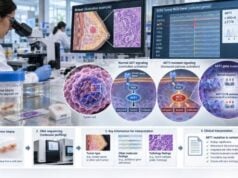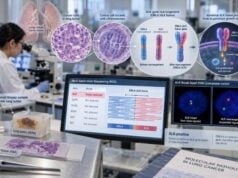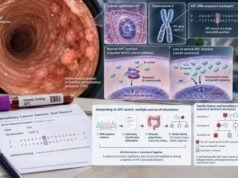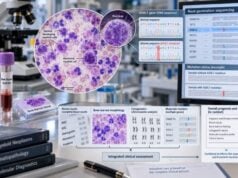
A MUTYH mutation test looks for inherited changes in the MUTYH gene that can raise the risk of colorectal polyps and colorectal cancer. The most important distinction is whether a person has one pathogenic MUTYH variant or two. Two disease-causing variants, usually one inherited from each parent, can cause MUTYH-associated polyposis (MAP), an autosomal recessive hereditary cancer syndrome. People with MAP may develop dozens to hundreds of colon adenomas, but some develop colorectal cancer with only a modest number of polyps or even without obvious polyposis. A single pathogenic MUTYH variant is much more common and usually does not carry the same level of risk. Testing may be ordered because of multiple adenomas, colorectal cancer at a younger age, a suggestive family history, or findings on a broader hereditary cancer panel. The result can guide colonoscopy planning, decisions about surgery, upper gastrointestinal surveillance, and testing of relatives.
- Two pathogenic MUTYH variants usually indicate MUTYH-associated polyposis, especially when they are confirmed to be on opposite copies of the gene.
- One pathogenic MUTYH variant does not mean a person has MAP; colorectal screening is usually based on personal and family history.
- A variant of uncertain significance (VUS) is not a positive hereditary-cancer result and should not by itself change surgery or family testing plans.
- Blood or saliva is commonly used for germline MUTYH testing, often as part of a multigene hereditary colorectal cancer or polyposis panel.
- A positive biallelic result usually leads to lifelong colorectal surveillance, with upper gastrointestinal surveillance added because duodenal adenomas and cancer can also occur.
Table of Contents
- What the MUTYH Test Detects
- Who May Need MUTYH Testing
- How the Test Is Performed
- How to Interpret MUTYH Results
- Cancer Risk and Polyposis
- What Happens After a Positive Result
- Family Testing and Common Questions
What the MUTYH Test Detects
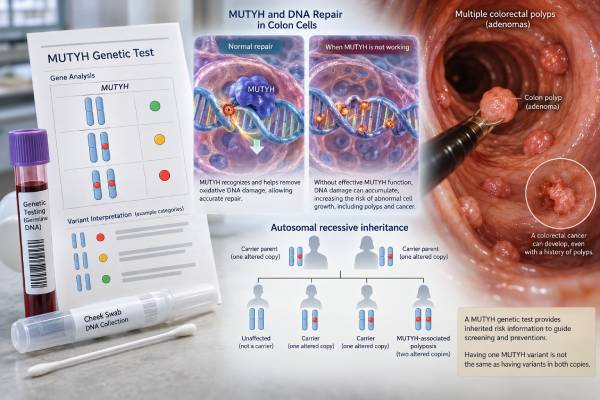
The MUTYH test is primarily a germline genetic test, meaning it looks for variants a person was born with and may pass to children. MUTYH makes a DNA-repair enzyme involved in base-excision repair. One of its jobs is correcting certain DNA errors caused by oxidative damage. When both copies of MUTYH lose normal function, these errors can accumulate and promote the development of adenomas and colorectal cancer.
This mechanism is different from the mismatch-repair defects involved in Lynch syndrome. A person with many colorectal adenomas may therefore be evaluated with a broader cancer gene mutation panel rather than a single-gene test, because several inherited syndromes can produce overlapping clinical patterns.
One variant versus two variants
Humans usually have two copies of MUTYH, one inherited from each biological parent. The number and arrangement of pathogenic variants matter:
- Biallelic pathogenic variants: Disease-causing variants affect both MUTYH copies. They may be the same variant on both copies, called homozygous, or two different variants, called compound heterozygous. When the variants are on opposite copies, or in trans, the finding supports MAP.
- Monoallelic pathogenic variant: One MUTYH copy has a pathogenic variant and the other is functioning. This is often called carrier status. It does not establish MAP.
- No pathogenic variant detected: Testing did not identify a disease-causing MUTYH change with the methods used. This does not necessarily explain away a strong personal or family history, because another gene or an undetectable variant may be involved.
Two recurrent pathogenic variants are relatively common in people of European ancestry: c.536A>G (p.Tyr179Cys) and c.1187G>A (p.Gly396Asp). Laboratories may report other pathogenic variants, including truncating, splice-site, or deletion variants. Older publications sometimes use different protein numbering, which can make the same variant appear under another name.
Tumor sequencing can also detect MUTYH changes, but a variant found in a tumor is not automatically inherited. Germline testing from blood, saliva, or another non-tumor source is needed when hereditary risk is being assessed.
Who May Need MUTYH Testing
MUTYH testing is most useful when the clinical picture suggests an inherited adenomatous polyposis syndrome or when a colorectal cancer evaluation raises concern for MUTYH-related disease. Testing decisions increasingly use the overall pattern rather than a single rigid polyp cutoff.
Situations that can prompt testing include:
- Multiple colorectal adenomas, especially when the cumulative number reaches the range of 10 or more
- Dozens of adenomas with no pathogenic APC variant identified
- Colorectal cancer plus a personal history of multiple adenomas
- Colorectal cancer at a younger-than-expected age with other suggestive features
- Duodenal adenomas or duodenal cancer together with colorectal polyposis
- A sibling or other close relative with confirmed biallelic MUTYH pathogenic variants
- A pathogenic MUTYH variant found incidentally on a hereditary cancer panel
- A colorectal tumor with a mutation pattern suggestive of defective MUTYH-related base-excision repair
MUTYH-associated polyposis can resemble attenuated familial adenomatous polyposis. For that reason, clinicians often evaluate MUTYH and APC mutations together when a patient has an adenomatous polyposis phenotype.
Family history can be less obvious in MAP than in dominantly inherited syndromes. Because MAP is autosomal recessive, parents of an affected person are typically unaffected carriers. Several siblings may be affected, while multiple generations do not necessarily show colorectal cancer. This “horizontal” family pattern can be a clue, but lack of family history does not rule MAP out.
Genetic counseling before or after testing can be especially valuable when the result could affect surgery, relatives, reproductive planning, or interpretation of a VUS.
How the Test Is Performed
Germline MUTYH testing usually requires a blood sample or saliva sample. No fasting is needed. Medications generally do not affect the DNA sequence, so routine medicines are not stopped simply for this test.
A laboratory may use several methods:
- DNA sequencing checks the coding regions and nearby splice boundaries for single-letter substitutions and small insertions or deletions.
- Deletion/duplication analysis looks for larger losses or gains involving one or more exons when the assay includes this capability.
- Multigene next-generation sequencing evaluates MUTYH alongside other colorectal cancer and polyposis genes.
A comprehensive hereditary panel may be more informative than testing only the two common founder variants, particularly in people without Northern European ancestry or in families with an unexplained polyposis pattern. A negative founder-variant screen is not the same as full-gene analysis.
Why the sample source matters
Blood and saliva usually represent a person’s constitutional, or germline, DNA. Tumor tissue represents cancer DNA and can contain acquired changes that developed only in the tumor. If tumor profiling identifies a MUTYH variant at a level suspicious for germline origin, the next step may be confirmatory germline testing.
Tumor mutational signatures can provide an additional clue. Cancers caused by biallelic MUTYH loss often show characteristic C-to-A DNA substitutions and signatures associated with defective repair of oxidative damage. These signatures can help identify patients who deserve hereditary evaluation, but they are not a substitute for a properly interpreted germline result.
For people with colorectal cancer, MUTYH testing may sit alongside molecular tests such as microsatellite instability testing. The tests answer different questions: MSI evaluates mismatch-repair biology, while MUTYH testing evaluates a base-excision repair gene and hereditary MAP risk.
How to Interpret MUTYH Results
The correct interpretation depends on the variant classification, number of variants, and whether two variants are in cis or in trans. A report should not be reduced to the word “positive” without these details.
| Result | Usual interpretation | Typical next step |
|---|---|---|
| Two pathogenic or likely pathogenic variants in trans | Consistent with MUTYH-associated polyposis | Hereditary cancer counseling, colon surveillance, upper GI surveillance, and family testing |
| One pathogenic or likely pathogenic variant | Monoallelic carrier; does not establish MAP | Base colorectal screening on personal and family history; consider testing the other parent or relatives in specific situations |
| Variant of uncertain significance | Evidence is insufficient to call the variant harmful or harmless | Do not use the VUS alone for major medical decisions; reclassification may occur over time |
| No pathogenic variant detected | No explanatory MUTYH variant found by the assay | Reassess phenotype, family history, test coverage, and other polyposis genes if suspicion remains high |
Pathogenic and likely pathogenic variants
Clinical laboratories generally treat pathogenic and likely pathogenic variants as medically actionable categories when the inheritance pattern fits. In MUTYH, however, one pathogenic variant and two pathogenic variants have very different implications.
If two variants are found, the report may need to establish phase. “In trans” means the variants are on different MUTYH copies, which supports biallelic loss. “In cis” means both variants are on the same copy, leaving the other copy unaffected. Testing parents or other relatives can sometimes clarify phase.
A VUS is not a diagnosis
A VUS should not be used as if it were a pathogenic result. It should not, by itself, trigger prophylactic colectomy or predictive testing of healthy relatives. Medical decisions should instead follow the person’s polyp burden, cancer history, family history, and other established findings. Laboratories periodically re-evaluate variants as new population, functional, and clinical evidence accumulates.
Cancer Risk and Polyposis
Biallelic MUTYH pathogenic variants substantially increase colorectal cancer risk. MAP often causes 10 to a few hundred adenomatous polyps, although the number varies widely. Some people develop colorectal cancer with relatively few recognized adenomas, so absence of classic carpeting polyposis does not exclude the syndrome.
Older natural-history estimates place untreated lifetime colorectal cancer risk in the range of roughly 80% to 90%, with substantial risk already present by around age 60. Modern surveillance changes that natural history by finding and removing precancerous adenomas and identifying cancer earlier.
The phenotype overlaps with attenuated FAP, but inheritance differs. APC-related FAP is usually autosomal dominant, while MAP is autosomal recessive. Comparing the hereditary pattern, polyp burden, and molecular result helps distinguish the two conditions.
Other cancer risks
MAP is best established as a colorectal cancer predisposition syndrome, but extracolonic disease also matters. Duodenal adenomas are common enough that upper gastrointestinal surveillance is routinely considered. Studies have also reported increased risks of duodenal, ovarian, bladder, and certain other cancers, although risk estimates are less precise than for colorectal cancer and not every reported association changes routine screening.
For a person with colorectal cancer, clinicians may also review tumor markers and genomic findings summarized in a colorectal cancer biomarker panel. These tumor-directed tests can affect treatment, whereas germline MUTYH testing primarily addresses inherited predisposition and long-term surveillance.
What about one MUTYH variant?
The risk associated with a single pathogenic MUTYH variant has been debated. Recent counseling frameworks and guideline approaches generally do not treat monoallelic carriers as if they have MAP. In the absence of a strong family history, colorectal cancer risk appears close enough to average population risk that intensified colonoscopy solely because of carrier status may not be justified.
That does not mean family history should be ignored. A monoallelic carrier who also has a first-degree relative with colorectal cancer, numerous adenomas, or another hereditary finding may need a different screening plan. The key is to manage the whole risk profile rather than the MUTYH result in isolation.
What Happens After a Positive Result
For biallelic MUTYH pathogenic variants, the goal is to prevent colorectal cancer while preserving quality of life. Management depends on age, polyp number, polyp size and pathology, ability to clear polyps endoscopically, prior cancer, and upper gastrointestinal findings.
Colon and rectal surveillance
Current European guidance generally supports regular high-quality colonoscopy for MAP, often at 1- to 2-year intervals, with removal of relevant adenomas. The exact starting age and interval can vary by guideline, family presentation, and findings. Surveillance becomes more frequent or management changes when polyp burden accelerates, advanced adenomas appear, or endoscopic control is no longer practical.
Surgery is not automatic for every person with MAP. Colectomy may be considered when:
- Colorectal cancer is diagnosed
- The number, size, or distribution of polyps cannot be controlled safely with repeated colonoscopy
- Advanced dysplasia develops repeatedly
- Surveillance becomes unreliable or technically difficult
The surgical approach is individualized. Some people can retain the rectum, while others require more extensive surgery depending on rectal polyp burden, cancer location, and future surveillance needs.
Upper gastrointestinal surveillance
MAP can cause duodenal and gastric adenomas. Upper endoscopy, often with careful duodenal and ampullary assessment, is therefore part of long-term care. Surveillance intervals are based on the number, size, histology, and location of lesions rather than on the gene result alone.
Because a hereditary result can affect multiple organs and family members, care is often coordinated through gastroenterology, genetics, surgery, and oncology when cancer is present.
A positive germline result also stays relevant after colorectal cancer treatment. The inherited predisposition does not disappear after tumor removal, so surveillance of remaining colorectal tissue and the upper GI tract continues.
Family Testing and Common Questions
A confirmed biallelic MUTYH result has clear implications for biological relatives. Because MAP is autosomal recessive, the inheritance pattern differs from many hereditary cancer syndromes.
If a person has two pathogenic MUTYH variants, each biological parent is usually a carrier of one variant. Full siblings typically have a 25% chance of inheriting both familial variants, a 50% chance of being a carrier, and a 25% chance of inheriting neither, assuming both parents carry one pathogenic variant.
Children of a person with MAP will inherit at least one pathogenic MUTYH variant. Their chance of having MAP depends on whether the other biological parent also carries a pathogenic MUTYH variant. Since carrier status is not rare in some populations, partner testing may be discussed when reproductive risk matters.
Does a positive test mean cancer is present?
No. Germline MUTYH testing measures inherited susceptibility, not whether a tumor exists today. A person can have biallelic pathogenic variants without currently having cancer. Colonoscopy and other clinical evaluations are needed to detect polyps or malignancy.
Can a person with MAP have few polyps?
Yes. Although multiple adenomas are typical, the phenotype is variable. Some patients present with colorectal cancer and fewer polyps than expected. This is one reason genetic testing may be useful even when a person does not have hundreds of adenomas.
Should healthy relatives be tested for a VUS?
Usually not for predictive purposes. Cascade testing is most useful when the family has a known pathogenic or likely pathogenic variant. A VUS has not been shown to cause disease, so testing healthy relatives for that finding generally does not provide a clear medical answer unless a genetics team is using family studies to help classify the variant.
What if MUTYH testing is negative but polyposis is obvious?
A negative result does not end the evaluation when the phenotype remains strongly suggestive. Other hereditary syndromes can cause adenomatous polyposis. A clinician or genetic counselor may review whether testing included deletion/duplication analysis and whether a broader panel covered genes such as APC, POLE, POLD1, NTHL1, MSH3, and other relevant genes.
The practical value of a MUTYH test comes from matching the laboratory result to the clinical picture. Two pathogenic variants can establish a high-risk inherited syndrome and change lifelong surveillance. One pathogenic variant usually calls for more measured interpretation. A VUS calls for caution. In every case, the result is most useful when it is considered together with colonoscopy findings, personal cancer history, and the family’s pattern of disease.
References
- Updated European guidelines for clinical management of familial adenomatous polyposis (FAP), MUTYH-associated polyposis (MAP), gastric adenocarcinoma, proximal polyposis of the stomach (GAPPS) and other rare adenomatous polyposis syndromes: a joint EHTG-ESCP revision 2024 (Guideline)
- Phenotype Correlations With Pathogenic DNA Variants in the MUTYH Gene: A Review of Over 2000 Cases 2025 (Review)
- Management of familial adenomatous polyposis and MUTYH-associated polyposis; new insights 2022 (Review)
- An updated counseling framework for moderate-penetrance colorectal cancer susceptibility genes 2022 (Meta-Analysis)
- Identifying colorectal cancer caused by biallelic MUTYH pathogenic variants using tumor mutational signatures 2022
Disclaimer
This article provides general information about MUTYH genetic testing and hereditary cancer risk and is not a substitute for individualized medical or genetic counseling. Surveillance, surgery, and family-testing decisions depend on the exact variants, whether two variants are in trans, personal and family history, and current clinical guidelines. Discuss a positive, negative, or uncertain result with a qualified genetics or medical professional before changing care.