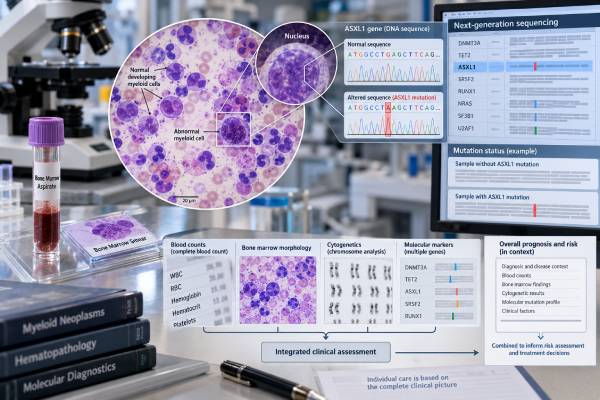
An ASXL1 mutation test looks for acquired DNA changes in the ASXL1 gene, an epigenetic regulator that is frequently altered in myeloid blood disorders. ASXL1 mutations can occur in acute myeloid leukemia (AML), myelodysplastic syndromes (MDS), chronic myelomonocytic leukemia (CMML), myeloproliferative neoplasms, and age-related clonal hematopoiesis. That range is important: a positive ASXL1 result does not automatically mean a person has leukemia or another myeloid cancer. Doctors interpret the mutation together with blood counts, bone marrow findings, chromosome results, symptoms, and other gene mutations. In established myeloid neoplasms, a pathogenic ASXL1 mutation often carries adverse prognostic weight and may contribute to molecular risk scoring. In people without diagnostic evidence of a blood cancer, the same mutation may represent clonal hematopoiesis instead. Testing is usually performed by next-generation sequencing on blood or bone marrow and is most informative as part of a broader myeloid mutation panel.
- A positive ASXL1 result means a reportable ASXL1 variant was detected, but the diagnosis depends on the clinical and bone marrow context.
- Truncating ASXL1 mutations are generally associated with poorer outcomes in several myeloid neoplasms, including AML and CMML.
- ASXL1 can also be found in clonal hematopoiesis, especially with aging, so mutation presence alone does not prove cancer.
- The variant allele fraction shows how much of the tested DNA carries the mutation; it is not a stand-alone measure of cancer stage or aggressiveness.
- No fasting is needed; testing usually uses peripheral blood or a bone marrow specimen already collected for hematologic evaluation.
Table of Contents
- What ASXL1 Does and Why It Is Tested
- When ASXL1 Testing Is Ordered
- How ASXL1 Mutation Testing Is Performed
- How to Interpret an ASXL1 Result
- ASXL1 in AML, MDS, CMML, and MPN
- ASXL1 and Clonal Hematopoiesis
- Prognosis, Treatment, and Follow-Up
What ASXL1 Does and Why It Is Tested
ASXL1 helps regulate which genes are switched on or off in blood-forming stem cells, so damaging mutations can disturb normal blood-cell development. The gene encodes additional sex combs-like 1, a protein involved in chromatin regulation. Chromatin is the DNA-protein structure that helps control gene expression. When ASXL1 is altered, the balance of epigenetic signals can shift in ways that favor abnormal stem-cell self-renewal and impaired maturation.
Most clinically important ASXL1 mutations in myeloid disease are frameshift or nonsense variants that truncate the protein. These changes tend to cluster in the terminal exon. They do not act like a simple “on/off” tumor marker; their significance depends on the disease in which they occur and the other molecular changes present in the same clone.
ASXL1 belongs to a group of genes commonly altered in myeloid neoplasms and clonal hematopoiesis. Other frequent age-related or myeloid-associated mutations include DNMT3A and TET2. A DNMT3A mutation test and a TET2 mutation test often appear on the same NGS panel as ASXL1.
The purpose of testing is usually one or more of the following:
- Support classification of a suspected myeloid neoplasm.
- Refine prognosis after a diagnosis such as AML, MDS, or CMML has been established.
- Contribute to molecular risk models.
- Define the mutation profile before treatment or stem-cell transplant decisions.
- Identify a clonal process when unexplained cytopenias or blood-count abnormalities are being evaluated.
ASXL1 is not usually a direct drug-selection biomarker in the way FLT3 or IDH1 can be in AML. Its main clinical role is disease characterization and risk interpretation.
When ASXL1 Testing Is Ordered
ASXL1 is commonly tested when blood counts or bone marrow findings suggest a myeloid disorder, or when a known myeloid cancer needs molecular risk assessment. It is usually included in a multigene panel rather than ordered alone.
Testing may be appropriate in people with:
- Persistent unexplained anemia, neutropenia, thrombocytopenia, or combinations of low blood counts.
- Persistent monocytosis when CMML is being considered.
- Leukocytosis, thrombocytosis, splenomegaly, or marrow findings suggesting a myeloproliferative neoplasm.
- Suspected or confirmed MDS.
- Newly diagnosed AML.
- A prior myeloid neoplasm that has changed clinically or progressed.
The mutation profile is interpreted with morphology and cytogenetics. For example, AML risk assessment also considers gene abnormalities such as NPM1, FLT3, TP53, RUNX1, and specific chromosomal changes. An FLT3 mutation test can directly influence targeted therapy decisions, while an NPM1 mutation test can affect AML classification, prognosis, and measurable residual disease monitoring. ASXL1 provides a different layer of information.
Testing is also ordered in people with persistent blood-count abnormalities that do not yet meet criteria for MDS or another neoplasm. In that setting, finding ASXL1 may support a clonal condition such as clonal cytopenia of undetermined significance, but it still does not replace bone marrow and clinical criteria.
ASXL1 testing is generally not a population screening test. Discovering the mutation incidentally in a healthy person can create uncertainty because clonal hematopoiesis becomes more common with age and often never progresses to leukemia.
How ASXL1 Mutation Testing Is Performed
Next-generation sequencing is the standard way to detect ASXL1 mutations in clinical myeloid testing. The assay usually examines dozens or hundreds of genes from peripheral blood or bone marrow DNA.
Peripheral blood is often adequate when abnormal cells are circulating. Bone marrow may be preferred when blood counts are low, blasts are confined to the marrow, or a full morphologic and molecular evaluation is already being performed. The laboratory should state the specimen type, sequencing coverage, reporting threshold, and the exact variant found.
No fasting or medication hold is usually required. The molecular test itself adds no special preparation beyond the blood draw or bone marrow procedure that is clinically indicated.
Variant allele fraction
Reports often include a variant allele fraction, or VAF. A VAF of 15% means about 15% of sequencing reads at that location carried the variant. VAF can roughly reflect clone size, but the relationship is not one-to-one because copy-number changes, normal-cell admixture, and multiple clones can alter the number.
A low VAF does not automatically make a pathogenic mutation unimportant. Likewise, a high VAF does not prove aggressive leukemia. The VAF is most useful when interpreted with blood counts, marrow blast percentage, other mutations, and serial changes over time.
Technical issues with ASXL1
One well-known ASXL1 hotspot, commonly described as c.1934dupG, p.Gly646Trpfs*12, occurs in a homopolymer region that historically raised concerns about sequencing artifacts. Modern validated NGS methods and orthogonal review can distinguish true mutations more reliably, but the laboratory’s quality controls still matter. A result should come from a clinically validated assay rather than an unconfirmed research sequence.
Broad testing is usually preferable to single-gene analysis because the co-mutation pattern can change interpretation. A patient with ASXL1 plus RUNX1, SRSF2, or other myelodysplasia-related gene changes may have a different risk profile from someone with an isolated low-level ASXL1 clone and normal blood counts.
How to Interpret an ASXL1 Result
The result should answer four questions: what exact variant was found, how it is classified, how large the clone is, and what diagnosis the patient actually has. The word “positive” alone is not enough.
| Result | Typical interpretation | Main caution |
|---|---|---|
| Pathogenic truncating ASXL1 mutation in established AML, MDS, or CMML | Supports the molecular profile and may worsen prognostic risk | Risk still depends on the full genetic and clinical picture |
| ASXL1 mutation with unexplained cytopenia but no diagnostic marrow features | May indicate a clonal cytopenia state | Does not by itself establish MDS |
| Low-level ASXL1 mutation with normal counts | May represent clonal hematopoiesis | Most people with clonal hematopoiesis do not develop leukemia |
| ASXL1 variant of uncertain significance | Evidence is insufficient to call the variant disease-causing | Should not be treated as an adverse pathogenic mutation without supporting evidence |
| No ASXL1 mutation detected | No reportable ASXL1 variant was found by that assay | Does not rule out a myeloid neoplasm or other driver mutations |
A pathogenic or likely pathogenic ASXL1 variant is a biologically important finding, but its prognostic meaning changes by disease. For example, ASXL1 is part of adverse-risk frameworks in AML and is a negative factor in several CMML models. In MDS, modern prognostic tools use a broader molecular profile rather than a single-gene rule.
A variant of uncertain significance, or VUS, should be interpreted conservatively. Some ASXL1 missense changes are not established drivers. A VUS should not be automatically counted as an adverse-risk mutation in a scoring system unless the specific model and laboratory classification support doing so.
A negative result does not exclude AML, MDS, CMML, or an MPN. Many patients with these conditions have other gene or chromosome abnormalities. It simply means the assay did not detect a reportable ASXL1 mutation.
One more distinction is whether the result came from tumor-focused somatic testing or a germline assay. Most ASXL1 mutations in myeloid disease are acquired and are not inherited. Rare constitutional ASXL1 disorders exist, but they usually present in a very different clinical context and require dedicated germline evaluation. Because blood itself contains the abnormal hematopoietic clone, a blood result cannot always be assumed to represent inherited DNA. If a germline question arises, specialists may use cultured skin fibroblasts or another nonhematopoietic specimen rather than peripheral blood.
ASXL1 in AML, MDS, CMML, and MPN
ASXL1 is most useful as a prognostic and disease-biology marker across several myeloid neoplasms, but its weight differs by diagnosis.
Acute myeloid leukemia
In AML, the 2022 European LeukemiaNet recommendations place pathogenic ASXL1 mutations among myelodysplasia-related gene mutations that can contribute to adverse genetic risk, provided a favorable-risk defining abnormality is not present. This is one reason ASXL1 testing is standard in modern AML panels.
A systematic review and meta-analysis published in 2024 found ASXL1 mutations were associated with worse overall survival in AML. Even so, the mutation is not interpreted in isolation. Age, fitness, cytogenetics, NPM1 status, FLT3 status, TP53, prior MDS, treatment intensity, and transplant eligibility all matter.
A RUNX1 mutation test is often evaluated in the same adverse myeloid context, while TP53 testing in blood cancer can identify a particularly high-risk molecular subgroup.
Myelodysplastic syndromes
MDS prognosis has moved beyond older clinical scores toward models that incorporate mutations. The Molecular International Prognostic Scoring System, or IPSS-M, combines blood counts, marrow blasts, cytogenetics, and a broad set of gene mutations. ASXL1 contributes to this integrated molecular risk assessment rather than acting as a single binary prognosis switch.
This matters because two people with the same ASXL1 mutation can have very different outcomes if one has low-risk cytogenetics and mild cytopenias while the other has excess blasts and multiple high-risk mutations.
Chronic myelomonocytic leukemia
ASXL1 has particularly strong prognostic importance in CMML. Truncating mutations are included in widely used CMML molecular risk models and are associated with shorter survival. Current CMML reviews continue to recognize ASXL1 as a negative prognostic factor, especially when combined with other adverse clinical features.
Myeloproliferative neoplasms
ASXL1 can also occur in primary myelofibrosis, essential thrombocythemia, polycythemia vera, and related MPNs. In myelofibrosis, additional high-risk mutations such as ASXL1 can influence prognostic scoring and transplant discussions. However, the major diagnostic driver mutations in classic MPNs remain JAK2, CALR, and MPL.
ASXL1 and Clonal Hematopoiesis
The same ASXL1 mutation seen in leukemia can also appear in people who do not have a blood cancer. This phenomenon is called clonal hematopoiesis, in which a blood-forming stem-cell clone acquires a mutation and expands over time.
Clonal hematopoiesis becomes more common with age. ASXL1, DNMT3A, and TET2 are among the most frequently involved genes. When a recognized driver mutation is present at a measurable clone size but there is no hematologic malignancy and no otherwise unexplained cytopenia, the finding may meet criteria for clonal hematopoiesis of indeterminate potential, commonly abbreviated CHIP.
CHIP is associated with an increased relative risk of developing a hematologic cancer compared with people without CHIP, but the absolute annual risk of progression is generally low for many individuals. Risk is higher with larger clones, multiple mutations, certain high-risk genes, abnormal blood counts, and specific mutation combinations.
Clonal hematopoiesis is also associated with noncancer outcomes, particularly cardiovascular and inflammatory disease. ASXL1-mutated clones have been linked to inflammatory signaling, although how that should change routine preventive care is still being studied.
A positive ASXL1 result in an otherwise healthy person should therefore not be labeled “leukemia.” The correct next step is to review blood counts, symptoms, clone size, other mutations, and whether a hematology evaluation is needed. Unnecessary repeat marrow biopsies or cancer treatment should be avoided when diagnostic criteria are not met.
Prognosis, Treatment, and Follow-Up
ASXL1 status can influence risk assessment, but it usually does not determine treatment by itself. The diagnosis and overall molecular profile drive management.
For AML, ASXL1 can move the genetic-risk interpretation toward an adverse category in the appropriate setting. That may affect discussions about treatment intensity, allogeneic stem-cell transplant in remission, and clinical-trial options. It does not mean every ASXL1-mutated patient should receive the same regimen.
For MDS, molecular scoring can reclassify patients compared with older systems and may alter when clinicians consider disease-modifying therapy or transplant. For CMML, ASXL1 is incorporated into molecular risk models alongside blood counts and other features. For myelofibrosis, high-risk additional mutations may also influence transplant timing.
There is no routine ASXL1-specific targeted drug analogous to an FLT3 inhibitor. Treatments address the myeloid disease as a whole and may include hypomethylating agents, venetoclax-based regimens in AML, cytoreduction, supportive transfusions, growth factors, or allogeneic stem-cell transplantation depending on the diagnosis.
Follow-up should answer practical questions rather than simply repeating the same mutation test on a fixed schedule:
- Has the blood count changed meaningfully?
- Has the marrow blast percentage increased?
- Have new chromosome or gene abnormalities appeared?
- Is the patient responding clinically to treatment?
- Would repeat molecular testing change the next treatment decision?
Serial VAF measurements can sometimes show clonal expansion or contraction, but ASXL1 is not universally used as a stand-alone measurable residual disease marker. Persistent ASXL1 after therapy may sometimes reflect an antecedent clonal hematopoiesis clone rather than active leukemia. More leukemia-specific markers, when available, may be better for MRD assessment.
A useful conversation after receiving an ASXL1 report includes asking the hematologist: What exact variant was found? Is it pathogenic? What is the VAF? Does it count in my disease’s current risk model? What other mutations were detected? Does this finding change transplant recommendations or treatment? And could this represent clonal hematopoiesis rather than the malignant clone?
The most important principle is that ASXL1 is a context-dependent marker. It can be a significant adverse feature in a proven myeloid neoplasm, yet the same gene can appear in an otherwise stable age-related clone. Accurate interpretation requires the full hematologic picture.
The specimen source should also be considered when ASXL1 is used in a diagnostic workup. A blood result may reflect the dominant myeloid clone, but marrow morphology is still needed when classifying many myelodysplastic and myeloproliferative disorders. After treatment, persistence of an ASXL1 clone does not always equal persistent leukemia because clonal hematopoiesis can survive remission. Disease-specific measurable-residual-disease markers, blood counts, marrow findings, and the full mutation pattern provide a more reliable picture than ASXL1 alone.
References
- Diagnosis and management of AML in adults: 2022 recommendations from an international expert panel on behalf of the ELN 2022 (Guideline)
- Molecular International Prognostic Scoring System for Myelodysplastic Syndromes 2022
- Epigenetic regulation by ASXL1 in myeloid malignancies 2023 (Review)
- Prognostic significance of ASXL1 mutations in acute myeloid leukemia: A systematic review and meta-analysis 2024 (Systematic Review)
- Chronic myelomonocytic leukemia: 2024 update on diagnosis, risk stratification and management 2024 (Review)
- ASXL1 mutation-related clonal hematopoiesis and age-related diseases: clinical evidence and molecular insights 2025 (Review)
Disclaimer
This article is for general education and does not replace interpretation by a hematologist, pathologist, or molecular laboratory. ASXL1 results must be assessed with blood counts, bone marrow findings, cytogenetics, co-mutations, and the confirmed diagnosis. Do not make treatment or transplant decisions from an ASXL1 result alone.