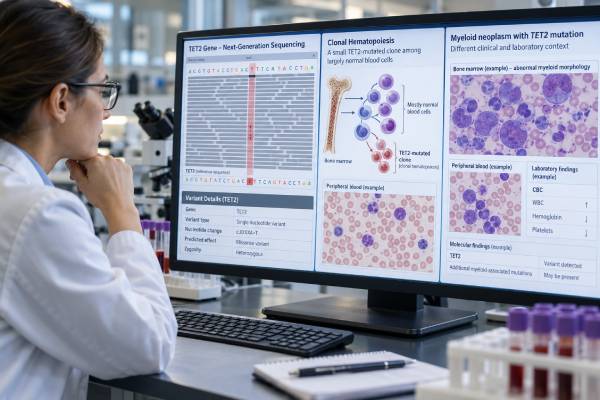
A TET2 mutation test looks for acquired changes in the TET2 gene in blood or bone marrow cells. TET2 helps regulate DNA methylation and normal blood-cell development, and loss-of-function mutations are common in clonal hematopoiesis as well as several myeloid cancers, including myelodysplastic neoplasms (MDS), acute myeloid leukemia (AML), and chronic myelomonocytic leukemia (CMML). The most important point is that a TET2 mutation does not automatically mean a person has blood cancer. TET2 is one of the genes most often found in age-related clonal hematopoiesis, where a mutated blood-cell clone expands without meeting criteria for leukemia or another myeloid neoplasm. The same mutation can also be one piece of a malignant molecular profile. Doctors therefore interpret TET2 together with blood counts, symptoms, bone marrow findings, chromosome results, other gene mutations, and the variant allele frequency (VAF). The result is most useful as part of a complete hematologic evaluation rather than as an isolated positive-or-negative cancer test.
- A positive TET2 mutation means a blood-cell clone carries an acquired TET2 variant, but it does not by itself diagnose leukemia, MDS, or another cancer.
- TET2 is a common clonal hematopoiesis gene, especially with advancing age, so normal blood counts and absence of diagnostic marrow findings can point toward CHIP rather than malignancy.
- Persistent unexplained low blood counts plus a TET2 mutation can fit clonal cytopenia of undetermined significance (CCUS) if criteria for a myeloid neoplasm are not met.
- Variant allele frequency helps estimate clone size but is not a direct tumor-percentage measurement and must be interpreted with other mutations and the clinical picture.
- There is no routine TET2-targeted treatment chosen from the mutation alone; treatment is based on the diagnosed disorder, risk category, symptoms, and the full molecular profile.
Table of Contents
- What TET2 Does and How Testing Works
- What a Positive TET2 Result Means
- TET2 and Clonal Hematopoiesis
- TET2 in MDS, AML, and Other Myeloid Neoplasms
- How to Interpret Variant Allele Frequency
- Prognosis and Treatment Meaning
- Follow-Up After a TET2 Mutation Is Found
What TET2 Does and How Testing Works
TET2 encodes an enzyme involved in epigenetic regulation. Rather than changing the DNA sequence of other genes, TET2 helps control chemical marks on DNA that influence which genes blood-forming stem and progenitor cells use. Loss of normal TET2 function can give a hematopoietic stem-cell clone a growth advantage, allowing it to make a larger share of circulating blood cells over time.
Most clinical TET2 testing is performed by next-generation sequencing (NGS) as part of a multigene myeloid panel rather than as a single-gene assay. The sample may be peripheral blood or bone marrow. A panel is generally more informative because myeloid diseases are driven by combinations of alterations, and the meaning of TET2 changes depending on what else is present.
A report usually includes:
- the gene name, TET2;
- the exact DNA and protein-level variant when known;
- whether the laboratory classifies the variant as pathogenic, likely pathogenic, uncertain, or benign;
- the variant allele frequency, often shown as a percentage; and
- other mutations detected in the same assay.
Not every TET2 variant should be treated as disease-causing. Laboratories use databases, published evidence, predicted protein effects, population frequency, and internal criteria to classify variants. A variant of uncertain significance (VUS) is not the same as a pathogenic mutation and generally should not drive a cancer diagnosis by itself.
TET2 variants found in routine blood-cancer testing are usually somatic, meaning acquired in a subset of blood cells rather than inherited in every cell. If an inherited predisposition is suspected from the specific variant or family history, confirmation requires appropriate germline testing from a non-hematopoietic source and genetics expertise.
What a Positive TET2 Result Means
A positive pathogenic or likely pathogenic TET2 result means the tested sample contains a clone of cells with altered TET2. The test does not, however, identify the clinical category on its own.
The same result can appear in several settings:
- Clonal hematopoiesis without cytopenia. A person may have normal or near-normal blood counts and no evidence of a hematologic neoplasm.
- Clonal cytopenia. A person may have persistent unexplained anemia, neutropenia, or thrombocytopenia with a mutation but without enough morphologic or genetic evidence for MDS or another myeloid cancer.
- Established myeloid neoplasm. TET2 can be part of the mutation profile in MDS, AML, CMML, myeloproliferative neoplasms, and overlap disorders.
- Other hematologic disease. TET2 mutations can occur in some lymphoid neoplasms as well, although their diagnostic meaning differs.
This is why the report should be paired with a complete blood count and clinical history. A mutation discovered incidentally during broad sequencing in a healthy older adult has a very different meaning from the same mutation found in bone marrow containing dysplastic cells and increased blasts.
If the test was ordered because of suspected leukemia or MDS, clinicians often review the TET2 result through a broader MDS mutation panel or another myeloid sequencing panel. Mutations in genes such as TP53, RUNX1, ASXL1, SRSF2, SF3B1, FLT3, NPM1, IDH1, or IDH2 may have different diagnostic, prognostic, or treatment implications.
A negative TET2 test also does not exclude a myeloid disorder. Many patients with AML, MDS, or CMML do not carry a TET2 mutation, and a negative result simply means the assay did not detect a reportable TET2 alteration within its technical limits.
TET2 and Clonal Hematopoiesis
TET2 is one of the classic genes associated with clonal hematopoiesis, along with DNMT3A and ASXL1. Clonal hematopoiesis means that a hematopoietic stem or progenitor cell has acquired a mutation that gives its descendants a competitive advantage, so that clone becomes detectable in blood.
When a recognized driver mutation is present without unexplained cytopenias or a diagnosed blood cancer, the finding may be called clonal hematopoiesis of indeterminate potential (CHIP). Historically, CHIP has often been defined using a VAF threshold of at least about 2%, although modern sequencing can detect much smaller clones and research definitions continue to evolve.
CHIP becomes more common with age. Most people with CHIP do not develop leukemia. The average annual rate of progression across CHIP populations is low, but risk is not uniform. Larger clones, multiple mutations, certain high-risk genes, abnormal blood counts, and changing clone size can all increase concern.
TET2-mutated clonal hematopoiesis also has biological effects beyond leukemia risk. TET2-deficient blood cells can produce altered inflammatory signals, and clonal hematopoiesis has been associated in population studies with cardiovascular and other non-malignant conditions. These associations are important scientifically, but they do not mean every person with a TET2 clone needs medication aimed at the clone. Routine clinical management remains focused on individual risk, blood-count surveillance, and control of standard cardiovascular risk factors when appropriate.
A related category is clonal cytopenia of undetermined significance (CCUS). This term is used when a person has persistent unexplained cytopenia plus one or more clonal hematopoiesis mutations but does not meet criteria for a defined myeloid neoplasm. CCUS generally carries a higher progression risk than CHIP, especially with higher-risk mutation patterns.
A TET2 result should therefore be interpreted along a continuum: small age-related clone, higher-risk clonal cytopenia, or part of an established neoplasm. The mutation itself is not the boundary between these states.
TET2 in MDS, AML, and Other Myeloid Neoplasms
TET2 mutations occur across several myeloid malignancies. They are reported in a meaningful minority of adults with AML and are also frequent in MDS and CMML. In CMML, TET2 often appears with mutations in genes involved in RNA splicing or signaling. In AML, TET2 may coexist with many different molecular subtypes.
The mutation contributes to disease biology by altering epigenetic regulation and blood-cell differentiation, but it is rarely the only event. Transformation from a TET2-mutated clone to overt cancer typically requires additional cooperating changes that affect proliferation, differentiation, DNA repair, signaling, or transcription.
This explains an important diagnostic principle: TET2 is not a disease-defining AML mutation. Unlike some recurrent genetic abnormalities that can establish a specific AML category in the proper setting, TET2 is better viewed as a common cooperating or founding lesion. AML diagnosis still depends on marrow/blood blast findings and disease-defining genetic criteria under current classifications.
Likewise, TET2 positivity alone does not establish MDS. MDS diagnosis integrates persistent cytopenia, marrow morphology, blast percentage, cytogenetics, and molecular findings. A clonal mutation can strengthen the evidence that a cytopenia is biologically clonal, but common age-related mutations such as TET2 require careful interpretation because they also occur outside MDS.
TET2 may be especially informative when viewed with mutation order. A TET2 mutation that arose years earlier may represent the founding clone, while later mutations help drive progression. This can create a situation where the TET2 clone remains detectable even after treatment has eliminated a leukemia-specific subclone. For that reason, TET2 is often a poor stand-alone marker for leukemia MRD testing: persistence may reflect clonal hematopoiesis rather than residual AML.
How to Interpret Variant Allele Frequency
Variant allele frequency is the proportion of sequencing reads at a DNA position that carry the variant. A TET2 VAF of 10%, for example, means roughly 10% of the reads at that site contained the mutation. It does not mean exactly 10% of marrow cells are cancer cells.
Several factors break that simple one-to-one relationship. Human cells normally have two copies of most genes, and a mutation may affect one or both copies. Copy-number changes, loss of heterozygosity, sample purity, lineage distribution, and technical assay factors can all alter the measured VAF. A mutation present in one copy in a simple diploid clone can sometimes correspond roughly to a clone about twice the VAF, but that shortcut is not reliable enough for clinical conclusions without context.
VAF is still useful. In clonal hematopoiesis, a larger clone generally deserves more attention than a tiny stable clone, especially when combined with cytopenias or additional mutations. Serial VAF measurements can also show clonal expansion, although small changes may reflect analytical variation rather than true biology.
A high VAF may raise questions about whether a variant could be germline, but VAF alone cannot determine inherited status. Somatic clones can also reach high allele fractions. When germline evaluation matters, testing should use an appropriate non-blood tissue source and specialist interpretation.
When reviewing a report, ask:
- What is the exact TET2 variant classification?
- What is the VAF?
- Are there additional pathogenic mutations?
- Are blood counts normal or persistently abnormal?
- Was the sample blood or bone marrow?
- Does marrow morphology meet criteria for MDS, AML, CMML, or another neoplasm?
- Is the clone stable, expanding, or newly detected?
Those questions are far more useful than applying a single “dangerous VAF” cutoff to every patient.
Prognosis and Treatment Meaning
The prognostic effect of TET2 depends strongly on disease context and co-mutations. Studies in AML and other myeloid neoplasms have produced mixed results because TET2-mutated patients are not one uniform group. Age, cytogenetics, treatment intensity, mutation partners, and the specific disease subtype can outweigh the isolated presence of TET2.
In AML, current risk systems do not generally treat TET2 as a simple stand-alone adverse-risk marker. Other features—such as TP53 abnormalities, certain myelodysplasia-related mutations or cytogenetics, and disease-defining molecular lesions—can have much stronger established effects on classification and prognosis. A hematologic cancer biomarker panel is therefore interpreted as a molecular pattern, not a list of independent yes-or-no risk labels.
TET2 status alone also does not select a standard targeted drug. Patients with AML or MDS may receive intensive chemotherapy, hypomethylating agents, venetoclax-based combinations, targeted drugs for other actionable mutations, stem cell transplantation, or clinical-trial therapy depending on the diagnosis and overall risk. Research is exploring metabolic, epigenetic, inflammatory, and immune vulnerabilities linked to TET2 loss, but these approaches are not equivalent to a routine approved “TET2 inhibitor” or “TET2 treatment.”
In CHIP, there is likewise no standard therapy aimed simply at eradicating a TET2-mutated clone. Management usually emphasizes surveillance proportional to risk and treatment of conventional health risks. High-risk clonal hematopoiesis and CCUS are active areas of prevention research, and clinical trials are testing whether intervention can reduce progression.
The mutation is therefore clinically meaningful, but its role is to refine the story: it can identify clonality, explain part of disease biology, and contribute to risk assessment. It rarely provides a complete diagnosis, prognosis, or treatment plan by itself.
Follow-Up After a TET2 Mutation Is Found
Follow-up should match the reason the mutation was found.
For an incidental TET2 mutation with normal blood counts and no signs of a hematologic neoplasm, clinicians may confirm that the finding fits clonal hematopoiesis, review the mutation profile and VAF, and periodically repeat a complete blood count. The interval varies with clone size, age, other mutations, symptoms, and local practice. Routine repeated sequencing is not always necessary for low-risk stable CHIP.
If there are persistent unexplained cytopenias, the evaluation is more intensive. Common steps include reviewing nutritional deficiencies, medications, kidney or liver disease, autoimmune causes, infection, and other explanations for low counts. Bone marrow examination may be appropriate to assess morphology, blasts, cytogenetics, and the complete mutation profile. A TET2 mutation plus cytopenia may support CCUS, but MDS must be excluded using current diagnostic criteria.
For established AML, MDS, CMML, or another myeloid neoplasm, follow-up is driven by that disease. Doctors track blood counts, marrow response when indicated, cytogenetic and molecular markers, and treatment-specific endpoints. Leukemia-specific mutations such as NPM1 can sometimes be better MRD markers than age-related clonal hematopoiesis genes such as TET2.
New symptoms should prompt earlier evaluation rather than waiting for scheduled testing. Persistent fatigue with worsening anemia, unusual bruising or bleeding, recurrent infections, unexplained fever, drenching night sweats, or a clear downward trend in blood counts deserves clinical review.
A positive TET2 result is best understood as evidence of a clone whose importance ranges from common age-related hematopoiesis to part of a myeloid cancer. The distinction comes from the blood counts, marrow, co-mutations, and clinical course—not from the gene name alone.
Risk in clonal hematopoiesis is increasingly assessed with combinations of features rather than the presence of TET2 alone. Factors that raise concern include multiple driver mutations, larger clones, mutations in higher-risk genes, abnormal red-cell indices, persistent cytopenias, and a clone that expands on serial testing. TET2 as a single stable mutation in an otherwise healthy person can carry a different outlook from TET2 plus a spliceosome mutation in someone with falling blood counts.
Lifestyle changes have not been proven to remove a TET2-mutated clone. Still, because clonal hematopoiesis is associated with cardiovascular risk at the population level, clinicians often make sure conventional modifiable risks—blood pressure, cholesterol, diabetes, smoking, exercise, and weight—are addressed according to standard preventive guidelines. This is general risk reduction, not a mutation-specific treatment.
A stable TET2 mutation can remain detectable for years. That persistence is not automatically evidence of treatment failure if the patient had a TET2-mutated founding clone before leukemia developed. The treating team should distinguish residual clonal hematopoiesis from residual malignant disease using the full response profile.
References
- TET2 mutation as prototypic clonal hematopoiesis lesion 2024 (Review)
- TET2 mutation in acute myeloid leukemia: biology, clinical significance, and therapeutic insights. 2024 (Review)
- Clonal hematopoiesis of indeterminate potential: the root cause of, and fertile ground for, hematological malignancies 2025 (Review)
- Clonal hematopoiesis: elements associated with clonal expansion and diseases. 2025 (Review)
- Clonal hematopoiesis of indeterminate potential: recent developments and perspectives 2025 (Review)
- Clonal hematopoiesis and its progression to myeloid neoplasms: insights into risk, biology, and therapeutic strategies 2026 (Review)
Disclaimer
A TET2 mutation can occur in clonal hematopoiesis without cancer as well as in established myeloid neoplasms. The result should be interpreted with blood counts, marrow findings, co-mutations, VAF, and clinical history. Do not use a TET2 result alone to diagnose leukemia or decide treatment.