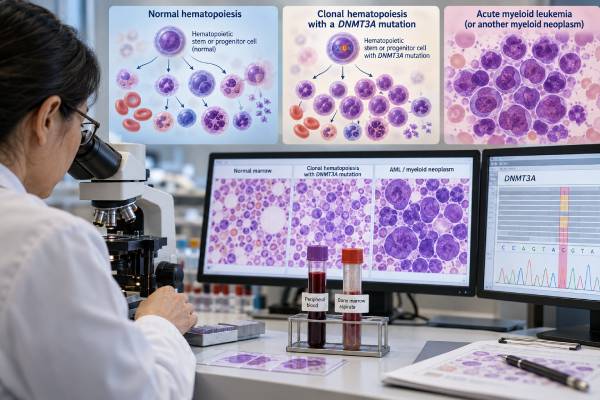
A DNMT3A mutation test looks for acquired changes in the DNMT3A gene, an important regulator of DNA methylation and blood-cell development. DNMT3A mutations are common in acute myeloid leukemia (AML), but they are also among the most frequent mutations found in age-related clonal hematopoiesis in people who do not have leukemia. That overlap makes interpretation more nuanced than a simple positive-or-negative cancer test. In a patient with AML, a DNMT3A mutation helps define the molecular profile and may contribute to prognostic assessment when considered with cytogenetics and other mutations. In a person without AML, the same type of mutation may represent clonal hematopoiesis, especially when blood counts and bone marrow findings do not meet criteria for a myeloid neoplasm. The result therefore needs context: specimen type, variant, variant allele frequency, blood counts, marrow findings, other mutations, and the clinical reason for testing all matter.
- A positive DNMT3A mutation does not by itself diagnose AML or another blood cancer because DNMT3A is also a common clonal hematopoiesis gene.
- DNMT3A mutations occur in roughly 20–30% of adult AML, with the R882 hotspot among the best-known recurrent variants.
- The variant allele frequency, or VAF, estimates how much of the tested DNA carries the mutation but is not the same as the percentage of leukemia cells.
- In AML, DNMT3A is not an ELN 2022 adverse-risk mutation by itself; overall risk depends on the complete genetic and cytogenetic profile.
- DNMT3A can persist during remission because it may mark a pre-leukemic clone, so it is often less specific for measurable residual AML than later leukemia-defining mutations.
Table of Contents
- What DNMT3A Does and Why It Is Tested
- How DNMT3A Mutation Testing Is Performed
- What a Positive DNMT3A Result Means
- DNMT3A in AML Risk and Prognosis
- DNMT3A and Clonal Hematopoiesis
- How to Read VAF and Follow-Up Results
- What Happens After a DNMT3A Result
What DNMT3A Does and Why It Is Tested
DNMT3A is an epigenetic regulator that helps establish patterns of DNA methylation in developing blood cells. DNA methylation is a chemical tagging system that influences which genes are active or silent. When DNMT3A is altered in a hematopoietic stem cell, that cell can gain a competitive advantage and expand into a clone.
This explains why DNMT3A appears at several points along the spectrum from normal aging to leukemia. A DNMT3A-mutated clone may remain stable for years without causing low blood counts or cancer. In other people, additional mutations accumulate and the clone contributes to a myelodysplastic syndrome, myeloproliferative neoplasm, or AML.
Clinicians most often encounter DNMT3A testing as part of a multigene next-generation sequencing panel, not as a stand-alone test. In newly diagnosed AML, molecular profiling is performed because modern classification and risk assessment depend heavily on genetics. The same panel may include NPM1, FLT3, IDH1, IDH2, TP53, RUNX1, spliceosome genes, and many others. A dedicated NPM1 mutation result, for example, may carry different diagnostic and measurable residual disease implications than DNMT3A even when both variants are present in the same leukemia.
DNMT3A testing may also be ordered during evaluation of unexplained cytopenias, abnormal blood counts, suspected myelodysplastic syndrome, or another myeloid neoplasm. In that setting, the question is not simply whether a mutation exists. The clinician is trying to decide whether the molecular finding is part of an actual neoplasm, clonal cytopenia, or clonal hematopoiesis without a defined blood cancer.
DNMT3A is especially important because it is often an early clonal event. It can be present before overt AML develops and can remain detectable after the AML itself has entered remission. That biology is central to interpreting both diagnostic and follow-up results.
How DNMT3A Mutation Testing Is Performed
Most DNMT3A testing uses DNA sequencing from peripheral blood or bone marrow. Bone marrow is commonly tested during a diagnostic leukemia or myelodysplasia workup because the marrow provides direct information about blasts, cell morphology, and the hematopoietic clone. Peripheral blood can also be suitable, particularly when abnormal cells are circulating or the test is being used to evaluate clonal hematopoiesis.
Next-generation sequencing, or NGS, reads many genes at once and can identify numerous DNMT3A variants. One well-known hotspot is R882, meaning the amino acid arginine at position 882 is altered. Variants such as R882H and R882C are common in AML, but clinically relevant DNMT3A mutations can occur elsewhere in the gene as well.
A molecular report typically includes several pieces of information:
| Report element | What it means |
|---|---|
| Gene | DNMT3A |
| Variant | The exact DNA and protein change, such as a change involving R882 |
| Classification | Usually pathogenic, likely pathogenic, uncertain, or another laboratory category |
| Variant allele frequency | The proportion of sequencing reads carrying the variant |
| Coverage or sensitivity | Technical information about how reliably the assay can detect a variant |
The test usually requires no fasting or special preparation. If blood is used, it is collected like other blood tests. If bone marrow is used, preparation relates to the marrow aspiration and biopsy rather than to DNMT3A sequencing itself.
A negative result means the assay did not detect a reportable DNMT3A alteration above its limit of detection. It does not rule out AML, MDS, or another myeloid neoplasm. Many patients with these diseases have no DNMT3A mutation, and other genetic or chromosome abnormalities may be more important to their diagnosis.
Test design also matters. Different laboratories sequence different regions, use different depth thresholds, and may report low-level variants differently. When results from two dates are being compared, using the same assay or understanding the sensitivity of both assays helps prevent misleading conclusions.
What a Positive DNMT3A Result Means
A positive DNMT3A result means a mutation was detected in a population of blood-forming cells, but the mutation alone does not identify the disease state. The same molecular finding can appear in AML, another myeloid neoplasm, clonal cytopenia, or clonal hematopoiesis without cancer.
Context changes the meaning substantially. Consider three examples:
- A person has 45% myeloblasts in bone marrow, an NPM1 mutation, and a DNMT3A R882 mutation. Here, DNMT3A is part of the AML molecular profile.
- A person has persistent anemia, no AML-defining lesion, fewer than 20% blasts, and a DNMT3A mutation. The mutation may support a clonal marrow disorder, but morphology, cytogenetics, other variants, and diagnostic criteria determine whether the final diagnosis is MDS, clonal cytopenia, or something else.
- A healthy older adult has normal counts and a low-level DNMT3A mutation discovered incidentally. That may fit clonal hematopoiesis rather than leukemia.
The pathology report may call a DNMT3A variant “pathogenic” or “likely pathogenic.” Those labels describe evidence that the DNA change affects gene function; they do not mean the person definitely has a pathogenic clinical condition. A pathogenic somatic mutation can be present in clonal hematopoiesis without an overt hematologic malignancy.
The exact variant also matters. R882 mutations are biologically distinctive and common in AML, while non-R882 variants form a broader group. Research studies have reported differences in co-mutations, methylation patterns, and outcomes among DNMT3A subtypes. In practice, however, treatment and risk decisions are rarely made from the DNMT3A position alone.
A positive result should be read alongside the complete blood count, blood smear, marrow morphology when available, chromosome analysis, FISH, and the rest of the molecular panel. For suspected MDS, a myelodysplastic syndrome mutation panel can show whether DNMT3A occurs alone or with mutations that are more strongly associated with a defined myeloid neoplasm.
DNMT3A in AML Risk and Prognosis
DNMT3A mutations are common in adult AML, particularly in older adults and cytogenetically normal AML. Studies often place the frequency around 20–30%, although prevalence varies with age, AML subtype, and the population tested.
Historically, many studies associated DNMT3A mutation—especially R882—with poorer outcomes. The relationship is real but complicated. AML prognosis is shaped by the entire molecular architecture, the treatment used, patient age and fitness, measurable residual disease response, and whether allogeneic stem cell transplantation is performed. DNMT3A frequently co-occurs with NPM1 and FLT3 alterations, which can change risk substantially.
Under the 2022 European LeukemiaNet genetic risk system, DNMT3A is not listed as an adverse-risk mutation by itself. A patient whose only relevant molecular finding is DNMT3A cannot be assigned an adverse ELN category solely for that reason. The risk category is derived from the full set of defining cytogenetic and molecular abnormalities.
This distinction prevents a common error: reading “DNMT3A positive” and assuming it automatically means high-risk AML. Some DNMT3A-mutated AML cases have additional favorable-risk features; others have intermediate- or adverse-risk findings. The integrated result matters more than the single gene.
Research continues to refine this area. Recent genomic studies show that DNMT3A-mutated AML is heterogeneous and that co-mutation patterns can separate groups with different outcomes. That is one reason broad profiling is more informative than interpreting DNMT3A in isolation.
DNMT3A currently has no widely used approved therapy that directly targets the mutant DNMT3A protein in the way FLT3 or mutant IDH can be targeted. Its main clinical role is therefore molecular characterization and biologic context rather than selection of a DNMT3A-specific drug.
When an AML panel also detects actionable mutations, those other findings may guide therapy. For example, a FLT3 mutation can identify eligibility for FLT3-directed treatment, while IDH1 or IDH2 mutations can identify other targeted options.
DNMT3A and Clonal Hematopoiesis
DNMT3A is one of the most common genes involved in clonal hematopoiesis, an age-associated expansion of blood cells descended from a stem cell that acquired a somatic mutation. TET2 and ASXL1 are other common clonal hematopoiesis genes.
Clonal hematopoiesis is not the same as leukemia. Many people with a DNMT3A-mutated clone never develop a hematologic cancer. The finding becomes more common with age, and increasingly sensitive sequencing can detect very small clones that older assays would have missed.
The term clonal hematopoiesis of indeterminate potential (CHIP) is generally used when a recognized myeloid cancer-associated somatic mutation is present at a qualifying clone size but the person does not have unexplained cytopenias or a defined hematologic neoplasm. The traditional sequencing threshold used in many definitions is a VAF of about 2% or greater, although modern assays can detect smaller clones and classification frameworks continue to evolve.
Clonal cytopenia of undetermined significance (CCUS) describes a different situation: a person has persistent otherwise unexplained cytopenia plus a clonal molecular or cytogenetic abnormality but does not meet criteria for a defined myeloid neoplasm. CCUS generally carries a higher risk of progression than CHIP, especially when the clone is large or includes multiple or higher-risk mutations.
A DNMT3A mutation alone often carries less progression risk than some spliceosome, TP53, or multiple-mutation patterns, particularly when the DNMT3A clone is small. Risk is not zero, however, and clone size, blood-count trends, age, mutation type, and co-mutations all matter.
Clonal hematopoiesis also has associations beyond leukemia. Large studies link CHIP with cardiovascular and inflammatory outcomes, although risk differs by gene and clone size. This does not mean everyone with DNMT3A-mutated CHIP needs cancer treatment or cardiovascular medication specifically because of the mutation. It means clinicians should interpret the result as a risk marker that may justify appropriate blood-count surveillance and attention to standard cardiovascular risk reduction.
A related TET2 mutation result has many of the same interpretive challenges because TET2 also occurs in both clonal hematopoiesis and overt myeloid neoplasms.
How to Read VAF and Follow-Up Results
The variant allele frequency (VAF) is the percentage of sequencing reads at a location that contain the mutation. If a report lists DNMT3A at 12% VAF, about 12% of sequencing reads for that position carried the variant in the tested sample.
VAF is useful, but it is not a direct leukemia-cell percentage. A heterozygous mutation present in every cell of a pure clone often produces a VAF near 50%, but real samples contain mixtures of normal and abnormal cells. Copy-number changes, loss of the normal allele, sample purity, sequencing bias, and whether the mutation is heterozygous or homozygous can all shift the number.
For clonal hematopoiesis, a rising VAF over time can indicate clonal expansion, especially if the change is reproducible on the same platform. Even then, the trend should be interpreted with blood counts and other variants rather than in isolation.
For AML remission monitoring, DNMT3A is particularly tricky. DNMT3A, TET2, and ASXL1 are often called DTA mutations. These can arise early in leukemogenesis and may remain in pre-leukemic stem cells after chemotherapy has cleared the overt leukemia. Therefore, persistence of DNMT3A at remission can reflect residual clonal hematopoiesis rather than active AML.
That is why DNMT3A alone is generally not treated as a highly specific molecular measurable residual disease marker in the same way as NPM1 or a leukemia-defining fusion. A person can be in morphologic and clinical remission while a DNMT3A clone remains detectable. Recent studies also show that persistent clonal mutations can still contain prognostic information in some settings, so the result should not simply be ignored; it must be interpreted in combination with non-DTA mutations, flow cytometry, and the treatment context.
A leukemia MRD assessment may therefore use multiparameter flow cytometry, PCR for a more specific molecular marker, or error-corrected sequencing panels rather than relying on DNMT3A alone.
What Happens After a DNMT3A Result
The next step depends on why the test was ordered. In newly diagnosed AML, the DNMT3A result is incorporated into the full molecular profile and reviewed with cytogenetics, morphology, patient factors, and other mutations. The hematology team then assigns disease classification and risk and chooses therapy based on the complete picture.
In unexplained cytopenia, the clinician may recommend bone marrow examination if it has not already been done. A marrow assessment can show dysplasia, blast percentage, fibrosis, cellularity, and other features that sequencing cannot determine. Additional chromosome testing may reveal abnormalities not captured by a mutation panel.
In an otherwise healthy person with an incidental DNMT3A clone, management is usually observation rather than treatment. Follow-up often centers on periodic complete blood counts and clinical review. The appropriate interval varies with the clone size, mutation pattern, age, blood-count stability, and whether there are other risk factors. New or worsening anemia, neutropenia, thrombocytopenia, unexplained leukocytosis, or constitutional symptoms should prompt reassessment rather than simply waiting for the next routine check.
Genetic counseling may be appropriate in unusual situations where a variant could be germline, particularly when the VAF and personal or family history raise that possibility. Most DNMT3A findings on hematologic NGS panels are acquired somatic mutations, but tumor-only testing cannot always prove somatic origin. Confirmatory germline testing uses non-blood tissue and should be ordered through an appropriate genetics workflow.
When comparing serial reports, focus on more than the word “positive.” Ask whether the same DNMT3A variant is present, whether its VAF has changed materially, whether additional mutations have appeared or disappeared, and how the blood counts or marrow findings changed at the same time.
The most useful interpretation question is: What clinical state does this DNMT3A clone represent in this person now? In AML, it may be part of the leukemia’s founding clone. In remission, it may represent residual pre-leukemic hematopoiesis. In a person without cancer, it may represent CHIP. The laboratory result is the same type of molecular observation, but the diagnosis comes from the surrounding evidence.
References
- Diagnosis and management of AML in adults: 2022 recommendations from an international expert panel on behalf of the ELN 2022 (Guideline)
- The 5th edition of the World Health Organization Classification of Haematolymphoid Tumours: Myeloid and Histiocytic/Dendritic Neoplasms 2022 (Review)
- Significance of targeting DNMT3A mutations in AML 2024 (Review)
- Clonal hematopoiesis of indeterminate potential: the root cause of, and fertile ground for, hematological malignancies 2025 (Review)
- Clonal hematopoiesis of indeterminate potential as a prognostic factor: a systematic review and meta-analysis 2024 (Systematic Review)
- Persistent postremission clonal hematopoiesis shapes the relapse trajectories of acute myeloid leukemia 2025 (Review)
Disclaimer
A DNMT3A mutation must be interpreted in the context of blood counts, bone marrow findings, cytogenetics, other mutations, and the reason testing was performed. A positive result does not by itself diagnose AML, MDS, CHIP, or another condition. Discuss the full molecular report and any surveillance or treatment implications with a hematologist or other clinician familiar with myeloid disorders.