A mismatch repair (MMR) gene test evaluates genes that protect DNA from copying errors, most importantly MLH1, MSH2, MSH6, and PMS2, with EPCAM also relevant because certain EPCAM deletions can silence MSH2. Germline testing for pathogenic variants in these genes can diagnose Lynch syndrome, the most common inherited colorectal cancer syndrome. Tumor testing is related but answers a different question: immunohistochemistry can show loss of MMR proteins, while microsatellite instability testing measures the functional result of repair failure. A tumor with deficient mismatch repair (dMMR) can suggest Lynch syndrome and can also have treatment implications, but many dMMR cancers are caused by acquired changes rather than inherited variants. Correct interpretation depends on whether the result came from blood, saliva, or tumor; which gene and variant were found; whether the finding is pathogenic or uncertain; and whether tumor studies such as MLH1 promoter methylation or paired tumor-normal sequencing explain the abnormality.
- A germline pathogenic variant in MLH1, MSH2, MSH6, or PMS2 can confirm Lynch syndrome; certain EPCAM deletions can also cause Lynch syndrome through MSH2 silencing.
- Tumor dMMR or MSI-H is not the same as a germline diagnosis because sporadic cancers can lose mismatch repair through acquired changes.
- MMR immunohistochemistry patterns help point to the affected pathway: MLH1/PMS2 loss suggests MLH1, while MSH2/MSH6 loss suggests MSH2.
- A negative germline panel does not always end the workup when tumor testing strongly suggests dMMR; double-somatic events and technical limitations may need evaluation.
- A variant of uncertain significance should not be used to diagnose Lynch syndrome or trigger predictive testing of relatives as though it were pathogenic.
Table of Contents
- What the MMR Genes Do
- Germline Versus Tumor Testing
- How to Read MMR IHC Patterns
- What Germline Results Mean
- Gene-Specific Lynch Syndrome Risk
- MSI, dMMR, and Cancer Treatment
- Limitations and Next Steps
What the MMR Genes Do
The DNA mismatch repair system corrects small errors introduced when DNA is copied before a cell divides. Four proteins are central in routine cancer testing: MLH1, PMS2, MSH2, and MSH6.
MSH2 pairs with MSH6 to recognize many base mismatches and small insertion/deletion loops. MLH1 pairs with PMS2 to coordinate repair after the error is recognized. When one of these pathways fails, repetitive DNA regions called microsatellites accumulate length changes. The tumor may become microsatellite instability-high (MSI-H).
Lynch syndrome occurs when a person inherits a pathogenic variant that impairs one of these repair genes. One altered copy is present in every cell, and a susceptible cell can become mismatch-repair deficient after the remaining functional copy is lost or inactivated. The condition follows an autosomal dominant inheritance pattern, so each biological child of a carrier has a 50% chance of inheriting the familial variant.
EPCAM is not itself a mismatch repair gene, but certain germline deletions affecting the end of EPCAM can cause methylation and silencing of the neighboring MSH2 gene. For that reason, clinically appropriate Lynch syndrome panels include EPCAM deletion analysis.
MMR failure is important for two reasons. It can identify an inherited cancer predisposition, and it can create a tumor phenotype that responds to immune checkpoint therapy. Those two uses overlap but are not identical.
Germline Versus Tumor Testing
The first question when reading an MMR result is: Was this a germline test or a tumor test?
Germline testing
Germline testing usually uses blood or saliva and asks whether a pathogenic variant is present constitutionally. A confirmed pathogenic or likely pathogenic variant in MLH1, MSH2, MSH6, or PMS2 can establish Lynch syndrome. A qualifying EPCAM deletion can do the same through MSH2 silencing.
Modern germline panels generally use sequencing plus deletion/duplication analysis. This matters because not all disease-causing variants are single-letter DNA changes. Larger deletions, duplications, or rearrangements can be missed by sequence-only assays.
PMS2 requires special laboratory attention because highly similar pseudogene sequences can interfere with short-read testing. Validated clinical laboratories use methods designed to distinguish PMS2 from its pseudogenes and may use supplementary techniques when needed.
Tumor testing
Tumor screening can use MMR immunohistochemistry, MSI testing by PCR or NGS, or both. These tests ask whether the cancer has lost repair function. They do not directly prove the cause is inherited.
A dMMR tumor may be caused by Lynch syndrome, by MLH1 promoter methylation, or by two somatic hits affecting an MMR gene. Tumor NGS can also reveal an MMR variant, but tumor-only sequencing cannot always determine whether that variant is germline.
Paired tumor-normal testing
Paired sequencing analyzes tumor DNA and a normal specimen together. This can help separate inherited variants from tumor-specific alterations and can identify double-somatic MMR inactivation in patients whose tumors look like Lynch syndrome but whose germline panel is negative.
The distinction matters for the family. A germline pathogenic variant can justify cascade testing of relatives. A clearly double-somatic tumor generally does not imply the same inherited risk.
How to Read MMR IHC Patterns
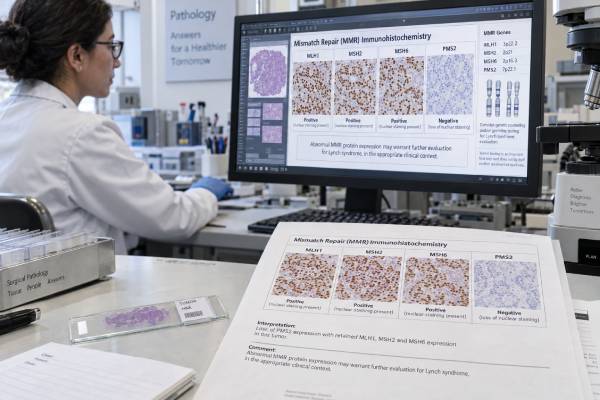
MMR immunohistochemistry evaluates whether the four core proteins are present in tumor-cell nuclei. Normal tissue on the same slide should retain staining and act as an internal control.
| Tumor IHC pattern | Most likely pathway to evaluate | Common next step |
|---|---|---|
| Loss of MLH1 and PMS2 | MLH1 dysfunction | MLH1 promoter methylation; colorectal BRAF triage where appropriate; germline testing if indicated |
| Isolated PMS2 loss | PMS2, sometimes MLH1 | Germline PMS2 evaluation and review for MLH1 variants depending on context |
| Loss of MSH2 and MSH6 | MSH2 or EPCAM-related MSH2 silencing | Germline MSH2/EPCAM evaluation |
| Isolated MSH6 loss | MSH6 dysfunction | Germline MSH6 evaluation |
| All four retained | No protein loss detected | Consider MSI or additional hereditary testing if clinical suspicion remains strong |
These patterns reflect protein pairing. PMS2 often disappears when MLH1 is absent because PMS2 is unstable without its partner. MSH6 often disappears when MSH2 is absent. The reverse is not always true, which is why isolated PMS2 and isolated MSH6 loss can occur.
MLH1 promoter methylation
MLH1/PMS2 loss has a common sporadic explanation: MLH1 promoter hypermethylation. This epigenetic change shuts off MLH1 in the tumor and is frequent in sporadic colorectal and endometrial cancers. In colorectal cancer, BRAF V600E may further support a sporadic MLH1-methylated pathway.
Methylation is not an absolute hereditary exclusion in every patient. Constitutional MLH1 epimutation is rare, and strong clinical features can justify genetics review despite tumor methylation.
IHC and MSI can disagree
Most clearly dMMR colorectal cancers are MSI-H, but discordance occurs. Some MSH6-deficient tumors show lower levels of instability. Missense variants can preserve detectable protein while impairing function. Poor fixation and low tumor content can cause technical error. Clinically important discordance should be investigated rather than ignored.
What Germline Results Mean
Pathogenic or likely pathogenic
A pathogenic or likely pathogenic germline variant in an MMR gene establishes a hereditary predisposition when the classification is clinically validated. The report should state the gene, exact DNA and protein change, and variant classification.
The result guides gene-specific surveillance and enables relatives to have targeted testing for the known familial variant. A positive result does not mean that cancer is present or inevitable; it means risk is high enough to justify enhanced prevention and early detection.
Negative
A negative result can be reassuring or inconclusive depending on context.
If a relative tests negative for a known familial pathogenic variant, that person generally did not inherit that specific Lynch syndrome risk. If an affected patient with dMMR cancer has a negative multigene germline panel, the tumor mechanism may still need clarification.
Possible explanations include double-somatic MMR mutations, promoter methylation, mosaicism, a technically difficult structural variant, or another hereditary syndrome. Negative testing should therefore be interpreted against the original tumor findings and family history.
Variant of uncertain significance
A VUS is a DNA change with insufficient evidence for a benign or pathogenic classification. It does not diagnose Lynch syndrome. Major management changes and predictive family testing should not be based on a VUS alone.
Laboratories can reclassify variants over time. Patients should keep contact information current with the testing laboratory or genetics clinic so important reclassification can be communicated.
Gene-Specific Lynch Syndrome Risk
Lynch syndrome is better understood as several related gene-specific risk states rather than one uniform syndrome.
MLH1
MLH1 carriers generally have relatively high colorectal cancer risk and important endometrial and ovarian cancer risk. Colorectal surveillance usually begins at a younger age than for lower-penetrance genes.
MSH2 and EPCAM
MSH2 carriers also have substantial colorectal and endometrial risk and are particularly associated with urinary-tract and certain sebaceous skin tumors. EPCAM deletions that silence MSH2 can create a similar but tissue-dependent risk pattern.
MSH6
MSH6 carriers tend to have later colorectal cancer onset and lower colorectal penetrance than MLH1 or MSH2 carriers, but endometrial cancer remains a major risk. Surveillance is still substantially more intensive than average-risk population screening.
PMS2
PMS2 is generally the lowest-penetrance of the four major MMR genes for colorectal and endometrial cancer. Cancer often occurs later, and some guidelines use later surveillance starting ages or different risk-reduction recommendations than for MLH1 or MSH2.
These differences matter when planning colonoscopy, gynecologic risk reduction, and screening for other Lynch-spectrum cancers. Family history can modify a gene-based plan, especially when a family shows unusually early disease.
Frequent high-quality colonoscopy is the most established preventive intervention. Gynecologic counseling may include awareness of abnormal bleeding and discussion of risk-reducing hysterectomy with or without salpingo-oophorectomy after childbearing for appropriate carriers. Upper gastrointestinal, urinary-tract, pancreatic, and other surveillance varies by gene, family history, and guideline.
MSI, dMMR, and Cancer Treatment
MMR testing has become a treatment biomarker because dMMR/MSI-H tumors often accumulate many mutations and neoantigens. These features can make the cancer particularly susceptible to immune checkpoint inhibitors.
The effect is established in several cancer types and treatment settings, including colorectal and endometrial cancers. MSI-H/dMMR can also be relevant in gastric, small-bowel, biliary, pancreatic, and other solid tumors depending on stage and current indications.
A critical distinction is that treatment uses the tumor phenotype, while hereditary counseling uses the germline result. A sporadic MLH1-methylated MSI-H cancer can still be immunotherapy-sensitive. A Lynch syndrome carrier can develop a tumor that is not dMMR and therefore should not be assumed to qualify for therapy solely because of the inherited variant.
MMR status can also influence prognosis and adjuvant treatment in localized disease. For example, stage II dMMR colon cancer has distinctive prognostic and fluoropyrimidine-response features. These decisions remain stage-specific and should be made within the complete oncologic context.
Limitations and Next Steps
The most common error is treating every “MMR abnormal” result as a Lynch syndrome diagnosis. Tumor dMMR, germline pathogenic variants, promoter methylation, and somatic mutations are different findings.
A practical review should answer:
- Was the abnormality found in tumor or germline DNA?
- What was the MMR IHC loss pattern?
- Was the tumor MSI-H, MSS, or discordant with IHC?
- If MLH1/PMS2 were lost, was promoter methylation evaluated?
- If germline testing was negative, was double-somatic MMR inactivation considered?
- Did the germline assay include deletion/duplication analysis and technically robust PMS2 testing?
- Was a VUS mistakenly presented as a positive diagnosis?
If Lynch syndrome is confirmed, the next step is not simply more genetic testing. The patient needs a gene-specific surveillance plan, discussion of risk reduction, communication with biological relatives, and cascade testing of adults who wish to know their status.
If the germline panel is negative but the tumor strongly suggests dMMR, molecular pathology and genetics can often clarify the cause. This prevents two opposite errors: missing a hereditary syndrome or unnecessarily labeling a family as having Lynch syndrome when the cancer was caused by somatic events only.
Practical panel interpretation examples
A multigene result is easiest to understand by separating what was found from where it was found. A pathogenic MLH1 variant in germline DNA establishes inherited Lynch syndrome. A pathogenic MLH1 variant found only in tumor DNA does not, because it may be somatic. Loss of MLH1/PMS2 protein on IHC is another layer again: it shows pathway dysfunction but does not identify whether the cause is a germline variant, tumor methylation, or somatic mutation.
The same logic applies to MSH2. Combined MSH2/MSH6 loss points to the MSH2 pathway, but a germline panel must also account for EPCAM deletions. For isolated PMS2 loss, the laboratory method deserves particular attention because PMS2 pseudogenes can complicate testing. A report from a validated hereditary-cancer laboratory should describe how technically ambiguous PMS2 regions were resolved.
What “Lynch-like syndrome” can mean
Some patients have a dMMR/MSI-H tumor strongly suggestive of Lynch syndrome but no pathogenic germline MMR variant. Historically, these cases were sometimes grouped under terms such as “Lynch-like syndrome.” That label should not be treated as a final molecular diagnosis. Modern tumor sequencing often identifies double-somatic MMR alterations that explain at least some of these cases.
Clarifying the mechanism matters because surveillance for the patient may still be influenced by personal history, but predictive testing of relatives depends on finding a heritable variant. When no germline cause is established, relatives should not be told they carry a known familial mutation that has never actually been demonstrated.
Documentation for long-term care
Patients benefit from keeping three separate records: the tumor pathology/IHC report, the MSI or tumor-sequencing report, and the germline genetic report. These documents answer different questions and may be needed years later when surveillance guidelines change, another cancer develops, or a relative requests testing. A one-line chart problem such as “Lynch syndrome?” is not an adequate substitute for the original evidence.
For families, the most actionable result is a clearly classified germline pathogenic variant. Once that is known, relatives can be tested efficiently and do not need to recreate the original patient’s entire tumor workup. Conversely, when no germline cause is established, relatives should be counseled from the documented family history rather than from an uncertain tumor label alone.
References
- The guidelines for clinical practice for carriers of germline mutations in the Lynch syndrome predisposition genes MLH1, MSH2, MSH6, PMS2 and large deletions of EPCAM (4.2024) 2024 (Guideline)
- Cancer risks in Lynch syndrome carriers: a systematic review and meta-analysis 2026 (Systematic Review)
- Lynch Syndrome-Impact of the Type of Deficient Mismatch Repair Gene Mutation on Diagnosis, Clinical Presentation, Surveillance and Therapeutic Approaches 2025 (Review)
- Lynch Syndrome as a Spectrum of Four Distinct Genetic Disorders: Toward Genotype-Guided Precision Management in the NGS Era 2026 (Review)
- Mismatch Repair and Microsatellite Instability Testing for Immune Checkpoint Inhibitor Therapy: Guideline From the College of American Pathologists in Collaboration With the Association for Molecular Pathology and Fight Colorectal Cancer 2022 (Guideline)
- Challenges and opportunities for Lynch syndrome cascade testing in the United States 2024 (Review)
Disclaimer
MMR tumor testing and germline genetic testing answer different questions and should be interpreted with pathology, personal and family history, and current gene-specific guidelines. This article is educational and does not replace genetic counseling, cancer surveillance planning, or treatment advice from qualified clinicians.