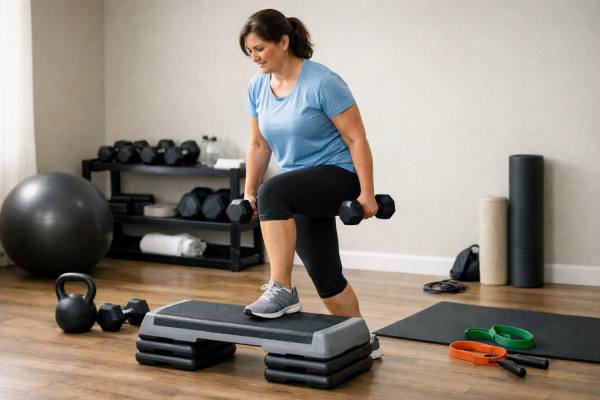
Circuit training can be excellent for weight loss when it is built around full-body movements, the right work-to-rest balance, and a schedule you can repeat consistently. It blends strength and cardio into the same session, which makes it time-efficient and useful for people who want to burn calories, improve fitness, and hold on to muscle while losing fat.
The best circuit workouts are not random exercise mashups. They are structured around movement patterns, effort, recovery, and progression. This article explains how circuit training helps with fat loss, which full-body exercises work best, how to build a circuit that fits your level, and how often to do it without burning out.
Table of Contents
- What circuit training is and why it works
- Can circuit training really help you lose fat?
- Best full-body exercises for fat-loss circuits
- How to structure a circuit for weight loss
- Sample full-body circuit workouts
- How often to do circuit training
- Common mistakes, safety, and results
What circuit training is and why it works
Circuit training means moving through a sequence of exercises with limited rest between them. Instead of doing one movement for all your sets before resting for long periods, you rotate from exercise to exercise, then repeat the full round for multiple cycles.
A classic fat-loss circuit might include a squat, a push, a hinge, a row, and a conditioning move. That structure keeps more muscle groups working across the session, which raises heart rate, shortens downtime, and makes the workout feel more athletic and efficient than traditional straight-set training.
That does not mean circuit training is automatically better than every other workout style. It means it is especially good at solving a common real-world problem: people want a workout that improves fitness, burns meaningful calories, and fits into a busy schedule.
The reason circuit training works well for fat loss comes down to a few overlapping effects:
- It increases training density by packing more work into less time.
- It combines resistance exercise and cardio demand in the same session.
- It uses large muscle groups, which usually means a higher total energy cost.
- It can help preserve lean mass better than cardio-only approaches.
- It is easy to scale up or down based on fitness level, equipment, and joint tolerance.
Another advantage is that full-body circuits can improve more than one quality at the same time. A well-built session can train muscular endurance, basic strength, work capacity, coordination, and cardiovascular fitness without needing separate one-hour blocks for each. That is one reason they often appeal to beginners and people returning to exercise after a long break.
Still, not every circuit is effective. Randomly pairing ten exercises with no plan can turn into a messy sweat session that feels hard but does not progress well. Good circuits prioritize movement quality, exercise order, and enough challenge to create adaptation. In practice, the most effective fat-loss circuits usually center on big, efficient patterns such as squats, hinges, presses, rows, carries, and fast locomotion. That is why the best plans overlap heavily with good compound exercise selection.
Can circuit training really help you lose fat?
Yes, but not because it is a magic format. Circuit training helps with fat loss for the same reason any solid exercise program helps: it can raise total energy expenditure, improve fitness, support muscle retention, and make it easier to stay consistent long enough to see results.
The part many people miss is that exercise rarely causes major fat loss on its own unless food intake also supports the goal. Circuit training can absolutely move the needle, but it works best when it is part of a broader plan that includes a sustainable calorie deficit.
Full-body circuits are especially useful when time is limited. A 25- to 40-minute session can feel like both strength training and cardio, which is appealing if you do not want separate workouts for each. For many people, that improves adherence. And adherence matters more than finding the single hardest workout on paper.
Circuit training also offers a useful middle ground between pure lifting and pure cardio:
- Compared with steady-state cardio, it usually provides more muscle stimulus.
- Compared with traditional heavy lifting, it usually keeps heart rate higher.
- Compared with high-intensity interval training only, it can feel more balanced and sustainable.
This matters during weight loss because the goal is not just to make the scale drop. The better goal is to lose fat while keeping as much strength and lean tissue as possible. If you lose weight quickly but become weaker, flatter, and less active, the process tends to be harder to maintain.
Circuit training can also help reduce the all-or-nothing mindset. People often assume they need a long gym session to make progress. In reality, a focused 30-minute circuit done three times per week often beats an ambitious five-day plan that never gets off the ground.
That said, circuit training is not immune to common problems. Some people overestimate calories burned. Others use weights that are too light, rest too long, or choose flashy exercises they cannot do well. And some unconsciously eat more after training, which reduces the deficit. That behavioral effect is one reason exercise compensation can slow progress even when workouts feel productive.
The bottom line is practical: circuit training can be an excellent fat-loss tool, especially for busy people who want efficient full-body sessions. It just works best when expectations are realistic and the plan supports total weekly activity, recovery, and nutrition.
Best full-body exercises for fat-loss circuits
The best exercises for circuit training are usually the ones that train a lot of muscle at once, are easy to perform safely under mild fatigue, and can be adjusted for different fitness levels. That is why simple full-body patterns beat novelty most of the time.
A good circuit does not need dozens of moves. It needs the right categories.
| Movement category | Examples | Why it matters |
|---|---|---|
| Squat | Goblet squat, bodyweight squat, split squat, step-up | Trains legs, raises heart rate, builds lower-body strength |
| Hinge | Romanian deadlift, kettlebell deadlift, hip hinge, glute bridge | Targets glutes and hamstrings and balances squat-heavy plans |
| Push | Push-up, incline push-up, dumbbell press, overhead press | Builds chest, shoulders, and triceps while adding upper-body demand |
| Pull | Dumbbell row, band row, cable row, suspension row | Supports posture and rounds out upper-body training |
| Carry or core stability | Farmer carry, suitcase carry, plank, dead bug | Improves trunk control and makes circuits feel more athletic |
| Conditioning finisher | Bike sprint, fast march, jump rope, mountain climber, sled push | Adds metabolic demand without needing a separate cardio session |
When choosing exercises, think less about “fat-burning moves” and more about efficiency. Big movement patterns tend to be more productive than isolated exercises such as triceps kickbacks or front raises. There is nothing wrong with those exercises, but they are usually not the best use of limited circuit time.
For beginners, the best circuit exercises are often the least fancy ones:
- squats to a box or bench
- step-ups
- incline push-ups
- one-arm dumbbell rows
- glute bridges
- loaded carries
- brisk walking intervals on a treadmill or bike
For intermediate trainees, you can push intensity with more load, more range of motion, or slightly more technical exercises such as reverse lunges, kettlebell swings, dumbbell thrusters, or renegade rows, as long as form stays solid.
One useful rule is to avoid stacking too many highly technical moves in the same circuit. If you are breathing hard and moving fast, it is better to choose safe, repeatable exercises than complex lifts that break down when fatigue rises. That is also where progressive overload while losing weight becomes important. The goal is not just to survive the session. It is to keep making the work slightly harder over time by using more load, more reps, better pacing, or stronger movement quality.
How to structure a circuit for weight loss
Good circuit design is what separates effective fat-loss training from random sweating. Most full-body circuits work best when they include four to six exercises, use mostly noncompeting movement patterns, and keep rest short enough to maintain pace without turning the session into sloppy chaos.
A practical full-body circuit often follows this order:
- Lower-body compound move
- Upper-body push
- Lower-body hinge or single-leg move
- Upper-body pull
- Core or carry
- Optional conditioning finisher
This sequence spreads fatigue more intelligently than doing three leg-heavy moves back to back. It also lets you maintain better output across the whole round.
There are several ways to dose the work:
- Time-based circuits: 30 to 45 seconds of work, then 15 to 30 seconds to transition.
- Rep-based circuits: 8 to 15 reps per exercise, then move on.
- Distance-based circuits: useful for carries, sled pushes, rowing, or walking.
- Hybrid circuits: strength reps first, then a timed conditioning block at the end.
For most weight-loss circuits, moderate loads and moderate-to-hard effort work better than going extremely heavy. You want enough resistance to challenge muscle, but not so much that every station needs long rest or spotter-level concentration.
A good starting point for many people looks like this:
| Element | Beginner target | Intermediate target |
|---|---|---|
| Exercises per round | 4 to 5 | 5 to 6 |
| Work interval | 30 to 40 seconds | 40 to 50 seconds |
| Transition or rest | 20 to 30 seconds | 10 to 20 seconds |
| Total rounds | 2 to 3 | 3 to 5 |
| Total session length | 20 to 30 minutes | 25 to 40 minutes |
Do not skip the warm-up just because the session is short. Circuit training raises heart rate quickly, so joints and tissues need a brief ramp-up. A few minutes of easy cardio, bodyweight squats, hip hinges, arm circles, and rehearsal reps can make the whole workout smoother. A basic warm-up and recovery routine is enough.
It also helps to match session length to training quality. Many people assume longer is always better, but once pace drops and rest periods stretch, the “circuit” becomes less efficient. That is why understanding how long workouts should be can improve results. A crisp 28-minute circuit can be far more productive than a dragged-out 60-minute session with too much downtime.
Sample full-body circuit workouts
The best circuit workout is the one that fits your level, equipment, and joints. Below are three practical full-body options you can use as templates.
Beginner bodyweight circuit
Use 30 seconds of work and 20 to 30 seconds to transition. Complete 2 to 4 rounds.
- Squat to chair
- Incline push-up on bench, table, or wall
- Glute bridge
- March in place or fast step-ups
- Bird dog or dead bug
- Brisk walk for 2 minutes after the last round if you want extra movement
This is a good starting place for someone who is deconditioned, coming back after time off, or not ready for impact. It can also work as a foundation before progressing to a fuller bodyweight workout plan.
Dumbbell full-body circuit
Use 8 to 12 reps per strength movement. Rest 15 to 30 seconds between stations and 60 to 90 seconds between rounds. Complete 3 to 4 rounds.
- Goblet squat
- One-arm dumbbell row
- Romanian deadlift
- Dumbbell floor press or bench press
- Reverse lunge
- Farmer carry for 30 to 45 seconds
This circuit has excellent coverage: quads, glutes, hamstrings, chest, back, core, and grip all get useful work. It is also easy to progress by adding load or a round. If you like this format, it pairs naturally with a more detailed full-body dumbbell workout on days when you want a longer session.
Gym circuit with cardio finisher
Use 40 seconds of work and 20 seconds to transition. Complete 3 to 5 rounds.
- Leg press or goblet squat
- Cable row
- Dumbbell overhead press
- Kettlebell deadlift
- Walking lunges or step-ups
- Bike or rower hard effort
This version suits people who want that classic “strength plus conditioning” feel. The final cardio station should be challenging, but not so hard that the whole circuit falls apart in round two.
A few practical notes make all three circuits better:
- Stop each set with good form still intact.
- Keep exercise setup simple.
- Record your weights, reps, or rounds.
- Add difficulty gradually, not randomly.
- Keep at least one easy rep in reserve on most strength stations if you are a beginner.
Circuit training should feel purposeful, not frantic. When workouts are too rushed, movement quality drops and the session becomes more about surviving than progressing.
How often to do circuit training
For most people trying to lose fat, two to four circuit sessions per week is the sweet spot. The right number depends on your current fitness, how hard the circuits are, how much other cardio or step work you do, and how well you recover.
A beginner usually does well with 2 to 3 sessions per week on nonconsecutive days. That is enough to build the habit, improve conditioning, and recover properly. An intermediate trainee may do well with 3 to 4 sessions per week, especially if not every circuit is maximal effort.
A simple weekly approach might look like this:
- Monday: full-body circuit
- Tuesday: walking or low-intensity cardio
- Wednesday: full-body circuit
- Thursday: rest or easy steps
- Friday: full-body circuit
- Saturday: optional longer walk, bike, or sport
- Sunday: rest
That setup works because circuit training is demanding. It may not look like traditional heavy lifting, but it still creates muscular and cardiovascular fatigue. If every session leaves you drained for two days, frequency is too high or effort is too aggressive.
Weekly planning matters more than any single session. A well-balanced routine often combines circuit training with walking, general activity, and at least some lower-stress movement. This is where questions like how many days a week to work out become useful. The best answer is rarely “as many as possible.” It is the highest frequency you can recover from and maintain.
Rest is also part of the fat-loss plan, not a sign of weakness. Too little recovery can reduce workout quality, increase soreness, and make consistency harder. Knowing how to use rest days per week properly helps circuit training stay productive instead of becoming another all-or-nothing cycle.
As a general rule:
- Do circuits hard enough to matter.
- Leave enough recovery to repeat them well.
- Increase volume only after consistency is established.
That usually leads to better fat-loss results than cramming five punishing circuits into one week and then needing four days to recover.
Common mistakes, safety, and results
Circuit training has a lot going for it, but it is easy to misuse. The most common mistake is confusing exhaustion with effectiveness. A workout that leaves you flat on the floor is not automatically better than one that lets you improve performance week after week.
Another major mistake is choosing weights that are too light. If you can breeze through every station without muscular challenge, you may get a cardio effect but miss much of the muscle-preserving benefit. On the other hand, going too heavy can force long rest breaks and wreck the flow of the session. The goal is the middle ground: enough resistance to challenge you, enough movement quality to keep the workout safe.
Common pitfalls include:
- turning every circuit into a max-effort test
- doing too many jumping or high-impact exercises too soon
- using complicated lifts under fatigue
- resting so long that density disappears
- copying advanced online workouts without the base fitness to match
- assuming sweat equals fat loss
- eating back the calories you think you burned
The last point matters more than people expect. Circuit training can help create a calorie deficit, but exercise devices and trackers often overestimate calorie burn. That is one reason overestimating exercise calories can quietly stall progress.
Nutrition also affects how well circuits work. If protein is too low, recovery and muscle retention may suffer. You do not need bodybuilder eating habits, but you do need enough daily intake to support training quality and preserve lean mass. That becomes especially important when body weight is dropping.
As for safety, circuit training is not automatically unsafe, but it deserves the same respect as any other training. Start below your maximum, especially if you have been sedentary, have joint pain, or have medical issues that affect exercise tolerance. Brisk walking, controlled bodyweight movements, and light dumbbell circuits are often smarter starting points than burpees, jump squats, and all-out intervals.
Realistic expectations help too. Circuit training can improve fitness quickly and support visible fat loss over time, but it is not a shortcut around fundamentals. Expect gradual progress, not instant transformation. A solid result looks like better stamina, stronger lifts, improved body composition, and steady fat loss over months rather than a dramatic one-week drop.
References
- Weight loss effects of circuit training interventions: A systematic review and meta‐analysis 2019 (Systematic Review and Meta-Analysis)
- Exercise training in the management of overweight and obesity in adults: Synthesis of the evidence and recommendations from the European Association for the Study of Obesity Physical Activity Working Group 2021 (Review and Recommendations)
- Resistance training effectiveness on body composition and body weight outcomes in individuals with overweight and obesity across the lifespan: A systematic review and meta-analysis 2022 (Systematic Review and Meta-Analysis)
- Aerobic Exercise and Weight Loss in Adults: A Systematic Review and Dose-Response Meta-Analysis 2024 (Systematic Review and Meta-Analysis)
- Adult Activity: An Overview | Physical Activity Basics | CDC 2023 (Official Guidance)
Disclaimer
This article is for general educational purposes only and is not a substitute for medical advice, diagnosis, or treatment. If you have heart disease, uncontrolled blood pressure, major joint pain, recent surgery, or any condition that makes exercise safety uncertain, speak with a qualified clinician before starting circuit training.
If this article helped, share it on Facebook, X, or any other platform where it may help someone build a smarter fat-loss routine.