A pair of dumbbells can do more for weight loss than many people expect. They do not just “tone” muscles or add a little resistance to squats. Used well, they let you train your legs, back, chest, shoulders, and core in one session, raise your heart rate, and keep valuable lean mass while you lose fat. That is a strong combination, especially if you want home workouts that feel efficient rather than random.
This guide breaks the topic into the parts that matter most: why dumbbell training helps with fat loss, how to set up a safe and practical home routine, which exercises deserve a place in a full-body plan, and how to progress without making workouts longer and harder every week. You will also get a complete program you can repeat, adjust, and fit around busy days, limited equipment, or beginner-level fitness.
Table of Contents
- Why dumbbells work for fat loss
- Set up your home workout space
- Best dumbbell exercises to build around
- The full-body dumbbell program
- Progression, scheduling and recovery
- Make the workouts work for weight loss
Why dumbbells work for fat loss
A dumbbell workout supports fat loss in a practical way: it helps you burn energy during the session, keeps or builds muscle while dieting, and improves how much quality work you can do each week. That last part is easy to overlook. For most people, the best workout is not the most dramatic one. It is the one they can recover from, repeat, and fit into normal life.
Dumbbells are useful because they create enough resistance to challenge major muscle groups without requiring a barbell, rack, or large training space. At home, that matters. You can train the lower body with squats, split squats, deadlift patterns, and carries. You can train the upper body with rows, presses, and floor work. In one session, you can cover nearly every movement pattern that matters for a beginner or intermediate lifter.
That makes dumbbells especially helpful during a calorie deficit. When people lose weight without enough resistance training, they often lose some lean mass along with body fat. A better plan is to keep lifting while controlling food intake. This is why so many effective fat-loss plans include strength work, even when scale loss is the main goal. A broader beginner strength training plan follows the same idea: preserve muscle, improve performance, and make the weight you lose more likely to come from fat.
Another advantage is flexibility. Dumbbell training works across several styles:
- Straight sets with longer rest for strength and muscle retention
- Circuits for density and time efficiency
- Supersets that pair upper- and lower-body exercises
- Hybrid sessions that mix lifting with short cardio intervals
That means you can adjust the feel of the workout without changing the basic equipment. You can also scale the challenge by changing one variable at a time:
- Increase the weight.
- Add reps.
- Slow the lowering phase.
- Reduce rest slightly.
- Add an extra set only when needed.
A good dumbbell plan also gives you better markers of progress than the scale alone. Stronger rows, steadier split squats, and more total reps at the same load usually signal that your body is adapting well, even if body weight moves slowly. That is one reason many people see better results when they think in terms of body recomposition and non-scale progress rather than treating the scale as the only useful metric.
Dumbbells do have limits. If your weights are very light, some lower-body work may become too easy over time. But for many home exercisers, especially beginners and intermediates, one or two pairs of dumbbells are enough to build a serious full-body routine that supports long-term fat loss.
Set up your home workout space
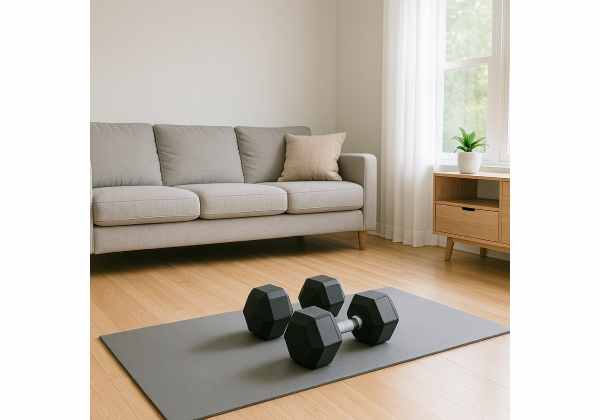
A home dumbbell workout gets much easier to stick with when the setup is simple. You do not need a dedicated gym room. You need enough space to hinge, squat, step back into a lunge, and lie on the floor comfortably. For most people, a clear area roughly the size of a yoga mat plus a little extra room is enough.
Start with the basics:
- One or two pairs of dumbbells, or adjustable dumbbells
- Flat, stable floor space
- Athletic shoes or grippy training shoes if you prefer footwear
- A timer
- Optional bench, sturdy chair, or step for support and variations
If you are buying dumbbells for weight loss workouts at home, adjustable sets are often the best long-term choice because they let you progress without filling a corner of the house with equipment. Fixed dumbbells still work well if you already own them, but most people benefit from at least one lighter pair for shoulder work and one heavier pair for squats, rows, and deadlifts.
Weight selection does not need to be perfect on day one. A useful rule is that your last two or three reps should feel challenging while still looking controlled. If every rep feels easy and fast, the load is too light. If you cannot maintain range of motion or good balance, it is too heavy.
Before each session, take three minutes to prepare the area. That sounds trivial, but it removes excuses and reduces awkward interruptions. Put the weights where you can reach them, silence your phone, and decide your exercise order before you begin. That small amount of structure makes home training feel much more deliberate.
Warm-ups matter too, especially when you are training in a cold room first thing in the morning or after a long workday at a desk. A short sequence is enough:
- March in place for 30 to 60 seconds.
- Do bodyweight squats for 8 to 10 reps.
- Hinge at the hips for 8 to 10 reps.
- Add arm circles and shoulder rolls.
- Practice one light set of your first two exercises.
A more detailed plan for warm-up, mobility, and recovery can help if you tend to feel stiff, rushed, or sore between sessions.
Safety at home is mostly about self-control. Do not rush technical movements to make the workout feel “hardcore.” Do not set weights down where you will step on them during the next exercise. And do not assume every session has to leave you exhausted to count. Good home training feels organized, not frantic.
Lastly, plan recovery as part of the setup rather than as an afterthought. If you want to lift three or four times per week, you need room for your body to adapt. That could mean alternating harder and easier days, walking on off days, or simply honoring your rest-day structure instead of treating rest like failure.
A smart setup does not look glamorous, but it makes consistency much more likely.
Best dumbbell exercises to build around
The best full-body dumbbell workout is built around a small group of repeatable exercises, not a giant menu of random moves. You want patterns that cover the lower body, upper body push and pull, and trunk stability while staying safe and practical at home.
A strong full-body exercise pool includes the following.
Squat pattern
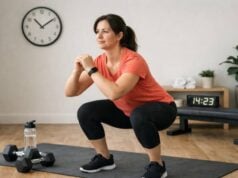
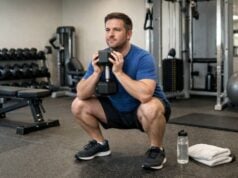
Goblet squat is usually the best starting point. Holding one dumbbell at chest level helps many people stay more upright and learn depth. It trains the quads, glutes, and trunk at the same time.
Other useful options:
- Dumbbell front squat with two weights
- Box squat to a chair
- Split squat for people who struggle with deep bilateral squats
Hip hinge pattern
Dumbbell Romanian deadlift is one of the most valuable home exercises for weight loss and muscle retention. It trains the glutes, hamstrings, and back without requiring huge loads. The key is pushing the hips back and keeping the weights close to the body.
Other options:
- Dumbbell deadlift from the floor if your mobility allows it
- Staggered-stance Romanian deadlift
- Hip bridge with a dumbbell on the lap
Single-leg work
Reverse lunge and split squat deserve a regular place in the program because they raise effort quickly, improve balance, and challenge the legs with moderate loads. This is often where home workouts become effective even without very heavy dumbbells. If your main focus is lower-body training, a more targeted look at glute and leg workouts for fat loss can help you expand this category.
Upper-body pull
One-arm dumbbell row is the backbone of home upper-body pulling. It trains the upper back and lats, supports posture, and balances pressing volume. A chest-supported variation using a bench or incline can work too, but a simple hand-on-chair setup is enough.
Upper-body push
At home, dumbbell floor press is often more practical than a bench press. It trains the chest, shoulders, and triceps with a stable setup and reduced shoulder strain for many lifters. For vertical pushing, the standing overhead press is a strong choice if you can control rib position and avoid leaning back excessively.
Core and carry work
The core does not need endless crunches. For fat-loss training, it responds well to exercises that resist movement while the limbs work. Good choices include:
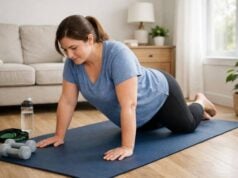
- Plank variations
- Dead bugs
- Suitcase carry
- Farmer carry
This is one reason core training during fat loss is better framed as stability and strength work rather than spot reduction.
A good exercise menu does not have to be large. In fact, smaller is often better. Repeating the same key exercises for several weeks lets you track progress and improve technique. Variety matters far less than people think. The real value comes from doing the right movements often enough, with enough quality, to force adaptation.
The full-body dumbbell program
Here is a practical full-body dumbbell workout for weight loss at home. It is designed for three sessions per week on nonconsecutive days, such as Monday, Wednesday, and Friday. Each workout should take about 35 to 50 minutes depending on rest periods and how much setup you need.
Use a load that leaves you with about 1 to 3 reps in reserve on most sets. That means you finish the set knowing you could have done a little more, but not much more.
Workout A
- Goblet squat — 3 sets of 8 to 12
- One-arm dumbbell row — 3 sets of 10 to 12 each side
- Dumbbell Romanian deadlift — 3 sets of 8 to 12
- Dumbbell floor press — 3 sets of 8 to 12
- Reverse lunge — 2 to 3 sets of 8 to 10 each side
- Suitcase carry — 3 rounds of 20 to 40 seconds each side
Rest about 60 to 90 seconds between sets on the main lifts and 45 to 60 seconds on carries if needed.
Workout B
- Dumbbell deadlift or squat variation — 3 sets of 8 to 10
- Standing dumbbell overhead press — 3 sets of 8 to 10
- Split squat — 3 sets of 8 to 10 each side
- Two-dumbbell bent-over row — 3 sets of 10 to 12
- Dumbbell hip bridge — 3 sets of 12 to 15
- Dead bug or plank — 2 to 3 sets
Workout C
- Goblet squat or front squat — 3 sets of 10
- One-arm row — 3 sets of 10 each side
- Romanian deadlift — 3 sets of 10
- Floor press or push press — 3 sets of 8 to 10
- Step-up or reverse lunge — 2 to 3 sets of 10 each side
- Farmer carry — 3 rounds
If you only train twice per week, alternate Workout A and Workout B, then continue the rotation next week. If you want a denser, more conditioning-focused feel, pair movements into supersets:
- Squat with row
- Hinge with press
- Lunge with carry or trunk work
That format keeps the heart rate up without turning strength work into rushed cardio.
For beginners, two sets on the first week is enough. Learn the movements, control the tempo, and stop sets before form falls apart. For intermediates, three working sets on most lifts is a solid default. More is not always better at home, especially if recovery, sleep, and food intake are not yet dialed in.
You can also add a 5- to 10-minute finisher if time allows:
- brisk step-ups
- marching with dumbbells
- light carries
- short intervals on a bike or treadmill
If your schedule is tighter, you may be better off pairing this program with ideas from 30-minute workout templates rather than forcing every dumbbell session to do everything at once. And if you need an even lighter equipment option on some days, a resistance band workout can fill the gap without disrupting the week.
The goal of the program is simple: full-body strength work you can repeat long enough to matter.
Progression, scheduling and recovery
A home dumbbell plan works only if it keeps moving forward. Progress does not require constant exercise changes. In fact, frequent exercise swapping is one of the easiest ways to stall. The better approach is to keep the main lifts in place and progress them slowly.
Use a rep-range method. If your target is 8 to 12 reps, stay with the same weight until you can complete all planned sets at the top end of the range with good form. Then increase the load slightly and start again near the lower end of the range.
For example:
- Week 1: goblet squat, 3 sets of 8
- Week 2: 10, 9, 8
- Week 3: 12, 10, 9
- Week 4: 12, 12, 11
- Week 5: increase weight and return to 8 or 9 reps
This keeps progress objective without making the program complicated. When dumbbells are too light to progress with weight alone, you still have useful options:
- Add a pause at the bottom of squats.
- Slow the lowering phase to 3 seconds.
- Increase range of motion.
- Reduce rest slightly.
- Add one extra set for the main movement only.
Scheduling matters too. Most home exercisers do well with one of these layouts:
- Three-day plan: Monday, Wednesday, Friday
- Two-day plan: Tuesday and Saturday or any two nonconsecutive days
- Four-day split for experienced lifters: two harder sessions and two shorter accessory or conditioning sessions
You do not need to train daily for the plan to work. You need enough weekly quality to create a reason for your body to adapt. For many people, a helpful benchmark is combining strength training with enough total weekly movement to meet the broader target in exercise recommendations for weight loss.
Recovery is where many home programs quietly fail. Watch for these signs that you are pushing too hard:
- performance drops across several sessions
- sleep gets worse
- joint irritation builds
- motivation crashes
- every workout feels like a test instead of training
If that happens, keep the schedule but reduce effort for one week. Use lighter weights, fewer sets, or slower pacing. That is not lost time. It is often what lets progress resume.
Finally, remember that lifting days are only part of the week. Walking between sessions helps with recovery and increases total energy expenditure without adding much stress. That is why many people pair dumbbell work with a consistent walking routine instead of adding endless high-intensity sessions.
Progress should feel steady, not desperate.
Make the workouts work for weight loss
A dumbbell workout can be excellent for weight loss, but it works best inside a wider routine. Lifting alone rarely creates large fat loss unless your eating pattern, daily movement, and recovery are at least reasonably aligned.
Start with the calorie picture. You do not need a perfect diet, but you do need some form of energy deficit over time. That can come from portion control, better food quality, structured meal timing, or tracking for a period. A simple guide to creating a calorie deficit that feels sustainable is often more useful than trying to “out-train” inconsistent eating.
Protein matters especially when you are using strength training to lose weight. It supports recovery, helps preserve lean mass, and usually makes meals more filling. For many adults, spreading protein across three or four meals works better than trying to cram most of it into dinner. If you want practical intake targets, protein guidance for weight loss can help you set them more precisely.
Daily movement outside workouts matters too. A 40-minute dumbbell session is valuable, but it does not erase an otherwise motionless day. Try to make the rest of the day slightly more active:
- take a short walk after meals
- use stairs when practical
- stand up between long work blocks
- add a few five-minute movement breaks
These habits help close the gap between “I exercise” and “I live actively.” That gap is often where results are won or lost.
A few common mistakes can make home dumbbell workouts feel ineffective:
- Using weights that are too light forever
The session feels busy but stops being challenging. - Turning every set into cardio
You rush so much that reps become sloppy and the main muscles never get enough tension. - Changing the routine every week
You lose any clear way to measure progress. - Expecting spot reduction
Leg exercises do not specifically remove thigh fat, and core work does not directly burn belly fat. - Ignoring recovery and hunger
Poor sleep, low protein intake, and frequent overeating can hide the effect of a solid training plan.
A good weekly fat-loss routine might look like this:
- 3 full-body dumbbell workouts
- 2 to 4 walking sessions
- consistent protein intake
- mostly minimally processed meals
- sleep that is regular enough to support training
That is not flashy, but it is powerful because it is repeatable. Home dumbbell training becomes effective when it is treated like a long-term system rather than a short burst of motivation. The exercises matter. The structure matters. But the outcome usually depends on whether the whole week supports the goal.
References
- WHO guidelines on physical activity and sedentary behaviour 2020 (Guideline)
- Effect of exercise training on weight loss, body composition changes, and weight maintenance in adults with overweight or obesity: An overview of 12 systematic reviews and 149 studies 2021 (Review)
- Resistance training effectiveness on body composition and body weight outcomes in individuals with overweight and obesity across the lifespan: A systematic review and meta-analysis 2022 (Systematic Review)
- The Effect of Resistance Training in Healthy Adults on Body Fat Percentage, Fat Mass and Visceral Fat: A Systematic Review and Meta-Analysis 2022 (Systematic Review)
- Aerobic Exercise and Weight Loss in Adults: A Systematic Review and Dose-Response Meta-Analysis 2024 (Systematic Review)
Disclaimer
This article is for general educational purposes only and is not a substitute for medical advice, diagnosis, or treatment. Check with a qualified clinician before starting a home dumbbell program if you have heart, joint, balance, or metabolic concerns, or if you are pregnant, postpartum, or returning after an injury.
If this article was helpful, please share it on Facebook, X, or any other platform you prefer.