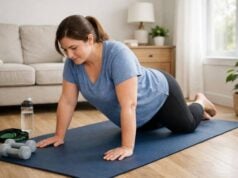
Some days you have a full hour for training. Many days, you do not. That is where a well-built 30-minute workout can be unusually powerful. Short sessions lower the barrier to starting, fit around work and family, and still give you enough time to lift, push your heart rate up, and finish feeling like you actually trained. For weight loss, that matters. The best routine is rarely the most extreme one. It is the one you can repeat often enough to create real weekly results.
This guide explains how 30-minute fat-burning workouts actually support fat loss, how to structure them so they do more than just make you sweat, and how to choose a template that matches your fitness level, schedule, and equipment. You will also see how to progress these workouts without making them longer, and how to combine them with steps, food choices, and recovery so your effort translates into visible progress.
Table of Contents
- Why 30 minutes can work
- The best 30-minute workout structure
- Five busy-day workout templates
- Choose the right template for you
- Progress without making workouts longer
- Make short workouts drive fat loss
Why 30 minutes can work
A 30-minute workout is not effective because the number itself is special. It works because it is long enough to create a useful training dose and short enough to repeat on real-life schedules. That combination is what makes it so valuable for fat loss.
The phrase “fat-burning workout” can be misleading if you take it too literally. No single session melts fat from one area, and the sweatiest workout is not automatically the best one. Fat loss happens when your body is in a calorie deficit over time. Exercise helps by increasing energy expenditure, improving fitness, protecting lean mass, and making it easier to stay consistent with healthy habits. A good 30-minute session supports all four.
The time math matters too. Five 30-minute workouts per week gets you to 150 minutes of activity, which lines up with widely used exercise targets for adults. That is why short sessions are not a compromise by default. In many cases, they are the most realistic way to build enough weekly volume to matter. If you want a broader look at how much exercise is usually needed for weight loss, the weekly picture is more useful than obsessing over one perfect workout.
Short workouts also reduce friction. You can do one before work, on a lunch break, or after dinner without turning the whole day into a logistics problem. That tends to improve adherence, and adherence is the part of training that actually changes body composition.
What makes a 30-minute workout worth doing?
- It uses large muscle groups.
- It limits dead time.
- It matches effort to your fitness level.
- It includes either meaningful strength work, purposeful cardio, or both.
- It leaves you recovered enough to come back again.
That last point is easy to miss. A workout that destroys you once is less useful than a workout you can do four times next week. Many people lose progress by treating every short session like a punishment. In reality, the most effective approach is usually a mix of strength circuits, brisk cardio, interval work, and walking. If you want a fuller breakdown of which exercises tend to work best for weight loss, the answer is almost always a blend rather than a single mode.
The best 30-minute workout is not the one that looks toughest on paper. It is the one that helps you build a better week.
The best 30-minute workout structure
A strong 30-minute session usually follows a simple formula: warm up, do the main work, then finish with a short cooldown or finisher. That sounds basic, but it keeps the session focused and stops you from wasting the first ten minutes deciding what to do.
A practical structure looks like this:
- Warm-up: 4 to 5 minutes
Use movements that raise body temperature, loosen stiff joints, and rehearse the patterns you are about to train. Think marching, bodyweight squats to a chair, hip hinges, arm circles, easy step-ups, or light rowing. - Main work: 20 to 22 minutes
This is the core of the session. Depending on the day, it might be a strength circuit, intervals on a bike or treadmill, or a hybrid that alternates lifting with cardio bursts. - Cooldown or finisher: 3 to 5 minutes
Use this time to walk, breathe, stretch lightly, or finish with one simple movement such as loaded carries, easy cycling, or incline walking.
The goal is density, not chaos. You want to fit a lot of useful work into a short window without rushing so much that form falls apart.
Here are the rules that make the format work:
- Start with simple movements. Complex lifts and long setups eat too much time in short sessions.
- Prioritize compound exercises. Squats, hinges, rows, presses, lunges, carries, step-ups, and brisk locomotion give you more return per minute.
- Control rest on purpose. For fat loss, rest periods matter because they shape the pace of the session. Too much rest turns a 30-minute workout into a 15-minute workout.
- Keep intensity honest. Moderate work should feel like you could still speak in short sentences. Hard intervals should feel hard, not reckless.
A useful way to judge effort is RPE, or rate of perceived exertion:
- RPE 5 to 6: easy to moderate
- RPE 7 to 8: challenging but repeatable
- RPE 8 to 9: hard interval effort
- RPE 10: all-out, which is rarely necessary for routine fat-loss training
Most people do best when the majority of sessions sit around RPE 6 to 8, with only small portions pushing harder. That keeps training productive without turning recovery into the limiting factor.
If you are new to exercise or coming back after time off, use longer rest and simpler work-to-rest ratios, such as 30 seconds of work and 30 to 60 seconds of recovery. If you are more experienced, you can tighten rest, add load, or build denser circuits. Good preparation helps here, and a dedicated plan for warm-up, mobility, and recovery can make short workouts feel much better. The same goes for understanding the trade-offs between HIIT and steady-state cardio instead of assuming one is always superior.
Structure is what turns “I exercised for 30 minutes” into “I trained with a purpose for 30 minutes.”
Five busy-day workout templates
You do not need endless variety. You need a handful of templates you can run with minimal thought. These five cover most busy-day situations.
1. Bodyweight circuit for home
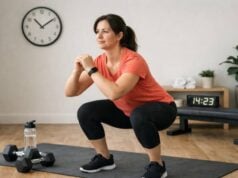
This is the best option when you have no equipment and almost no transition time.
- Warm up for 5 minutes with marching, squat-to-chair, hip hinges, shoulder rolls, and easy lunges.
- Then do 3 to 4 rounds of:
- Bodyweight squat: 40 seconds
- Incline push-up on a bench, table, or wall: 40 seconds
- Reverse lunge or split squat: 40 seconds
- Fast march or high-knee march: 40 seconds
- Plank hold or shoulder taps: 30 to 40 seconds
- Rest 20 seconds between exercises and 60 seconds between rounds.
- Finish with 2 to 3 minutes of easy walking and breathing.
This works well because it hits legs, upper body, trunk, and heart rate without setup time. If you want more ideas in this style, a bodyweight workout without equipment pairs well with this template.
2. Dumbbell full-body density workout
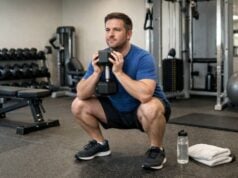
This template is excellent when your main goal is fat loss without sacrificing muscle.
- Warm up for 4 to 5 minutes.
- Set a timer for 20 minutes.
- Rotate through:
- Goblet squat: 8 to 12 reps
- One-arm row: 8 to 12 reps each side
- Romanian deadlift: 10 to 12 reps
- Floor press or overhead press: 8 to 12 reps
- Step-up or reverse lunge: 8 to 10 reps each side
- Rest only as needed to keep form solid.
- Cool down for 3 to 4 minutes.
The goal is not to sprint. It is to complete quality rounds with controlled rest. Write down how many rounds you finish so you have a simple progression marker.
3. Treadmill incline interval walk
This is a strong choice for people who want hard work without running.
- Walk easily for 5 minutes.
- Then do 8 to 10 rounds of:
- 1 minute brisk at a challenging incline
- 1 minute easy at lower incline
- Finish with 5 minutes of moderate flat or slight-incline walking, then cool down.
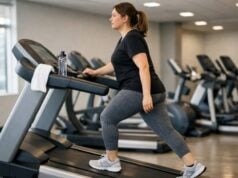
The intensity should feel strong but controlled. You should not need to hold the rails unless balance is an issue. If this format clicks for you, a more detailed treadmill walking guide can help you build it out.
4. Low-impact bike or rower interval ladder
This template suits people who want intensity with less joint pounding.
- Warm up easily for 4 minutes.
- Do:
- 30 seconds hard, 60 seconds easy
- 45 seconds hard, 60 seconds easy
- 60 seconds hard, 60 seconds easy
- 45 seconds hard, 60 seconds easy
- 30 seconds hard, 60 seconds easy
- Repeat the ladder twice.
- Cool down for 4 minutes.
Use “hard” to mean challenging, not maximal. The first half should not ruin the second half.
5. Strength-plus-steps hybrid
This is ideal for high-stress workdays when mental bandwidth is low.
- Walk briskly for 10 minutes.
- Do a 12-minute EMOM, meaning every minute on the minute:
- Minute 1: 10 squats
- Minute 2: 8 incline push-ups
- Minute 3: 10 hip hinges or kettlebell deadlifts
- Minute 4: 10 band rows or dumbbell rows
- Repeat the 4-minute cycle three times.
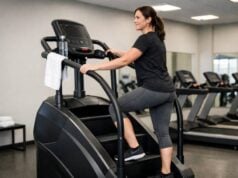
- Finish with 8 minutes of brisk walking, stairs, or step-ups.
This template is simple, repeatable, and surprisingly effective because it combines daily movement with enough strength work to keep the session useful.
You do not need to use all five. Pick two or three that fit your life, then repeat them until they become automatic.
Choose the right template for you
The best workout on paper is not always the best workout for your body, schedule, or stress level. Choosing the right template is mostly about matching the session to your current constraints.
Start with your main limiting factor.
If your issue is time and motivation, use the template with the fewest barriers. That is usually the bodyweight circuit or the strength-plus-steps hybrid. Both start quickly, require little setup, and do not depend on travel to a gym.
If your priority is keeping muscle while losing fat, do at least two strength-forward sessions each week. The dumbbell density workout is the strongest fit here because it keeps more of the 30 minutes focused on resistance work instead of pure cardio.
If your issue is joint comfort, choose lower-impact options. The bike or rower ladder and incline walking are often better tolerated than jumping, sprinting, or repeated burpees. If impact has been a problem before, a guide to joint-friendly low-impact cardio can help you stay consistent without flaring things up.
If your issue is energy management, do not force high-intensity intervals every time. On poor-sleep days, after stressful travel, or when your legs still feel heavy, a brisk walk plus basic strength work may give you more benefit than trying to “push through” a savage session.
A few practical rules make selection easier:
- Beginners: start with walking, bodyweight circuits, or hybrid sessions.
- Intermediate exercisers: rotate two strength-based sessions and one interval session.
- Advanced exercisers: use intervals sparingly and keep strength quality high.
- People with desk jobs: favor sessions that include walking before or after lifting.
- People with unpredictable schedules: keep one no-equipment template ready at all times.
It also helps to stop worrying about the perfect time of day. Morning workouts are not inherently better than evening ones. The best time is the one you can protect most often. If scheduling is your biggest obstacle, comparing morning and evening workout routines can make the choice feel less emotional and more practical.
A simple weekly setup for many busy adults looks like this:
- Monday: dumbbell full-body
- Wednesday: incline walk intervals
- Friday: bodyweight or hybrid session
- Weekend: longer walk, bike ride, or extra steps
That is enough to create momentum. You can always add more later, but the first win is choosing a template you will still be doing next month.
Progress without making workouts longer
One of the biggest mistakes with 30-minute workouts is assuming that progress means adding more time. It does not. You can improve the training effect while keeping the session at the same length.
The safest way is to change one variable at a time.
You can progress a short workout by:
- adding a few reps to each set
- increasing the load slightly
- shortening rest periods
- increasing treadmill incline or bike resistance
- adding one extra round within the same time block
- improving technique so more of the work is useful
For example, if your first dumbbell session gets through three rounds in 20 minutes, your next target might be three rounds with cleaner form and slightly shorter rest. After that, you might move to four rounds or use a heavier weight for the squat and row.
A simple four-week approach works well:
- Week 1: learn the template and keep 1 to 3 reps in reserve on strength moves.
- Week 2: add a small amount of volume, such as one extra round or a few extra reps.
- Week 3: increase difficulty with load, incline, or tighter rest.
- Week 4: keep the session length the same but reduce effort slightly to recover.
That fourth week matters more than many people realize. Progress is not a straight line, especially during fat loss, when energy and recovery can dip.
Track more than body weight. Useful signs that your 30-minute plan is working include:
- the same workout feels easier
- you complete more work in the same time
- walking pace or interval pace improves
- recovery heart rate improves
- waist measurements trend down
- clothes fit better
- everyday tasks feel less tiring
Also watch for the opposite. If every session feels worse, soreness lasts several days, or your motivation crashes, you may need more recovery rather than more intensity. Planned recovery is part of good programming, especially if you are layering short hard sessions into a busy week. A guide on how many rest days to take can help you avoid the trap of doing too much. On the other side, if your schedule suddenly tightens even more, you can sometimes bridge the gap with well-designed 20-minute HIIT sessions instead of skipping training entirely.
The point of progression is not to prove toughness. It is to make sure the same 30 minutes still asks your body to adapt.
Make short workouts drive fat loss
A 30-minute workout can support fat loss very well, but it usually does not do the whole job by itself. The people who get the best results from short sessions almost always pair them with a few low-drama habits outside the workout.
The first is protein intake. When you are trying to lose fat, protein helps protect lean mass and supports fullness. That matters even more if you are using short, efficient workouts instead of long training sessions. A practical target is to include a meaningful protein source at each meal, and a more detailed guide to protein intake for weight loss can help if you want numbers.
The second is daily movement beyond exercise. Many people do a hard workout, then unconsciously move less for the rest of the day. That can erase part of the benefit. Short sessions work better when they sit inside an active day, not when they replace it. This is where NEAT and daily movement outside formal exercise become important.
A strong busy-day fat-loss setup often includes:
- one 30-minute workout
- a step target or several short walks
- protein-centered meals
- enough fiber and water to control hunger
- consistent sleep times when possible
There are also a few common mistakes to avoid.
- Do not overestimate calorie burn. The session matters, but it is rarely a free pass to eat far more afterward.
- Do not chase soreness. Soreness is not proof of fat loss.
- Do not rely only on hard intervals. Strength work and steady movement are easier to repeat.
- Do not ignore recovery. Poor sleep and high stress can make short workouts feel much harder than they should.
If you want a practical template for a very busy day, this works well:
- Morning or lunch: 30-minute workout
- After two meals: 5 to 10 minutes of walking
- Across the day: aim for a step floor
- Meals: center each around protein, produce, and a reasonable portion of carbs
- Evening: keep bedtime consistent enough that tomorrow’s workout does not feel impossible
That combination is what makes the training “fat-burning” in real life. Not because one session is magical, but because it fits into a pattern that is hard to disrupt.
Short workouts work best when they make the rest of your day better, not when they demand the rest of your day revolve around them.
References
- WHO guidelines on physical activity and sedentary behaviour 2020 (Guideline)
- Aerobic Exercise and Weight Loss in Adults: A Systematic Review and Dose-Response Meta-Analysis 2024 (Systematic Review)
- Physical activity and exercise for weight loss and maintenance in people living with obesity 2023 (Review)
- The Effect of Resistance Training in Healthy Adults on Body Fat Percentage, Fat Mass and Visceral Fat: A Systematic Review and Meta-Analysis 2022 (Systematic Review)
- Effect of exercise training on weight loss, body composition changes, and weight maintenance in adults with overweight or obesity: An overview of 12 systematic reviews and 149 studies 2021 (Overview of Reviews)
Disclaimer
This article is for general educational purposes only and is not a substitute for medical advice, diagnosis, or treatment. Check with a qualified clinician before starting a new exercise program if you have heart, lung, metabolic, joint, or balance issues, or if you are pregnant, postpartum, or returning after a long break.
If you found this article useful, please share it on Facebook, X, or any other platform you use.