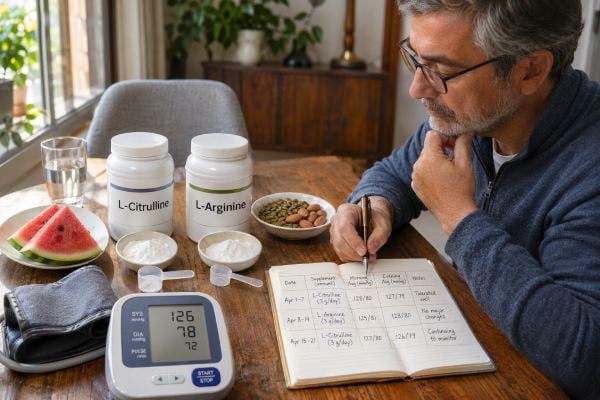
For raising circulating arginine and supporting nitric oxide production, L-citrulline generally has the pharmacokinetic advantage over oral L-arginine. Citrulline bypasses much of the intestinal and liver breakdown that limits swallowed arginine, then the kidneys convert it to arginine. That often produces a steadier rise in blood arginine with less gastrointestinal distress. But that does not prove citrulline lowers blood pressure more than arginine in a direct head-to-head comparison.
Both supplements have clinical-trial evidence suggesting possible blood-pressure benefits. A 2022 meta-analysis found L-arginine lowered systolic and diastolic pressure on average, while a 2025 meta-analysis found modest reductions with L-citrulline or watermelon in middle-aged and older adults. The trials vary greatly in dose, population, duration, and product, and a 2024 review of registered trial designs highlighted how difficult firm comparisons remain. For hypertension, neither supplement should replace proven treatment such as a DASH-style diet, exercise, sodium reduction, weight management when appropriate, or prescribed medication.
Table of Contents
- Short Answer: Citrulline Has the Absorption Advantage
- How the Nitric Oxide Pathway Works
- What Citrulline Studies Show
- What Arginine Studies Show
- Doses, Forms, and Side Effects
- Who Should Be Cautious
- Better-Proven Ways to Support Blood Pressure
Short Answer: Citrulline Has the Absorption Advantage
If the question is which supplement more efficiently raises blood arginine, L-citrulline is usually the better answer. If the question is which one definitely lowers blood pressure more, the evidence is not strong enough to declare a winner.
Arginine is the amino acid nitric oxide synthase uses directly to make nitric oxide. It sounds logical, then, to swallow more arginine. The problem is that a meaningful fraction of oral arginine is broken down by enzymes in the intestine and liver before it reaches the wider circulation.
Citrulline takes a different route. It is absorbed from the gut, largely avoids first-pass breakdown in the liver, and travels to the kidneys, where it is converted into arginine. A classic randomized pharmacokinetic study found that oral citrulline raised plasma arginine more effectively than tested oral arginine regimens and increased markers of nitric-oxide signaling.
That is why many researchers consider citrulline a more efficient oral precursor for increasing arginine availability. It also tends to cause fewer gastrointestinal problems than large arginine doses.
A practical comparison looks like this:
- Citrulline: Better oral delivery of arginine, usually better tolerated, and increasingly studied for endothelial function and blood pressure.
- Arginine: Direct nitric-oxide substrate with positive blood-pressure meta-analysis data, but substantial first-pass metabolism and more gastrointestinal side effects at high doses.
- Combination products: Biologically plausible and sometimes promising in subgroup analyses, but not proven necessary or superior for routine hypertension management.
- Food sources: Watermelon supplies citrulline, while protein foods supply arginine. They provide nutrients beyond the isolated amino acid and are easier to fit into a long-term eating pattern.
However, blood pressure is a clinical outcome, not merely a blood amino-acid level. A supplement can raise arginine without producing a large enough change in nitric oxide, arterial stiffness, kidney sodium handling, or vascular resistance to lower blood pressure meaningfully. Hypertension also has many causes that nitric oxide supplements do not address.
The guide to citrulline for blood pressure and nitric oxide covers the citrulline evidence in more detail, while arginine supplements for blood pressure focuses on the arginine side.
How the Nitric Oxide Pathway Works
Nitric oxide is a signaling molecule made by cells lining blood vessels. One of its important cardiovascular jobs is telling vascular smooth muscle to relax. When vessels relax, resistance can fall and blood flow can improve.
The simplified pathway looks like this:
- L-citrulline is converted to L-arginine, mainly through recycling pathways that include the kidneys and cells throughout the body.
- Nitric oxide synthase uses L-arginine to produce nitric oxide and L-citrulline.
- Nitric oxide activates signaling in smooth muscle, including cyclic GMP, which supports vasodilation.
The body already makes and recycles both amino acids. More substrate does not always mean proportionally more nitric oxide because enzyme activity, oxidative stress, endothelial health, asymmetric dimethylarginine, kidney function, and other factors can limit the pathway.
This is also why nitrate-rich vegetables can support nitric oxide through a different route. Dietary nitrate from foods such as beets and leafy greens can be converted to nitrite and then nitric oxide. That pathway does not depend on taking arginine. The overview of nitric oxide supplements, beets, and citrulline compares those approaches.
Endothelial function matters, but blood pressure is regulated by much more than vasodilation. The kidneys control sodium and water balance; the nervous system adjusts vessel tone and heart function; hormones such as angiotensin and aldosterone affect fluid and vascular resistance. Sleep apnea, alcohol, obesity, kidney disease, medications, and genetics can all raise blood pressure.
So a supplement that nudges the nitric oxide pathway is addressing only one part of the system. That can be useful in selected people, but it explains why trial results are inconsistent.
What Citrulline Studies Show
L-citrulline has two advantages that make it attractive: it can raise arginine efficiently, and it has clinical evidence for improving some measures of vascular function.
A 2022 meta-analysis of randomized trials found that longer-term L-citrulline supplementation improved brachial-artery flow-mediated dilation, a measure of endothelial function. It did not show broad improvements across every cardiometabolic marker, which is an important reminder that better vessel responsiveness does not automatically translate into a dramatic blood-pressure change.
A 2022 randomized trial in hypertensive postmenopausal women used 10 grams of L-citrulline daily for four weeks. Citrulline increased serum arginine and improved flow-mediated dilation. It also reduced some central blood-pressure measures, although the study was small and the findings should not be generalized to everyone with hypertension.
A newer 2025 meta-analysis examined L-citrulline supplementation and watermelon intake in middle-aged and older adults. Across 15 randomized trials, systolic pressure fell by about 4 mmHg and diastolic pressure by about 2.5 mmHg on average. Those are clinically interesting changes, but the analysis combined interventions and populations that were not identical.
Some subgroup results in that analysis suggested larger effects from combined citrulline and arginine, but subgroup findings are not enough to establish that a combination is routinely superior. Direct trials designed specifically to compare citrulline, arginine, combination therapy, and placebo using the same doses and patient population would be more convincing.
A 2024 assessment of registered clinical trials also emphasized the heterogeneity of the evidence: few trials met strict comparison criteria, and participant selection, doses, durations, and blood-pressure endpoints differed substantially. That is why it is reasonable to say citrulline is pharmacokinetically more efficient without claiming it is definitively the best blood-pressure supplement.
Watermelon is a natural source of citrulline, particularly the rind. Eating watermelon can fit a heart-healthy diet, but the citrulline content of a normal serving is not identical to a standardized supplement dose. Food also brings water, carbohydrate, potassium, and other nutrients, so supplement and food trials are not interchangeable.
What Arginine Studies Show
L-arginine has been studied for decades because it is the direct substrate for nitric oxide synthase. Despite poorer oral efficiency, enough arginine can reach the circulation at higher doses to affect vascular physiology.
A 2022 systematic review and dose-response meta-analysis included 22 randomized placebo-controlled trials and reported average reductions of about 6.4 mmHg systolic and 2.6 mmHg diastolic with oral L-arginine. The effects varied between studies, and the pooled result does not mean every person should expect that reduction.
The same review found that study dose, duration, baseline blood pressure, and participant characteristics influenced results. Some trials were short, and many had modest sample sizes. That limits confidence about long-term outcomes.
Arginine also presents a practical problem: the doses used in cardiovascular and exercise studies are often several grams per day, sometimes divided across doses. At higher oral intakes, nausea, abdominal discomfort, bloating, and diarrhea become more common. Those side effects can make adherence difficult.
Because arginine is directly metabolized by arginase in the gut and liver, simply taking more is not an elegant solution. This is the main physiological reason citrulline has gained attention as an alternative precursor.
Importantly, neither arginine nor citrulline has evidence comparable with approved antihypertensive medications for preventing stroke, heart attack, heart failure, or kidney complications. Trials primarily measure blood pressure and vascular markers, not major cardiovascular events.
If you are considering arginine because you want better circulation or a “pump,” remember that exercise-performance marketing often uses the same nitric-oxide language as blood-pressure marketing. A product may contain caffeine, stimulants, or multiple amino acids. Those blends are harder to evaluate and can even raise heart rate or blood pressure despite including arginine.
Doses, Forms, and Side Effects
There is no universally approved supplement dose of citrulline or arginine for hypertension. Research doses vary widely, so the safest approach is to treat published ranges as study conditions rather than prescriptions.
L-citrulline: Cardiovascular studies commonly use several grams per day. A 2023 review described many studies in the range of roughly 2.4 to 6 grams daily, while some clinical trials have used 10 grams per day. Citrulline is sold as plain L-citrulline and as citrulline malate. Citrulline malate combines citrulline with malate and is common in sports supplements; the labeled gram amount is not necessarily the amount of pure citrulline.
L-arginine: Blood-pressure trials often use several grams daily, and some use substantially larger amounts. Because oral arginine is less efficiently delivered to the systemic circulation, higher doses are common, but gastrointestinal intolerance also increases.
If a clinician agrees that a trial is reasonable, a few practical rules help:
- Use a single-ingredient product rather than a complex pre-workout blend.
- Look for independent quality testing when possible.
- Start at the lower end of the agreed dose rather than jumping to a high research dose.
- Track home blood pressure using consistent technique.
- Record dizziness, headache, nausea, diarrhea, or palpitations.
- Do not change prescribed medication based on a few lower readings.
Supplement labels deserve careful reading. “Nitric oxide booster” is a marketing category, not a standardized formulation. Some products contain beetroot, nitrates, caffeine, creatine, taurine, herbal stimulants, or other ingredients that make it impossible to know which component caused a benefit or side effect.
Citrulline malate deserves special attention because labels may list the weight of the combined compound rather than the amount of L-citrulline itself. A scoop labeled 8 grams of citrulline malate is not necessarily equivalent to 8 grams of pure L-citrulline. Ratios also vary by manufacturer. For a blood-pressure experiment, plain L-citrulline is easier to interpret than a multi-ingredient sports formula because the active amount is clearer and stimulants are less likely to confound your readings.
Timing is another area where marketing outruns evidence. Exercise products often recommend taking citrulline shortly before a workout, while blood-pressure trials commonly study daily use over weeks. An acute “pump” is not the same outcome as chronic resting blood-pressure control. If the goal is hypertension rather than gym performance, evaluate average home readings over time rather than whether you feel warmer, more vascular, or more energized after a dose.
For many people, food-first options are easier to sustain. Beets and leafy greens support the nitrate-nitrite-nitric-oxide pathway; watermelon provides citrulline; nuts, seeds, legumes, fish, vegetables, and whole grains support vascular health more broadly. If you are interested in dietary nitrate, see beetroot juice for high blood pressure.
Who Should Be Cautious
Both citrulline and arginine can influence vascular tone, so people taking blood-pressure-lowering drugs should use concentrated supplements cautiously. The main concern is an additive effect that produces lightheadedness or blood pressure that is too low, especially when standing.
Extra caution is appropriate if you take nitrates for angina, multiple antihypertensive medicines, or drugs for erectile dysfunction that also enhance the nitric-oxide/cGMP pathway. That does not mean every combination is forbidden, but it is a good reason to involve a pharmacist or clinician rather than experimenting independently.
People with kidney disease should also get medical advice. The kidneys participate in citrulline-to-arginine metabolism, and advanced kidney disease changes amino-acid handling as well as electrolyte and medication risk. Severe liver disease can alter amino-acid metabolism too.
Pregnancy is another situation where supplement use should be clinician-directed. Arginine has been studied in hypertensive disorders of pregnancy, but evidence is condition-specific and does not justify self-treating pregnancy-related high blood pressure with over-the-counter supplements.
Stop and seek medical advice if a supplement causes persistent vomiting, severe diarrhea, fainting, marked weakness, chest pain, or palpitations. Mild gastrointestinal symptoms are more common with arginine, but severe symptoms should not be normalized.
Anyone with very high or rapidly rising blood pressure should focus on medical evaluation rather than supplement selection. Readings around or above 180/120 mmHg, particularly with chest pain, shortness of breath, neurologic symptoms, confusion, or vision changes, can represent a hypertensive emergency and require urgent care.
Finally, a supplement trial is more interpretable if you change one thing at a time. Starting citrulline, beetroot powder, magnesium, a pre-workout, and a new exercise plan simultaneously makes it difficult to identify what changed your pressure or caused a side effect.
If your clinician agrees to a trial, record the exact product, daily amount, start date, medication schedule, and morning or evening blood-pressure averages. Give more weight to a consistent trend than to a single low reading after exercise or a hot shower. This simple record also makes it easier to stop an ineffective supplement instead of continuing it indefinitely because the mechanism sounds persuasive.
Better-Proven Ways to Support Blood Pressure
If your goal is lower blood pressure, begin with interventions that have stronger evidence and broader cardiovascular benefits.
Follow a DASH-style eating pattern. Emphasize vegetables, fruit, beans, whole grains, nuts, seeds, and appropriate low-fat dairy or alternatives while limiting highly processed foods and excess saturated fat. The DASH diet addresses several blood-pressure mechanisms at once.
Reduce excess sodium. Sodium sensitivity varies, but people with hypertension often benefit from lowering intake, especially when their baseline intake is high.
Exercise regularly. Aerobic exercise, resistance training, and a generally active day can all help. Exercise also supports endothelial nitric oxide production without requiring an amino-acid supplement. The guide to the best exercises for high blood pressure explains practical options.
Address sleep and sleep apnea. Poor sleep and untreated obstructive sleep apnea can keep blood pressure elevated despite a good diet.
Limit heavy alcohol intake and stop smoking. These changes affect much more than nitric oxide and have clear cardiovascular value.
Use medication when indicated. Modern antihypertensive drugs have robust evidence for reducing cardiovascular events. Supplements should never be used to delay treatment when blood pressure is persistently above the range your clinician recommends.
If you still want to test a nitric-oxide supplement after those foundations are in place, citrulline is generally the more efficient way to raise circulating arginine. Arginine also has blood-pressure trial data, but it is less efficiently absorbed and more likely to cause gastrointestinal side effects at higher doses. The decisive point is that better arginine bioavailability is not the same as proven superior blood-pressure lowering. Choose based on your clinical context, medication list, tolerance, and clinician guidance rather than on marketing claims.
References
- Does l-citrulline supplementation and watermelon intake reduce blood pressure in middle-aged and older adults? A systematic review and meta-analysis of randomized controlled trials 2025 (Systematic Review)
- Effect of l-Arginine Supplementation on Blood Pressure in Adults: A Systematic Review and Dose-Response Meta-analysis of Randomized Clinical Trials 2022 (Systematic Review)
- Effects of l-citrulline supplementation and watermelon consumption on longer-term and postprandial vascular function and cardiometabolic risk markers: a meta-analysis of randomised controlled trials in adults 2022 (Meta-Analysis)
- Dietary Arginine and Citrulline Supplements for Cardiovascular Health and Athletic Performance: A Narrative Review 2023 (Review)
- Effects of L-Citrulline Supplementation on Endothelial Function and Blood Pressure in Hypertensive Postmenopausal Women 2022 (Randomized Trial)
- Pharmacokinetic and pharmacodynamic properties of oral L-citrulline and L-arginine: impact on nitric oxide metabolism 2008 (Randomized Pharmacokinetic Study)
Disclaimer
This article is for general education and does not replace individualized hypertension care. If you take nitrates, erectile-dysfunction medicines, blood-pressure drugs, or have kidney, liver, cardiovascular, or pregnancy-related conditions, discuss citrulline or arginine supplements with a clinician or pharmacist before using them. Do not stop or reduce prescribed antihypertensive medication because a supplement lowers a few home readings.