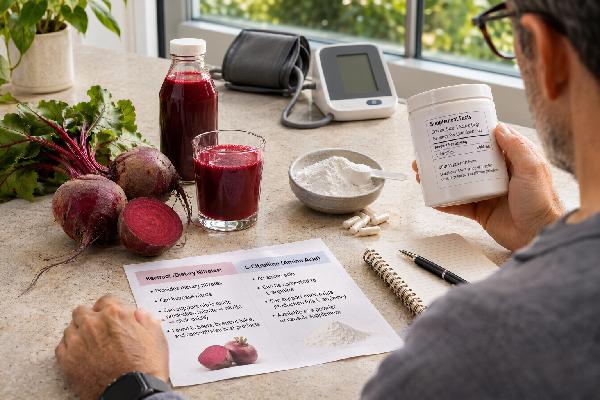
“Nitric oxide booster” is a broad marketing label, not one specific supplement. The best-supported options work by giving your body raw materials it can use to make nitric oxide: nitrate from foods such as beetroot, or amino acids such as L-citrulline that increase arginine availability. Nitric oxide helps blood vessels relax, so these approaches may modestly improve blood pressure, blood flow, or exercise performance in some people. The evidence is not equally strong for every product, dose, or health goal.
For blood-pressure support, nitrate-rich beetroot has the most consistent recent evidence, especially in people with hypertension. L-citrulline is promising, but results are more mixed and depend on the population studied. L-arginine can work biologically, yet oral citrulline often raises circulating arginine more efficiently. Many “pump” blends combine these ingredients with caffeine or stimulants, which can work against a blood-pressure goal. The practical question is therefore not whether nitric oxide matters—it does—but which source, dose, and product make sense for the outcome you actually want.
Table of Contents
- What nitric oxide does
- Beetroot and dietary nitrate
- L-citrulline and L-arginine
- Which option is worth it
- Doses, timing, and product labels
- Safety, interactions, and who should be careful
- A practical way to try it
What nitric oxide does
Nitric oxide, often shortened to NO, is a signaling molecule made throughout the body. In the cardiovascular system, it helps the smooth muscle in blood-vessel walls relax. That relaxation can widen arteries, improve blood flow, and reduce vascular resistance. Healthy endothelial cells—the cells lining blood vessels—produce nitric oxide from the amino acid L-arginine using enzymes called nitric oxide synthases.
There is also a second pathway. Nitrate from vegetables can be converted to nitrite and then to nitric oxide. Oral bacteria play an important role in this nitrate-nitrite pathway, which is one reason antiseptic mouthwash can reduce some of the blood-pressure response to dietary nitrate.
Nitric oxide production is influenced by exercise, diet, age, vascular health, smoking, oxidative stress, and disease. That has made “boosting NO” a popular idea for both cardiovascular health and sports performance. The biology is real, but supplement marketing often stretches beyond the evidence.
A supplement may increase nitric oxide-related biomarkers without proving that it prevents heart attacks or replaces blood-pressure medication. Most trials look at intermediate outcomes such as systolic pressure, flow-mediated dilation, arterial stiffness, exercise economy, or time to exhaustion. Those outcomes can be useful, but they are not the same as long-term cardiovascular events.
If your main goal is blood pressure, lifestyle basics still carry more weight than any NO supplement. A DASH-style eating pattern, regular activity, adequate sleep, and appropriate sodium intake affect many pathways at once rather than targeting nitric oxide alone.
Beetroot and dietary nitrate
Beetroot is the most recognizable nitrate supplement, but nitrate itself is also abundant in arugula, spinach, lettuce, celery, and other leafy vegetables. After nitrate is absorbed, some circulates back into saliva. Oral bacteria convert it to nitrite, which can then be reduced to nitric oxide in the body.
The blood-pressure evidence is meaningful but modest. A 2024 systematic review and meta-analysis in adults with hypertension found that beetroot juice providing roughly 200 to 800 mg of nitrate per day reduced clinic systolic blood pressure by about 5 mmHg on average compared with control. The analysis did not find a clear reduction in diastolic or 24-hour ambulatory pressure, and the certainty of evidence was rated low.
A broader 2025 dose-response meta-analysis of randomized trials also found that dietary nitrate increased plasma nitrate and nitrite and was associated with reductions in blood pressure plus improvements in vascular measures such as flow-mediated dilation and pulse-wave velocity. Effects tended to be stronger in people with hypertension than in healthier groups.
That makes nitrate-rich foods or standardized beet products a reasonable adjunct for some people, not a substitute for treatment. A 5 mmHg average systolic reduction is clinically relevant at a population level, but an individual response can be smaller, larger, or absent.
Beetroot also has sports-performance evidence, especially for endurance exercise. Nitrate can reduce the oxygen cost of a given workload and may improve exercise efficiency. Benefits are not universal, and trained elite athletes sometimes show smaller gains because their nitric oxide systems and exercise economy are already highly adapted.
Whole beets have nutritional advantages beyond nitrate, including potassium, folate, fiber, and plant compounds. Concentrated beet juice shots and powders are easier to standardize for nitrate, but labels vary. For a focused comparison, beetroot powder versus juice explains why nitrate content matters more than the word “beet” on the front of a container.
L-citrulline and L-arginine
L-citrulline is an amino acid that the kidneys convert into L-arginine. Arginine is then available for nitric oxide production. Counterintuitively, taking citrulline can raise circulating arginine more effectively than taking the same idea directly as oral arginine because arginine undergoes substantial metabolism in the intestine and liver before reaching the bloodstream.
That is why citrulline is common in pre-workout supplements and vascular-health products. Typical research doses often fall around 3 to 6 g/day of L-citrulline, with some trials using higher amounts. Citrulline malate is a different product: it combines citrulline with malate, so a 6 g scoop of “citrulline malate” does not necessarily provide 6 g of pure citrulline.
Blood-pressure findings are mixed. Older meta-analyses reached different conclusions, partly because trials were small and populations varied. More recent analyses suggest potential benefit in selected groups. A 2025 meta-analysis in middle-aged and older adults reported average reductions of about 4 mmHg systolic and 2.5 mmHg diastolic with L-citrulline supplementation or watermelon intake. A 2026 review of cold-exposure trials found larger reductions in cold-induced blood-pressure responses, but that is a specialized setting and should not be generalized to everyday hypertension.
A 2024 review of registered trials emphasized an important limitation: the evidence base is heterogeneous. Studies differ in dose, duration, age, baseline blood pressure, sex, and whether the outcome is resting pressure, central pressure, arterial stiffness, or a response to stress. That makes it hard to promise a specific effect for a healthy person buying a supplement.
L-arginine can also increase nitric oxide substrate availability, but oral tolerance and metabolism are drawbacks. Gastrointestinal upset becomes more common at larger doses. Citrulline is often the more practical choice when the goal is to raise arginine levels. See citrulline versus arginine for nitric oxide for a deeper comparison.
Which option is worth it
The best choice depends on your target. There is no universal “best nitric oxide supplement.”
| Goal | Most reasonable option | Why | Main limitation |
|---|---|---|---|
| Modest blood-pressure support | Nitrate-rich vegetables or standardized beetroot | Most consistent recent BP evidence | Response varies; not a medication replacement |
| Endurance exercise support | Standardized dietary nitrate | Can improve exercise economy in some users | Smaller effects in some highly trained athletes |
| Resistance-training “pump” | L-citrulline | Raises arginine availability and is widely studied in sports settings | Performance effects are not guaranteed |
| General cardiovascular prevention | Diet rich in vegetables and exercise | Supports NO plus many other risk pathways | Less marketable than a supplement, but more comprehensive |
For someone with high blood pressure who wants to try one evidence-based nutrition strategy, nitrate-rich vegetables are a strong first step. Arugula, spinach, lettuce, and beetroot can raise nitrate intake while improving overall dietary quality. A supplement becomes more useful when standardization and convenience matter.
Be cautious with products marketed as “NO boosters” that never state the actual nitrate or citrulline dose. Beet powder can contain plenty of colorful beet compounds but an unknown amount of nitrate. Proprietary blends can hide underdosed ingredients. Pre-workouts may contain enough caffeine, yohimbine-like stimulants, or other compounds to raise heart rate and blood pressure despite including citrulline.
Do not judge effectiveness by facial flushing or a dramatic “pump.” Niacin can cause flushing without meaningfully reproducing nitric oxide’s vascular benefits, and stimulants can make a workout feel intense while increasing cardiovascular strain.
Doses, timing, and product labels
For beetroot and nitrate, the most useful number is nitrate content, not grams of powder. Clinical studies commonly use several hundred milligrams of nitrate per day. The 2024 hypertension meta-analysis included daily nitrate doses of about 200 to 800 mg from beetroot juice.
Exercise studies often time nitrate a few hours before activity because plasma nitrate rises first and nitrite peaks later. Chronic daily use has also been studied. If a product gives no nitrate amount, you cannot confidently match it to research.
For L-citrulline, common research doses are around 3 to 6 g/day, with some protocols using 6 to 8 g before exercise. Read the label carefully if the product says “citrulline malate.” Ratios such as 2:1 describe citrulline relative to malate, so the total scoop weight overstates the amount of citrulline.
A useful label checklist is:
- Is the active ingredient listed in an exact amount?
- For beet products, is nitrate content standardized in mg or mmol?
- For citrulline, is it pure L-citrulline or a citrulline-malate blend?
- Does the product contain caffeine or other stimulants?
- Is there third-party testing for identity and contamination?
- Does the serving size require several scoops or capsules to reach a studied dose?
Avoid strong antiseptic mouthwash around nitrate dosing if your goal is the nitrate-nitrite-NO pathway, unless you need the mouthwash for a dental reason. Oral bacteria contribute to nitrate conversion. Good dental hygiene is still important; the point is not to stop medically needed oral care.
For blood pressure, do not make decisions from one reading. Measure consistently and look at averages. A structured home blood-pressure schedule is more useful than checking only when you take a supplement.
Safety, interactions, and who should be careful
Most healthy adults tolerate food-based nitrate and moderate citrulline doses well, but “natural” does not mean interaction-free. The main practical concern is additive blood-pressure lowering.
Talk with a clinician before using concentrated nitrate or citrulline if you take multiple antihypertensive medicines, have symptomatic low blood pressure, faint easily, or have significant heart disease. The same caution applies if you take vasodilator drugs. Combining several blood-pressure-lowering agents can cause dizziness or lightheadedness even when each one is reasonable alone.
Nitrate supplements are not the same as prescription nitrate medications such as nitroglycerin, and they should not be used to treat angina. Chest pressure during exertion needs medical evaluation, not a beet shot.
Kidney disease also changes the conversation. People with advanced kidney disease may need individualized guidance on potassium-rich foods and supplements. Whole beetroot and leafy greens can be high in potassium, even though nitrate itself is not potassium.
Beetroot can turn urine or stool pink-red, a harmless effect called beeturia. It can be alarming if you do not expect it. People prone to calcium oxalate kidney stones may also want to discuss large, frequent amounts of high-oxalate beet greens or beet products with a clinician or dietitian.
Citrulline can cause stomach upset in some users, especially at high doses. Supplements should also be treated cautiously in pregnancy and breastfeeding because high-dose supplemental forms are not as well studied as normal food intake.
Finally, supplements are not screened like prescription drugs for effectiveness before sale. Look for reputable manufacturers and independent quality testing, particularly if you compete in drug-tested sport.
A practical way to try it
If your goal is cardiovascular health rather than bodybuilding, start with food. Add one or two nitrate-rich vegetable servings most days—arugula in a salad, spinach with a meal, roasted beets, or lettuce in a sandwich. That supports nitric oxide biology while also adding fiber, potassium, folate, and other protective nutrients. Leafy greens for blood pressure are especially useful because they combine nitrate with overall dietary quality.
If you want a standardized trial for blood pressure, choose one product with a stated nitrate dose, keep the rest of your routine stable, and track home pressure for several weeks. Do not start three supplements at once. If your average falls meaningfully or you develop lightheadedness, share the readings with your clinician, especially if you take medication.
For exercise, test a product in training rather than for the first time on race day. Nitrate can cause gastrointestinal discomfort in some people, and beet products can be bulky or strongly flavored. Citrulline is easier for some athletes to tolerate, but large scoops may still upset the stomach.
A sensible decision hierarchy is:
- Fix the basics that improve endothelial function: exercise, sleep, tobacco avoidance, and a plant-rich diet.
- Use nitrate-rich foods regularly if they fit your diet.
- Consider a standardized beetroot product if convenience or a defined dose matters.
- Consider L-citrulline when your goal is exercise blood flow or when you specifically want an arginine precursor.
- Skip proprietary “NO” blends with hidden doses or heavy stimulant loads.
Nitric oxide supplements can be useful tools, but they are best viewed as targeted additions rather than cardiovascular shortcuts. For blood pressure, beetroot/nitrate currently has the clearest practical evidence. Citrulline is reasonable but less predictable. And if a supplement is being used to compensate for smoking, inactivity, uncontrolled blood pressure, or a poor diet, addressing those larger drivers will do far more for long-term heart risk.
A short, structured trial is more informative than judging a supplement by how you feel after one dose. Blood pressure naturally varies, so take readings under similar conditions and use an average. For a beetroot or nitrate product, note the nitrate amount rather than relying on the grams of powder or milliliters of juice. Products made from the same plant can deliver very different nitrate doses.
For L-citrulline, check whether the label lists pure L-citrulline or citrulline malate. Citrulline malate includes malate, so a scoop labeled with a combined weight does not necessarily provide that many grams of L-citrulline. Proprietary blends make comparison even harder because the effective ingredients may not be disclosed.
It also helps to match the product to the outcome. If the goal is a modest blood-pressure effect, dietary nitrate currently has the more direct evidence base. If the goal is exercise performance or blood flow during training, both nitrate and citrulline have been studied, but results depend on dose, training status, and the type of exercise. If the goal is long-term cardiovascular prevention, neither replaces blood-pressure treatment, lipid management, exercise, sleep, and a high-quality diet.
Consider cost per effective dose. A premium “nitric oxide booster” may contain tiny amounts of several ingredients, while plain beetroot concentrate or single-ingredient L-citrulline can make the dose easier to verify. Third-party testing is useful when available, especially for athletes concerned about contamination.
Finally, monitor for reasons to stop. Persistent dizziness, faintness, palpitations, severe gastrointestinal symptoms, or unexpectedly low blood pressure deserve attention. People using nitrates for chest pain, multiple blood-pressure medicines, or drugs for erectile dysfunction should get medical guidance before trying a supplement that may further lower pressure. The goal is to improve vascular health without stacking effects blindly.
Food can also be the simplest way to decide whether the nitric-oxide idea fits your routine. A salad with arugula and spinach, roasted beets with dinner, or another nitrate-rich vegetable adds compounds that support the nitrate–nitrite–nitric oxide pathway without requiring a supplement. That approach will not deliver a precisely standardized dose, but it improves diet quality at the same time. If a standardized product adds cost or complexity without a clear blood-pressure or performance benefit after a fair trial, there is little reason to keep taking it.
The evidence is strongest when the product matches what was studied. Beetroot trials often use a measured nitrate dose, not just an arbitrary scoop of red powder. A product can look like beetroot and still provide too little nitrate to reproduce a clinical trial. If the label lists only “beet powder” with no nitrate standardization, you cannot confidently translate the serving into a research dose.
Citrulline has a similar problem. Studies may use several grams per day, while a multi-ingredient pre-workout might contain a much smaller amount hidden inside a blend. Stimulants such as caffeine or synephrine can also raise heart rate or blood pressure, making the product a poor way to judge citrulline’s vascular effect. Single-ingredient products are easier to evaluate.
Expect modest changes, not a dramatic transformation. Even a 4 to 5 mmHg average reduction in systolic pressure can be meaningful at a population level, but an individual’s readings may move less, more, or not at all. Home blood pressure also varies from day to day, which is why an average over time is more useful than one “before and after” reading.
If you already have well-controlled blood pressure on medication, the value of adding a supplement may be small. If your pressure is uncontrolled, supplements should not delay proven treatment. And if your main goal is heart health rather than a small performance edge, vegetables, exercise, tobacco avoidance, sleep, and prescribed therapy offer a broader benefit than any isolated nitric oxide booster.
References
- Plasma nitrate, dietary nitrate, blood pressure, and vascular health biomarkers: a GRADE-Assessed systematic review and dose-response meta-analysis of randomized controlled trials 2025 (Systematic Review)
- Effects of beetroot juice on blood pressure in hypertension according to European Society of Hypertension Guidelines: A systematic review and meta-analysis 2024 (Systematic Review)
- Effects of chronic nitrate supplementation on blood pressure in adults: a systematic review and meta-analysis of randomized clinical trials 2026 (Systematic Review)
- Does l-citrulline supplementation and watermelon intake reduce blood pressure in middle-aged and older adults? A systematic review and meta-analysis of randomized controlled trials 2025 (Systematic Review)
- Assessment of Registered Clinical Trial Designs: Comparison of L-Arginine and/or L-Citrulline Interventions for Hypertension 2024 (Review)
Disclaimer
This article is for general education and does not replace medical diagnosis or treatment. Do not use supplements to replace prescribed blood-pressure or heart medication, and discuss concentrated nitrate or amino-acid supplements with a clinician if you have cardiovascular disease, kidney disease, low blood pressure, pregnancy, or take multiple medications.