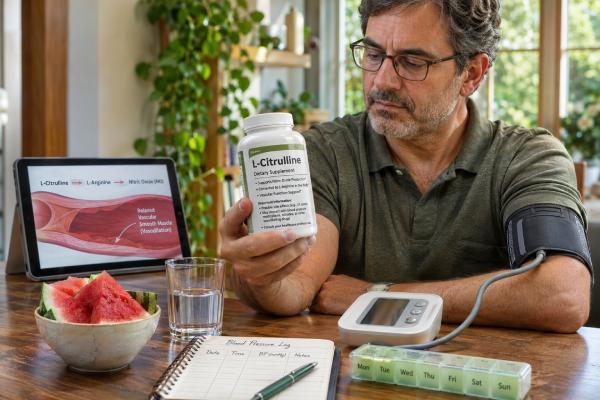
L-citrulline may lower blood pressure by a few mmHg in some adults, especially middle-aged or older people with elevated readings, but the evidence is not strong enough to treat it like a blood-pressure medicine. This amino acid raises the body’s supply of L-arginine, which blood vessels use to make nitric oxide. Nitric oxide helps arteries relax and can reduce resistance to blood flow. Recent meta-analyses suggest modest improvements in systolic and diastolic pressure, yet studies differ in dose, duration, population, and measurement methods. That means some people may respond while others notice no meaningful change. L-citrulline is usually well tolerated, but it can add to the blood-pressure-lowering effects of antihypertensive drugs and other vasodilators. Product quality and dose also matter, because “citrulline malate” and multi-ingredient pre-workouts are not the same as pure L-citrulline. For most people, the sensible approach is to treat it as an optional add-on after diet, exercise, sleep, sodium control, and prescribed treatment are already addressed.
Table of Contents
- How L-Citrulline Supports Nitric Oxide
- What the Blood-Pressure Research Shows
- Who May Benefit Most
- Doses, Forms, and Timing
- Side Effects and Interactions
- L-Citrulline vs Arginine and Beets
- How to Test It Safely
How L-Citrulline Supports Nitric Oxide
L-citrulline is a nonessential amino acid. Your body makes it naturally, and watermelon is its best-known food source. Its cardiovascular value comes mainly from what happens after absorption: the kidneys convert citrulline into L-arginine, and endothelial cells can then use L-arginine to produce nitric oxide.
Nitric oxide is a short-lived signaling molecule that tells smooth muscle in the artery wall to relax. That widens the vessel, lowers vascular resistance, and may reduce blood pressure. Nitric oxide also participates in normal endothelial function, blood-flow regulation, and exercise responses.
It may seem simpler to take L-arginine directly, but oral arginine is heavily metabolized in the gut and liver before much of it reaches the circulation. Citrulline bypasses more of this first-pass metabolism and can raise circulating arginine efficiently. That is one reason studies often consider L-citrulline an indirect nitric-oxide strategy rather than merely another amino acid supplement.
The pathway is still not a guaranteed pressure-lowering switch. Nitric oxide production depends on endothelial health, enzymes, oxidative stress, cofactors, kidney function, baseline blood pressure, and other factors. If hypertension is being driven mainly by excess sodium, sleep apnea, kidney disease, medication effects, or stiff arteries, simply providing more citrulline may have limited impact.
This distinction matters because supplement marketing often implies that “more nitric oxide” automatically means healthier blood pressure. The biology is more complicated. A product may increase arginine availability without producing a clinically meaningful change in your average pressure.
For a broader comparison of the two amino acids, see citrulline versus arginine for nitric oxide and blood pressure. The important practical point is that citrulline has a plausible mechanism and measurable physiological effects, but mechanism alone is not proof of long-term cardiovascular benefit.
What the Blood-Pressure Research Shows
Recent evidence suggests a small average blood-pressure benefit, with important limitations.
A 2025 systematic review and meta-analysis of randomized trials in middle-aged and older adults found that L-citrulline supplementation or watermelon intake reduced systolic blood pressure by about 4 mmHg and diastolic pressure by about 2.5 mmHg on average. Those changes are meaningful enough to be interesting, but they are averages across different interventions and populations.
Another 2025 meta-analysis examined arterial stiffness and endothelial function. It found signals that citrulline or watermelon may improve some vascular measures, but not every endpoint changed consistently. A 2026 systematic review in postmenopausal women likewise reported that several blood-pressure studies showed systolic improvement while other vascular and metabolic outcomes were mixed.
The uncertainty is not a minor technical issue. A 2024 assessment of registered L-arginine and L-citrulline trials found large differences in participant selection, doses, duration, and blood-pressure endpoints. Only a small fraction of completed registered trials fit the review’s criteria. The authors concluded that robust standardized evidence for chronic blood-pressure lowering in the general population remains limited.
So what does a 3–4 mmHg change mean in real life? If your home average is 138/86 mmHg and a stable intervention brings it to 134/83 mmHg, that is a useful shift. But a single reading from 138 to 134 proves very little. Blood pressure naturally varies with stress, sleep, exercise, sodium intake, caffeine, alcohol, pain, temperature, and measurement technique.
It is also worth separating resting blood pressure from exercise physiology. Citrulline may increase arginine availability and blood flow during activity without producing the same magnitude of change in a seated resting reading. Studies that measure brachial artery dilation, pulse-wave velocity, or exercise performance are useful for understanding mechanism, but those endpoints cannot be converted directly into a predicted blood-pressure reduction. A product advertisement may combine all of these findings as if they prove the same benefit; they do not.
Duration matters too. Many trials last days or weeks rather than years. Short studies can show whether pressure moves, but they cannot establish whether the effect persists, whether people continue taking the supplement, or whether long-term cardiovascular events are reduced. That gap is especially important for hypertension because risk accumulates over decades. A small supplement effect that disappears after a few weeks is less valuable than a sustainable eating, activity, or medication plan.
Finally, baseline pressure influences how much room there is to improve. Trials that enroll people with higher starting pressure often show larger absolute reductions than studies of healthy adults. This is common across many blood-pressure interventions and should temper expectations if your readings are already near normal.
There is also no evidence that L-citrulline alone prevents heart attacks or strokes. Blood-pressure reduction is a surrogate outcome. Proven hypertension care should still be built around accurate diagnosis, lifestyle changes, and medication when indicated.
If you are trying to improve readings without relying on supplements, the higher-priority strategies are covered in how to lower blood pressure naturally. L-citrulline is best viewed as a possible extra tool, not the foundation of the plan.
Who May Benefit Most
The people most likely to have room for a useful effect are adults with mildly elevated blood pressure rather than people whose pressure is already low.
Research has often focused on middle-aged or older adults, people with overweight or metabolic risk factors, and adults with prehypertension or hypertension. These groups may have impaired endothelial function or reduced nitric-oxide signaling, which makes the mechanism plausible. However, there is no routine laboratory test that can identify a “citrulline responder” before you try it.
A reasonable candidate is someone who:
- Has repeated home readings above the desired range but is medically stable.
- Has already addressed sodium intake, physical activity, sleep, alcohol, and body weight where relevant.
- Can measure blood pressure with a validated upper-arm cuff.
- Is willing to keep the rest of the routine stable during a short trial.
- Has reviewed the supplement with a clinician or pharmacist if taking blood-pressure or heart medication.
Someone with a home average around 130–140 mmHg systolic may be able to detect a modest change if everything else stays consistent. Someone starting at 108/68 mmHg has little reason to pursue lower pressure and more reason to worry about dizziness.
Do not use citrulline to delay treatment of clearly high readings. An average around 160/100 mmHg, for example, needs medical evaluation and usually more than a supplement. Likewise, a blood pressure of 180/120 mmHg or higher can represent a hypertensive crisis, especially when accompanied by chest pain, shortness of breath, neurologic symptoms, severe headache, or vision changes.
Athletes sometimes take citrulline for exercise “pump” or performance. Feeling warmer, noticing more muscle fullness, or exercising with less perceived effort does not prove that resting blood pressure improved. The outcome should be an average of correctly measured readings.
People who already follow a strong dietary pattern may get more value from focusing on proven food-based approaches such as the DASH diet for high blood pressure than from trying to optimize one amino acid pathway.
Doses, Forms, and Timing
There is no universally established medical dose of L-citrulline for hypertension.
Trials and reviews have used a range of doses. A 2023 narrative review noted positive physiological effects in studies using roughly 2.4–6 g/day of L-citrulline over short periods, while blood-pressure studies across the literature have used different regimens. Some research has used watermelon products rather than isolated citrulline, which makes direct dose comparisons difficult.
For a cautious adult who has clinician approval, the practical goal is not to find the largest dose. It is to use a clearly labeled product at a consistent amount that can be tolerated and evaluated. Gram-level doses are common in research; tiny proprietary-blend amounts may be too low to resemble studied interventions.
Pay attention to the form:
- L-citrulline lists the amount of citrulline directly.
- Citrulline malate combines citrulline with malate, so an 8 g serving is not necessarily 8 g of L-citrulline. Product ratios also vary.
- Pre-workout blends may include caffeine, niacin, creatine, stimulants, beet extracts, or L-arginine. These ingredients can change heart rate, symptoms, or blood pressure and make the result hard to interpret.
- Watermelon foods or concentrates can provide citrulline, but content varies by cultivar, part of the fruit, processing, and serving size.
Timing is also not settled. Exercise studies often use a pre-workout dose, but that does not establish the best schedule for chronic blood-pressure control. Splitting the daily amount may improve stomach tolerance for some people. The most important feature during a personal trial is consistency.
Avoid changing several variables at once. If you start citrulline, cut sodium dramatically, increase exercise, and stop alcohol in the same week, an improved blood-pressure average is welcome but you cannot tell how much the supplement contributed.
Supplements also are not regulated like prescription medicines. Batch-to-batch potency and contamination risk can differ across brands, so a label claim alone is not a guarantee of pharmaceutical-level consistency. Look for a product that lists the exact citrulline amount rather than hiding it in a proprietary blend, and favor independent quality testing when available.
Side Effects and Interactions
L-citrulline appears well tolerated in most short-term studies, but “well tolerated” does not mean risk-free for every person.
Potential side effects include stomach discomfort, nausea, diarrhea, bloating, headache, flushing, or lightheadedness. Gastrointestinal problems are more likely when a large amount is taken at once. Because the intended mechanism is vasodilation, dizziness or weakness can be a sign that blood pressure has fallen too far for you.
The main interaction concern is additive blood-pressure lowering. Use extra caution with:
- Antihypertensive drugs such as ACE inhibitors, ARBs, calcium-channel blockers, beta-blockers, or diuretics.
- Nitrate medicines used for angina.
- PDE-5 inhibitors such as sildenafil or tadalafil, which also interact with nitric-oxide signaling and can lower blood pressure.
- Other supplements marketed for vasodilation, including high-dose arginine or concentrated nitrate products.
Evidence for specific supplement-drug interactions is limited, so caution is based partly on pharmacology rather than large safety trials. That is exactly why a pharmacist review is useful when several blood-pressure-lowering agents are involved.
People with advanced kidney disease should not self-prescribe high-dose amino acid supplements. Citrulline is converted to arginine partly in the kidneys, and kidney disease can alter amino-acid handling, medication use, electrolyte management, and blood-pressure goals. Pregnancy and breastfeeding are other situations in which self-directed high-dose supplementation is inappropriate even though citrulline biology itself is normal physiology.
If you have symptomatic low blood pressure, recurrent fainting, unstable heart disease, unexplained chest pain, or recent major cardiovascular events, prioritize medical assessment over supplement experimentation.
One subtle point: the absence of side effects does not prove the product is helping. A supplement can be easy to tolerate and still have no measurable effect on blood pressure.
L-Citrulline vs Arginine and Beets
L-citrulline, L-arginine, and dietary nitrate all aim at nitric-oxide biology, but they enter the pathway in different ways.
L-citrulline raises circulating L-arginine after conversion in the kidneys. Direct L-arginine supplies the nitric-oxide substrate itself, but more is lost to gut and liver metabolism. Dietary nitrate from vegetables such as arugula, spinach, lettuce, and beets follows a separate nitrate-to-nitrite-to-nitric-oxide pathway that depends partly on oral bacteria.
This creates three practical differences.
First, citrulline often raises blood arginine efficiently and may cause fewer gastrointestinal problems than very large oral arginine doses. Second, food-based nitrate comes packaged with potassium, folate, fiber, and other plant compounds, making vegetables beneficial beyond nitric oxide. Third, the evidence bases are different: none of these options should be treated as a substitute for antihypertensive medication when medication is indicated.
For people comparing supplements, “more pathways” does not necessarily mean “better.” Stacking citrulline, arginine, beet concentrate, and prescription blood-pressure drugs can increase the chance of hypotension while making it impossible to know which ingredient had an effect.
If you prefer a food-first approach, beetroot juice for blood pressure and vegetables for heart health provide useful alternatives. If you choose a supplement experiment, use one intervention at a time.
Amino-acid supplements may be most attractive to people who dislike nitrate-rich foods or want a measured dose, but convenience is not the same as superior evidence. The choice should be based on your medications, baseline pressure, diet, tolerance, and ability to monitor safely.
How to Test It Safely
A good supplement trial should answer a simple question: does this product produce a meaningful change in your average home blood pressure without causing problems?
Start by establishing a baseline. Measure at home for seven days before changing anything. A common method is two readings, one minute apart, in the morning and evening. Sit quietly for five minutes first, keep your back supported and feet flat, support the arm at heart level, and use the correct cuff size. Avoid exercise, smoking, and caffeine for about 30 minutes beforehand.
Then keep the experiment clean:
- Use one pure L-citrulline product at a stable dose discussed with your clinician if necessary.
- Keep prescription medicines unchanged unless your prescriber changes them.
- Keep sodium intake, alcohol, caffeine, exercise, and sleep patterns as consistent as practical.
- Record morning and evening readings for several weeks.
- Note dizziness, faintness, GI symptoms, palpitations, or unusual fatigue.
- Compare weekly averages rather than the best individual number.
The best home blood-pressure monitoring schedule is more useful than checking repeatedly whenever you feel anxious. Excessive spot checking can create misleading data because pressure changes minute to minute.
If readings fall modestly and you feel well, discuss whether continuing makes sense. If nothing changes, do not keep escalating the dose indefinitely. If pressure drops too low, you develop symptoms, or your readings remain clearly above goal, stop treating the supplement as the solution and review the overall plan.
The biggest gains usually come from interventions with multiple benefits: reducing excess sodium, eating more minimally processed plant foods, exercising regularly, getting adequate sleep, treating sleep apnea, losing excess weight when appropriate, and taking prescribed medication consistently. Citrulline may add a few mmHg for some people, but it should fit around those priorities rather than replace them.
References
- Does l-citrulline supplementation and watermelon intake reduce blood pressure in middle-aged and older adults? A systematic review and meta-analysis of randomized controlled trials 2025 (Systematic Review)
- Assessment of Registered Clinical Trial Designs: Comparison of L-Arginine and/or L-Citrulline Interventions for Hypertension 2024 (Review)
- Dietary Arginine and Citrulline Supplements for Cardiovascular Health and Athletic Performance: A Narrative Review 2023 (Review)
- Effects of L-citrulline supplementation and watermelon intake on arterial stiffness and endothelial function in middle-aged and older adults: a systematic review and meta-analysis of randomized controlled trials 2025 (Systematic Review)
- Citrulline supplementation in postmenopausal women: a systematic review of vascular, muscular, and metabolic effects 2026 (Systematic Review)
Disclaimer
This article is for general education and is not a diagnosis or personalized treatment plan. L-citrulline can affect blood pressure and may interact with medications or be inappropriate with certain medical conditions, so discuss regular supplementation with a qualified clinician or pharmacist. Seek urgent medical care for very high blood pressure with chest pain, shortness of breath, neurologic symptoms, fainting, or other emergency signs.