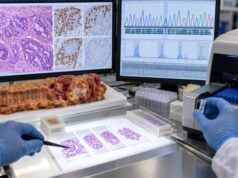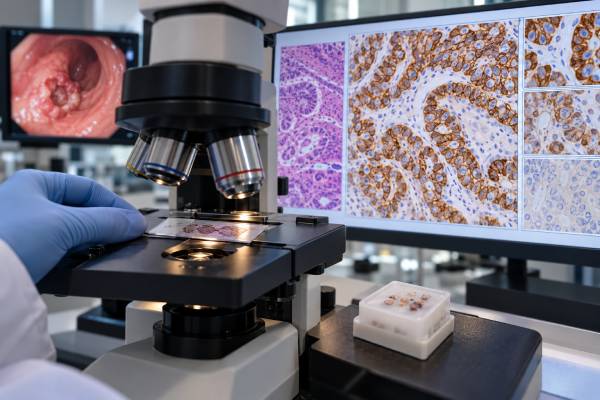
The CLDN18.2 test is a tumor-tissue immunohistochemistry test used to identify gastric or gastroesophageal junction adenocarcinomas that express enough claudin 18.2 to qualify for CLDN18.2-directed treatment. For the currently approved zolbetuximab setting, a tumor is considered CLDN18.2 positive when at least 75% of viable tumor cells show moderate-to-strong membranous staining with the approved companion-diagnostic approach. This is not a blood tumor marker, and the result is not interpreted like a serum value. Pathologists evaluate stained tumor cells on a biopsy or surgical specimen, considering both the percentage of positive cells and staining intensity. A positive result does not by itself indicate a worse prognosis or prove that a patient will respond, but it can identify an actionable treatment target in HER2-negative, locally advanced unresectable or metastatic gastric/GEJ adenocarcinoma. CLDN18.2 should be interpreted together with HER2, PD-L1, MSI/MMR, tumor stage, treatment history, and specimen quality.
- CLDN18.2 testing is performed on tumor tissue by immunohistochemistry, not as a routine blood test.
- For approved zolbetuximab selection, positivity is defined as moderate-to-strong membranous staining in at least 75% of viable tumor cells.
- A positive CLDN18.2 result is a predictive treatment biomarker, not a stand-alone cancer diagnosis or stage measurement.
- HER2 status still matters because the established first-line zolbetuximab indication is for HER2-negative advanced gastric/GEJ adenocarcinoma.
- Tumor heterogeneity can cause different CLDN18.2 results between biopsy sites or between primary and metastatic tissue.
Table of Contents
- What CLDN18.2 Is
- How CLDN18.2 Testing Is Performed
- How the Expression Score Is Read
- What a Positive Result Means
- CLDN18.2 With Other Gastric Biomarkers
- Limitations and Tumor Heterogeneity
- Questions to Ask After Testing
What CLDN18.2 Is
Claudins are proteins that form tight junctions between epithelial cells. The CLDN18 gene produces two main isoforms: claudin 18.1, associated primarily with lung tissue, and claudin 18.2, normally expressed in differentiated gastric mucosal cells.
In healthy stomach tissue, claudin 18.2 is largely hidden within tight junctions. During malignant transformation, loss of normal cell polarity and tissue architecture can expose the protein on the cancer-cell surface. That makes it accessible to a therapeutic antibody.
Zolbetuximab is a monoclonal antibody that binds CLDN18.2 and promotes immune-mediated cancer-cell killing through mechanisms including antibody-dependent cellular cytotoxicity and complement-dependent cytotoxicity. The biomarker test therefore functions as a target-selection assay: it asks whether enough tumor cells display the target for a treatment strategy supported by clinical-trial evidence.
CLDN18.2 is not a mutation test. A tumor can have strong protein expression without a CLDN18 gene mutation or amplification. It is also not equivalent to HER2, PD-L1, MSI, or EBV. Each marker describes a different biological feature.
For that reason, CLDN18.2 is usually considered as part of a broader gastric cancer biomarker panel in advanced disease.
How CLDN18.2 Testing Is Performed
Testing is usually performed on formalin-fixed, paraffin-embedded tumor tissue from an endoscopic biopsy, surgical resection, or metastatic biopsy. A pathologist first confirms that viable adenocarcinoma is present and that the specimen is suitable for immunohistochemistry.
The currently used companion-diagnostic approach for zolbetuximab employs the VENTANA CLDN18 (43-14A) RxDx Assay. The stain highlights membranous CLDN18 expression in tumor cells. The pathologist evaluates two features:
- the intensity of membranous staining, typically categorized as absent, weak, moderate, or strong; and
- the percentage of viable tumor cells showing the required intensity.
This is different from HER2 scoring, where categories such as 0, 1+, 2+, and 3+ have a separate algorithm and equivocal cases may require in situ hybridization. It is also different from PD-L1 combined positive score, which includes certain immune cells as well as tumor cells.
The specimen should contain enough viable tumor to represent the cancer. Tiny biopsies, crushed tissue, necrosis, cautery artifact, or poorly preserved blocks can make scoring difficult. When the original specimen is inadequate, another block or a repeat biopsy may be considered if the result would change treatment.
No fasting or blood preparation is required because the patient does not undergo a separate blood draw for the biomarker itself; the test is performed on tissue already obtained or on tissue collected through a clinically indicated biopsy.
How the Expression Score Is Read
For the approved zolbetuximab treatment setting, CLDN18.2 positivity is defined as at least 75% of viable tumor cells showing moderate-to-strong membranous staining using the validated assay. This threshold was used in the pivotal SPOTLIGHT and GLOW phase III trials.
| Staining pattern | General interpretation for approved zolbetuximab selection | Important note |
|---|---|---|
| ≥75% of viable tumor cells with moderate-to-strong membranous staining | CLDN18.2 positive | Can satisfy the biomarker component of treatment eligibility |
| <75% meeting the required intensity | Does not meet the approved positivity threshold | Lower expression may still be studied in clinical trials |
| Insufficient viable tumor | Indeterminate or not assessable | Another specimen may be needed |
The threshold is important because older studies used different cutoffs, such as 40% or 70% of tumor cells. A result from an older report or a research assay should not automatically be treated as equivalent to the current companion-diagnostic definition.
The percentage is not a continuous “cancer severity score.” A tumor with 90% positive cells is not necessarily twice as aggressive as one with 45%, and a 100% result does not mean every cancer cell in the body expresses the target identically. The score is primarily used to categorize expression for a specific therapeutic context.
Pathology reports may phrase the result as “CLDN18 positive,” “CLDN18.2 positive,” or may provide the percentage and intensity. When treatment eligibility is being considered, the oncologist should confirm that the assay, cutoff, and specimen are appropriate for the intended therapy.
What a Positive Result Means
A positive result means the tumor expresses CLDN18.2 at the level used to select patients for CLDN18.2-targeted therapy. In HER2-negative, locally advanced unresectable or metastatic gastric/GEJ adenocarcinoma, zolbetuximab combined with fluoropyrimidine-platinum chemotherapy improved progression-free and overall survival in the SPOTLIGHT and GLOW trials compared with chemotherapy alone.
A positive result does not mean that zolbetuximab will work for every patient. Trial results describe average benefit across a selected population. Individual outcomes depend on tumor burden, performance status, coexisting biomarkers, treatment tolerance, and other biological factors.
A positive result also does not automatically decide between every possible first-line regimen. Advanced gastric cancer treatment can involve overlapping biomarker pathways. A CLDN18.2-positive tumor may also express PD-L1, and a small subset may have MSI-high/dMMR biology. Treatment selection may therefore require discussion of immunotherapy evidence, HER2 status, contraindications, and patient priorities.
Zolbetuximab has characteristic adverse effects, particularly nausea and vomiting, often most prominent during early infusions. These effects are treatment issues rather than test-result issues, but they matter when deciding whether an actionable biomarker should translate into a particular therapy.
CLDN18.2 With Other Gastric Biomarkers
Gastric cancer biomarker testing increasingly works as a panel because several targets can coexist.
HER2 is usually assessed by immunohistochemistry with confirmatory in situ hybridization in appropriate equivocal cases. HER2-positive tumors have established HER2-directed treatment options. The pivotal zolbetuximab trials enrolled HER2-negative disease, so HER2 testing is essential before positioning CLDN18.2 therapy.
PD-L1 is commonly reported as a combined positive score (CPS). It can influence the expected benefit from adding immune checkpoint blockade to chemotherapy. A PD-L1 CPS test uses a completely different scoring system from CLDN18.2.
MSI/MMR identifies tumors with defective DNA mismatch repair. MSI-high/dMMR gastric cancers can be highly sensitive to immunotherapy and may have a distinct prognosis. MSI testing in gastric cancer can therefore change treatment priorities even when CLDN18.2 is also positive.
EBV identifies another molecular subtype by EBER in situ hybridization. EBV-positive tumors often show immune-rich biology, but EBV is not currently used as a stand-alone companion diagnostic for the same treatment decision.
The practical approach is not to ask which one marker “wins.” The oncology team integrates all clinically relevant markers, the line of therapy, drug approvals, and the patient’s overall condition.
Limitations and Tumor Heterogeneity
Gastric cancers are often heterogeneous. Different areas of the same tumor can show different biomarker expression, and a metastasis can differ from the primary tumor. CLDN18.2 is no exception.
A small endoscopic biopsy samples only a fraction of the cancer. If expression is patchy, the biopsy can underrepresent or overrepresent the overall percentage. Studies comparing matched specimens have found generally useful concordance but not perfect agreement.
Expression can also change over time or after treatment. When a previously negative result seems inconsistent with the clinical situation and a new biopsy is available, retesting may be reasonable, especially as new CLDN18.2-directed agents with different expression thresholds enter trials.
Another limitation is assay interchangeability. Research antibodies and laboratory-developed tests may not reproduce the same staining intensity or cutoff as the validated companion diagnostic. A report should identify the antibody clone or platform when possible.
Finally, “CLDN18.2 positive” is a predictive classification, not a general prognosis score. Studies have not consistently shown that CLDN18.2 expression by itself predicts survival in the absence of targeted treatment. Its strongest established value is identifying a therapeutically relevant surface target.
Questions to Ask After Testing
A patient or clinician reviewing a CLDN18.2 report can clarify the result with a few specific questions:
- Was the test performed with a validated companion-diagnostic assay?
- What percentage of viable tumor cells had moderate-to-strong membranous staining?
- Does the result meet the ≥75% threshold for the intended zolbetuximab indication?
- Is the tumor HER2 negative?
- What are the PD-L1 and MSI/MMR results?
- Was the specimen large and representative enough to trust the score?
- Would a newer metastatic specimen be more informative if the original tissue is limited?
Can CLDN18.2 be measured in blood?
Routine treatment selection is based on tumor-tissue immunohistochemistry. Blood-based CLDN18.2 assays are not the established companion-diagnostic standard.
Does 50% expression mean the test is almost positive?
It means the tumor shows expression but does not meet the current ≥75% companion-diagnostic threshold for the approved zolbetuximab setting. Clinical trials may use different thresholds for investigational drugs.
Can CLDN18.2 change after treatment?
Yes, expression may differ across tumor sites or over time. The importance of retesting depends on available tissue and whether the result would change a treatment option.
Is a positive result inherited?
No. CLDN18.2 IHC measures protein expression in tumor cells. It is not a germline hereditary cancer test.
The result becomes useful only when the scoring method and therapeutic context are matched correctly. “Positive” should therefore be read as a defined pathology threshold tied to a specific evidence base, not as a generic statement that the cancer is severe or that one treatment is guaranteed to work.
How pathologists distinguish membranous staining from nonspecific signal
For CLDN18.2 treatment selection, the relevant signal is membranous staining in viable tumor cells. Cytoplasmic haze, necrotic debris, or staining in non-neoplastic gastric glands should not be counted as if it were therapeutic target expression in the carcinoma.
Gastric biopsies can be fragmented and may contain only small clusters of tumor. A pathologist has to distinguish malignant cells from normal glands and from inflammation before estimating the percentage that meets the intensity threshold. This is one reason the result is a pathology interpretation rather than a machine-generated percentage alone.
When the specimen contains several biopsy fragments, expression may vary from fragment to fragment. The final score reflects the viable tumor represented in the tested material. If only a tiny amount of tumor is present, the report may note limitations even when a numerical percentage is provided.
Why the 75% cutoff should not be generalized to every CLDN18.2 drug
The ≥75% moderate-to-strong staining threshold is tied to the evidence and companion diagnostic used for zolbetuximab in advanced HER2-negative gastric/GEJ adenocarcinoma. It should not automatically be applied to every investigational CLDN18.2 antibody, antibody-drug conjugate, bispecific antibody, or CAR-T product.
New therapies may work at lower expression levels or may use different assays and cutoffs. A patient whose tumor shows 40% or 60% expression may not meet the current zolbetuximab definition but could still qualify for a clinical trial with different eligibility criteria.
This is a broader lesson in precision oncology: a biomarker threshold belongs to a specific drug, assay, disease, and evidence base. “CLDN18.2 positive” is not a universal biological constant independent of treatment context.
Testing at diagnosis versus retesting later
For advanced disease, early testing can prevent treatment delays. Many centers now try to obtain HER2, PD-L1, MSI/MMR, and CLDN18.2 results from the diagnostic biopsy so the first-line plan can be made without additional procedures.
Retesting may be considered when the original specimen was small, expression was near the threshold, or a new metastatic biopsy is available after treatment. The potential benefit of retesting is greatest when the result would open a treatment option that otherwise would not be available.
There is no requirement to retest every CLDN18.2-negative tumor routinely. The decision depends on tissue availability, prior therapy, the age and quality of the original specimen, and emerging treatment choices.
What coexisting biomarkers can mean for first-line choices
A HER2-negative, CLDN18.2-positive tumor may also have PD-L1 expression. Some patients may therefore appear eligible for more than one evidence-based first-line strategy. There are no simple cross-trial rules proving that one option is always superior to another for every overlap pattern.
MSI-H/dMMR adds another layer because these tumors can be exceptionally sensitive to immune checkpoint inhibition. In such cases, the strength of the MSI signal may outweigh a more general biomarker overlap. Patient age, autoimmune disease, neuropathy risk, nausea tolerance, disease burden, and local approvals also matter.
The value of a complete panel is that these questions can be discussed before treatment starts. The CLDN18.2 result should be seen as one actionable branch in a decision tree, not as a replacement for the rest of gastric cancer biomarker testing.
Why the pathology report should identify the specimen
CLDN18.2 expression can vary between the primary stomach tumor and metastatic sites, so the report should make clear which block or biopsy was tested. A result from a small diagnostic biopsy may remain clinically useful, but knowing the specimen helps the oncology team judge whether heterogeneity could matter.
If a later metastatic biopsy is available, it may provide an opportunity to reassess multiple biomarkers at once rather than repeating CLDN18.2 alone. The decision should be driven by whether new information would change treatment, not by a routine requirement to retest every patient.
Bottom-line interpretation
The most important details on a CLDN18.2 report are the assay, the percentage of viable tumor cells with moderate-to-strong membrane staining, and whether the tumor is HER2 negative in the intended treatment setting. A simple word such as “positive” is less useful without those details. Matching the pathology threshold to the drug evidence prevents both missed treatment opportunities and inappropriate use outside the validated population.
References
- Advances and challenges in gastric cancer testing: the role of biomarkers 2025 (Review)
- Claudin 18.2 as a New Biomarker in Gastric Cancer—What Should We Know? 2024 (Review)
- Global prevalence of claudin 18 isoform 2 in tumors of patients with locally advanced unresectable or metastatic gastric or gastroesophageal junction adenocarcinoma 2024 (Review)
- Targeting Claudin-18.2 for cancer therapy: updates from 2024 ASCO annual meeting 2024 (Review)
- CLDN18.2-Directed Therapeutics in Gastric and Gastroesophageal Junction Adenocarcinoma: Biomarker Assessment, Expression Dynamics, and Treatment Sequencing 2026 (Review)
Disclaimer
CLDN18.2 results must be interpreted using the assay, staining threshold, tumor type, HER2 status, and current treatment indication. A positive test identifies a potential therapeutic target but does not guarantee response or replace full oncologic staging and biomarker review. Treatment decisions should be made with an oncology team familiar with current gastric cancer approvals and the patient’s overall health.