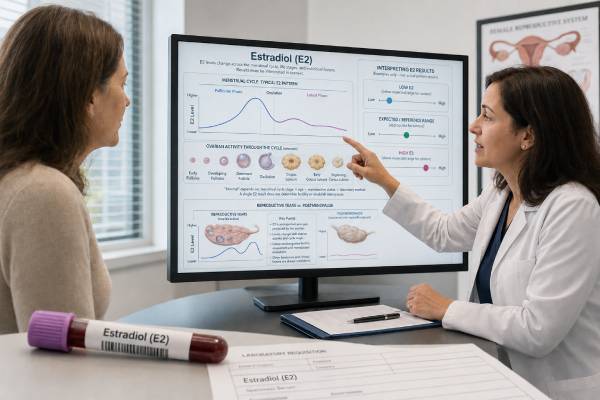
An estradiol (E2) test measures the most active estrogen during the reproductive years. It helps evaluate menstrual changes, fertility treatment, ovarian function, puberty, menopause-related questions, and hormone therapy. Estradiol rises and falls across the menstrual cycle, so the same result can be normal on one day and unexpected on another. Early-follicular E2 is often measured with FSH during fertility evaluation; a higher-than-expected early value can suppress FSH and complicate ovarian-reserve interpretation. Low estradiol may occur with menopause, primary ovarian insufficiency, hypothalamic suppression, or pituitary disease. High results may reflect a normal preovulatory surge, pregnancy, fertility medication, obesity-related estrogen production, or less commonly an estrogen-producing tumor. Routine estradiol testing is usually not needed to diagnose typical menopause after age 45 because symptoms and menstrual history are more informative. Laboratory method, cycle day, age, sex, pregnancy, and hormone use must be considered.
- Estradiol is the dominant estrogen before menopause and changes markedly across the menstrual cycle.
- Cycle day and treatment timing are essential; one universal normal range does not apply.
- Low E2 with high FSH suggests reduced ovarian function, while low E2 with low FSH suggests central suppression.
- High early-follicular E2 can make FSH look reassuring despite reduced ovarian reserve.
- Typical menopause after age 45 is usually diagnosed clinically rather than with repeated estradiol testing.
- Unexpected bleeding, severe pelvic pain, or pregnancy symptoms require clinical assessment beyond an E2 result.
Table of Contents
- What the estradiol Test Measures
- Why the Test Is Ordered
- Preparation, Timing, and the Testing Process
- Normal Range and How Results Are Interpreted
- What High estradiol Results Can Mean
- What Low estradiol Results Can Mean
- How Results Fit With Other Hormones and Tests
- Next Steps After the Result
What the estradiol Test Measures
Estradiol is produced mainly by ovarian follicles before menopause. Smaller amounts come from the testes, adrenal precursors, and conversion of androgens in fat and other tissues. It supports the uterine lining, breast and reproductive tissues, bone, brain, skin, and cardiovascular physiology.
During a menstrual cycle, E2 is relatively low early, rises as a dominant follicle grows, peaks before ovulation, falls briefly, and has a second smaller luteal rise. Menopause, pregnancy, puberty, and hormone treatment each create a different expected pattern.
A hormone result is a measurement made under defined laboratory conditions, not a diagnosis by itself. The same concentration can carry different meaning at different ages, cycle stages, pregnancy stages, or times of day. Laboratories also use different analyzers, calibration systems, antibodies, and calculation methods. For that reason, the reference interval printed beside the result should take priority over a range copied from another report or website.
Sensitive measurement matters at low concentrations, such as in children, men, postmenopausal women, or people taking aromatase inhibitors. Standard immunoassays can be less accurate near their lower limit; mass spectrometry may be preferred for a clinically important low result.
A broader estrogen levels test compares estradiol with estrone and estriol.
Why the Test Is Ordered
Estradiol is ordered when its result can clarify ovarian or testicular function, cycle stage, treatment response, or a pituitary-gonadal pattern.
- Irregular or absent periods, infertility, or suspected anovulation.
- Monitoring follicles during IVF or ovulation induction.
- Possible primary ovarian insufficiency or central hypogonadism.
- Early or delayed puberty.
- Unexpected estrogen effects in men, such as gynecomastia, in selected evaluations.
- Monitoring certain hormone therapies or estrogen-producing tumors.
Estradiol is not a general test for every menopause symptom. In typical perimenopause, levels fluctuate so widely that a normal result does not exclude the transition and a low result may reverse in the next cycle. Testing becomes more useful with early symptoms, amenorrhea before age 40, hysterectomy with unclear ovarian status, or suspected pituitary disease.
Interpretation starts with the reason the test was ordered. A clinician looking for an adrenal enzyme disorder uses different cutoffs and follow-up tests than a clinician evaluating irregular periods, infertility, menopausal symptoms, or androgen deficiency. The result should be read with symptoms, examination findings, age, reproductive stage, and related laboratory values rather than compared with one universal “optimal” number.
When periods stop unexpectedly, an amenorrhea hormone panel commonly includes pregnancy testing, FSH, estradiol, prolactin, and thyroid studies.
Preparation, Timing, and the Testing Process
Timing depends on the question. Early-follicular testing, preovulatory monitoring, treatment monitoring, and postmenopausal assessment use different expectations.
- Record the first day of the last period and the cycle day of collection.
- List contraceptives, fertility medicines, estrogen, testosterone, aromatase inhibitors, and supplements.
- Follow the fertility clinic’s exact timing when monitoring stimulation.
- Report pregnancy, lactation, recent ovarian surgery, or major illness.
- Use the same laboratory and method for treatment trends when possible.
For ovarian-reserve interpretation, E2 is often drawn on cycle days 2–4 with FSH. During IVF, serial values are interpreted with follicle ultrasound and medication dose. For people on injectable or transdermal hormones, the interval from the last dose can change the level.
Before collection, provide a complete list of prescription medicines, over-the-counter products, supplements, contraceptives, fertility drugs, and hormone therapy. Do not stop prescribed treatment without instructions. Some products change hormone production, while others alter binding proteins or interfere with an immunoassay. High-dose biotin is a well-known source of interference in several hormone tests, although the direction and size of the error depend on the platform.
Acute illness can temporarily suppress or stimulate reproductive signaling. A test drawn during fever, major surgery, severe calorie restriction, or intense training may describe that temporary state rather than the person’s usual hormone function. When the clinical situation is stable and there is no urgent reason to test immediately, postponing or repeating the measurement can prevent an incorrect label.
Normal Range and How Results Are Interpreted
Estradiol is usually reported in pg/mL or pmol/L. Approximate ranges overlap between phases and assays, so the table is illustrative rather than diagnostic.
| Stage | Approximate pattern | Interpretive note |
|---|---|---|
| Early follicular | Often about 20–80 pg/mL | Higher values can suppress FSH |
| Preovulatory | May rise above 150–300 pg/mL | Peak timing varies |
| Luteal | Often about 50–250 pg/mL | Pulses and corpus luteum activity create variation |
| Postmenopause without therapy | Often below about 20–30 pg/mL | Assay sensitivity is important |
| Pregnancy or stimulation | Can be much higher | Use stage- or protocol-specific expectations |
Approximate conversion is 1 pg/mL equals 3.67 pmol/L. A laboratory may use substantially different limits. Estradiol in men, children, or people on gender-affirming therapy requires the relevant population and treatment goal rather than a generic female cycle range.
A value close to a cutoff deserves more caution than a value that is clearly and repeatedly abnormal. Borderline results may move across the reference limit because of normal biologic variation, recent illness, sleep disruption, exercise, stress, or sample timing. Clinicians often repeat a test under better-controlled conditions before ordering imaging or beginning treatment. The repeat is most useful when the timing, medication list, and assay method are documented.
Trends can be useful when the same question is followed over time, but only when the measurements are reasonably comparable. A change between laboratories may reflect a method difference. A change after starting or stopping hormones may be expected. Record the laboratory, units, collection time, cycle day or pregnancy week, and relevant treatment so later results can be compared in context.
FSH and E2 should be interpreted together, as described in the FSH test guide.
What High estradiol Results Can Mean
High estradiol can be physiologic, treatment-related, or due to increased endogenous production. Timing and symptoms determine whether it is expected.
- Normal preovulatory surge, luteal activity, or pregnancy.
- Ovarian stimulation or estrogen therapy.
- Obesity-related aromatization of androgens.
- Functional ovarian cyst or persistent follicle.
- Reduced liver clearance or certain medicines.
- Rare estrogen-producing ovarian, testicular, or adrenal tumors.
During fertility treatment, E2 is a response marker rather than a stand-alone safety test. Follicle number, size, symptoms, and the treatment protocol determine ovarian hyperstimulation risk. A high value in a natural cycle may simply reflect the correct preovulatory timing.
In men, a modestly high result can accompany obesity, liver disease, or testosterone therapy. Gynecomastia evaluation also considers testosterone, LH, hCG, prolactin, liver function, medicines, and examination. Treating the number without finding the cause can be harmful.
Repeat an unexpected result with documented timing and a reliable method. Persistent elevation with a mass, postmenopausal bleeding, rapid puberty, or virilization requires targeted evaluation.
During fertility treatment, an ovulation hormone panel and ultrasound provide more context than estradiol alone.
What Low estradiol Results Can Mean
Low estradiol indicates reduced estrogen production or treatment exposure, but the gonadotropin pattern shows whether the problem is ovarian or central.
- Natural menopause or the late menopausal transition.
- Primary ovarian insufficiency or ovarian damage.
- Hypothalamic suppression from low energy availability, stress, or intensive exercise.
- Pituitary disease, high prolactin, or severe chronic illness.
- Aromatase inhibitors, GnRH analogs, or insufficient estrogen replacement.
- Normal early-follicular or prepubertal physiology.
Low E2 with high FSH points toward ovarian failure because the pituitary is increasing stimulation. Low E2 with low or normal FSH suggests reduced hypothalamic or pituitary signaling. Symptoms can include hot flashes, vaginal dryness, sleep change, absent periods, and bone loss, but these symptoms are not specific.
In amenorrheic athletes or people with undernutrition, restoring energy availability is central to recovery and bone protection. Simply prescribing estrogen without addressing the energy deficit may not correct the underlying risk.
Evaluation may include pregnancy testing, FSH, LH, prolactin, TSH, bone health assessment, and investigation of nutrition or chronic disease. Hormone therapy decisions depend on age, cause, contraindications, and goals.
Persistent low E2 before age 40 may require a primary ovarian insufficiency evaluation.
How Results Fit With Other Hormones and Tests
E2 becomes most informative when paired with FSH, LH, cycle timing, and symptoms.
| Estradiol | FSH/LH pattern | Possible interpretation |
|---|---|---|
| Low | FSH high | Primary ovarian insufficiency or menopause |
| Low | FSH/LH low or normal | Hypothalamic or pituitary suppression |
| High early in cycle | FSH may appear lower | Persistent follicle or reduced reserve can complicate interpretation |
| Rising during stimulation | Follicles enlarging on ultrasound | Expected treatment response |
| Unexpectedly high after menopause | Variable | Review hormones, assay, liver status, and possible estrogen source |
AMH and antral follicle count estimate ovarian response but do not replace E2 when the question is current follicle activity. Progesterone helps confirm ovulation after E2 has risen and the follicle has released an egg.
Next Steps After the Result
The next step is determined by reproductive stage, symptoms, and the hormone pattern rather than the E2 number alone.
- Verify cycle day, pregnancy status, treatment timing, units, and laboratory method.
- Repeat an unexpected low or high result under standardized conditions.
- Interpret FSH and LH with E2 to localize ovarian versus central dysfunction.
- Use ultrasound and serial testing when monitoring fertility treatment.
- Evaluate bleeding, masses, puberty changes, or pituitary symptoms promptly.
- Choose treatment based on the confirmed cause, age, fertility goals, and bone or symptom risks.
For typical menopause, treatment decisions are based mainly on symptoms, health history, and contraindications rather than achieving a target E2. For ovarian insufficiency at a young age, physiologic hormone replacement is often considered until the usual age of menopause unless contraindicated. Fertility pathways require separate counseling.
Bring the actual report to the follow-up visit rather than only recalling that the level was “high” or “low.” The report shows units, the laboratory interval, specimen type, and sometimes the assay method. Ask whether the result needs confirmation, whether a related hormone should be measured at the same time, and what finding would change management.
A useful plan defines the next step and its timing. That may be no action, a repeat test, a dynamic stimulation or suppression test, ultrasound, semen analysis, genetic testing, or referral to endocrinology, reproductive endocrinology, urology, or maternal-fetal medicine. It should also identify symptoms that warrant earlier contact instead of waiting for the routine appointment.
Rapidly progressive symptoms deserve faster evaluation than a mild, stable laboratory abnormality. Examples include sudden virilization, severe headache with visual change, signs of adrenal crisis, heavy bleeding with dizziness, or concerning pregnancy symptoms. The laboratory number may guide the workup, but urgent decisions are driven by the whole clinical picture.
Treatment should address the confirmed cause and the person’s goals. Lowering or raising a laboratory value without establishing why it is abnormal can hide an important condition or create new problems. Hormone therapy can affect fertility, blood counts, liver function, clot risk, bone health, and pregnancy, so monitoring plans should be individualized.
Seek prompt care for severe pelvic pain, heavy bleeding with dizziness, a positive pregnancy test with one-sided pain, or neurologic symptoms such as severe headache and visual change. These situations cannot be assessed safely with estradiol alone.
When a repeat measurement is planned, try to reproduce the conditions that matter for this test. Use the same laboratory when practical, note the collection time, and record any change in medicines or reproductive stage. Consistency does not remove all biologic variation, but it makes a true trend easier to distinguish from noise.
Reference intervals describe a population selected by the laboratory; they do not define a treatment target for every person. A result inside the interval can still require attention when symptoms are strong or when another hormone shows a clear mismatch. Conversely, a small deviation may not represent disease when the timing or clinical setting explains it.
A laboratory result can answer only the question built into the test. It may show hormone concentration, but it cannot by itself prove ovulation quality, egg quality, sperm production, placental health, or the cause of a symptom. Those conclusions usually require a combination of history, examination, imaging, and other targeted tests.
When fertility is the concern, age, duration of trying to conceive, menstrual pattern, pregnancy history, semen findings, and tubal or uterine factors often affect the plan as much as a single hormone value. Testing both partners in parallel can prevent months of delay and reduce the chance that an incidental hormone result distracts from a more direct cause.
When symptoms are being monitored rather than fertility, define the outcome that treatment is meant to improve. Examples include restoration of periods, relief of hot flashes, reduction of unwanted hair growth, recovery of sexual function, preservation of bone health, or safe progression of puberty. Laboratory monitoring is most useful when tied to one of these clinical outcomes.
People using nonprescription “hormone balance” products should mention them before testing. DHEA, progesterone creams, testosterone boosters, compounded preparations, and biotin can alter physiology or make results harder to interpret. Product labels may not reliably predict the dose absorbed, so the safest approach is to review the exact container or ingredient list with the clinician.
Results can also differ because laboratories report conventional and SI units. A value expressed in ng/dL cannot be compared directly with one expressed in nmol/L without a hormone-specific conversion. Always compare the number, unit, and interval together. This simple check prevents many apparent contradictions between reports.
An abnormal result can have emotional weight, especially during fertility treatment, pregnancy, or puberty evaluation. Ask the clinician to separate what is known from what remains uncertain. A clear explanation of the likely causes, the confirmation plan, and the time frame for action is more useful than trying to interpret every decimal place independently.
Clinicians also consider whether the test result agrees with the physical findings. A marked biochemical abnormality without expected symptoms may prompt confirmation with a more specific laboratory method. Strong symptoms with a normal result may lead to testing at a different time, measuring a related hormone, or looking for a nonhormonal cause.
The pace of change can be as important as the level itself. Slow changes over years commonly fit physiologic aging or a chronic endocrine condition. Changes over weeks or a few months raise more concern for a new medicine effect, pregnancy-related change, acute illness, or a hormone-producing lesion, especially when symptoms progress quickly.
No single follow-up pathway fits every abnormal value. Mild and explainable results may only need observation. Persistent or substantial abnormalities may require specialist review and tests chosen to locate the source of hormone production or the level of signaling failure. The sequence should be deliberate so that each test answers a specific unresolved question.
Keep a copy of the laboratory report and the order indication. The clinician needs more than the highlighted flag: the numeric value, unit, reference interval, specimen type, collection date and time, and any comment about the assay can change interpretation. A result copied into a patient portal message without those details may be impossible to compare with a later test. This documentation is especially important when care moves between a primary clinician, endocrinologist, fertility clinic, and hospital laboratory.
Before repeating testing, decide what the repeat is meant to resolve. It may confirm persistence, correct a timing error, remove a medication effect, or use a more specific assay. Repeating the same poorly timed test without changing the conditions often reproduces uncertainty rather than solving it. The clinician should also state what result would lead to observation, another laboratory test, imaging, or treatment.
Small deviations from a reference interval are common because the interval usually contains about 95% of a selected comparison population. Some healthy people fall outside it, while some people with disease fall inside it. The clinical importance depends on how far the value is from the limit, whether it persists, whether related hormones agree, and whether symptoms fit the physiology. A reference flag is therefore a prompt for interpretation, not proof of disease.
Hormone results are also affected by changes in binding proteins and metabolism. Liver disease, thyroid disease, kidney disease, pregnancy, body composition, and oral estrogen exposure can change measured concentrations without producing the same change in tissue effect. When a binding issue is suspected, the clinician may use a free or calculated hormone, a related binding protein, or a more specific laboratory method rather than interpreting the total concentration alone.
Fertility decisions should not be reduced to a single endocrine value. A hormone may help choose medication dose, confirm ovulation, or identify a treatable disorder, but it does not measure every step required for pregnancy. Reproductive age, sperm exposure or semen quality, tubal patency, uterine anatomy, timing, prior pregnancies, and the duration of trying all influence the next step. A balanced evaluation prevents overreaction to an incidental result.
Testing can be different during pregnancy, adolescence, menopause, or hormone treatment because physiology is intentionally changing. A range derived from untreated adults may be inappropriate in these settings. Ask whether the laboratory interval matches the patient’s age and reproductive state and whether the clinical team uses a separate treatment or pregnancy target. This is particularly important when a portal automatically marks a result high or low against a generic range.
A laboratory method with greater analytical specificity is useful when the expected concentration is low, the result is surprising, or a major decision depends on the number. Mass-spectrometry methods can separate closely related steroids better than many immunoassays, while dynamic tests can reveal reserve or responsiveness that a basal sample cannot show. The best method depends on the hormone and question; a technically sophisticated test is not automatically necessary for every routine result.
References
- Recommendations for the measurement of sexual steroids in clinical practice. A position statement of SEQCML/SEEN/SEEP 2023 (Position Statement)
- Comprehensive Review of Estradiol, Progesterone, Luteinizing Hormone, and Follicle-Stimulating Hormone Reference Intervals in Transgender, Nonbinary, and Cisgender Individuals 2025 (Review)
- Current evaluation of amenorrhea: a committee opinion 2024 (Committee Opinion)
- Menopause 2026 (Review)
- Guideline on premature ovarian insufficiency 2024 (Guideline)
Disclaimer
This article is general information and cannot diagnose infertility, menopause, ovarian insufficiency, or a tumor. Estradiol interpretation depends on cycle day, age, treatment, pregnancy, and assay method. Discuss abnormal results with a qualified clinician.