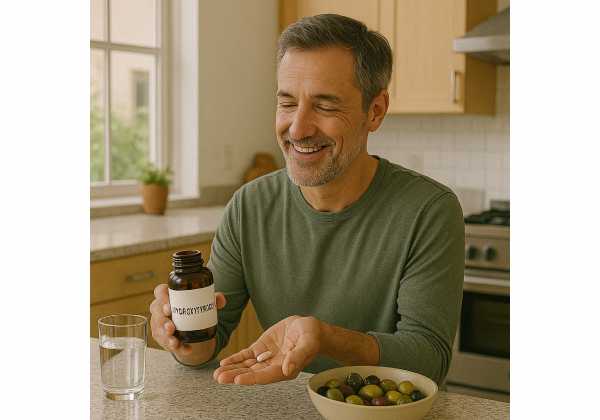
Hydroxytyrosol is one of the main protective polyphenols in olives, extra-virgin olive oil, and olive leaf extracts. It helps explain why traditional Mediterranean eating patterns do more than swap butter for oil. The strongest human evidence does not show hydroxytyrosol as a stand-alone anti-aging pill. It shows olive polyphenols working inside a larger food pattern that supports blood vessels, lipid oxidation control, inflammation balance, metabolic health, and possibly brain aging.
For longevity, hydroxytyrosol fits best as a food-first tool: choose high-quality extra-virgin olive oil, use it daily in place of less healthy fats, and treat supplements as optional, targeted add-ons. The useful dose is usually small compared with many nutraceuticals. The challenge is quality, stability, and knowing whether a product delivers the olive compounds listed on the label.
Table of Contents
- What Hydroxytyrosol Is
- How It Supports Healthy Aging
- Food Sources and Olive Oil Quality
- Supplements, Dosing, and Labels
- Safety, Side Effects, and Interactions
- Who Benefits Most
- How to Use It in a Longevity Plan
- Common Mistakes
What Hydroxytyrosol Is
Hydroxytyrosol is a small phenolic compound made by the olive tree. It appears in olives, olive oil, olive leaves, and olive-processing water. In extra-virgin olive oil, it exists both as free hydroxytyrosol and as part of larger related compounds, including oleuropein derivatives, oleacein, and other secoiridoids. During digestion, processing, and storage, some of these compounds break down into hydroxytyrosol and tyrosol.
Hydroxytyrosol gets attention because it is strongly active in lab tests against oxidative stress. In human biology, its role is more subtle. After absorption, the body quickly converts much of it into metabolites through glucuronidation, sulfation, and methylation. That means the compound in the bloodstream is often not the same free hydroxytyrosol seen in a test tube. This does not make it useless. It means the health effects likely come from metabolites, gene-signaling effects, vascular responses, and interactions with gut microbes rather than direct antioxidant “mopping up.”
Polyphenols are not vitamins. There is no official daily requirement for hydroxytyrosol, and deficiency is not a recognized condition. A better way to view it is as a bioactive food compound: it is not required for survival, but regular intake from whole foods supports patterns linked with healthier aging.
Hydroxytyrosol differs from common olive oil nutrients in two important ways. First, it is not the fat. Olive oil’s main fat is oleic acid, a monounsaturated fatty acid. Second, it is not present in equal amounts across all olive oils. Refined olive oil keeps much of the oleic acid but loses many phenolic compounds during processing. Extra-virgin olive oil keeps more of the olive’s phenolic fraction because it is mechanically extracted without heavy refining.
This distinction matters for anyone comparing olive oil and longevity. A tablespoon of refined olive oil and a tablespoon of high-phenolic extra-virgin olive oil deliver similar calories and fat, but they do not deliver the same polyphenol profile.
How It Supports Healthy Aging
Hydroxytyrosol fits into longevity through mechanisms that overlap with the main risks of aging: vascular dysfunction, lipid oxidation, chronic low-grade inflammation, metabolic strain, and brain vulnerability. The evidence is strongest for cardiovascular markers and weakest for claims that it directly slows biological aging.
Blood lipids and LDL oxidation
One of the clearest human-relevant findings is that olive oil polyphenols help protect blood lipids from oxidative damage. Oxidized LDL is not the same thing as LDL cholesterol on a standard lipid panel. LDL cholesterol measures how much cholesterol is carried inside LDL particles. Oxidized LDL reflects chemical damage to those particles, which makes them more likely to contribute to atherosclerosis.
The European health claim for olive oil polyphenols uses a daily target of 5 mg of hydroxytyrosol and related compounds from 20 g of olive oil. In kitchen terms, 20 g is about 1.5 tablespoons. Not every olive oil contains enough polyphenols to meet that threshold, so oil quality matters.
Hydroxytyrosol does not replace lipid management. Someone with high ApoB, high non-HDL cholesterol, familial risk, diabetes, or existing cardiovascular disease still needs standard risk assessment. Olive polyphenols support the terrain; they do not erase particle burden. For a more direct marker-focused approach, ApoB and non-HDL cholesterol give clearer information about atherosclerotic risk than total cholesterol alone.
Endothelial function and vascular aging
The endothelium is the thin inner lining of blood vessels. Healthy endothelial cells help regulate blood flow, nitric oxide signaling, blood pressure, clotting balance, and inflammation. Aging, smoking, high glucose, hypertension, poor sleep, visceral fat, and chronic inflammation all stress this lining.
Hydroxytyrosol and related olive phenolics appear to support endothelial function through several routes:
- Lower oxidative stress inside vascular cells
- Better nitric oxide availability
- Reduced inflammatory signaling
- Less LDL oxidation
- Support for normal platelet and immune signaling
Human trials vary in design, dose, and product type, so the results are not uniform. Still, vascular biology is one of the more credible reasons to prioritize high-polyphenol extra-virgin olive oil over generic fat replacement.
Inflammation and redox balance
Hydroxytyrosol sits in the broader family of plant compounds that influence redox balance. Redox balance means the body produces enough reactive molecules for normal signaling without letting oxidative damage run unchecked.
This matters because aging is not helped by suppressing every oxidative signal. Exercise, heat exposure, cold exposure, and fasting-like stressors all rely on short bursts of cellular stress to trigger adaptation. Olive polyphenols appear gentler than high-dose antioxidant supplements because they come in food amounts and interact with signaling pathways rather than acting like a blunt chemical shield. This fits the broader idea of redox balance and antioxidants: support resilience without flattening the signals that help cells adapt.
Inflammation is similar. Hydroxytyrosol is often described as anti-inflammatory, but that phrase needs precision. It does not work like an NSAID pain reliever. It appears to reduce overactive inflammatory signaling in certain contexts, especially where oxidative stress, metabolic strain, and vascular dysfunction overlap.
Metabolic health
Olive oil is calorie-dense, but Mediterranean diets rich in extra-virgin olive oil have still performed well in cardiometabolic research. The reason is simple: the oil usually replaces butter, cream, processed sauces, refined snack fats, or low-quality dressings while improving the taste of vegetables, legumes, fish, and whole grains.
Hydroxytyrosol itself has been studied for glucose control, insulin signaling, and lipid metabolism. Human results remain mixed, and supplement trials are still too small to support strong disease-treatment claims. The most reliable metabolic use is food pattern design: extra-virgin olive oil helps people eat more plants and fewer ultra-processed fats.
For someone tracking metabolic aging, hydroxytyrosol is not the first lever. Protein intake, waist size, resistance training, sleep, fiber, and glucose control come first. Olive polyphenols then add a useful layer. People monitoring A1c, fasting glucose, and fasting insulin should judge progress by those markers, not by a supplement label.
Brain aging and the gut-brain connection
Mediterranean diets with extra-virgin olive oil have been linked with better cognitive aging in several human studies. Hydroxytyrosol is one candidate mechanism, but it is not the whole explanation. Olive oil improves meals, displaces lower-quality fats, supports vascular health, and travels with other protective foods: fish, greens, beans, herbs, nuts, fruit, and fermented foods.
The brain benefits likely follow several paths:
- Better vascular function and blood flow
- Lower cardiometabolic risk
- Less oxidative and inflammatory stress
- Gut microbiome effects from olive polyphenols
- Better adherence to a plant-rich eating pattern
The gut angle is especially interesting. Many polyphenols reach the colon, where microbes transform them into smaller compounds. Those metabolites then influence inflammation, gut barrier function, and immune signaling. This helps explain why polyphenol-rich foods often work best as a pattern rather than as isolated extracts. A diet that combines olive oil with legumes, onions, greens, berries, herbs, and fermented foods creates a better microbial environment than olive oil alone. That is the same logic behind gut-friendly nutrition for longevity.
Food Sources and Olive Oil Quality
The best everyday source of hydroxytyrosol is high-quality extra-virgin olive oil. Table olives, olive leaf extracts, and olive-derived supplements also contribute, but they differ in sodium content, compound profile, dose precision, and safety considerations.
Extra-virgin olive oil is the most practical choice because it fits normal meals. The target does not require exotic dosing. About 1 to 2 tablespoons daily of a high-polyphenol oil is enough to make olive phenolics a routine part of the diet.
Extra-virgin olive oil
Extra-virgin olive oil contains more phenolic compounds than refined olive oil because it is mechanically extracted and less processed. Its flavor gives clues about phenolic strength. Bitterness and peppery throat sting often signal higher polyphenol content, especially from compounds such as oleuropein derivatives and oleocanthal.
Look for:
- “Extra virgin” on the label
- Harvest date, not only best-by date
- Dark glass, tins, or bag-in-box packaging
- Recent harvest within the last 12 to 18 months
- Storage away from heat and light
- A producer that lists total polyphenols or lab testing when available
Polyphenol values vary widely. Some oils contain less than 100 mg/kg total phenolics, while high-phenolic oils exceed 250 to 500 mg/kg. Those numbers are not always listed on retail labels, and testing methods differ. Taste, harvest date, and reputable sourcing remain useful when lab numbers are absent.
Use extra-virgin olive oil in salad dressings, dips, lentils, beans, roasted vegetables, soups after cooking, and low-to-moderate heat cooking. It is more heat-stable than many people assume because its monounsaturated fat profile and antioxidant content protect it. Still, repeated overheating, deep frying, and long storage degrade quality.
Table olives
Olives contain hydroxytyrosol and related compounds, especially after curing breaks down oleuropein. They also bring fiber-like plant material and strong flavor. The drawback is sodium. Many table olives are brined, so people with hypertension, kidney disease, heart failure, or salt-sensitive blood pressure should treat olives as a condiment, not a main polyphenol source.
A practical serving is 5 to 10 olives with a meal. Rinse brined olives if sodium intake needs tighter control.
Olive leaf extract
Olive leaf extract usually emphasizes oleuropein, which metabolizes partly into hydroxytyrosol. It is more supplement-like than food-like. Some products are used for blood pressure, glucose, or immune support, but product quality varies.
Olive leaf extract is not the same as olive oil polyphenols. It contains a different mix of compounds and does not provide the culinary fat replacement that makes extra-virgin olive oil so useful in Mediterranean eating.
Olive mill wastewater and fruit extracts
Some newer supplements come from olive fruit water or olive-processing byproducts. These products aim to concentrate hydroxytyrosol while reducing waste. They are promising from a sustainability viewpoint, but the user still needs proof of standardization, contaminant testing, and clear dosing.
| Source | Main advantage | Main caution | Practical use |
|---|---|---|---|
| High-polyphenol extra-virgin olive oil | Food-based, supports Mediterranean meals | Polyphenol content varies | 1 to 2 tablespoons daily |
| Regular extra-virgin olive oil | Easy to find and use | May contain fewer phenolics | Daily replacement for butter or refined oils |
| Table olives | Whole-food source with strong flavor | Often high in sodium | 5 to 10 olives as a condiment |
| Olive leaf extract | Concentrated oleuropein-rich option | Different profile from olive oil | Use only standardized products |
| Hydroxytyrosol supplement | Precise dose | Less evidence than food-pattern use | Consider for targeted short trials |
Supplements, Dosing, and Labels
Hydroxytyrosol supplements are usually sold as capsules, softgels, liquids, or olive fruit extracts. They often provide 5 mg to 25 mg of hydroxytyrosol per serving, though some products use higher amounts. More is not automatically better. Human evidence does not show that pushing the dose far above food-like intake creates greater longevity benefits.
A practical supplement range is often 5 to 15 mg per day of hydroxytyrosol, especially for people using it to approximate the olive polyphenol exposure found in high-quality Mediterranean diets. Some clinical studies use 15 mg daily or higher, but trial designs differ and outcomes are not consistent enough to define an optimal dose.
The label needs careful reading. “Olive extract 500 mg” does not tell you the hydroxytyrosol dose. A good label states the amount of hydroxytyrosol, oleuropein, or total olive polyphenols per serving.
Look for these details:
- Standardized hydroxytyrosol amount in mg
- Source, such as olive fruit, olive water, olive leaf, or synthetic hydroxytyrosol
- Third-party testing or certificate of analysis
- Heavy metal, solvent, and microbial testing
- Clear serving size and daily dose
- Minimal proprietary blends
- Expiration date and storage instructions
The food matrix matters. Hydroxytyrosol in extra-virgin olive oil arrives with fat, other phenolics, tocopherols, and a meal. A capsule arrives in isolation. That does not make supplements ineffective, but it changes absorption and metabolism. Some formulations use emulsions, encapsulation, or lipid carriers to improve delivery. These technologies are interesting, but they need more human evidence before they become a reason to pay a large premium.
Hydroxytyrosol also overlaps with other polyphenol supplements, including resveratrol, quercetin, curcumin, EGCG, cocoa flavanols, and grape seed extract. Stacking several high-dose polyphenols rarely has clear evidence. It also makes side effects and interactions harder to trace. A cleaner approach is to choose one targeted supplement at a time, use a defined dose, and track a small number of outcomes.
Safety, Side Effects, and Interactions
Hydroxytyrosol from foods has a strong safety profile. People have consumed olives and olive oil for centuries, and extra-virgin olive oil is a core part of Mediterranean diets. Supplemental hydroxytyrosol also has supportive safety assessments at intended use levels, but supplement quality and personal medical context still matter.
Common side effects are uncommon at typical doses. When they occur, they usually involve digestion: nausea, loose stool, reflux, or stomach discomfort. Liquid olive extracts sometimes taste bitter or peppery, which some people find unpleasant.
Use more caution with supplements if any of these apply:
- Pregnancy or breastfeeding
- Planned surgery in the next 1 to 2 weeks
- Use of anticoagulant or antiplatelet medication
- Low blood pressure or blood pressure medication
- Diabetes medication or frequent hypoglycemia
- Kidney disease, liver disease, or complex chronic illness
- Multiple supplements with blood-thinning or glucose-lowering effects
- Known allergy or sensitivity to olive products
Food-level extra-virgin olive oil is usually easier to fit safely than concentrated extracts. The main issue with oil is calories. One tablespoon contains about 120 calories. Adding olive oil on top of an unchanged diet can lead to weight gain. Replacing butter, creamy dressings, refined seed-oil snacks, or ultra-processed sauces is a better strategy.
Table olives create a different safety issue: sodium. A small serving fits well for most people, but large servings can raise sodium intake quickly. People working on blood pressure should pair olive foods with a broader sodium-potassium pattern, not treat olives as an unlimited health food.
Supplements also need a stop rule. Stop and reassess if you notice bruising, unusual bleeding, dizziness, persistent digestive symptoms, allergic symptoms, or unexpected changes in blood pressure or glucose. This is especially important when hydroxytyrosol is stacked with fish oil, garlic extract, nattokinase, aspirin, anticoagulants, diabetes drugs, or blood pressure medication.
Who Benefits Most
Hydroxytyrosol makes the most sense for people who want to strengthen a Mediterranean-style eating pattern, improve fat quality, and support vascular aging. It is less compelling for someone expecting a single compound to override poor sleep, low activity, smoking, low protein intake, or uncontrolled cardiometabolic risk.
Good candidates include adults who:
- Use butter, cream sauces, or refined dressings often and want a better daily fat
- Enjoy Mediterranean meals and want to improve olive oil quality
- Have mildly elevated cardiometabolic risk and are already addressing core habits
- Want a food-first polyphenol strategy
- Prefer a small, targeted supplement over large supplement stacks
- Track lipids, blood pressure, glucose, or inflammatory markers over time
People who should be more cautious include those on complex medication regimens, those prone to low blood pressure, those with bleeding risk, and those using several supplements with overlapping effects.
Hydroxytyrosol also appeals to people interested in brain aging, but it should sit inside a wider plan. Brain health relies on blood pressure control, hearing and vision care, sleep, strength, social connection, glucose control, and learning. A Mediterranean pattern rich in olive oil supports that plan better than isolated hydroxytyrosol alone. The same food pattern overlaps with brain-healthy eating for longevity, especially when it includes leafy greens, legumes, berries, fish, nuts, and herbs.
People with high LDL particle burden should avoid a common trap: using olive oil as a reason to ignore lipids. Extra-virgin olive oil improves diet quality, but ApoB-driven risk still needs direct management. Use olive oil as part of the plan, not as an excuse to skip medical evaluation.
How to Use It in a Longevity Plan
Hydroxytyrosol works best when the plan is simple enough to repeat. The most reliable strategy is not chasing the highest-polyphenol bottle online. It is building a meal pattern where extra-virgin olive oil helps you eat more plants and fewer low-quality fats.
Start with the food version:
- Choose a fresh extra-virgin olive oil with a harvest date.
- Use 1 tablespoon daily for two weeks.
- Replace another fat rather than adding calories.
- Increase to 1.5 to 2 tablespoons daily if weight and digestion remain stable.
- Store the bottle closed, cool, and away from light.
- Use it with vegetables, legumes, fish, eggs, yogurt dips, soups, or whole grains.
The easiest meals are often the most sustainable: lentil soup finished with olive oil, Greek-style yogurt with herbs and olive oil, sardines with lemon and greens, beans with tomato and extra-virgin olive oil, or a large salad with olive oil and vinegar. This approach matches the broader Mediterranean eating pattern better than taking a capsule beside a low-quality diet.
Track outcomes that match your reason for using it. For vascular and metabolic health, useful markers include home blood pressure, waist circumference, ApoB or non-HDL cholesterol, triglycerides, fasting glucose, A1c, fasting insulin, and hs-CRP when appropriate. For daily response, track digestion, appetite, body weight trend, and meal satisfaction.
A supplement trial should be structured. Use one product, one dose, and one reason. For example, 5 to 15 mg hydroxytyrosol daily for 8 to 12 weeks while keeping other supplements stable. That gives enough time to see whether digestion, blood pressure, lipids, oxidized LDL if tested, or inflammation markers move in a useful direction. Changing five supplements at once creates noise.
A simple 8-week experiment looks like this:
| Step | Action | Why it helps |
|---|---|---|
| Week 0 | Record diet pattern, weight, waist, blood pressure, and relevant labs | Creates a baseline |
| Weeks 1–2 | Add high-quality extra-virgin olive oil or begin a low-dose supplement | Checks tolerance |
| Weeks 3–8 | Keep dose and diet steady | Reduces confusion from other changes |
| Week 8 | Review weight, waist, blood pressure, symptoms, and selected labs | Shows whether the change helped |
| After review | Continue, adjust, or stop | Keeps the plan evidence-based for the individual |
For most adults, the best long-term version is food-based: extra-virgin olive oil most days, olives in modest amounts, and supplements only when they solve a specific problem.
Common Mistakes
The first mistake is assuming all olive oils provide the same hydroxytyrosol exposure. They do not. Refined olive oil has a useful fat profile but fewer phenolics. Old, poorly stored, or mild-tasting oils often contain less of the bitter, peppery phenolic fraction. Choose fresh extra-virgin olive oil when the goal is polyphenols.
The second mistake is chasing extreme doses. Hydroxytyrosol is active at low amounts, and the Mediterranean pattern does not require megadosing. A supplement that provides 5 to 15 mg per day already sits in a meaningful range. Higher doses need a clear reason, better monitoring, and more caution.
The third mistake is adding olive oil without replacing other calories. Olive oil is healthy, but it is still energy-dense. Pouring it over an already calorie-surplus diet can increase body fat, which works against metabolic longevity. Use it to replace butter, creamy dressings, and low-quality snack fats.
The fourth mistake is ignoring the meal. Hydroxytyrosol is not a license to keep a low-fiber, low-protein, ultra-processed diet. Olive oil performs best with vegetables, legumes, herbs, fish, whole grains, fermented foods, and nuts. The meal pattern creates the result.
The fifth mistake is using supplements while ignoring medication interactions. Concentrated olive extracts may influence blood pressure, glucose, platelet activity, or digestion in sensitive people. A clinician or pharmacist should review the plan when medications are involved.
The sixth mistake is expecting immediate feelings. Hydroxytyrosol is not caffeine. It usually does not create a noticeable “boost.” Its value is measured through meal quality, adherence, blood pressure, lipid markers, inflammatory patterns, and long-term cardiovascular risk.
References
- Hydroxytyrosol Bioavailability: Unraveling Influencing Factors and Optimization Strategies for Dietary Supplements 2025 (Review)
- Systemic Health Effects of Oleuropein and Hydroxytyrosol Supplementation: A Systematic Review of Randomized Controlled Trials 2024 (Systematic Review)
- Hydroxytyrosol in Foods: Analysis, Food Sources, EU Dietary Intake, and Potential Uses 2022 (Review)
- Dietary EVOO Polyphenols and Gut Microbiota Interaction: Are There Any Sex/Gender Influences? 2022 (Review)
- Primary Prevention of Cardiovascular Disease with a Mediterranean Diet Supplemented with Extra-Virgin Olive Oil or Nuts 2018 (RCT)
- Safety of hydroxytyrosol as a novel food pursuant to Regulation (EC) No 258/97 2017 (Safety Opinion)
Disclaimer
This article is educational and does not replace care from a qualified clinician, pharmacist, or dietitian. Hydroxytyrosol supplements and concentrated olive extracts need extra caution for people who are pregnant, breastfeeding, preparing for surgery, taking blood thinners, or using blood pressure or diabetes medication. Food-based extra-virgin olive oil is usually the safest starting point, but personal medical needs should guide the final plan.