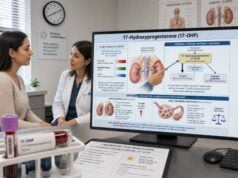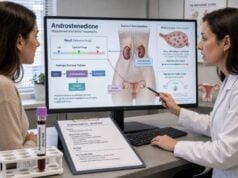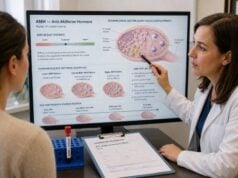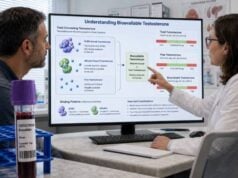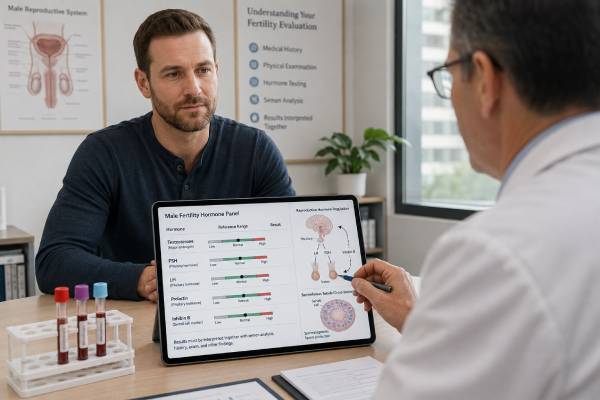
A male infertility blood test panel measures hormones that control testosterone production and sperm development. It commonly includes total testosterone, follicle-stimulating hormone (FSH), luteinizing hormone (LH), prolactin, and sometimes inhibin B. These results can help distinguish reduced sperm production in the testes from a signaling problem in the pituitary gland or hypothalamus. They can also reveal conditions such as low testosterone, hyperprolactinemia, medication effects, or less common endocrine disorders.
Blood tests are only one part of a fertility evaluation. A semen analysis directly measures sperm concentration, movement, and shape, while the medical history and examination may identify varicocele, testicular injury, prior infection, genetic risk, or obstruction. Hormone values also vary by laboratory, time of day, illness, body weight, and medication use. A clinician therefore interprets the panel as a pattern rather than judging one result in isolation.
- The core panel usually includes morning total testosterone, FSH, LH, and prolactin; inhibin B is an optional marker of Sertoli-cell and sperm-producing activity.
- High FSH with low testosterone often suggests primary testicular dysfunction, especially when semen analysis shows severe oligospermia or azoospermia.
- Low testosterone with low or inappropriately normal LH and FSH can indicate hypothalamic or pituitary suppression.
- A mildly high prolactin result should usually be repeated under controlled conditions because stress, sleep, exercise, and medicines can raise it temporarily.
- Normal hormone results do not rule out male infertility, obstruction, genetic causes, varicocele, or sperm-function problems.
- Do not start testosterone therapy while trying to conceive unless a fertility specialist specifically directs it; external testosterone can markedly suppress sperm production.
Table of Contents
- What the Male Infertility Hormone Panel Measures
- When Hormone Testing Is Used
- Preparation, Timing, and the Blood Draw
- Understanding Testosterone, FSH, LH, Prolactin, and Inhibin B
- Common Result Patterns and What They May Mean
- Ranges, Units, and Interpretation Limits
- Follow-Up Tests and Next Steps
- Common Questions and Interpretation Mistakes
What the Male Infertility Hormone Panel Measures
The panel evaluates the hypothalamic-pituitary-testicular axis, the hormone pathway that supports testosterone production and spermatogenesis. The hypothalamus releases gonadotropin-releasing hormone in pulses. This stimulates the pituitary gland to release LH and FSH. LH acts mainly on Leydig cells in the testes to produce testosterone. FSH acts mainly on Sertoli cells, which support developing sperm and release inhibin B.
Inhibin B feeds information back to the pituitary. When functioning Sertoli cells and developing germ cells produce enough inhibin B, FSH secretion is restrained. When the seminiferous tubules are damaged and sperm production falls, inhibin B may decrease and FSH may rise. The relationship is useful, but it is not exact enough to replace semen analysis or testicular assessment.
A standard panel may contain:
| Test | Main source or target | Main question it helps answer |
|---|---|---|
| Total testosterone | Produced mainly by testicular Leydig cells under LH stimulation | Is androgen production low, normal, or high? |
| FSH | Pituitary hormone acting on Sertoli cells | Is the pituitary increasing its signal because sperm-producing tissue is impaired? |
| LH | Pituitary hormone acting on Leydig cells | Is low testosterone caused mainly by testicular failure or reduced central signaling? |
| Prolactin | Pituitary hormone | Could excess prolactin be suppressing reproductive signaling, libido, or testosterone? |
| Inhibin B | Produced mainly by Sertoli cells | Is there biochemical evidence of reduced Sertoli-cell or spermatogenic activity? |
Some clinicians add sex hormone-binding globulin (SHBG), calculated free testosterone, estradiol, thyroid-stimulating hormone, or other tests according to symptoms and the first results. An SHBG test is especially helpful when total testosterone may not reflect the biologically available fraction, such as with obesity, liver disease, thyroid disorders, aging, or certain medicines.
The panel does not measure fertility directly. Pregnancy depends on sperm production and delivery, sexual function, timing, the reproductive health of the other partner, and chance. Hormones help explain a problem; they do not provide a simple fertile-or-infertile answer.
When Hormone Testing Is Used
Hormone testing is commonly ordered when a semen analysis is abnormal or when symptoms suggest an endocrine cause. It may be especially useful with azoospermia, severe oligospermia, small or soft testes, reduced libido, erectile difficulty, sparse body hair, gynecomastia, delayed or incomplete puberty, headaches, visual symptoms, or a history of pituitary disease.
A male fertility evaluation should usually begin at the same time as evaluation of the other partner. Testing is often appropriate after 12 months of regular unprotected intercourse without pregnancy, after 6 months when the female partner is 35 or older, or earlier when either partner has a known risk factor. Earlier male evaluation may be reasonable after cancer treatment, testicular torsion, undescended testes, genital surgery, major testicular trauma, mumps orchitis, anabolic-steroid exposure, or prior infertility.
The first-line assessment usually includes:
- A reproductive, sexual, medical, medication, family, and exposure history
- A focused physical examination, including testicular size and the presence of the vas deferens or a varicocele
- At least one properly collected semen analysis, with repeat testing when the first result is abnormal
- Targeted hormone tests based on symptoms, examination findings, and semen results
A testosterone blood test is often included when sperm counts are low, but a normal testosterone value does not prove normal sperm production. Testosterone concentration in blood reflects Leydig-cell function more than the condition of the seminiferous tubules where sperm develop.
Likewise, hormone testing is not always necessary for a man with normal semen parameters, normal sexual function, and no suggestive findings. Broad, repeated panels can create confusing borderline results without improving care. Targeted testing usually provides more useful information.
Preparation, Timing, and the Blood Draw
Total testosterone should generally be measured in the early morning, commonly between 7 and 10 a.m., because levels tend to be highest then. Shift workers may need testing soon after their main sleep period rather than at a conventional clock time. A low value is usually confirmed on a separate morning before diagnosing testosterone deficiency, particularly when the result is near the laboratory cutoff.
FSH, LH, and inhibin B are less dependent on clock time than testosterone, but collecting the full panel together in the morning makes the pattern easier to interpret. Prolactin can rise during sleep and shortly after waking. Many laboratories prefer collection at least a couple of hours after waking, after the patient has sat quietly for 15 to 30 minutes.
Preparation may include the following:
- Follow the laboratory’s fasting instructions. Fasting is not universally required for every hormone, but some clinicians request a morning fasting sample to reduce variability and allow metabolic tests to be drawn at the same time.
- Avoid unusually strenuous exercise before testing. Heavy exercise can temporarily affect testosterone or prolactin.
- Arrive with enough time to rest. Anxiety, pain, difficult venipuncture, and rushing can increase prolactin.
- Report all prescription medicines, over-the-counter products, injections, gels, supplements, and performance-enhancing drugs.
- Tell the clinician about recent acute illness, severe sleep loss, calorie restriction, or major weight change, because these can suppress reproductive hormones.
Medicines that may alter results include testosterone, anabolic steroids, opioids, glucocorticoids, antipsychotics, some antidepressants, metoclopramide, certain antiseizure drugs, and hormonal fertility treatments. Biotin supplements can interfere with some immunoassays. Do not stop prescribed treatment without medical advice; the clinician may adjust timing, repeat testing, or use a different assay.
The blood draw itself takes only a few minutes. Temporary bruising, soreness, or lightheadedness can occur. Unlike semen analysis, no abstinence period is normally needed for the hormone panel.
Understanding Testosterone, FSH, LH, Prolactin, and Inhibin B
Total testosterone
Testosterone supports libido, erectile physiology, muscle and bone health, red blood cell production, and the high intratesticular testosterone concentration needed for sperm development. Blood total testosterone includes hormone bound tightly to SHBG, loosely to albumin, and a small free fraction.
A low morning total testosterone level may result from testicular damage, pituitary or hypothalamic disease, obesity, untreated sleep apnea, severe systemic illness, energy deficiency, opioid use, glucocorticoids, anabolic-steroid withdrawal, or aging-related changes. When SHBG is abnormal or total testosterone is borderline, free or bioavailable testosterone may add context.
Importantly, prescribed testosterone can improve blood testosterone while suppressing LH and FSH. This lowers intratesticular testosterone and may reduce sperm counts to very low levels or zero. Men who want biological children should discuss fertility-preserving alternatives with a reproductive urologist or endocrinologist before using testosterone.
FSH
FSH is the most informative routine blood marker of seminiferous-tubule injury. A clearly elevated FSH level often means the pituitary is sending a stronger signal because the testes are not producing sperm normally. This pattern is common in primary testicular failure, some genetic conditions, damage from chemotherapy or radiation, severe infection, or advanced testicular injury.
Normal FSH does not guarantee normal spermatogenesis. Focal sperm production may persist despite a high level, and significant infertility may occur with a normal level. Obstruction can produce azoospermia with normal FSH and normal-sized testes because sperm production continues but sperm cannot enter the ejaculate.
LH
LH is interpreted alongside testosterone. High LH with low testosterone suggests that the testes are not responding adequately, a pattern called primary or hypergonadotropic hypogonadism. Low or inappropriately normal LH with low testosterone points toward secondary or hypogonadotropic hypogonadism, in which the hypothalamus or pituitary is not providing enough stimulation.
High LH with testosterone still within range may represent compensated testicular dysfunction. This finding does not automatically require treatment, but it can prompt review of symptoms, testicular history, medications, and repeat results.
Prolactin
Markedly elevated prolactin can suppress gonadotropin-releasing hormone, lowering LH, FSH, testosterone, libido, and sometimes sperm production. Causes include prolactin-secreting pituitary adenomas, other sellar masses, hypothyroidism, kidney or liver disease, chest-wall stimulation, and several medicines.
A slight elevation is common and often temporary. The clinician may repeat prolactin under calmer conditions and may request testing for macroprolactin, a larger form that can raise the measured value while causing few or no biological effects. Persistent substantial elevation, especially with headaches, visual-field changes, or very low testosterone, requires timely assessment.
Inhibin B
Inhibin B reflects Sertoli-cell activity and is often positively associated with sperm concentration and testicular volume. Low values can support evidence of impaired spermatogenesis, particularly when FSH is high. However, there is no single cutoff that reliably separates fertile from infertile men or predicts whether sperm will be found during surgical retrieval.
Assays and age-specific ranges differ. Inhibin B may add information in selected cases, including nonobstructive azoospermia, childhood or adolescent gonadal assessment, and follow-up after gonadotoxic treatment, but many fertility evaluations do not require it. A dedicated inhibin B test should be interpreted with semen results, FSH, testicular size, and the clinical setting.
Common Result Patterns and What They May Mean
Clinicians combine the hormones because relationships between them are more informative than isolated numbers.
| Typical pattern | Possible interpretation | Common next considerations |
|---|---|---|
| Low testosterone, high LH, often high FSH | Primary testicular dysfunction | Repeat morning testosterone; semen analysis; testicular history; karyotype or Y-chromosome testing when indicated |
| Low testosterone, low or normal LH and FSH | Hypothalamic or pituitary suppression | Prolactin, iron studies, medication review, nutritional and systemic illness assessment, pituitary evaluation when indicated |
| Normal testosterone, high FSH, low inhibin B | Predominant spermatogenic impairment with preserved Leydig-cell function | Repeat semen analysis; genetic testing if severe oligospermia or azoospermia; reproductive-urology consultation |
| Normal hormones with azoospermia | Possible obstruction, ejaculatory disorder, focal testicular failure, or some genetic causes | Repeat centrifuged semen analysis, semen volume and pH, examination, imaging or genetic testing as indicated |
| Low LH and FSH after testosterone or anabolic steroids | Medication-induced suppression | Stop or change only under specialist guidance; recovery monitoring; fertility-directed therapy when appropriate |
| High prolactin with low testosterone and low/normal LH | Prolactin-related central suppression | Repeat prolactin, medication review, macroprolactin, thyroid testing, pituitary imaging when indicated |
Primary testicular dysfunction can affect sperm production more severely than testosterone production. A man may therefore have a high FSH and very low sperm count while total testosterone remains normal. Conversely, obesity or illness may lower blood testosterone without causing severe sperm failure.
Hypogonadotropic hypogonadism is one of the more treatable endocrine causes of male infertility. When the testes can respond, specialist treatment with gonadotropins or pulsatile gonadotropin-releasing hormone may stimulate testosterone production and spermatogenesis. Treatment often takes months because sperm development is slow. External testosterone is not an equivalent fertility treatment.
In nonobstructive azoospermia, hormone values estimate the likelihood of broad testicular dysfunction but cannot prove that no sperm are present anywhere in the testes. Even very high FSH or low inhibin B cannot by itself determine the outcome of microdissection testicular sperm extraction. The cause, genetics, testicular histology, testicular volume, and surgical expertise also matter.
Ranges, Units, and Interpretation Limits
Reference intervals vary by assay, laboratory, age, body composition, and collection conditions. The range printed on the report should take priority. Approximate adult male intervals commonly seen on laboratory reports are shown below only to explain scale, not to diagnose a condition.
| Marker | Common reporting units | Broad example interval often used by laboratories |
|---|---|---|
| Total testosterone | ng/dL or nmol/L | Roughly 300–1,000 ng/dL, or about 10.4–34.7 nmol/L |
| FSH | IU/L or mIU/mL | Often about 1.5–12 IU/L |
| LH | IU/L or mIU/mL | Often about 1.7–8.6 IU/L |
| Prolactin | ng/mL or mIU/L | Often about 4–15 ng/mL, with assay-specific upper limits |
| Inhibin B | pg/mL | Strongly assay- and age-dependent; no universal fertility cutoff |
Some professional groups use a total testosterone concentration below 300 ng/dL as a reasonable diagnostic cutoff for testosterone deficiency, but symptoms and at least two properly collected morning measurements are generally required. A fertility evaluation asks an additional question: whether the hormone pattern supports sperm production. A man can have a value above 300 ng/dL and still have severe infertility, or a value below 300 ng/dL with recoverable, temporary suppression.
Unit conversion can cause confusion. For testosterone, 1 ng/dL is approximately 0.0347 nmol/L. Prolactin conversion is assay dependent, so the laboratory’s own conversion factor should be used. Comparing a result with an online range from another laboratory can be misleading.
Several factors can create borderline or discordant results:
- Testosterone varies from day to day and falls during acute illness or poor sleep.
- SHBG changes can raise or lower total testosterone without the same change in free testosterone.
- FSH is released in pulses and may remain normal despite localized testicular damage.
- Prolactin is sensitive to stress and some assays detect macroprolactin.
- Inhibin B methods are not fully interchangeable and cutoffs used in research may not fit a local assay.
This is why repeat testing and pattern recognition are more reliable than reacting to one borderline result.
Follow-Up Tests and Next Steps
The next step depends on the semen analysis, examination, symptoms, and hormone pattern. Common follow-up tests include:
- Repeat morning total testosterone, with SHBG and calculated or measured free testosterone when appropriate
- Repeat prolactin, thyroid testing, macroprolactin, and pituitary magnetic resonance imaging for selected persistent elevations
- A second semen analysis because sperm parameters vary and an abnormal baseline should usually be confirmed
- Genetic testing for men with azoospermia or severe oligospermia, such as karyotype and Y-chromosome microdeletion testing
- CFTR testing when congenital absence of the vas deferens or another obstructive pattern is suspected
- Scrotal ultrasound when examination is unclear or a mass, marked asymmetry, or selected varicocele question exists
- Post-ejaculatory urine testing when retrograde ejaculation is possible
A more comprehensive male fertility hormone panel may include extra markers, but additional testing should answer a defined clinical question. Sperm DNA fragmentation, antisperm antibodies, oxidative-stress tests, and advanced sperm-function assays are not routine for every patient.
Treatment targets the cause. Options may include stopping gonadotoxic medicines when safely possible, treating a prolactinoma or hypothyroidism, correcting severe energy deficiency, using gonadotropin therapy for central hypogonadism, repairing selected obstructions, treating a clinically significant varicocele, retrieving sperm surgically, or using intrauterine insemination or in vitro fertilization with intracytoplasmic sperm injection.
Seek prompt medical review for a new testicular lump, sudden severe testicular pain, rapidly progressive breast enlargement, severe headache with visual change, or symptoms of a major pituitary disorder. These are not typical findings to manage through repeat home or direct-to-consumer testing.
Common Questions and Interpretation Mistakes
Can a normal panel prove fertility?
No. Normal testosterone, FSH, LH, and prolactin do not confirm normal sperm count, motility, morphology, DNA integrity, sperm delivery, or the ability to achieve pregnancy. Semen analysis remains central.
Does high FSH mean there is no chance of biological fatherhood?
No. High FSH suggests impaired sperm-producing tissue, but it does not show whether small areas of sperm production remain. Some men with high FSH have sperm in the ejaculate or during surgical retrieval. Prognosis depends on the diagnosis and the full evaluation.
Is low inhibin B the same as azoospermia?
No. Low inhibin B supports reduced Sertoli-cell or spermatogenic activity, but the overlap between individuals is substantial. It cannot replace examination of a properly processed semen sample.
Should low testosterone be treated immediately?
The result should first be confirmed and the cause identified. For a man trying to conceive, routine testosterone replacement can worsen fertility. A reproductive specialist may use other approaches that support the body’s own LH and FSH signaling when appropriate.
Is the LH-to-testosterone or FSH-to-inhibin ratio diagnostic?
Ratios can be useful in research or specialized settings, but they are not universal stand-alone diagnostic tools. Assay differences and clinical context limit simple cutoffs.
Common mistakes include drawing testosterone late in the day, failing to repeat a borderline low value, ignoring medication and supplement use, treating a single mild prolactin elevation as a tumor, using age-inappropriate inhibin B ranges, and interpreting blood tests without semen analysis. The most reliable interpretation comes from a clinician who can connect the hormone pattern to symptoms, examination findings, semen results, and reproductive plans.
References
- Diagnosis and Treatment of Infertility in Men: AUA/ASRM Guideline 2024 (Guideline)
- MALE INFERTILITY 2026 (Guideline)
- WHO laboratory manual for the examination and processing of human semen, 6th ed 2021 (Manual)
- Diagnosis and Treatment of Infertility in Men: AUA/ASRM Guideline Part I 2021 (Guideline)
- Diagnosis and treatment of infertility in men: AUA/ASRM guideline part II 2021 (Guideline)
- Role of Follicle-stimulating Hormone, Inhibin B, and Anti-Müllerian Hormone in Predicting Sperm Retrieval from Men with Nonobstructive Azoospermia Undergoing Microdissection Testicular Sperm Extraction: A Systematic Review and Meta-analysis 2024 (Systematic Review)
Disclaimer
This article provides general education about male infertility hormone testing and cannot diagnose the cause of infertility or replace care from a qualified clinician. Hormone ranges and treatment decisions depend on the assay, symptoms, semen findings, medical history, and reproductive goals. Seek urgent care for sudden testicular pain, a new testicular mass, or severe headache with visual changes.