An inhibin B test measures a reproductive hormone produced mainly by ovarian granulosa cells in women and Sertoli cells in the testes in men. It helps regulate follicle-stimulating hormone, or FSH, through feedback to the pituitary gland. In men, inhibin B can provide information about Sertoli-cell activity and sperm-producing tissue. In women, it reflects activity in small developing follicles and has been studied as an ovarian reserve marker.
The test is not a direct measurement of fertility. A low result does not prove that pregnancy is impossible or that no sperm can be produced, and a normal result does not rule out infertility. Inhibin B assays and reference ranges vary, values change with age and reproductive stage, and the result overlaps substantially between fertile and infertile people. Clinicians therefore interpret it with FSH, semen analysis, testicular size, menstrual history, AMH, ultrasound findings, and the reason for testing.
- In men, low inhibin B with high FSH usually supports impaired sperm production, but semen analysis remains the primary test.
- A normal inhibin B result does not exclude oligospermia, azoospermia, obstruction, or a genetic cause of infertility.
- In women, inhibin B is usually measured early in the menstrual cycle, but AMH and antral follicle count are more commonly used for ovarian reserve.
- There is no universal inhibin B cutoff that proves fertility, infertility, or successful surgical sperm retrieval.
- Age, puberty stage, menopause, gonadotoxic treatment, ovarian stimulation, and laboratory method can markedly change the result.
- Repeat testing is most useful when an unexpected value would change management and the same laboratory method can be used.
Table of Contents
- What Inhibin B Does
- Why the Test Is Ordered
- Timing and Preparation
- Inhibin B Results in Men
- Inhibin B Results in Women
- Ranges and Common Result Patterns
- Limitations of the Test
- Follow-Up Tests and Next Steps
What Inhibin B Does
Inhibin B is a dimeric glycoprotein made from an alpha subunit and a beta-B subunit. It belongs to the transforming growth factor beta family. Its major endocrine action is to suppress FSH secretion from the pituitary. The source and meaning of the hormone differ by sex and life stage.
In adult men, Sertoli cells in the seminiferous tubules produce inhibin B in association with germ-cell development. FSH stimulates Sertoli-cell function, while inhibin B feeds back to restrain FSH. When sperm-producing tissue is damaged, inhibin B often falls and FSH often rises. The relationship is inverse but not perfectly predictable because focal sperm production, age, assay method, and the cause of testicular dysfunction all affect the values.
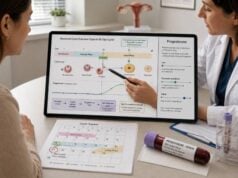
In women, granulosa cells in preantral and small antral follicles produce inhibin B. Concentrations usually rise during the early follicular phase as a cohort of follicles develops, then fall before or around the midcycle period. A smaller functioning follicle pool can produce lower early-cycle inhibin B, allowing FSH to rise. However, the hormone fluctuates more than anti-Müllerian hormone and has not become the preferred stand-alone measure of ovarian reserve.
| Reproductive setting | Main source | Main interpretation |
|---|---|---|
| Adult male | Sertoli cells and developing germ-cell environment | Contextual marker of seminiferous-tubule and spermatogenic activity |
| Reproductive-age female | Granulosa cells of small growing follicles | Cycle-sensitive marker of follicular activity and possible ovarian reserve |
| Childhood and puberty | Sertoli or granulosa cells depending on sex | Marker of gonadal tissue and maturation in selected endocrine evaluations |
| After gonadotoxic treatment | Surviving gonadal support cells | One possible marker of treatment-related gonadal injury or recovery |
Inhibin B is different from inhibin A. Inhibin A is especially important in pregnancy screening and can be produced by the corpus luteum and placenta. Inhibin B is more closely linked to early ovarian follicles and Sertoli-cell activity.
Why the Test Is Ordered
Inhibin B is a specialized test rather than a universal part of fertility evaluation. Clinicians may order it when the result could add information beyond routine tests.
In men, possible reasons include:
- Evaluation of severe oligospermia or azoospermia
- Assessment of Sertoli-cell function after childhood cancer treatment, chemotherapy, radiation, or testicular injury
- Selected evaluation of delayed puberty, disorders of sex development, or suspected testicular tissue in childhood
- Research or specialist counseling before surgical sperm retrieval
- Follow-up of gonadal function in specific genetic or endocrine conditions
The first-line male infertility evaluation still relies on history, physical examination, and semen analysis. FSH and testosterone are usually more widely available than inhibin B. A dedicated male infertility blood test panel may include inhibin B when the clinician is trying to characterize sperm-producing function more closely.
In women, possible reasons include:
- A specialist ovarian reserve assessment when other results are unclear
- Research protocols or older IVF assessment pathways
- Follow-up after gonadotoxic treatment
- Selected evaluation of ovarian function in adolescents or young adults
- Monitoring of some ovarian granulosa cell or sex cord-stromal tumors, often together with inhibin A and other markers
Routine ovarian reserve evaluation more commonly uses AMH and antral follicle count. Early-cycle FSH and estradiol may provide additional context. Inhibin B often adds little independent predictive value once those tests and age are known.
The test should not be ordered as a general wellness marker or as a way to certify future fertility. No blood test can guarantee that a person will conceive later. In women, egg quality and age-related aneuploidy risk are not captured by inhibin B. In men, sperm delivery, motility, morphology, genetics, and sexual function are not measured by it.
Timing and Preparation
No special preparation is usually required for the blood draw, and fasting is not routinely necessary unless other tests are being collected. The sample is taken from a vein in the arm. Mild bruising, soreness, or temporary lightheadedness may occur.
For women, timing is important. Inhibin B is usually measured during the early follicular phase, often on cycle day 2, 3, 4, or 5. Cycle day 1 is the first day of full menstrual flow. Using a consistent cycle day allows comparison with the laboratory’s early-follicular range and with FSH and estradiol.
For men, collection time is less standardized than for testosterone. Inhibin B has some biological variation but does not require the same strict early-morning timing as total testosterone. A morning sample may still be convenient when FSH, LH, and testosterone are drawn together.
Before testing, tell the clinician and laboratory about:
- Hormonal contraception, fertility medicines, testosterone, anabolic steroids, or gonadotropins
- Chemotherapy, radiation, testicular or ovarian surgery, and the dates of treatment
- Pregnancy or breastfeeding
- Menstrual cycle day and menopausal status
- Recent severe illness, major weight change, or intensive exercise
- High-dose biotin or other supplements that may interfere with immunoassays
Ovarian stimulation can change inhibin B markedly because multiple follicles are active. Hormonal contraception can suppress ovarian follicular activity and may lower some ovarian reserve markers. Testosterone and anabolic steroids suppress pituitary gonadotropins and sperm production, changing the male hormone pattern.
Repeat testing should ideally use the same laboratory because assay calibration and reference intervals differ. A result from one platform may not be directly interchangeable with a result from another.
Inhibin B Results in Men
In adult men, inhibin B generally correlates positively with sperm concentration and testicular volume and inversely with FSH. The clearest abnormal pattern is low inhibin B with high FSH and an abnormal semen analysis. This supports primary impairment of the seminiferous tubules, where sperm are produced.
Possible causes of low inhibin B include:
- Primary testicular failure
- Nonobstructive azoospermia
- Severe oligospermia
- Klinefelter syndrome or selected genetic causes of spermatogenic failure
- Prior chemotherapy or testicular radiation
- Bilateral undescended testes or significant testicular injury
- Advanced damage from infection, torsion, or toxic exposure
- Age-related or chronic-disease effects in some individuals
Low inhibin B is not specific to one diagnosis. It does not show whether testicular injury is genetic, acquired, focal, or diffuse. It also cannot determine whether small areas of sperm production remain.
High or normal inhibin B may occur with preserved Sertoli-cell activity and sperm production. In a man with azoospermia, normal FSH, normal inhibin B, and normal-sized testes can raise the possibility of obstruction, but the pattern is not diagnostic. Some men with nonobstructive azoospermia have values within the reference interval, while some men with obstruction have lower values for unrelated reasons.
Can inhibin B predict surgical sperm retrieval?
Research has examined inhibin B, FSH, AMH, testicular volume, and other markers as predictors of finding sperm during microdissection testicular sperm extraction. Lower FSH and higher inhibin B may be associated with a better chance in some groups, but no cutoff is accurate enough to rule surgery in or out by itself.
A man with very low inhibin B can still have focal sperm production. Conversely, a normal value does not guarantee successful retrieval. The cause of azoospermia, genetic testing, prior surgery, testicular histology when available, and the expertise of the surgical center matter. An inhibin B test in men should therefore support counseling rather than determine the decision alone.
How FSH changes interpretation
The combination of inhibin B and FSH is more informative than either marker alone:
- Low inhibin B and high FSH: Stronger evidence of impaired spermatogenesis and reduced Sertoli-cell/germ-cell feedback
- Normal inhibin B and normal FSH: More compatible with preserved function, but semen abnormalities can still exist
- Low inhibin B and normal FSH: Possible early or partial dysfunction, assay variation, or a condition in which FSH has not risen
- Normal inhibin B and high FSH: Discordant pattern that may reflect biological variation, assay differences, partial damage, or recovery after treatment
The semen analysis remains decisive for whether sperm are present in the ejaculate. Hormones explain the likely mechanism rather than replace direct measurement.
Inhibin B Results in Women
In women, early-cycle inhibin B reflects activity in the cohort of small growing follicles. As ovarian reserve declines, fewer follicles may produce less inhibin B, reducing feedback on the pituitary and allowing early-cycle FSH to rise.
Possible causes or contexts for low inhibin B include:
- Increasing reproductive age
- Diminished ovarian reserve
- Primary ovarian insufficiency
- Menopause
- Previous ovarian surgery
- Chemotherapy or pelvic radiation
- Temporary suppression from hormonal treatment
- Differences in cycle timing or laboratory method
A low result does not mean that no eggs remain. Follicles are distributed unevenly, hormone output varies, and spontaneous ovulation can occur even with markedly reduced reserve. Inhibin B also does not measure whether an egg is chromosomally normal.
A high result can occur in a robust early follicular cohort, during ovarian stimulation, or with some granulosa cell tumors. It can also reflect a sample drawn later in the follicular phase than intended. A single high value is not a diagnosis of PCOS or an ovarian tumor.
For ovarian reserve, AMH is generally more stable across the cycle and antral follicle count directly visualizes small follicles. An ovarian reserve test panel may list inhibin B, but current practice often treats it as supplementary.
Can inhibin B predict natural pregnancy?
Not reliably. Ovarian reserve tests estimate follicle quantity and anticipated response to ovarian stimulation better than they predict spontaneous conception. Natural pregnancy depends on age, ovulation, tubal patency, sperm, timing, endometriosis, uterine factors, and egg and embryo competence.
A low inhibin B value in a young woman does not by itself establish infertility. A normal value in an older woman does not reverse the age-related decline in egg quality. Counseling should be based primarily on age, history, duration of trying, AMH or antral follicle count when indicated, and the complete fertility evaluation.
Ranges and Common Result Patterns
There is no universal inhibin B reference range. Laboratories use different immunoassays and may provide ranges by sex, age, pubertal stage, cycle phase, and menopausal status. The interval printed on the report should take priority.
Broad concentrations sometimes seen in adult testing illustrate the scale but should not be used for self-diagnosis:
| Group | Broad example pattern | Important caution |
|---|---|---|
| Adult men | Often tens to several hundred pg/mL | Lower limits vary widely; no universal fertility cutoff |
| Early-follicular premenopausal women | Often detectable, commonly tens of pg/mL | Strong cycle and assay dependence |
| Postmenopausal women | Often very low or undetectable | Tumor evaluation requires a specific clinical context |
| Children and adolescents | Age- and puberty-stage dependent | Adult ranges are inappropriate |
Some male infertility studies have proposed thresholds around 40–100 pg/mL for severe spermatogenic impairment or sperm-retrieval prediction, but these cutoffs are not interchangeable across assays and populations. A research cutoff should not be applied automatically to a clinical report.
Common patterns include:
| Inhibin B | FSH or related test | Possible interpretation |
|---|---|---|
| Low in a man | High FSH, low sperm concentration | Primary spermatogenic impairment |
| Normal in a man | Normal FSH, azoospermia | Obstruction is possible, but nonobstructive causes remain possible |
| Low in a woman | High early-cycle FSH, low AMH | Diminished ovarian reserve or ovarian insufficiency |
| Low in a woman | Normal AMH and FSH | Timing, assay variation, temporary suppression, or limited incremental significance |
| High in a woman | Multiple follicles during stimulation | Expected response to gonadotropins |
| Rising after granulosa cell tumor treatment | Prior marker-producing tumor | Possible recurrence requiring oncology assessment |
Interpretation should focus on whether the pattern fits the clinical question. A result outside the range that conflicts with every other finding is often repeated before major decisions are made.
Limitations of the Test
Inhibin B has several limitations that explain why it is not a universal fertility test.
Assay variability: Commercial tests are not fully standardized. Reference intervals and proposed cutoffs differ.
Biological overlap: Fertile and infertile people can have overlapping values. The test lacks a clean boundary between normal and abnormal reproductive function.
Cycle dependence in women: Concentrations change through the follicular phase and can be altered by ovarian cysts, stimulation, or hormonal suppression.
Incomplete view of male fertility: Inhibin B does not measure sperm motility, morphology, DNA integrity, ejaculation, obstruction, or sexual function.
Incomplete view of female fertility: It does not measure tubal patency, ovulation quality, endometriosis, uterine anatomy, egg quality, or embryo aneuploidy.
Limited prediction of treatment outcome: It cannot reliably predict natural conception, live birth, or surgical sperm retrieval by itself.
Age and developmental effects: Pediatric and adolescent interpretation requires specialized ranges and knowledge of pubertal stage.
A common mistake is to interpret “low” as “zero fertility.” Another is to assume that a normal result means testing can stop. The test provides one piece of a feedback system; it does not summarize the entire reproductive system.
Direct-to-consumer panels may present inhibin B with a simple traffic-light score. That format can hide uncertainty around the assay, cycle day, age, and the difference between ovarian quantity and reproductive outcome. A result should be linked to a specific clinical decision before it is repeated or acted upon.
Follow-Up Tests and Next Steps
For a man with low inhibin B or an abnormal semen analysis, follow-up may include:
- Repeat semen analysis in a qualified andrology laboratory
- Morning total testosterone, FSH, LH, and prolactin
- Testicular examination and volume assessment
- Genetic testing for azoospermia or severe oligospermia when indicated
- CFTR testing when congenital absence of the vas deferens or obstruction is suspected
- Reproductive-urology consultation before sperm retrieval or treatment
External testosterone should not be started casually in someone trying to conceive because it can suppress LH, FSH, intratesticular testosterone, and sperm production. Fertility-preserving treatment for low testosterone or central hypogonadism requires specialist planning.
For a woman with low inhibin B or concern about ovarian reserve, follow-up may include:
- AMH and transvaginal ultrasound antral follicle count
- Early-cycle FSH and estradiol
- Menstrual and ovulation assessment
- Review of prior ovarian surgery, chemotherapy, radiation, and family history of early menopause
- Timely reproductive-endocrinology counseling when age or treatment plans make delay important
When the test is being used after cancer treatment, trends should be interpreted with the type and dose of therapy, time since treatment, menstrual or semen recovery, and other gonadal markers. Recovery can take months or longer and may be incomplete.
For tumor surveillance, a rising inhibin B level should prompt review by the oncology team, especially when the original tumor secreted inhibin B. Imaging and clinical assessment determine whether recurrence is present. Do not rely on a single marker to delay evaluation of symptoms such as abnormal bleeding, pelvic pressure, a testicular mass, or increasing abdominal size.
The result is most useful when it changes a concrete next step: whether to complete genetic testing, assess obstruction, expedite fertility preservation, repeat ovarian reserve testing, or investigate a previously marker-producing tumor.
Before the follow-up visit, record the reason the test was ordered, collection time or cycle day, current hormones and supplements, and prior gonadotoxic treatment. Bring the complete report with units and reference interval. These details help the clinician decide whether the value is truly discordant, whether repeating it would add information, and whether a more direct test should take priority.
References
- Diagnosis and Treatment of Infertility in Men: AUA/ASRM Guideline 2024 (Guideline)
- MALE INFERTILITY 2026 (Guideline)
- Role of Follicle-stimulating Hormone, Inhibin B, and Anti-Müllerian Hormone in Predicting Sperm Retrieval from Men with Nonobstructive Azoospermia Undergoing Microdissection Testicular Sperm Extraction: A Systematic Review and Meta-analysis 2024 (Systematic Review)
- Inhibin-B and FSH Are Good Indicators of Spermatogenesis but Not the Best Indicators of Fertility 2022 (Clinical Study)
- Fertility evaluation of infertile women: a committee opinion 2021 (Guideline)
- Testing and interpreting measures of ovarian reserve: a committee opinion 2020 (Guideline)
Disclaimer
This article provides general education and cannot determine an individual’s fertility, diagnose testicular or ovarian failure, or predict treatment success. Inhibin B results must be interpreted with the assay-specific range, age, reproductive stage, semen analysis or ovarian testing, symptoms, and medical history by a qualified clinician. Seek prompt evaluation for a new testicular mass, sudden testicular pain, postmenopausal bleeding, or a rapidly enlarging pelvic or abdominal mass.