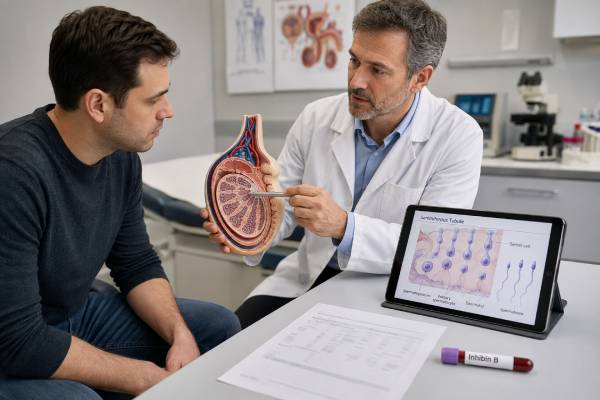
An inhibin B test measures a hormone made mainly by Sertoli cells in the testes and provides indirect information about seminiferous tubule activity and sperm production. In adult men, lower concentrations are often associated with reduced spermatogenesis, while FSH commonly rises as inhibin B feedback falls. The test can support evaluation of azoospermia, severe oligospermia, testicular damage, delayed puberty, or childhood disorders of testicular tissue. It cannot prove fertility, show whether sperm are moving normally, or replace semen analysis. A normal result does not rule out obstruction or every form of impaired sperm production, and a low result does not determine that sperm retrieval is impossible. Age, pubertal stage, assay, laboratory range, testicular volume, prior treatment, and the wider hormone pattern all affect interpretation. Clinicians usually assess inhibin B together with FSH, LH, testosterone, examination, and semen results. Its value is greatest when it answers a focused question about Sertoli-cell function rather than being treated as a stand-alone male fertility score.
- Inhibin B is a Sertoli-cell marker that broadly reflects active sperm-producing tissue, not sperm quality or guaranteed fertility.
- Low inhibin B with high FSH commonly suggests impaired spermatogenesis or seminiferous tubule damage.
- Normal inhibin B cannot exclude an obstructive cause of azoospermia or a clinically important semen abnormality.
- The result should use an age- and method-appropriate range, particularly in children and adolescents.
- Inhibin B may contribute to sperm-retrieval counseling, but it is not accurate enough to decide alone whether surgery should be attempted.
Table of Contents
- What inhibin B measures
- When the test is used
- Preparation and laboratory methods
- Normal range and result patterns
- Causes of low inhibin B
- High or normal inhibin B
- Inhibin B in azoospermia and sperm retrieval
- Next tests and clinical decisions
What inhibin B measures
Inhibin B is a dimeric glycoprotein produced mainly by Sertoli cells in the seminiferous tubules. In adult men, its production is closely related to Sertoli-cell activity and the presence of developing germ cells. It travels in the blood and provides negative feedback to the pituitary, helping restrain FSH secretion.
The relationship creates a common inverse pattern. When seminiferous tubules are active, inhibin B feedback tends to be higher and FSH is held within an appropriate range. When sperm-producing tissue is damaged, inhibin B often falls and FSH rises. The relationship is useful but not perfect because pituitary function, age, assay variation, focal sperm production, and the specific cause of infertility can alter it.
Inhibin B is different from testosterone. Testosterone is made mainly by Leydig cells in response to LH and supports sexual function, bone, muscle, red blood cells, and intratesticular spermatogenesis. A man can have normal testosterone and low inhibin B when seminiferous tubules are impaired but Leydig cells remain functional. Conversely, a central signaling problem can lower both FSH stimulation and inhibin B without primary destruction of testicular tissue.
The test is also different from anti-Müllerian hormone, another Sertoli-cell product. AMH is high before puberty and falls as Sertoli cells mature under androgen influence. Adult inhibin B is generally more directly associated with ongoing spermatogenic activity. An AMH test in men can be useful in selected developmental or testicular questions, but it is not interchangeable with inhibin B.
No blood marker measures sperm concentration, motility, morphology, DNA integrity, ejaculation, or the ability of sperm to reach and fertilize an egg. Inhibin B is therefore a piece of the fertility assessment, not a substitute for direct semen evaluation.
When the test is used
Inhibin B may be ordered during evaluation of azoospermia, severe oligospermia, small testes, suspected testicular failure, prior chemotherapy or radiation, cryptorchidism, torsion, orchitis, or a genetic condition affecting the testes. It is sometimes used when FSH and semen findings do not align or when a specialist wants another estimate of Sertoli-cell function.
In children, inhibin B can provide information about the presence and activity of testicular tissue during periods when testosterone is naturally low. It may contribute to assessment of undescended or nonpalpable testes, differences of sex development, anorchia, hypogonadotropic hypogonadism, and delayed puberty. Pediatric interpretation requires age- and pubertal-stage ranges; adult cutoffs are inappropriate.
For male infertility, the first-line evaluation usually includes reproductive history, examination, and at least one properly collected semen analysis, often repeated when abnormal. Hormonal tests are selected according to semen concentration, sexual symptoms, testicular size, and suspected endocrine disease. A male fertility hormone panel may include inhibin B, but not every infertile man needs it.
The test may support counseling before surgical sperm retrieval in nonobstructive azoospermia. Lower inhibin B is associated at a group level with poorer spermatogenesis, yet men with very low values can still have focal areas of sperm production. Current evidence does not support using inhibin B alone to deny microdissection testicular sperm extraction.
Inhibin B is not a general wellness, masculinity, or sexual-performance test. Libido and erections depend more directly on androgen status, vascular health, neurological function, medications, sleep, and psychological factors. Ordering inhibin B for fatigue without a fertility or testicular question is unlikely to clarify the cause.
Preparation and laboratory methods
Inhibin B is measured from a blood sample. Many laboratories do not require fasting, but the patient should follow the specific collection instructions. Morning sampling may improve consistency, particularly when the test is paired with testosterone and gonadotropins. When monitoring change, using the same laboratory, assay, and approximate time reduces avoidable variation.
Tell the clinician about fertility medicines, testosterone, anabolic steroids, hCG, FSH injections, chemotherapy, radiation, and recent testicular surgery. Exogenous testosterone and anabolic steroids suppress pituitary FSH and intratesticular testosterone, which can reduce spermatogenesis and alter inhibin B. Gonadotropin treatment can stimulate Sertoli-cell and Leydig-cell function, so the treatment schedule matters.
Acute illness can disturb reproductive hormones, though inhibin B may not change in exactly the same way as testosterone. A result obtained during severe illness should be interpreted cautiously. Pubertal stage, testicular volume, and prior cryptorchidism are particularly important in children and adolescents.
Assays are not fully interchangeable. Laboratories may use different immunoassays, calibrators, and reference populations. A result near the lower boundary should be judged against the interval printed on that report rather than converted to a cutoff from another study. Unit errors can be significant; common reporting uses picograms per milliliter, but the unit must be checked.
Pre-analytical problems, heterophile antibodies, and assay interference are less commonly discussed than with some other hormones but remain possible. An implausible result that conflicts strongly with semen analysis, FSH, and examination may be repeated or measured by another method. The clinician should avoid assigning permanent fertility implications to one discordant result.
Normal range and result patterns
There is no universal adult male inhibin B range. Concentrations vary with age, puberty, assay, population, and laboratory. Levels change substantially across childhood: they rise during early infancy, vary during childhood, increase with pubertal Sertoli-cell activity, and settle into an adult pattern. Older age may be associated with lower concentrations as testicular function changes.
Interpretation is strongest when inhibin B is paired with FSH and semen findings.
| Pattern | Possible interpretation | Important limitation |
|---|---|---|
| Low inhibin B, high FSH | Reduced seminiferous tubule function or impaired spermatogenesis | Does not prove complete absence of focal sperm production |
| Low inhibin B, low or normal FSH | Central gonadotropin deficiency, exogenous suppression, or mixed dysfunction | Requires LH, testosterone, medication history, and pituitary context |
| Normal inhibin B, azoospermia | Obstruction is possible, but nonobstructive causes remain possible | Normal result cannot diagnose obstruction |
| Normal inhibin B, abnormal semen analysis | Sperm motility, morphology, focal damage, varicocele, or other factors may be involved | Blood markers do not measure complete semen quality |
| Rising inhibin B during gonadotropin treatment | Sertoli-cell response may be occurring | Does not guarantee sperm in the ejaculate or pregnancy |
FSH itself must be interpreted as an appropriate response. A high FSH often indicates the pituitary is compensating for reduced inhibin B feedback. A “normal” FSH can still be inappropriate when there is severe central suppression. A FSH test in men provides complementary information, not a competing answer.
Inhibin B correlates with sperm concentration in many populations, but the overlap between fertile and infertile men is substantial. It cannot establish a minimum number of sperm, predict natural conception for a couple, or determine embryo quality. Female-partner age and health, intercourse timing, sperm function, and many other factors shape fertility outcomes.
Causes of low inhibin B
Low inhibin B most often reflects reduced Sertoli-cell function, loss of germ cells, or diminished FSH stimulation. Primary testicular causes include Klinefelter syndrome, prior undescended testes, testicular torsion, orchitis, chemotherapy, radiation, severe trauma, and advanced seminiferous tubule damage. Testicular volume may be reduced and FSH elevated.
Nonobstructive azoospermia is a broad category in which sperm production is absent or severely limited. Histological patterns include Sertoli-cell-only syndrome, maturation arrest, hypospermatogenesis, and mixed or focal changes. Inhibin B tends to be low in severe diffuse damage, but focal sperm-producing areas may remain even when the blood value is very low.
Central hypogonadism can lower inhibin B because Sertoli cells receive inadequate FSH stimulation and intratesticular testosterone is reduced. LH, FSH, and testosterone may all be low or inappropriately normal. Causes include pituitary tumors, congenital gonadotropin deficiency, high prolactin, severe obesity, systemic illness, undernutrition, opioids, and other suppressive medicines. In this setting, testicular tissue may respond to gonadotropin treatment, depending on age, prior development, and cause.
Exogenous testosterone and anabolic steroids suppress FSH and LH. Serum testosterone may appear normal or high during use, but intratesticular testosterone and sperm production can fall sharply. Inhibin B may decline. Recovery after stopping can take months or longer, and self-directed “post-cycle” drug use can complicate the pattern.
Varicocele, aging, chronic disease, and environmental or genetic factors may also be associated with lower inhibin B, but the value does not identify which one is responsible. A low result should prompt a targeted reproductive history and examination rather than a conclusion that the testes are permanently nonfunctional.
In children, low inhibin B can suggest absent or poorly functioning testicular tissue, but timing is crucial. A value expected in a prepubertal boy would be low for a pubertal adolescent. Pediatric endocrinology expertise is important when developmental decisions depend on the result.
High or normal inhibin B
A normal inhibin B result suggests that a meaningful amount of Sertoli-cell activity is present, but it does not certify normal fertility. Men can have normal concentrations with low sperm motility, abnormal morphology, sperm DNA damage, ejaculatory dysfunction, immune factors, varicocele, or intermittent production. The semen analysis remains the direct clinical test.
In azoospermia, a relatively preserved inhibin B value may make obstruction more plausible because sperm production can continue behind a blockage. However, obstruction is diagnosed from the complete pattern: semen volume and pH, testicular size, epididymal and vasal examination, FSH, genetic history, imaging in selected cases, and sometimes surgical findings. Normal inhibin B alone cannot distinguish obstructive from nonobstructive azoospermia reliably.
High results are less commonly a clinical problem. They may reflect age-related physiology in infancy or puberty, assay variation, active Sertoli-cell tissue, or gonadotropin stimulation. Certain sex-cord stromal tumors can secrete inhibin, but inhibin B is not used as a broad tumor screen in asymptomatic men. A markedly unexpected value should be repeated and interpreted with examination, imaging, and other markers rather than assumed to indicate cancer.
During fertility treatment for hypogonadotropic hypogonadism, rising inhibin B may show that Sertoli cells are responding before sperm appear in semen. This can be encouraging, but treatment duration may be long and response varies. Serial semen analysis is still required to know whether spermatogenesis has reached the ejaculate.
Values within the laboratory range should not be “optimized” with supplements. There is no established evidence-based target above normal that improves pregnancy rates. Hormones and fertility drugs can have significant adverse effects and should be used only for a defined diagnosis.
Inhibin B in azoospermia and sperm retrieval
Azoospermia means no sperm are found in the centrifuged semen sample. It should generally be confirmed because collection problems, recent fever, laboratory technique, and intermittent rare sperm can affect results. The first major distinction is obstruction versus impaired production.
In obstructive azoospermia, spermatogenesis may be normal but sperm cannot enter the ejaculate because of congenital absence of the vas deferens, prior infection, vasectomy, ejaculatory duct obstruction, or surgery. Testes are often normal in size, FSH and inhibin B may be preserved, and sperm retrieval rates are generally high when production is intact.
In nonobstructive azoospermia, sperm production is severely impaired. FSH is often high and inhibin B low, but neither result maps the entire testis. Spermatogenesis can be patchy. Microdissection testicular sperm extraction searches for larger, more promising seminiferous tubules under magnification and may find sperm even in men with unfavorable blood markers.
Systematic reviews have found that inhibin B, FSH, and AMH have limited ability to predict surgical sperm retrieval when used alone. Their sensitivity and specificity are not strong enough to replace clinical assessment or to guarantee success or failure. Testicular histology from a prior procedure, genetic diagnosis, testicular volume, age, and surgical expertise may add context, yet uncertainty remains.
Genetic testing is essential in selected men. Karyotype and Y-chromosome microdeletion testing can identify causes and, in some deletions, predict that retrieval is not feasible. CFTR testing is relevant when congenital absence of the vas deferens is suspected. Genetic counseling addresses inheritance and assisted-reproduction implications.
A low inhibin B value should therefore be presented as evidence of reduced average spermatogenic activity, not as a verdict. Counseling should cover the possibility of no sperm found, anesthesia and surgical risks, potential testosterone effects, cryopreservation, donor sperm, adoption, and the couple’s wider reproductive options.
Next tests and clinical decisions
The next step depends on why the test was ordered. For infertility, repeat semen analysis under standardized conditions is usually central. The report should include volume, sperm concentration or total count, motility, morphology where used, and evidence of inflammation or collection issues. A reproductive urologist evaluates testicular size, epididymides, vas deferens, varicocele, sexual function, and medical history.
FSH, LH, total testosterone, and prolactin help separate primary testicular damage from central suppression. Free testosterone or SHBG may clarify a borderline total value. Genetic testing is selected for severe oligospermia or azoospermia. Scrotal ultrasound is used when examination is difficult, a mass is suspected, or a structural question needs imaging; it is not a substitute for expert examination.
Treatment is cause-specific. Obstruction may be repaired or bypassed with sperm retrieval and assisted reproduction. Hypogonadotropic hypogonadism may respond to hCG with FSH added as needed. A varicocele may be repaired in selected infertile men with a palpable lesion and abnormal semen parameters. Infection, thyroid disease, high prolactin, or medication suppression is treated according to the underlying problem.
Exogenous testosterone is generally avoided when conception is desired because it suppresses sperm production. Men using anabolic steroids should disclose all compounds and dates. Recovery plans require medical supervision; adding multiple unregulated hormones can delay diagnosis and create additional risk.
Inhibin B can refine the picture, especially when considered with FSH and testicular volume. Its best use is as supporting evidence that guides a focused discussion. Fertility decisions should remain grounded in semen results, the cause of infertility, the female partner’s evaluation, and the couple’s goals.
Using inhibin B across different life stages
In infancy, the hypothalamic–pituitary–testicular axis is temporarily active, and inhibin B can help demonstrate functioning Sertoli cells even when external signs are subtle. During childhood, testosterone is often very low, while Sertoli-cell markers can still provide information about the presence of testicular tissue. At puberty, FSH stimulation and germ-cell development change inhibin B, while rising intratesticular testosterone matures Sertoli cells.
These developmental shifts make a single adult cutoff inappropriate for a child. Interpretation should use exact age, pubertal stage, testicular position and volume, prior surgery for cryptorchidism, and the specific assay. Pediatric decisions may also use AMH, LH, FSH, testosterone, hCG stimulation, imaging, and genetics. Inhibin B is supportive evidence, not a stand-alone test for whether puberty will occur normally.
In older adults, concentrations may decline with testicular aging and illness. A low value in an older man who is not pursuing fertility may have limited clinical relevance unless it accompanies symptoms, small testes, high FSH, or another diagnostic question. Testing should be ordered because the result will guide care, not as a general measure of biological age.
Why serial changes require caution
Inhibin B can change during gonadotropin treatment, after recovery from suppression, or as testicular disease evolves. A rise may suggest Sertoli-cell response, but it should be paired with testicular growth and semen analysis. Sperm can take months to appear in the ejaculate, and a biochemical response does not guarantee a usable sperm count.
Small differences between two results may reflect assay variation. The same laboratory and method are preferable, and trends should be interpreted over a clinically meaningful interval. Following inhibin B every few weeks without a treatment decision attached can add cost and anxiety without improving the fertility plan.
The result is most useful when it refines probability. It may strengthen evidence of impaired seminiferous tissue, support the presence of functioning testes in a developmental evaluation, or track response in central hypogonadism. It should not be used to promise pregnancy, predict embryo quality, or set a definitive threshold for surgical sperm retrieval.
Couples should also understand that a male biomarker does not account for the female partner’s age, ovarian reserve, tubal status, or treatment timeline. A modest chance of sperm retrieval may have different practical meaning when assisted reproduction is urgent. Joint counseling aligns the laboratory evidence with the couple’s options and values.
A low value should be communicated carefully. It indicates reduced average Sertoli-cell or germ-cell activity, not sterility and not a fixed percentage chance of fatherhood. Clear wording helps patients make informed choices without interpreting one biomarker as a final reproductive prognosis.
References
- Role of Follicle-stimulating Hormone, Inhibin B, and Anti-Müllerian Hormone in Predicting Sperm Retrieval in Men with Nonobstructive Azoospermia Undergoing Microdissection Testicular Sperm Extraction: A Systematic Review and Meta-analysis 2024 (Systematic Review and Meta-analysis)
- Inhibin-B and FSH Are Good Indicators of Spermatogenesis but Not the Best Indicators of Fertility 2022 (Clinical Study)
- Diagnosis and Treatment of Infertility in Men: AUA/ASRM Guideline 2024 (Clinical Guideline)
- Updates to Male Infertility: AUA/ASRM Guideline (2024) 2024 (Guideline Amendment)
- Sexual and Reproductive Health 2026 (Clinical Guideline)
Disclaimer
This information is educational and does not determine an individual’s fertility or chance of sperm retrieval. Inhibin B must be interpreted with age, assay, semen analysis, examination, FSH, testosterone, medical history, and genetic findings when relevant. Do not start or stop testosterone, gonadotropins, or fertility treatment without a reproductive specialist.