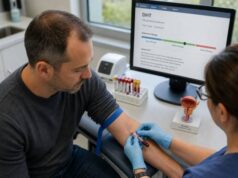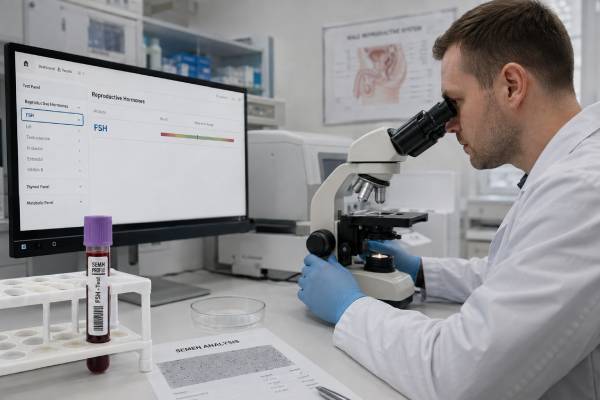
A follicle-stimulating hormone (FSH) test in men helps assess pituitary signaling to the sperm-producing tissue of the testes. FSH acts on Sertoli cells, which support developing sperm and produce inhibin B. The test is commonly used when semen analysis is abnormal, fertility is reduced, puberty is delayed, testes are small, or a pituitary or testicular disorder is suspected. High FSH usually means the pituitary is increasing its signal because seminiferous-tubule function is impaired. Low or inappropriately normal FSH may indicate hypothalamic or pituitary suppression, external testosterone or anabolic steroid use, severe illness, or another central cause. A normal FSH value does not guarantee normal sperm production, and a high value does not prove that no sperm can be found. Interpretation requires semen results, LH, testosterone, testicular size, medications, and often genetics. FSH is a useful locator of the problem, not a direct sperm count or a stand-alone fertility diagnosis.
- High FSH often supports impaired sperm production or primary testicular damage, especially with small testes and low inhibin B.
- Low FSH may reflect pituitary or hypothalamic suppression, including external testosterone, anabolic steroids, hyperprolactinemia, or congenital hypogonadotropic hypogonadism.
- Normal FSH does not rule out male infertility, because obstruction, genetic defects, or partial spermatogenic failure may occur with values in range.
- Semen analysis remains the direct test of sperm concentration, motility, and morphology.
- FSH ranges vary by assay, and the result should be interpreted with LH and testosterone rather than alone.
Table of Contents
- How FSH works in men
- Why an FSH test is ordered
- Preparation and reference ranges
- What high FSH can mean
- What low FSH can mean
- Normal FSH with abnormal fertility
- Interpreting FSH with other tests
- Treatment, follow-up, and limitations
How FSH works in men
FSH is a glycoprotein hormone made by gonadotroph cells in the anterior pituitary. The hypothalamus releases gonadotropin-releasing hormone in pulses, prompting the pituitary to release FSH and luteinizing hormone (LH). LH stimulates Leydig cells to make testosterone. FSH acts mainly on Sertoli cells inside the seminiferous tubules.
Sertoli cells create the environment in which germ cells develop into mature sperm. They support nutrition, form the blood-testis barrier, produce androgen-binding protein, regulate local signaling, and release inhibin B. High intratesticular testosterone and FSH work together to maintain spermatogenesis.
Inhibin B feeds back primarily on FSH. When active sperm production and Sertoli-cell function decline, inhibin B often falls. The pituitary receives less negative feedback and FSH rises. This explains why high FSH is a common marker of seminiferous-tubule damage.
The feedback is not exact. Some men with severe sperm-production problems have FSH inside range, and some men with elevated FSH still have sperm in the ejaculate or small areas of sperm production in the testes. Testicular tissue can be patchy, and assays measure the circulating signal rather than the microscopic outcome.
FSH secretion is pulsatile, but day-to-day variation is usually less problematic than testosterone’s morning decline. A single result is often interpretable, although repetition may be reasonable when it conflicts with the rest of the evaluation.
FSH should not be confused with a “female-only” hormone. It has a central male reproductive role from fetal and pubertal development through adult sperm production.
Why an FSH test is ordered
FSH is commonly ordered during evaluation of male infertility or hypogonadism. Indications include:
- Low sperm concentration, azoospermia, or another abnormal semen analysis
- Small or soft testes
- Delayed or incomplete puberty
- Low testosterone
- Reduced libido or erectile symptoms with a suspected pituitary cause
- Prior chemotherapy, radiation, testicular torsion, orchitis, or trauma
- Suspected Klinefelter syndrome or another genetic condition
- Monitoring recovery after anabolic steroid or testosterone suppression
- Evaluation before selected fertility treatments
A hormone evaluation is especially appropriate in an infertile man with sperm concentration below the laboratory reference, sexual symptoms, testicular atrophy, or evidence of an endocrine disorder. FSH is not always necessary after a completely normal semen analysis and normal examination unless another concern exists.
In azoospermia, FSH helps distinguish impaired sperm production from obstruction, but it cannot do so alone. A man with high FSH and small testes is more likely to have nonobstructive azoospermia. A man with normal FSH, normal-sized testes, and low-volume acidic semen may have an obstructive or ejaculatory-duct pattern. Exceptions are common enough that examination, semen details, genetics, imaging, and sometimes surgery are needed.
For delayed puberty, FSH is interpreted with LH, testosterone, testicular volume, growth pattern, and age. High gonadotropins suggest primary gonadal failure. Low values may reflect constitutional delay or central hypogonadism, which can be difficult to separate early in adolescence.
FSH is not a routine wellness test. Testing men without symptoms, fertility concerns, or risk factors can identify small deviations that do not change care.
Preparation and reference ranges
FSH is measured in a blood sample, usually reported in IU/L or mIU/mL; these units are numerically equivalent in many reports. Fasting is generally not required. The sample can often be collected at any time, although it is convenient to draw FSH with morning testosterone.
Tell the clinician about:
- Testosterone therapy, anabolic steroids, or selective androgen receptor modulators
- hCG, FSH injections, clomiphene, enclomiphene, tamoxifen, or aromatase inhibitors
- Opioids, glucocorticoids, and antipsychotics
- Recent severe illness, major weight loss, or excessive exercise
- Prior testicular surgery, chemotherapy, radiation, infection, or injury
- Fertility supplements and unregulated hormone products
External testosterone commonly suppresses FSH. The low result is an expected pharmacologic effect and may be accompanied by reduced intratesticular testosterone, smaller testes, and low sperm production. Recovery after stopping can take months or longer and varies with duration, dose, age, and baseline fertility.
Adult male reference intervals often span low single digits to roughly the low teens IU/L, but the exact range depends on assay and laboratory. A value above range is not linearly proportional to damage; FSH of 30 does not mean exactly twice the impairment of FSH 15.
Age and puberty matter. Pediatric ranges change across development, and a prepubertal value cannot be assessed using an adult interval. Gonadotropin assays also differ, so results should be trended with the same laboratory when possible.
Biotin can interfere with some immunoassays. High-dose biotin should be reported, and the laboratory can advise about any needed pause.
What high FSH can mean
High FSH usually indicates that the pituitary is trying to stimulate Sertoli cells and seminiferous tubules that are not providing normal inhibin B feedback.
Common causes include:
- Primary testicular failure
- Klinefelter syndrome
- Damage from chemotherapy or radiation
- Severe testicular trauma or torsion
- Mumps orchitis or another destructive infection
- Cryptorchidism, especially bilateral or late-corrected cases
- Sertoli-cell-only syndrome
- Maturation arrest or other nonobstructive azoospermia patterns
- Age-related decline in spermatogenic function
- Some Y-chromosome deletions or other genetic causes
High FSH can occur while testosterone remains normal. Leydig cells may still make adequate testosterone even when sperm-producing tubules are damaged. In that pattern, LH may be normal or mildly elevated, while inhibin B is low and semen analysis is abnormal.
A very high result increases the likelihood of severe spermatogenic impairment, but it does not prove complete absence of sperm. Men with nonobstructive azoospermia can have focal sperm production that is found during microdissection testicular sperm extraction. FSH is one predictor, not a gatekeeper.
High FSH with high LH and low testosterone suggests broader primary testicular failure affecting both seminiferous tubules and Leydig cells. Klinefelter syndrome, extensive gonadotoxic damage, or severe acquired testicular disease may produce this pattern.
A transient mild rise can reflect assay variation or recovery after central suppression. Confirmation and context prevent overdiagnosis.
What low FSH can mean
Low or inappropriately normal FSH can indicate reduced hypothalamic or pituitary stimulation. The word “inappropriately” matters: a value within range may still be abnormal when sperm production and testosterone are low, because the pituitary should be increasing its signal.
Causes include:
- Congenital hypogonadotropic hypogonadism
- Pituitary tumors or surgery
- Hyperprolactinemia
- Hemochromatosis or infiltrative pituitary disease
- Head trauma or cranial radiation
- External testosterone and anabolic steroids
- Opioids or high-dose glucocorticoids
- Severe obesity, undernutrition, chronic illness, or intense exercise
- Functional hypothalamic suppression
Low FSH often occurs with low LH and testosterone in central hypogonadism. Sperm production may be very low or absent because both FSH stimulation and intratesticular testosterone are inadequate.
A man taking testosterone may have a normal serum testosterone and very low FSH. This does not mean fertility is normal; serum testosterone from outside the body suppresses the signals needed inside the testes.
Hyperprolactinemia suppresses gonadotropin-releasing hormone and can lower FSH, LH, testosterone, libido, and fertility. A prolactin test in men is appropriate when central suppression or low sexual desire is unexplained.
In congenital central hypogonadism, fertility may be induced with hCG and FSH or pulsatile GnRH in selected patients. Standard testosterone can develop secondary sexual characteristics but does not stimulate sperm production.
Normal FSH with abnormal fertility
Normal FSH does not rule out male-factor infertility. Several conditions can produce poor semen results without a major change in circulating FSH.
Examples include:
- Obstruction of the vas deferens or ejaculatory ducts
- Congenital bilateral absence of the vas deferens
- Varicocele
- Partial or patchy spermatogenic impairment
- Sperm motility or morphology defects
- Genetic defects that affect sperm function more than Sertoli feedback
- Ejaculatory dysfunction
- Recent fever or toxic exposure
- Antisperm antibodies in selected settings
FSH responds mainly to inhibin B and Sertoli-cell output. A problem occurring after sperm leave the seminiferous tubules may not alter FSH. Obstruction is the clearest example: production can be normal, but sperm cannot reach the ejaculate.
Even within nonobstructive infertility, FSH can remain normal when enough seminiferous tissue continues to provide inhibin B feedback. This is why semen analysis is the direct starting point.
Semen results also vary. Fever, abstinence interval, collection problems, and normal biological variation can change concentration and motility. An abnormal analysis is often repeated before a definitive conclusion.
Interpreting FSH with other tests
Common FSH patterns in men
| FSH | LH/testosterone | Likely interpretation |
|---|---|---|
| High | Testosterone normal | Predominant seminiferous-tubule impairment |
| High | LH high, testosterone low | Primary testicular failure affecting sperm and androgen production |
| Low or normal | LH low or normal, testosterone low | Central hypogonadism or functional suppression |
| Low | Testosterone normal or high on treatment | External androgen suppression |
| Normal | Normal hormones, azoospermia | Obstruction or a form of production failure still possible |
Inhibin B is produced by Sertoli cells and usually moves opposite to FSH. Low inhibin B with high FSH supports impaired spermatogenesis. Discordant values occur, and neither result perfectly predicts sperm retrieval.
LH and testosterone assess Leydig-cell function. Prolactin identifies one cause of central suppression. Estradiol and SHBG may clarify obesity, liver disease, or treatment effects.
Genetic testing is important in severe oligospermia or azoospermia. Karyotype can identify Klinefelter syndrome. Y-chromosome microdeletion testing is used at guideline-defined sperm thresholds. CFTR testing is relevant when the vas deferens is absent or obstruction is suspected.
The inhibin B test and FSH offer complementary information, but semen analysis and diagnosis remain central.
Treatment, follow-up, and limitations
Treatment depends on the cause, not on lowering or raising FSH into range. High FSH from primary testicular damage usually cannot be normalized by giving testosterone, and lowering the laboratory value would not restore sperm production.
Men with central hypogonadism may benefit from hCG plus FSH when fertility is desired. FSH therapy has also been studied in selected men with idiopathic infertility and normal gonadotropins, but response is variable, treatment is costly, and patient selection remains debated.
Follow-up may include:
- Repeat semen analysis
- LH, total testosterone, SHBG, and free testosterone
- Inhibin B
- Prolactin and thyroid tests
- Genetic testing
- Scrotal ultrasound for selected findings
- Pituitary MRI when central disease is suspected
- Reproductive-urology consultation
Common mistakes include treating FSH as a sperm count, assuming high FSH means sperm retrieval is impossible, and assuming normal FSH proves obstruction. Another is starting testosterone in an infertile man without discussing its suppressive effect.
Seek prompt care for sudden testicular pain, a hard testicular lump, severe headache with visual change, or symptoms of pituitary compression. Fertility evaluation should be timely when the partner’s age or reproductive history narrows the treatment window.
FSH is most valuable as part of a map: it shows how strongly the pituitary is signaling Sertoli cells. Semen analysis shows the output, inhibin B reflects feedback, testosterone and LH assess Leydig function, and genetics or imaging identify causes that hormone levels cannot.
FSH in azoospermia and sperm-retrieval counseling
Azoospermia should be confirmed with careful examination of a centrifuged semen sample. Once confirmed, FSH helps distinguish broad patterns but cannot make the diagnosis alone. A normal FSH with normal-sized testes and preserved inhibin B may support obstruction, especially when semen volume, pH, and examination point in that direction. However, maturation arrest and focal testicular failure can also occur with a normal FSH.
A very high FSH is more consistent with widespread seminiferous tubule damage, yet sperm production can be patchy. Small islands of active spermatogenesis may remain even when the average feedback signal is poor. For this reason, high FSH should not be used by itself to deny microdissection testicular sperm extraction. Counseling should combine genetics, testicular volume, prior surgery or biopsy, underlying diagnosis, partner factors, and the experience of the surgical center.
Certain genetic results carry more definitive implications than FSH. Complete AZFa or AZFb Y-chromosome microdeletions are associated with an extremely poor chance of sperm retrieval, while other genetic findings have different prognoses and inheritance concerns. Karyotype can identify Klinefelter syndrome. CFTR testing is relevant when congenital absence of the vas deferens suggests obstruction. Genetic counseling should occur before assisted reproduction when a result could be passed to offspring.
FSH treatment is not the same as an FSH test
An elevated endogenous FSH shows that the pituitary is already increasing stimulation in response to reduced testicular feedback. Giving additional FSH in established primary testicular failure does not necessarily overcome damaged seminiferous tissue. Testosterone replacement can lower FSH through feedback but will usually suppress intratesticular testosterone and sperm production, so a lower laboratory number would not represent restored fertility.
In contrast, men with hypogonadotropic hypogonadism have inadequate gonadotropin stimulation. hCG is often used first to stimulate Leydig cells through the LH receptor, and FSH may be added to support Sertoli cells. Testicular growth, testosterone, inhibin B, and serial semen analyses are monitored over months. Men with a history of absent puberty or very small testes may require longer treatment than men who previously completed puberty.
FSH preparations have also been studied in selected men with idiopathic infertility and normal gonadotropins. Some trials report improvements in sperm concentration or pregnancy-related outcomes in subgroups, while benefits are inconsistent across studies. Cost, injection burden, duration, female-partner age, genetic variants, baseline FSH, and prior treatment all affect the decision. This is specialist therapy, not a response to any low-normal FSH value.
Changes over time and recovery after suppression
Spermatogenesis takes many weeks, so semen and Sertoli-cell markers do not recover immediately after fever, illness, chemotherapy, anabolic steroid use, or a treatment change. A repeat semen analysis may be timed several weeks to months later depending on the insult and urgency. FSH can recover earlier or later than semen parameters and should not be used as the only marker of recovery.
After stopping exogenous testosterone or anabolic steroids, LH and FSH may remain suppressed while the hypothalamic–pituitary axis restarts. Serum testosterone can improve before sperm reappear in meaningful numbers. Some men recover spontaneously, while others need specialist treatment. Age, duration and dose of exposure, baseline fertility, and use of multiple compounds influence the timeline.
A fever can temporarily reduce sperm production without causing a dramatic FSH rise. Varicocele, toxins, and partial testicular injury may also produce semen changes disproportionate to FSH. This reinforces why direct semen testing remains central.
For follow-up, clinicians should ask whether another FSH measurement will change management. Repeating it may be useful after gonadotropin therapy, recovery from central suppression, or a major change in testicular function. Frequent testing in stable primary failure rarely adds as much information as semen analysis, symptoms, testosterone, and a clear reproductive plan.
FSH after cancer treatment and testicular injury
Chemotherapy and radiation can affect germ cells at doses that leave Leydig-cell testosterone production relatively intact. FSH may therefore be high while LH and testosterone remain within range. The pattern indicates reduced sperm-producing reserve, not necessarily low androgen status. Fertility preservation should ideally be discussed before treatment, but post-treatment semen analysis and reproductive counseling remain valuable.
Recovery depends on the agents, cumulative dose, radiation field, age, baseline testicular function, and time since treatment. A falling FSH can accompany recovery, but semen analysis is the direct evidence that sperm have returned. Some men with persistently high FSH still have rare sperm suitable for cryopreservation or assisted reproduction.
Torsion, trauma, orchitis, and surgery can produce a similar compartment-specific pattern. One healthy testis may maintain normal serum testosterone while total sperm output falls. Examination and ultrasound address anatomy, while FSH and semen analysis describe endocrine response and reproductive output. Sudden testicular pain remains an emergency because rapid treatment of torsion is time-sensitive.
In adolescents treated for cancer or with prior undescended testes, adult reference ranges should not be applied until pubertal stage is considered. Long-term follow-up may include growth, puberty, testicular volume, gonadotropins, testosterone, and fertility counseling at an appropriate age.
The female partner’s reproductive timeline affects how long to pursue reversible male factors before assisted reproduction. A mildly abnormal FSH may justify observation in one couple but prompt faster coordinated treatment in another. Hormone interpretation should support a couple-centered plan rather than delay care while waiting for every value to normalize.
Men should also be told that FSH does not measure masculinity, libido, or erectile blood flow. Treating a high or low value as a performance marker can lead to unnecessary hormones and fertility harm. Its principal role is explaining pituitary signaling to sperm-producing tissue.
When results remain uncertain, a reproductive urologist can integrate hormones, semen findings, examination, genetics, and imaging without assigning more precision to FSH than the evidence supports.
References
- Updates to Male Infertility: AUA/ASRM Guideline (2024) 2024 (Guideline)
- Sexual and Reproductive Health 2026 (Guideline)
- FSH Therapy in Male Factor Infertility 2024 (Review)
- Role of Follicle-stimulating Hormone, Inhibin B, and Anti-Müllerian Hormone in Predicting Sperm Retrieval in Men with Nonobstructive Azoospermia Undergoing Microdissection Testicular Sperm Extraction: A Systematic Review and Meta-analysis 2024 (Systematic Review)
- Inhibin-B and FSH Are Good Indicators of Spermatogenesis but Not the Best Indicators of Fertility 2022 (Study)
Disclaimer
This article is educational and does not diagnose infertility, pituitary disease, or testicular failure. FSH must be interpreted with semen analysis, LH, testosterone, examination, medications, genetics, and the laboratory’s range. Do not start testosterone, gonadotropins, or fertility medication without specialist guidance.