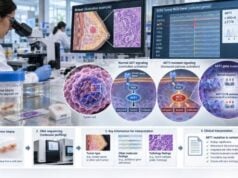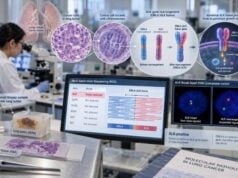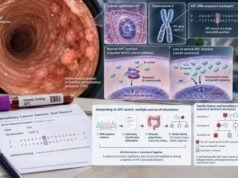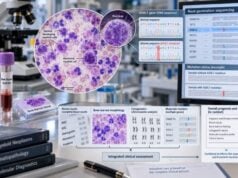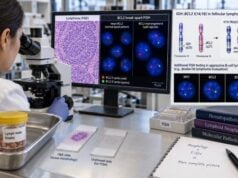
A KRAS mutation test looks for activating changes in the KRAS gene that can influence cancer classification and treatment. KRAS is one of the most common cancer-driving genes, but a positive result does not have one universal meaning. In colorectal cancer, KRAS mutations generally predict lack of benefit from anti-EGFR antibodies, while the KRAS G12C subtype can create a targeted-treatment option in advanced disease. In non-small cell lung cancer, KRAS G12C is an established actionable driver in previously treated disease and is distinct from other KRAS variants. In pancreatic ductal adenocarcinoma, KRAS mutations are present in the great majority of tumors, most often G12D, G12V, or G12R, and currently serve more as a molecular-defining feature than a broadly targetable marker. Correct interpretation therefore requires the exact codon and amino-acid change, the cancer type, other biomarkers, prior treatment, and the assay used.
- A positive KRAS result means an activating KRAS variant was detected; the exact variant, such as G12C, G12D, G12V, or G13D, determines much of its clinical meaning.
- In metastatic colorectal cancer, an activating KRAS mutation usually predicts resistance to cetuximab or panitumumab when used as conventional anti-EGFR therapy.
- KRAS G12C is directly targetable in selected advanced lung and colorectal cancers, but treatment strategies differ between those diseases.
- About 90% of pancreatic ductal adenocarcinomas carry a KRAS mutation, yet G12C is uncommon and most pancreatic KRAS variants do not have an approved mutation-specific drug.
- A negative KRAS result does not mean the tumor lacks a driver; testing for other alterations may be especially important in KRAS-wild-type lung, colorectal, or pancreatic cancer.
Table of Contents
- What the KRAS Test Measures
- How KRAS Testing Is Performed
- Positive, Negative, and Uncertain Results
- KRAS in Colorectal Cancer
- KRAS in Lung Cancer
- KRAS in Pancreatic Cancer
- Limitations and Next Steps
What the KRAS Test Measures
KRAS encodes a small GTPase that acts like a molecular switch inside the cell. In its normal state, KRAS cycles between an active and inactive form in response to signals from growth-factor receptors. Cancer-associated mutations can lock the protein into an active signaling state, driving pathways such as MAPK and PI3K that promote cell growth and survival.
Most clinically important KRAS mutations occur in codons 12 and 13, although codons 61, 117, and 146 can also be relevant in some cancers. The protein notation identifies the original amino acid, codon, and replacement amino acid. For example:
- G12C means glycine at codon 12 changed to cysteine;
- G12D means glycine changed to aspartic acid;
- G12V means glycine changed to valine; and
- G13D means glycine at codon 13 changed to aspartic acid.
These are not minor laboratory details. A G12C mutation can be directly druggable with a class of covalent inhibitors, while a G12D or G12V mutation may have very different treatment implications. A report that says only “KRAS positive” is therefore less useful than one that gives the precise variant.
KRAS testing is generally a somatic tumor test, meaning it looks for mutations acquired by cancer cells. A KRAS mutation found in a colon, lung, or pancreatic tumor usually does not mean the patient inherited the mutation or that family members carry it.
How KRAS Testing Is Performed
KRAS can be tested with targeted PCR-based methods or with next-generation sequencing (NGS). Broader NGS panels are increasingly preferred in advanced cancers because they assess KRAS alongside other biomarkers that may change treatment.
For colorectal and pancreatic cancer, testing usually uses tumor tissue from a biopsy or surgical specimen. For lung cancer, tissue is also preferred when available, but plasma circulating tumor DNA can be useful when tissue is limited or a rapid noninvasive result is needed. A positive plasma finding for a well-established driver can be actionable, while a negative plasma result may need confirmation in tissue because not every tumor sheds enough DNA into the bloodstream.
The pathology laboratory evaluates whether the specimen has enough viable tumor. Low tumor cellularity, necrosis, prior treatment, and degraded DNA can reduce test sensitivity. Formalin-fixed tissue is commonly used, but quality varies among blocks and specimens.
What to look for on the report
A complete KRAS report commonly includes the exact variant, variant allele frequency, assay method, regions covered, and an interpretation. Some reports describe the alteration as pathogenic, likely pathogenic, oncogenic, or therapeutically relevant.
The variant allele frequency (VAF) is the proportion of sequencing reads carrying the mutation. A VAF of 20%, for example, does not simply mean that 20% of tumor cells are mutated. Normal-cell contamination, tumor purity, copy-number changes, and clonality affect the number.
Broad molecular testing can be especially valuable when KRAS is negative. In lung adenocarcinoma, other drivers can include EGFR, ALK, ROS1, BRAF, MET exon 14 skipping, RET, NTRK, ERBB2, and others. In colorectal cancer, RAS testing is often interpreted with BRAF, mismatch repair or microsatellite instability, and HER2 status in appropriate cases. In pancreatic cancer, KRAS-wild-type tumors are enriched for potentially actionable alterations such as BRAF changes, NTRK or NRG1 fusions, and DNA-repair abnormalities.
Positive, Negative, and Uncertain Results
A positive KRAS result confirms that the tested tumor contains a reportable KRAS alteration. The result can act as a predictive biomarker, a marker of tumor biology, or both.
Positive result
The first question after a positive result is the exact variant. G12C has established targeted-treatment implications in some cancers. Other variants may be important because they predict resistance to a drug class or because they define a biologic subgroup, even when no variant-specific drug is routinely available.
A positive KRAS mutation also does not reveal stage. An early-stage localized tumor and a widely metastatic tumor can carry the same KRAS variant. Stage comes from imaging, surgery, pathology, and clinical evaluation.
Negative result
A negative result means no reportable KRAS alteration was found within the assay’s tested regions and sensitivity. It does not mean the tumor is benign or genetically normal. In fact, a KRAS-negative result can make testing for alternative drivers more important.
In colorectal cancer, laboratories often evaluate NRAS as part of extended RAS testing because an NRAS mutation also predicts lack of benefit from conventional anti-EGFR therapy. In pancreatic cancer, a genuine KRAS-wild-type result should prompt careful review of tumor content and consideration of broad profiling because unusual targetable drivers are more common in this small subgroup.
Variant of uncertain significance
A KRAS variant of uncertain significance is not the same as a known activating hotspot. It should not automatically be used to deny or select treatment. Molecular pathology review can help determine whether the variant has emerging functional or clinical evidence.
KRAS in Colorectal Cancer
KRAS testing has long been central to treatment selection in metastatic colorectal cancer because activating RAS mutations predict resistance to anti-EGFR antibodies used in the conventional RAS-wild-type setting.
Anti-EGFR treatment and RAS status
Cetuximab and panitumumab target the epidermal growth factor receptor. If KRAS is already activated downstream, blocking EGFR may not stop the growth signal. For that reason, tumors with activating KRAS mutations generally do not receive standard anti-EGFR therapy as though they were RAS wild-type.
The key concept is extended RAS testing, not just a single KRAS exon. Clinically relevant mutations in KRAS and NRAS can occur outside codon 12. A report limited to one hotspot may therefore be inadequate for modern anti-EGFR selection.
Tumor location matters too. Even among RAS-wild-type metastatic colorectal cancers, left-sided primary tumors generally derive more benefit from first-line anti-EGFR strategies than right-sided primary tumors. KRAS status is therefore necessary but not sufficient for the treatment decision.
KRAS G12C changes the treatment landscape
KRAS G12C occurs in only a small percentage of colorectal cancers, but it now has direct therapeutic significance. KRAS G12C inhibitors have shown greater activity in colorectal cancer when combined with an EGFR antibody than when used alone. This reflects rapid feedback activation through EGFR in colorectal tumor cells.
Clinical studies of combinations such as adagrasib plus cetuximab and sotorasib plus panitumumab have demonstrated meaningful response and progression-free survival in previously treated metastatic KRAS G12C colorectal cancer. The presence of G12C therefore changes the meaning of a “KRAS-positive” report: it predicts resistance to conventional anti-EGFR monotherapy but can support a later-line combination that includes EGFR blockade together with direct KRAS G12C inhibition.
This is a good example of why biomarker interpretation evolves. A mutation that historically meant “not eligible for EGFR therapy” can, in a specific combination and treatment setting, become the reason an EGFR antibody is paired with a targeted drug.
KRAS in Lung Cancer
KRAS is one of the most common oncogenic drivers in lung adenocarcinoma. G12C is the most frequent KRAS subtype in non-small cell lung cancer and is strongly associated with tobacco exposure, although it can occur in people with different smoking histories.
Why G12C matters
The cysteine created by the G12C mutation provides a binding site for covalent inhibitors that lock KRAS in an inactive state. This led to the development of drugs such as sotorasib and adagrasib for advanced KRAS G12C-mutated non-small cell lung cancer after prior therapy.
A G12C-positive result does not mean the targeted drug should automatically be the first treatment given. First-line decisions in advanced lung cancer also consider PD-L1 expression, histology, disease burden, symptoms, brain metastases, co-mutations, and the full molecular profile. Treatment standards also change as new trial data mature.
Co-mutations affect behavior
KRAS-mutant lung cancer is biologically heterogeneous. Co-alterations in genes such as STK11, KEAP1, and TP53 can influence tumor biology and response patterns. Two patients with the same KRAS G12C mutation can therefore have different clinical courses.
Resistance can also develop during KRAS G12C inhibition. Tumors may acquire additional KRAS changes, activate alternative signaling pathways, or undergo phenotypic changes. Repeat tissue or liquid biopsy at progression can sometimes identify these mechanisms and guide clinical-trial options.
Other KRAS variants such as G12D and G12V are not equivalent to G12C. They should not be assumed to respond to a G12C-specific inhibitor. Mutation-selective and broader RAS-pathway drugs are under active study, making precise variant reporting increasingly important.
KRAS in Pancreatic Cancer
Pancreatic ductal adenocarcinoma is one of the cancers most strongly associated with KRAS. Roughly 90% of tumors contain a KRAS mutation. The dominant variants are G12D, G12V, and G12R, while G12C occurs in only a small minority.
Because KRAS mutations are so common, a positive result in a pancreatic tumor generally supports familiar PDAC biology rather than identifying a rare diagnostic subgroup. It does not, by itself, determine resectability, stage, or prognosis.
Treatment relevance is variant-specific
Direct KRAS G12C inhibitors can be relevant for the small subset of pancreatic cancers with G12C, and clinical evidence has demonstrated activity in previously treated disease. Most patients, however, have non-G12C variants. Drugs targeting G12D, pan-RAS signaling, and upstream or downstream pathway components are areas of intense clinical development, but investigational therapy should not be confused with established standard treatment.
A particularly useful result can be KRAS wild-type. Because this is unusual in classic PDAC, it should prompt confirmation that the tested sample contains adequate tumor and consideration of broad genomic profiling. KRAS-wild-type pancreatic cancers are more likely than KRAS-mutant cases to harbor alternative drivers such as gene fusions or BRAF alterations that may be targetable.
Germline testing remains a separate issue. Patients with pancreatic cancer may qualify for hereditary cancer testing for genes such as BRCA1, BRCA2, PALB2, and others regardless of the tumor’s KRAS status. A somatic KRAS mutation does not rule out an inherited cancer predisposition.
Limitations and Next Steps
KRAS testing is only as reliable as the assay and specimen. A negative result can be false if tumor content is low, DNA quality is poor, or the panel does not cover relevant exons. Plasma testing can miss alterations when circulating tumor DNA is scarce. Conversely, an unexpected low-level mutation should be reviewed in the context of assay performance and specimen quality.
Another common mistake is applying one cancer’s rules to another. KRAS G12C can be targetable in both lung and colorectal cancer, but the effective treatment strategy, approved setting, and combination partners differ. A KRAS mutation in pancreatic cancer carries different implications again.
When reviewing a report, ask:
- What exact KRAS variant and codon were detected?
- Was testing done on tissue or plasma, and was the specimen adequate?
- Were NRAS and other disease-relevant genes included where appropriate?
- Does the variant predict resistance, create a targeted option, or mainly describe tumor biology in this cancer type?
- Are there co-mutations that change prognosis or treatment planning?
If treatment depends on a result that does not fit the pathology or clinical picture, repeat testing with a validated broader assay can be reasonable. For advanced disease, multidisciplinary interpretation by oncology and molecular pathology is often more useful than reading an automated “actionability” statement in isolation.
Practical interpretation examples
The phrase “KRAS mutation detected” can lead to very different decisions depending on the report. In metastatic colon cancer, a KRAS G12D result generally means the tumor should not be treated as conventional RAS-wild-type disease for cetuximab or panitumumab selection. The same G12D result in pancreatic ductal adenocarcinoma is common and mainly describes the tumor’s biology, although mutation-selective trials may be relevant. In lung adenocarcinoma, a KRAS G12C result can identify a direct targeted-treatment pathway after appropriate prior therapy. The gene is the same, but the treatment consequence is disease-specific.
A second common scenario is an apparently KRAS-wild-type pancreatic cancer. Because most classic pancreatic ductal adenocarcinomas are KRAS-mutated, a negative result deserves a quality check rather than being treated as routine. The pathologist should confirm that the sample contains enough tumor and that the assay covered the expected hotspots. If the negative result is reliable, broad RNA and DNA profiling becomes especially useful because KRAS-wild-type pancreatic cancers are enriched for alternative drivers, including gene fusions and BRAF-pathway alterations.
In colorectal cancer, the term “KRAS negative” should also be read carefully. Modern anti-EGFR selection depends on extended RAS status, including clinically relevant NRAS variants. A narrow test that reports only KRAS codons 12 and 13 is not equivalent to a contemporary multigene panel. The report should show what exons and genes were actually analyzed.
For plasma testing, the asymmetry of interpretation is important. A clearly detected, well-validated KRAS driver in circulating tumor DNA can be highly informative. A negative plasma result is less definitive because low-volume disease, treatment response, or biologic differences in DNA shedding can reduce circulating tumor DNA below detection. When a negative result would determine access to an important therapy, tissue testing is often the stronger fallback if suitable tissue can be obtained.
Finally, KRAS status can evolve under treatment pressure even though the founding mutation often remains. Resistance to a KRAS G12C inhibitor can involve new alterations in KRAS itself, activation of bypass pathways, or histologic change. At progression, repeat molecular profiling may therefore answer a different question from the original diagnostic test: not “what started this cancer?” but “what is driving resistance now?”
References
- Efficacy and Safety of Adagrasib plus Cetuximab in Patients with KRASG12C-Mutated Metastatic Colorectal Cancer 2024
- Sotorasib plus Panitumumab in Refractory Colorectal Cancer with Mutated KRAS G12C 2023 (RCT)
- Targeting KRASG12C in Non-Small-Cell Lung Cancer: Current Standards and Developments 2024 (Review)
- KRASG12C Inhibitors in Non-Small Cell Lung Cancer: A Review 2024 (Review)
- Targeting KRAS mutations in pancreatic cancer: opportunities for future strategies 2024 (Review)
- Targeting KRAS in pancreatic cancer 2024 (Review)
Disclaimer
KRAS results must be interpreted with the exact variant, cancer type, stage, other biomarkers, prior therapies, and current treatment standards. This article is educational and does not replace individualized advice from an oncologist, pathologist, surgeon, or genetics professional.