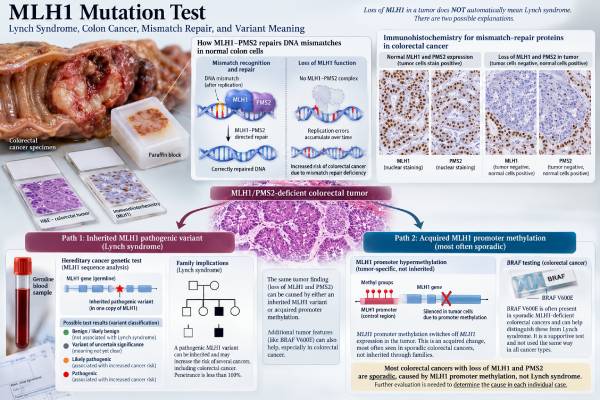
An MLH1 mutation test can be used to look for an inherited pathogenic variant that causes Lynch syndrome or to characterize changes found in a tumor. MLH1 is one of the major DNA mismatch repair genes. When both copies of MLH1 are inactivated in a tumor, the cancer often becomes mismatch-repair deficient and microsatellite instability-high (MSI-H). In colorectal and endometrial cancer, however, loss of MLH1 protein is frequently caused by acquired MLH1 promoter methylation, not by inherited Lynch syndrome. That distinction is central to result interpretation. A germline pathogenic MLH1 variant can establish Lynch syndrome and has implications for the patient and biological relatives. By contrast, tumor-only MLH1 loss or methylation may be sporadic. The most useful evaluation combines tumor immunohistochemistry, MSI testing, MLH1 promoter methylation, sometimes BRAF testing in colorectal cancer, and germline genetic testing when indicated.
- A germline pathogenic or likely pathogenic MLH1 variant confirms MLH1-associated Lynch syndrome.
- Loss of MLH1 and PMS2 staining in a tumor suggests MLH1 pathway dysfunction, but it does not by itself prove an inherited MLH1 mutation.
- MLH1 promoter hypermethylation is a common sporadic cause of MLH1 loss, especially in colorectal and endometrial cancer.
- In colorectal cancer, BRAF V600E can support a sporadic MLH1-methylated pathway, but BRAF testing is not a substitute for complete hereditary-risk assessment.
- A variant of uncertain significance does not diagnose Lynch syndrome and should not be used as if it were a pathogenic result.
Table of Contents
- What MLH1 Does
- When MLH1 Testing Is Used
- Tumor Screening and MLH1 Loss
- Germline Result Meaning
- Cancer Risk and Surveillance
- Treatment Implications of dMMR and MSI
- Limitations and Next Steps
What MLH1 Does
MLH1 is a core component of the DNA mismatch repair (MMR) system. This repair system corrects small copying errors that occur when DNA is replicated. MLH1 pairs mainly with PMS2 to form a protein complex that helps coordinate repair after an error has been recognized.
When a person inherits one nonworking MLH1 copy, every cell starts with one functional copy remaining. If a cell later loses or inactivates that second copy, mismatch repair can fail. Repetitive DNA regions called microsatellites then accumulate insertion and deletion errors, producing microsatellite instability. This is one molecular route to Lynch syndrome-associated cancer.
MLH1-associated Lynch syndrome is inherited in an autosomal dominant pattern. A person with a pathogenic germline MLH1 variant has a 50% chance of passing that variant to each biological child. The mutation does not mean cancer is present now and does not guarantee that cancer will occur, but it raises lifetime risk enough to justify structured surveillance and, in some circumstances, risk-reducing surgery.
The same gene can also be shut down somatically, meaning only in the tumor. A common mechanism is MLH1 promoter hypermethylation, an epigenetic change that turns down MLH1 expression without changing the DNA coding sequence. This is why tumor MLH1 loss and hereditary MLH1 mutation are related but not synonymous findings.
When MLH1 Testing Is Used
MLH1 testing can enter the diagnostic pathway in several ways.
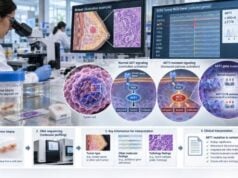
One common pathway begins with universal or broad tumor screening of colorectal or endometrial cancer. The tumor is tested by MMR immunohistochemistry, MSI testing, or both. If immunohistochemistry shows loss of MLH1 and PMS2, additional studies are often used to determine whether the pattern is more likely sporadic or hereditary.
Another pathway starts with a strong personal or family history of Lynch-associated cancers. A genetics professional may order a germline panel that includes MLH1, MSH2, MSH6, PMS2, and EPCAM, often along with other hereditary colorectal or endometrial cancer genes.
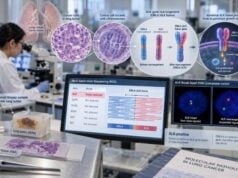
A third pathway arises from tumor NGS. A tumor panel may identify an MLH1 variant or biallelic MLH1 inactivation. Because tumor sequencing cannot always tell whether a variant is inherited, confirmatory germline testing from blood or saliva may be needed.
Germline versus tumor testing
Germline testing is usually performed on blood, saliva, or another non-tumor specimen. Its purpose is to determine whether the variant is constitutional and therefore potentially heritable.
Tumor testing evaluates the cancer itself. A pathogenic MLH1 variant in tumor DNA may be germline or somatic. Paired tumor-normal sequencing can distinguish these possibilities more directly than tumor-only testing.
No fasting is required for a blood or saliva genetic test. The most important preparation is often pretest genetic counseling, which helps the patient understand possible results, insurance and privacy considerations, family implications, and the difference between a pathogenic result and a VUS.
Tumor Screening and MLH1 Loss
MLH1 interpretation often begins with MMR immunohistochemistry. The four routinely assessed proteins are MLH1, PMS2, MSH2, and MSH6.
Loss of MLH1 and PMS2
MLH1 and PMS2 function as a pair. PMS2 is unstable without MLH1, so an MLH1 defect commonly causes loss of both MLH1 and PMS2 staining. This pattern points toward MLH1 as the upstream problem.
The pattern does not prove Lynch syndrome because acquired MLH1 promoter methylation can produce the same immunohistochemical loss. This is especially common in sporadic colorectal cancers in older adults and in sporadic endometrial cancers.
MLH1 promoter methylation
Promoter methylation testing evaluates whether the regulatory region of MLH1 is epigenetically silenced in the tumor. When MLH1/PMS2 are lost and tumor MLH1 promoter hypermethylation is present, a sporadic pathway becomes more likely.
However, methylation is not an absolute hereditary exclusion in every circumstance. Rare patients can have constitutional MLH1 epimutation or a germline MLH1 abnormality together with tumor methylation. Young age, multiple Lynch-spectrum cancers, or a strong family history can justify genetics evaluation even when tumor methylation is detected.
BRAF V600E in colorectal cancer
In colorectal cancer, BRAF V600E is strongly associated with the sporadic MLH1-methylated pathway and is rarely found in classic Lynch syndrome-related colorectal cancer. Therefore, BRAF testing can help triage MLH1/PMS2-deficient colorectal tumors.
This logic is mainly applied to colorectal cancer. BRAF is not used in the same way to rule in or rule out Lynch syndrome in endometrial cancer. A common mistake is transferring the colorectal algorithm to other tumor types without evidence.
MSI testing
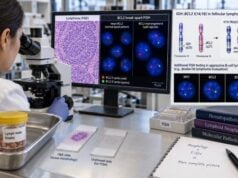
MLH1-deficient tumors often show MSI-H, but MMR immunohistochemistry and MSI are not identical tests. IHC identifies protein-expression loss and suggests which gene may be affected. MSI measures the functional consequence of repair deficiency at repetitive DNA loci. Discordant results occur and may require repeat or orthogonal testing.
Germline Result Meaning
A germline MLH1 report commonly falls into three clinically different categories.
Pathogenic or likely pathogenic
A pathogenic or likely pathogenic germline MLH1 variant establishes MLH1-associated Lynch syndrome when the laboratory classification is reliable. The result can explain an individual’s cancer history, affect future surveillance, and enable targeted testing of relatives.
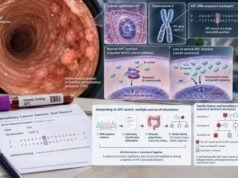
Once a familial pathogenic variant is known, relatives usually do not need a broad panel to answer the same family question. They can often have targeted testing for the exact familial variant, with broader testing considered when their personal history suggests an additional syndrome.
Negative
A negative germline result means no reportable pathogenic MLH1 variant was found by the assay. Its meaning depends on why testing was performed.
If a known familial MLH1 pathogenic variant was tested and the relative is truly negative, that person generally did not inherit that specific Lynch syndrome risk. If the patient has a strongly suggestive tumor but no known family variant, a negative result does not end the workup. The tumor may have two somatic MMR alterations, another hereditary gene may be responsible, or a technically difficult variant may have been missed.
Deletion/duplication analysis matters because not every pathogenic MLH1 alteration is a simple single-base change. Modern germline testing generally evaluates both sequence variants and larger copy-number changes.
Variant of uncertain significance
A VUS is not a positive Lynch syndrome result. Clinical management should not be escalated solely because of a VUS. Instead, care is based on personal and family history while the variant remains uncertain. Laboratories periodically reclassify variants as population, functional, segregation, and clinical data accumulate.
Patients should avoid testing unaffected relatives solely to see whether a VUS “tracks” in the family unless a genetics professional has a specific segregation strategy. Casual family testing can create confusion without resolving classification.
Cancer Risk and Surveillance
Pathogenic MLH1 variants are among the higher-penetrance Lynch syndrome genotypes for colorectal cancer. Risk is also increased for endometrial and several other cancers, with magnitude influenced by sex, age, family history, and the specific gene.
Lynch-associated cancers can include colorectal, endometrial, ovarian, stomach, small bowel, urinary tract, biliary tract, pancreatic, brain, and certain sebaceous skin tumors. The risk for each site is not identical across MLH1, MSH2, MSH6, and PMS2 carriers. Modern surveillance is increasingly gene-specific rather than treating all Lynch syndrome as a single uniform risk state.
Colonoscopy
Regular high-quality colonoscopy is the central preventive strategy for MLH1 carriers. Surveillance starts younger and is performed more often than average-risk screening because Lynch-associated neoplasia can arise at younger ages and progress more quickly.
The exact starting age and interval should follow the current guideline used by the treating genetics or gastroenterology team. Family history can modify the plan. A prior colorectal cancer, prior advanced adenoma, surgical anatomy, and quality of previous colonoscopies also matter.
Gynecologic risk
Women with MLH1-associated Lynch syndrome have elevated endometrial and ovarian cancer risk. Counseling may include symptom awareness, individualized surveillance, reproductive planning, and discussion of risk-reducing hysterectomy with or without salpingo-oophorectomy after childbearing, depending on age, gene-specific risk, comorbidities, and preferences.
Other cancers
Upper gastrointestinal, urinary tract, pancreatic, and other surveillance is more individualized. Recommendations vary by country, family history, ancestry, and guideline. The purpose of genetic counseling after a positive result is not simply to hand the patient a generic list of cancers, but to turn the gene-specific risk profile into a realistic lifelong plan.
Treatment Implications of dMMR and MSI
MLH1 status can affect cancer treatment because loss of mismatch repair often creates a high burden of mutation-derived neoantigens. This can make dMMR/MSI-H tumors sensitive to immune checkpoint blockade.
For colorectal, endometrial, gastric, small-bowel, and other cancers, MMR or MSI status is now a major predictive biomarker in appropriate advanced-disease settings. The clinically relevant treatment marker is the tumor phenotype—dMMR or MSI-H—not simply the fact that a person carries a germline MLH1 variant.
A Lynch syndrome carrier can develop a tumor that is not dMMR, and a person without Lynch syndrome can develop a sporadic MLH1-methylated dMMR cancer. Treatment should therefore use the actual tumor test rather than infer MSI status from family history alone.
For localized colon cancer, dMMR/MSI status also contributes to prognosis and can influence adjuvant-treatment discussions depending on stage and other features. The exact decision is disease- and stage-specific.
Limitations and Next Steps
MLH1 testing can be confusing because several different findings may be described with similar language. “MLH1 loss,” “MLH1 mutation,” “MLH1 promoter methylation,” and “MLH1 pathogenic germline variant” are not interchangeable.
When reviewing a result, ask:
- Was this tumor IHC, MSI testing, methylation testing, tumor sequencing, or germline testing?
- If MLH1 staining was lost, was PMS2 also lost?
- Was MLH1 promoter methylation assessed?
- In colorectal cancer, was BRAF V600E used as part of the sporadic-versus-hereditary triage?
- If a tumor variant was found, was germline confirmation performed?
- Was a VUS mistakenly described as a “mutation positive” result?
A strong family history can justify genetics review even after a seemingly sporadic tumor result. Conversely, a germline positive result should trigger cascade testing and gene-specific surveillance rather than repeated tumor screening alone.
Rare technical issues also matter. Pseudogenes are less problematic for MLH1 than for PMS2, but structural variants, deep intronic changes, mosaicism, and epigenetic abnormalities can escape routine assays. If the clinical and tumor evidence remains strongly suspicious after a negative germline panel, a hereditary-cancer specialist can determine whether expanded or research-level testing is appropriate.
Practical result combinations
Several common result combinations illustrate why MLH1 testing cannot be interpreted from one line of a report. A colorectal cancer with loss of MLH1/PMS2, MSI-H, MLH1 promoter methylation, and BRAF V600E is much more likely to represent a sporadic methylation pathway than classic germline MLH1-associated Lynch syndrome. A young patient with MLH1/PMS2 loss, MSI-H, no tumor methylation, and a pathogenic germline MLH1 variant has a very different explanation: inherited Lynch syndrome with implications for relatives.
A third scenario is less straightforward. An endometrial cancer shows MLH1/PMS2 loss and promoter methylation in a patient diagnosed unusually young with several relatives affected by Lynch-spectrum cancers. Tumor methylation lowers the probability of a conventional germline MLH1 sequence variant, but it should not automatically close the hereditary workup. Rare constitutional MLH1 epimutations and coincidental hereditary findings exist, and the family history may justify specialist genetics assessment.
How family testing changes after a positive result
Once a pathogenic germline MLH1 variant is confirmed, testing becomes simpler for relatives. Adult first-degree relatives can usually have targeted testing for the exact familial variant. A relative who carries it enters a Lynch syndrome surveillance program; a relative who tests negative for that known familial variant generally returns to screening based on their own history and any unrelated family risks.
The result can also affect reproductive counseling. Some couples want information about reproductive options because two pathogenic variants affecting the same MMR pathway can create rare recessive conditions when inherited from both parents. This is uncommon, but genetics professionals can address it when both partners have relevant family histories.
Why the original laboratory report matters
Patients sometimes receive summaries such as “Lynch negative” without the underlying data. The original report is more useful because it shows whether testing included deletion/duplication analysis, which transcript was used, whether a VUS was found, and whether the test was germline or tumor-only. Similarly, the pathology report documents the exact IHC pattern and whether methylation or BRAF testing was performed. Keeping these reports helps future clinicians avoid repeating tests or misclassifying a family years later.
Another practical issue is surgery after colorectal cancer. In a confirmed MLH1 carrier, the risk of a future colorectal primary can influence discussion of segmental versus more extensive colectomy. The decision is individualized and balances age, tumor location, bowel function, comorbidities, future colonoscopy adherence, and patient preferences. A germline result informs the risk calculation but does not dictate the same operation for every person.
For people who have never had cancer, a positive result should be viewed as a prevention opportunity rather than a diagnosis of malignancy. High-quality colonoscopy can remove precancerous lesions, and gene-specific counseling can organize gynecologic and other risk-reduction decisions before symptoms occur.
References
- The guidelines for clinical practice for carriers of germline mutations in the Lynch syndrome predisposition genes MLH1, MSH2, MSH6, PMS2 and large deletions of EPCAM (4.2024) 2024 (Guideline)
- Cancer risks in Lynch syndrome carriers: a systematic review and meta-analysis 2026 (Systematic Review)
- MLH1 Promotor Hypermethylation in Colorectal and Endometrial Carcinomas from Patients with Lynch Syndrome 2024
- MLH1 promoter hypermethylation and Lynch Syndrome: When to test for constitutional epimutations of MLH1 gene? 2025 (Review)
- Colorectal cancer and advanced adenoma characteristics according to causative mismatch repair gene variant in Japanese colorectal surveillance for Lynch syndrome 2024
- Mismatch Repair and Microsatellite Instability Testing for Immune Checkpoint Inhibitor Therapy: Guideline From the College of American Pathologists in Collaboration With the Association for Molecular Pathology and Fight Colorectal Cancer 2022 (Guideline)
Disclaimer
MLH1 tumor results and germline genetic results answer different questions and should be interpreted with personal history, family history, pathology, and current guidelines. This article is educational and does not replace genetic counseling, cancer screening advice, or treatment recommendations from qualified clinicians.