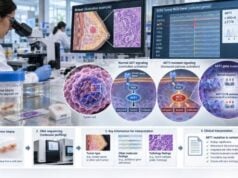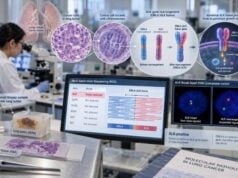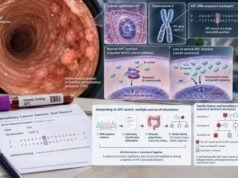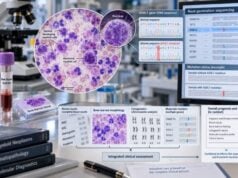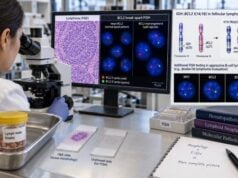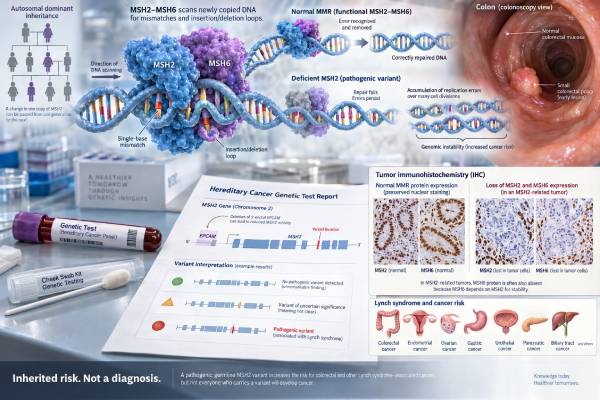
An MSH2 mutation test can identify an inherited pathogenic variant that causes Lynch syndrome or clarify an abnormal mismatch repair result found in a tumor. MSH2 is a central DNA mismatch repair gene and usually works with MSH6. When MSH2 is inactivated in a cancer, both MSH2 and MSH6 protein staining are often lost and the tumor commonly becomes microsatellite instability-high (MSI-H). A germline pathogenic MSH2 variant confirms MSH2-associated Lynch syndrome and has implications for colorectal, endometrial, ovarian, urinary-tract, and several other cancer risks. However, an abnormal tumor result does not automatically prove an inherited mutation. Some cancers have two acquired MSH2 pathway alterations, and deletions near the EPCAM gene can silence MSH2 without a sequence change inside MSH2 itself. Correct interpretation therefore combines tumor immunohistochemistry, MSI, germline sequencing and deletion/duplication analysis, EPCAM evaluation when indicated, and personal and family history.
- A germline pathogenic or likely pathogenic MSH2 variant confirms MSH2-associated Lynch syndrome.
- Loss of both MSH2 and MSH6 on tumor immunohistochemistry usually points to an MSH2-pathway abnormality and warrants hereditary evaluation.
- Certain EPCAM deletions can cause inherited MSH2 silencing, so a negative MSH2 sequence test alone may be incomplete.
- MSH2-associated Lynch syndrome carries substantial colorectal cancer risk and is also strongly associated with urinary-tract and several extracolonic cancers.
- A variant of uncertain significance is not a Lynch syndrome diagnosis and should not be managed as a pathogenic result.
Table of Contents
- What MSH2 Does
- When MSH2 Testing Is Used
- MSH2 and MSH6 Loss in Tumors
- Germline Result Meaning
- Cancer Risk and Surveillance
- Treatment Meaning of dMMR and MSI
- Limitations and Next Steps
What MSH2 Does
MSH2 is one of the main genes in the DNA mismatch repair (MMR) pathway. The MMR system corrects small DNA-copying errors that occur during cell division. MSH2 forms a protein pair with MSH6, known as MutS alpha, that recognizes many base-base mismatches and short insertion/deletion loops. MSH2 can also pair with MSH3 for other repair tasks.
When both functional copies of MSH2 are lost in a tumor cell, DNA errors accumulate. Repetitive DNA sequences called microsatellites become especially unstable, creating the MSI-H phenotype seen in many Lynch syndrome cancers.
A person with Lynch syndrome usually inherits one nonworking MSH2 copy in every cell. Cancer develops after a susceptible cell loses or disables the remaining working copy. Because one altered germline copy is enough to create inherited susceptibility, MSH2-associated Lynch syndrome follows an autosomal dominant inheritance pattern. Each biological child of a carrier has a 50% chance of inheriting the familial variant.
Most MSH2 abnormalities detected in a tumor are evaluated as somatic-versus-germline questions. A tumor result alone cannot always determine whether the variant was inherited. Germline testing uses blood or another validated non-tumor specimen to answer that question.
When MSH2 Testing Is Used
MSH2 testing may be ordered after an abnormal tumor screen, because of a personal or family history suggestive of Lynch syndrome, or as part of a broad hereditary cancer panel.
Many colorectal and endometrial cancers undergo MMR immunohistochemistry or MSI testing at diagnosis. If the tumor loses MSH2 and MSH6 staining, the pattern strongly suggests dysfunction in MSH2 or a mechanism that silences MSH2. Unlike MLH1/PMS2 loss, this pattern is not commonly explained by age-related MLH1 promoter methylation, so germline evaluation is usually important.
A patient may also be tested directly because of early colorectal or endometrial cancer, multiple Lynch-spectrum cancers, sebaceous tumors, upper urinary-tract cancer, or a family history of related cancers across generations.
Modern germline testing typically includes sequence analysis plus deletion/duplication analysis. Large deletions or rearrangements would be missed by a sequence-only method.
EPCAM is part of the MSH2 pathway
EPCAM sits just upstream of MSH2 on chromosome 2. Certain germline deletions involving the 3′ end of EPCAM can cause abnormal methylation and silencing of the neighboring MSH2 gene in EPCAM-expressing tissues. The result is Lynch syndrome biology even though the MSH2 coding sequence itself may be intact.
Therefore, hereditary panels used for Lynch syndrome generally evaluate clinically relevant EPCAM deletions as well as MLH1, MSH2, MSH6, and PMS2.
MSH2 and MSH6 Loss in Tumors
MMR immunohistochemistry is often the most direct clue to which repair gene is affected.
MSH2 stabilizes MSH6. If MSH2 is lost, MSH6 usually disappears with it. Therefore, combined loss of MSH2 and MSH6 is a classic pattern pointing toward MSH2 dysfunction. By contrast, an isolated MSH6 defect can produce loss of MSH6 while MSH2 remains present.
Normal stromal cells, lymphocytes, or other non-neoplastic cells should retain nuclear staining and serve as internal controls. If all cells are unstained, the test may be technically failed rather than biologically abnormal.
Tumors with MSH2/MSH6 loss are often MSI-H, but the tests are not identical. IHC measures protein expression; MSI measures accumulated DNA instability. Concordance is high in classic colorectal cancer, but discordance can occur.
Somatic MSH2 abnormalities
Not every MSH2/MSH6-deficient tumor is inherited. Some patients have double-somatic inactivation in the tumor: two acquired events disable both MSH2 copies without a germline variant. Paired tumor-normal sequencing can help distinguish this from Lynch syndrome when germline testing is negative.
This distinction matters for relatives. A confirmed germline MSH2 or EPCAM pathogenic variant creates a familial testing opportunity. A clearly double-somatic tumor generally does not imply the same inherited risk.
Germline Result Meaning
Pathogenic or likely pathogenic
A germline pathogenic or likely pathogenic MSH2 variant establishes MSH2-associated Lynch syndrome. The result changes future cancer surveillance and allows cascade testing of biological relatives for the exact familial variant.
A positive result does not mean cancer is inevitable. Penetrance is incomplete, and risk varies with age, sex, family history, environment, and other modifiers. It does mean that risk is high enough for enhanced prevention and early-detection strategies.
Negative
A negative result has different meanings depending on context. If a healthy relative tests negative for a known familial MSH2 variant, that person generally did not inherit that specific Lynch syndrome predisposition.
If an affected patient with MSH2/MSH6-deficient cancer has negative germline testing, the workup may continue. Possibilities include an EPCAM deletion, a structural or technically difficult MSH2 alteration, mosaicism, or two somatic hits in the tumor. Tumor sequencing can be especially useful in this “unexplained dMMR” setting.
Variant of uncertain significance
A VUS means the laboratory cannot determine whether the change disrupts MSH2 function. It should not be used as a positive Lynch syndrome diagnosis. Surveillance is based on personal and family history until the variant is reclassified.
Relatives should not undergo routine predictive testing for a VUS as though it were established disease-causing. Genetics professionals may sometimes coordinate segregation studies, but this is different from standard cascade testing for a pathogenic variant.
Cancer Risk and Surveillance
MSH2 is one of the higher-penetrance Lynch syndrome genes. Carriers face substantial lifetime risk of colorectal cancer and increased risk of endometrial cancer. MSH2 is also particularly associated with upper urinary-tract cancer, including ureter and renal pelvis cancers, and with sebaceous neoplasms in the Muir-Torre phenotype.
Other Lynch-spectrum sites include ovary, stomach, small bowel, biliary tract, pancreas, prostate, brain, and certain skin tumors. Risk is not identical for every carrier, and current surveillance recommendations increasingly account for the specific gene.
Colorectal surveillance
Frequent high-quality colonoscopy is the central prevention strategy. MSH2 carriers generally begin surveillance younger and undergo it more often than average-risk adults. Studies continue to refine whether intervals should differ by gene, but MLH1 and MSH2 are generally treated as higher colorectal-risk genes than MSH6 and PMS2.
A prior colorectal cancer changes the discussion because there is risk of a second primary colorectal cancer in the remaining colon. Surgical extent, age, bowel function, tumor location, and future surveillance capacity all influence decisions.
Gynecologic risk
Women with MSH2-associated Lynch syndrome have increased endometrial and ovarian cancer risk. Counseling includes symptom awareness, reproductive planning, and discussion of risk-reducing gynecologic surgery after childbearing when appropriate. Screening tests for endometrial and ovarian cancer do not have the same proven preventive effectiveness as colonoscopy, which is why individualized risk-reduction conversations are important.
Urinary tract and other sites
Because MSH2 is associated with relatively prominent urothelial risk, family history of ureter, renal pelvis, or bladder cancer can influence surveillance discussions. Guidelines differ on routine urine testing and imaging, so recommendations should be personalized rather than copied from a generic Lynch checklist.
Treatment Meaning of dMMR and MSI
Cancers caused by MSH2 loss are often dMMR and MSI-H. These tumors can accumulate many mutations and neoantigens, making them susceptible to immune checkpoint blockade in appropriate settings.
For advanced colorectal cancer, dMMR/MSI-H status can have major first-line treatment implications. It also matters in endometrial, gastric, small-bowel, and multiple other cancers depending on stage and current regulatory indications.
The predictive biomarker is the tumor’s dMMR/MSI-H phenotype, not simply the inherited MSH2 variant. A person with Lynch syndrome can theoretically develop an unrelated tumor that retains MMR function. Conversely, a patient without Lynch syndrome can have a somatic MSH2-deficient cancer that responds to immunotherapy.
In localized disease, MMR status may also influence prognosis and adjuvant-treatment decisions. Those decisions depend on tumor site and stage and should not be generalized from metastatic immunotherapy evidence.
Limitations and Next Steps
MSH2 interpretation can fail when testing stops too early. A sequence-only negative result may miss a deletion or rearrangement. A negative MSH2 result without EPCAM assessment may miss an inherited silencing mechanism. Tumor-only sequencing may identify a pathogenic variant but be unable to prove whether it is germline.
If MSH2/MSH6 are absent by IHC, useful next questions include:
- Was germline testing performed for MSH2 and EPCAM with deletion/duplication analysis?
- Is the tumor MSI-H?
- If germline testing is negative, was paired tumor-normal testing considered for double-somatic MMR alterations?
- Does the personal or family history include urinary-tract, sebaceous, colorectal, or endometrial cancers?
- Was a VUS incorrectly treated as a positive result?
A positive germline result should lead to gene-specific surveillance and cascade testing. A negative germline result in a strongly MSH2-deficient tumor should lead to clarification of the tumor mechanism rather than an automatic conclusion that “nothing genetic was found.”
Practical examples of MSH2 interpretation
A colon cancer with complete loss of MSH2 and MSH6, MSI-H, and a pathogenic germline MSH2 variant is a straightforward Lynch syndrome pattern. The same IHC and MSI pattern with negative germline MSH2/EPCAM testing is not automatically “Lynch syndrome without a mutation.” Paired tumor-normal sequencing may reveal two somatic MSH2 hits, which would explain the dMMR tumor without establishing inherited risk for relatives.
A second example involves a patient whose germline panel reports an EPCAM deletion but no coding variant in MSH2. That can still be a Lynch syndrome result if the deletion is one known to cause methylation and silencing of MSH2. Family testing should target the pathogenic EPCAM deletion, not search repeatedly for a nonexistent MSH2 sequence variant.
MSH2-associated extracolonic risk
MSH2 is particularly important when the family history includes upper urinary-tract cancers or sebaceous tumors. A patient with a sebaceous carcinoma plus a family history of colon and ureter cancer may have a pattern historically called Muir-Torre syndrome, now understood as part of the Lynch syndrome spectrum. Tumor MMR testing of the sebaceous lesion can be informative, but germline confirmation is still needed because sporadic MMR-deficient sebaceous tumors also occur.
Urinary-tract surveillance remains an area where guidelines vary. Some programs consider urinalysis or other monitoring, especially when MSH2 carriers have a family history of urothelial cancer, while evidence for a single universally effective strategy is limited. The practical point is that an MSH2 result should trigger gene-specific counseling rather than a colon-only prevention plan.
After colorectal cancer has already occurred
An MSH2 carrier treated for colorectal cancer remains at risk for new primary cancers, including a metachronous colorectal cancer in the remaining bowel. Surgical planning can therefore include a discussion of segmental versus more extensive colectomy, balanced against age, bowel function, tumor location, comorbidity, and the patient’s ability to undergo frequent future colonoscopy. The germline result informs this discussion but does not dictate one operation for every patient.
After any Lynch-associated cancer, surveillance should be coordinated so that oncology follow-up does not replace hereditary prevention. Monitoring for recurrence of the treated cancer and screening for new primary cancers are separate goals.
Reproductive and family implications
A confirmed pathogenic MSH2 variant can affect more than cancer screening. Adults who carry the variant may want counseling about reproductive options, timing of risk-reducing care, and how to share a result with siblings, adult children, and other relatives. Because inheritance is autosomal dominant, each biological child has a 50% chance of inheriting the familial variant.
Testing relatives is most efficient after the family’s exact pathogenic variant is known. A targeted test is usually sufficient to determine whether a relative inherited that specific risk. Testing children is generally deferred until closer to the age when surveillance would begin, because typical Lynch syndrome management starts in adulthood. Unusually early cancers in a family can change that discussion.
A positive result also has implications after cancer treatment. A person successfully treated for colon cancer still needs prevention for new primary cancers, and an endometrial cancer survivor still needs colorectal surveillance. Oncology follow-up for recurrence and Lynch syndrome surveillance are complementary rather than interchangeable.
A family history that appears small or unremarkable does not exclude MSH2-associated Lynch syndrome. Modern families may be small, relatives may have had preventive surgery, diagnoses may be unknown, and chance can delay cancer in carriers. Tumor MMR findings and a validated pathogenic germline result should therefore carry more weight than the absence of a dramatic pedigree.
References
- The guidelines for clinical practice for carriers of germline mutations in the Lynch syndrome predisposition genes MLH1, MSH2, MSH6, PMS2 and large deletions of EPCAM (4.2024) 2024 (Guideline)
- Cancer risks in Lynch syndrome carriers: a systematic review and meta-analysis 2026 (Systematic Review)
- Lynch Syndrome-Impact of the Type of Deficient Mismatch Repair Gene Mutation on Diagnosis, Clinical Presentation, Surveillance and Therapeutic Approaches 2025 (Review)
- Colorectal cancer and advanced adenoma characteristics according to causative mismatch repair gene variant in Japanese colorectal surveillance for Lynch syndrome 2024
- Risk of Gastric and Small Intestinal Cancer in Patients With Lynch Syndrome: Data From a Large, Community-Based US Population 2024
- Mismatch Repair and Microsatellite Instability Testing for Immune Checkpoint Inhibitor Therapy: Guideline From the College of American Pathologists in Collaboration With the Association for Molecular Pathology and Fight Colorectal Cancer 2022 (Guideline)
Disclaimer
MSH2 tumor testing and germline testing answer different questions and should be interpreted with personal and family history, MMR immunohistochemistry, MSI, and current Lynch syndrome guidance. This article is educational and does not replace genetic counseling, cancer surveillance planning, or oncology treatment advice.