An MSH6 mutation test can identify an inherited pathogenic variant that causes Lynch syndrome or help explain abnormal mismatch repair findings in a tumor. MSH6 works with MSH2 to recognize certain DNA-copying errors, but MSH6-associated Lynch syndrome has a somewhat different clinical pattern from MLH1- or MSH2-associated disease. Colorectal cancer risk is still increased, but onset tends to be later on average, while endometrial cancer is an especially important risk for women. Tumors with MSH6 dysfunction often show isolated loss of MSH6 on immunohistochemistry, although treatment, tumor biology, and technical factors can create other patterns. MSI can also be less dramatic in some MSH6-deficient tumors than in classic MLH1- or MSH2-deficient cancers. A germline pathogenic MSH6 variant confirms Lynch syndrome, while a tumor-only MSH6 change, negative result, or variant of uncertain significance requires more careful interpretation.
- A germline pathogenic or likely pathogenic MSH6 variant confirms MSH6-associated Lynch syndrome.
- Isolated loss of MSH6 protein in a tumor strongly suggests an MSH6-pathway defect and commonly leads to germline evaluation.
- MSH6-associated Lynch syndrome often has later colorectal cancer onset than MLH1- or MSH2-associated Lynch syndrome but remains clinically important.
- Endometrial cancer risk is a major concern in women with pathogenic MSH6 variants.
- A VUS does not establish Lynch syndrome, and an MSS result does not completely exclude MSH6 dysfunction in every tumor.
Table of Contents
- What MSH6 Does
- When MSH6 Testing Is Used
- Tumor Patterns and MSI
- Germline Result Meaning
- Cancer Risk and Surveillance
- Treatment Implications
- Limitations and Next Steps
What MSH6 Does
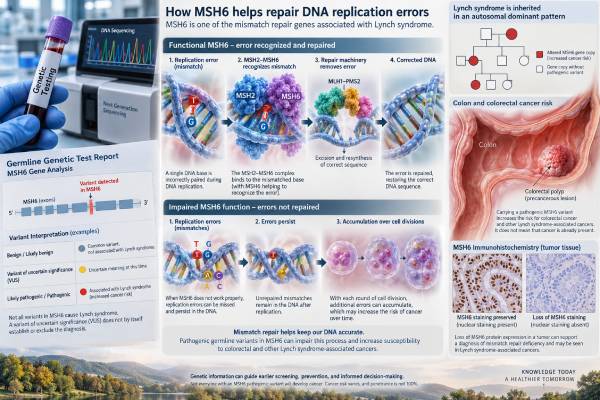
MSH6 is one of the main DNA mismatch repair (MMR) genes. The MSH6 protein pairs with MSH2 to form the MutS alpha complex, which recognizes single-base mismatches and small insertion/deletion loops created when DNA is copied.
After an error is recognized, other MMR proteins, including MLH1 and PMS2, coordinate correction. If this pathway fails, mutations accumulate, especially in repetitive DNA sequences called microsatellites. Tumors can become mismatch-repair deficient and microsatellite instability-high.
A person with MSH6-associated Lynch syndrome inherits one nonworking MSH6 copy in every cell. A susceptible cell can become MMR-deficient after the second functional copy is lost or inactivated. Because the predisposition is inherited in an autosomal dominant pattern, each biological child of a carrier has a 50% chance of inheriting the familial variant.
MSH6 is somewhat different from MLH1 and MSH2 because partial mismatch-repair activity can remain in some contexts. MSH2 can pair with MSH3, which can compensate for some repair functions. This helps explain why certain MSH6-deficient tumors show less dramatic microsatellite instability and why colorectal cancer often develops later on average.
When MSH6 Testing Is Used
MSH6 testing is commonly ordered after abnormal tumor screening or as part of a hereditary cancer panel.
Universal or broad MMR testing of colorectal and endometrial cancers often identifies the first clue. Isolated loss of MSH6 on immunohistochemistry is a classic pattern suggesting an MSH6 defect. The patient is then referred for germline testing unless there is a clear alternative explanation.
MSH6 may also be tested because of a personal or family history of colorectal, endometrial, ovarian, or other Lynch-spectrum cancers. Modern germline panels usually test MLH1, MSH2, MSH6, PMS2, and EPCAM together, because family history alone often cannot predict the responsible gene.
Tumor NGS may also detect an MSH6 variant. A tumor-only result cannot always determine whether the alteration is inherited. Germline confirmation is needed when the finding could represent Lynch syndrome.
What germline testing should cover
A complete clinical assay should generally include sequence analysis and deletion/duplication testing. Most pathogenic MSH6 variants are sequence changes, but larger deletions or rearrangements can occur.
Blood or saliva is commonly used for germline testing. If a hematologic malignancy, prior stem-cell transplant, or another unusual circumstance could make blood-derived DNA unreliable, the genetics team may choose a different tissue source.
Tumor Patterns and MSI
MMR immunohistochemistry evaluates MLH1, PMS2, MSH2, and MSH6 protein expression in tumor-cell nuclei.
Isolated MSH6 loss
Because MSH2 can remain stable without MSH6, a primary MSH6 defect usually causes loss of MSH6 with retained MSH2. This is different from an MSH2 defect, which commonly causes loss of both MSH2 and MSH6.
Normal stromal cells or lymphocytes should retain MSH6 staining and serve as internal controls. If tumor and normal cells are all negative, the stain may have failed technically.
MSH6 loss after treatment
Some tumors can show reduced or lost MSH6 staining after treatment, particularly after certain therapies that create secondary mutations or select for MMR-deficient clones. A post-treatment biopsy must therefore be interpreted with the pretreatment pathology and clinical history when available.
MSI can be weaker or discordant
MSH6-deficient cancers are often MSI-H, but some show fewer unstable markers than tumors with MLH1 or MSH2 loss. Older PCR panels containing less sensitive markers can occasionally classify an MSH6-deficient tumor as MSS or MSI-low.
This is one reason abnormal MSH6 IHC should not be ignored solely because MSI is not high. When results disagree, repeat testing, a modern mononucleotide panel, NGS-based MSI, or tumor sequencing can help clarify the defect.
Germline Result Meaning
Pathogenic or likely pathogenic
A germline pathogenic or likely pathogenic MSH6 variant confirms MSH6-associated Lynch syndrome. The result guides cancer surveillance for the patient and enables predictive testing of biological relatives.
A positive result does not mean cancer is already present or inevitable. Risk is substantial but incomplete, and the age distribution differs from other Lynch genes. Gene-specific counseling is therefore more useful than applying the same surveillance expectations to every Lynch syndrome carrier.
Negative
A negative germline result means no reportable pathogenic variant was found within the assay’s scope. If testing was targeted to a known familial variant and the relative is negative, the relative generally did not inherit that specific predisposition.
If an MSH6-deficient tumor is present but germline testing is negative, the tumor may contain two acquired MSH6 hits or another somatic mechanism. Paired tumor-normal testing can help distinguish sporadic dMMR from hereditary disease.
A negative result should also be checked against the assay’s coverage. Structural variants, mosaicism, or technically difficult regions can occasionally escape standard approaches.
Variant of uncertain significance
A VUS is not diagnostic of Lynch syndrome. Medical decisions should not be based on a VUS as though it were pathogenic. Instead, screening is guided by personal and family history while the laboratory continues to evaluate the variant as evidence accumulates.
Family members generally should not undergo predictive testing for a VUS outside a genetics-directed segregation study, because knowing whether a relative carries an uncertain variant usually does not answer whether they are at increased risk.
Cancer Risk and Surveillance
MSH6-associated Lynch syndrome has a distinctive risk pattern. Colorectal cancer risk is clearly increased compared with the general population but tends to be lower and later than in MLH1 or MSH2 carriers. Endometrial cancer risk remains substantial and is one of the most important clinical features of MSH6-associated disease.
Recent analyses place lifetime colorectal cancer risk across a broad range depending on sex, study design, and age, while endometrial cancer risk is often estimated in the tens of percent. Exact numbers should be taken from the current guideline used by the treating genetics service because prospective and retrospective studies produce different estimates.
Colonoscopy
Colonoscopy remains the main colorectal prevention strategy. Some guidelines allow a later starting age for MSH6 carriers than for MLH1 or MSH2 carriers, but surveillance is still much more intensive than average-risk screening. A family history of unusually early colorectal cancer can justify starting earlier.
The interval also depends on prior polyps, quality of bowel preparation, previous colorectal cancer, surgical anatomy, and local guideline. MSH6 should not be labeled “low risk” in a way that leads to routine population screening only.
Endometrial and ovarian risk
For women, counseling should address abnormal uterine bleeding, reproductive plans, gynecologic cancer risk, and risk-reducing surgery after childbearing when appropriate. Endometrial biopsy may be considered in some surveillance strategies, but evidence for mortality reduction is less robust than for colonoscopy.
Ovarian cancer risk is increased but generally lower than endometrial risk. The decision about hysterectomy and bilateral salpingo-oophorectomy should consider age, menopausal consequences, family history, gene-specific risk, and patient preferences.
Other cancers
MSH6 can also increase risk for other Lynch-spectrum tumors, including gastric, small-bowel, urinary-tract, pancreatic, brain, and certain skin cancers, though risks tend to be lower or less clearly quantified than for colorectal and endometrial cancer. Surveillance outside the colon and gynecologic tract is individualized by family history and guideline.
Treatment Implications
An MSH6-deficient tumor can be clinically important because dMMR/MSI-H predicts sensitivity to immune checkpoint blockade in multiple cancer types and settings.
The treatment biomarker is the tumor phenotype, not merely the germline mutation. A person with an inherited MSH6 variant can develop a tumor that retains MMR function, and a person without Lynch syndrome can develop a somatic MSH6-deficient cancer.
In metastatic colorectal and endometrial cancer, dMMR/MSI-H status can substantially alter systemic therapy. In other solid tumors, it can create a tissue-agnostic or disease-specific immunotherapy option depending on the current indication and prior treatment.
MSH6-associated tumors may sometimes have lower levels of MSI than MLH1- or MSH2-deficient tumors, but dMMR cancers can remain immunogenic and responsive to checkpoint therapy. A discordant MSS/IHC-deficient result should therefore be reviewed carefully rather than automatically excluding treatment solely because one assay is negative.
In localized disease, MMR status can also affect prognosis and adjuvant decisions, especially in colon cancer. Stage, pathologic risk factors, and the overall regimen remain essential.
Limitations and Next Steps
The main interpretation challenge is assuming that all Lynch syndrome genes behave the same. MSH6 often causes later-onset colorectal cancer and a prominent endometrial risk, but it still requires structured surveillance.
Common pitfalls include:
- dismissing isolated MSH6 loss because an older MSI assay reports MSS;
- treating a tumor-only MSH6 variant as automatically germline;
- treating a VUS as a positive result;
- assuming a negative germline test explains away abnormal tumor IHC; and
- using surveillance ages designed for MLH1/MSH2 without considering gene-specific guidance.
If isolated MSH6 loss is found, germline testing is generally appropriate. If germline testing is negative, paired tumor-normal sequencing can evaluate for double-somatic inactivation. If a germline pathogenic variant is confirmed, biological relatives can have targeted cascade testing for the familial variant.
Patients should ask for the exact variant classification, whether deletion/duplication analysis was included, and whether their surveillance plan is specifically based on MSH6 rather than on a generic Lynch syndrome schedule.
Practical examples of MSH6 interpretation
An endometrial cancer with isolated loss of MSH6 and a pathogenic germline MSH6 variant is a classic Lynch syndrome presentation. By contrast, isolated MSH6 loss discovered only in a post-treatment tumor sample may require comparison with pretreatment tissue because therapy can select for secondary MMR abnormalities. The timing of the specimen can therefore change how strongly an IHC result points toward inherited disease.
A colorectal tumor can also create a testing puzzle when MSH6 is lost by IHC but a PCR assay reports MSS. Because MSH6 loss can produce a weaker microsatellite-instability phenotype than MLH1 or MSH2 loss, the discrepancy should be reviewed rather than allowing the MSI result to overrule a well-controlled abnormal IHC pattern. Repeat MSI with a validated method, NGS-based MSI, and germline or tumor sequencing can resolve many of these cases.
Why age matters but does not erase risk
MSH6 carriers often develop colorectal cancer later than MLH1 or MSH2 carriers. This has led some guidelines to use later colonoscopy starting ages, but “later” should not be confused with “average risk.” A carrier still needs a structured Lynch syndrome program, and a family history of unusually early colorectal cancer can shift the starting age forward.
For women, MSH6-associated endometrial cancer risk can be substantial even when colorectal risk is comparatively lower. Abnormal uterine bleeding after menopause, bleeding between periods, or unexpected heavy bleeding deserves prompt evaluation rather than waiting for a routine surveillance visit. Risk-reducing hysterectomy after childbearing can be discussed in an individualized way, with ovarian-risk management considered separately.
What relatives should know
Once the familial pathogenic MSH6 variant is known, adult biological relatives can usually have a focused test for that exact variant. A positive relative enters gene-specific surveillance; a true negative for the familial variant generally does not need Lynch-level screening solely because of that branch of the family.
Testing minors is usually not urgent for a typical adult-onset MSH6-associated Lynch syndrome family because surveillance generally begins in adulthood. Exceptions can arise in unusual families with very early cancers or when another hereditary condition is suspected, and those decisions are best handled through genetics counseling.
Keeping the report current
MSH6 variants can be reclassified as new functional and population data accumulate. Patients with a VUS should avoid treating it as a lifelong fixed diagnosis. Periodic review through the testing laboratory or genetics clinic can determine whether the classification has changed. If a VUS is later upgraded to pathogenic, family testing and surveillance may change; if downgraded to benign, unnecessary anxiety and screening can be reduced.
Surveillance should remain gene-specific over time
A surveillance plan made at the time of genetic diagnosis may need revision as the patient ages, as family history changes, or as guidelines incorporate new prospective risk estimates. An MSH6 carrier who has a first advanced adenoma, for example, may need a different colonoscopy interval from a carrier with repeatedly normal high-quality examinations. A relative who develops colorectal cancer unusually young may also change the family-specific starting age for younger carriers.
Gynecologic counseling should be revisited as reproductive goals change. Before childbearing is complete, the emphasis may be on symptom awareness and individualized surveillance. Later, the balance may shift toward risk-reducing surgery. Menopausal effects, ovarian risk, hormone therapy considerations, and comorbidities should be discussed rather than treating hysterectomy and oophorectomy as a single inseparable decision.
The main benefit of identifying MSH6 before cancer develops is the ability to act on risk over decades. That includes colonoscopic prevention, prompt evaluation of symptoms, informed surgical choices, and targeted family testing. The mutation result is therefore most useful when it is translated into a living care plan rather than stored as a static laboratory label.
Because MSH6 penetrance is incomplete and age-dependent, unaffected older relatives can still be informative but do not automatically prove a familial variant is harmless. Variant classification should rely on the laboratory’s full evidence framework rather than on one relative’s cancer history.
References
- A multilevel perspective on MSH6-associated Lynch syndrome: Integrating molecular, biological, and clinical insights 2026 (Review)
- Cancer risks in Lynch syndrome carriers: a systematic review and meta-analysis 2026 (Systematic Review)
- The guidelines for clinical practice for carriers of germline mutations in the Lynch syndrome predisposition genes MLH1, MSH2, MSH6, PMS2 and large deletions of EPCAM (4.2024) 2024 (Guideline)
- Colorectal cancer and advanced adenoma characteristics according to causative mismatch repair gene variant in Japanese colorectal surveillance for Lynch syndrome 2024
- Gene-Specific Detection Rate of Adenomas and Advanced Adenomas in Lynch Syndrome 2025
- Mismatch Repair and Microsatellite Instability Testing for Immune Checkpoint Inhibitor Therapy: Guideline From the College of American Pathologists in Collaboration With the Association for Molecular Pathology and Fight Colorectal Cancer 2022 (Guideline)
Disclaimer
MSH6 results should be interpreted with tumor MMR testing, MSI, personal and family history, and gene-specific Lynch syndrome guidance. This article is educational and does not replace genetic counseling, surveillance planning, or individualized cancer treatment advice.