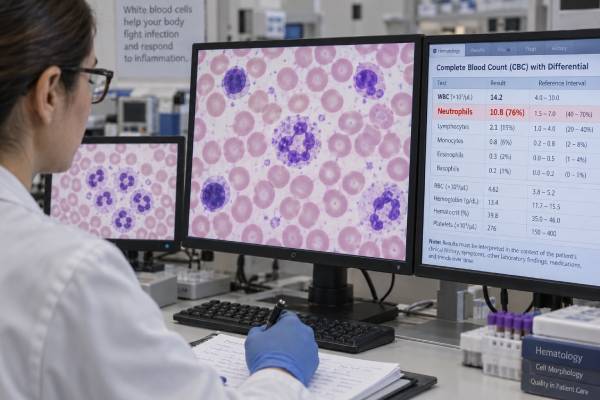
A neutrophil count test measures the most abundant type of white blood cell in most adults. Neutrophils are rapid-response immune cells that leave the bloodstream, enter injured or infected tissue, engulf microbes, release antimicrobial substances, and help coordinate inflammation. A high count, called neutrophilia, is commonly a normal reaction to infection, physical stress, inflammation, corticosteroid medicines, smoking, pregnancy, or tissue injury. Less often, persistent or extreme neutrophilia points to a bone-marrow disorder. The result is usually reported as both a percentage and an absolute neutrophil count (ANC); the absolute number is generally more informative because percentages can be distorted when another white-cell type changes. A high neutrophil count cannot prove that an infection is bacterial, and a normal count cannot exclude serious infection. Clinicians interpret the value with symptoms, the total white blood cell count, immature granulocytes, blood smear, medications, and trends. This article explains common patterns, “left shift,” reactive causes, and when further evaluation is needed.
- What the test measures: The absolute number and percentage of neutrophils in a blood sample.
- Most common reason for a high result: A reactive response to infection, inflammation, tissue injury, or physiologic stress.
- Best number to use: The ANC is usually more meaningful than the neutrophil percentage alone.
- Important caution: Corticosteroids and stress can raise circulating neutrophils without a new bacterial infection.
- When concern rises: Persistent, unexplained, very high counts or immature/abnormal cells may require hematology evaluation.
Table of Contents
- What neutrophils do and how the count is measured
- Normal range, ANC, and result patterns
- Common reactive causes of high neutrophils
- What neutrophilia means during infection
- Medicines, stress, smoking, and pregnancy
- Persistent neutrophilia and bone-marrow disorders
- Evaluation, treatment, and urgent warning signs
What Neutrophils Do and How the Count Is Measured
Neutrophils develop in the bone marrow from myeloid stem cells. Mature cells are stored in a large marrow reserve and released into blood as needed. They circulate briefly, move along vessel walls, and can enter tissues in response to chemical signals. At a site of infection or injury, they engulf organisms, release enzymes and reactive molecules, and can form extracellular traps that help contain microbes. These defenses are useful but can also damage nearby tissue when activation is excessive.
The count is part of a complete blood count with differential. Automated analyzers classify white cells as neutrophils, lymphocytes, monocytes, eosinophils, and basophils. The report may include:
- White blood cell count: The total number of leukocytes
- Neutrophil percentage: The proportion of white cells classified as neutrophils
- Absolute neutrophil count: The actual number of neutrophils per volume of blood
- Immature granulocytes: Early neutrophil-lineage cells released during strong marrow stimulation
- Manual differential: Microscopic classification when an analyzer flags unusual cells
The ANC can be calculated by multiplying the total white count by the proportion of mature neutrophils and bands. For example, a white count of 12,000 cells/µL with 75% neutrophils gives an ANC of about 9,000 cells/µL. Laboratories often calculate it automatically.
Percentages can mislead. If lymphocytes fall after corticosteroid use, the neutrophil percentage may increase even when the absolute count changes little. Conversely, a normal percentage can conceal an elevated ANC when the total white count is high. The absolute value, total count, and full differential should be reviewed together.
A routine venous sample is used. Fasting is not usually required. Time of day, exercise, emotional stress, smoking, recent meals, pregnancy, medicines, and acute illness can affect the result. A difficult blood draw does not usually create clinically important neutrophilia, but specimen delay or analyzer flags may prompt a repeat or smear review.
Normal Range, ANC, and Result Patterns
Adult reference intervals vary, but an ANC around 1,500–7,500 cells/µL is common. Some laboratories use a higher upper limit. Children have age-dependent ranges, and newborns can have substantially higher counts. Pregnancy, especially labor and the postpartum period, also changes expected values. The laboratory’s interval and the clinical setting are the correct comparison.
Neutrophilia generally means an ANC above the upper reference limit. Its significance depends on the magnitude, duration, cell maturity, and whether other blood-cell lines are abnormal.
| Pattern | Common interpretation | Helpful context |
|---|---|---|
| Mild, temporary neutrophilia | Stress, smoking, exercise, medication, or minor infection | Symptoms, recent events, repeat after recovery |
| Neutrophilia with fever and left shift | Acute infection or major inflammation is possible | Cultures, imaging, CRP, organ function, clinical severity |
| High neutrophils after corticosteroids | Demargination and delayed movement into tissue | Medication timing, lack or presence of infection signs |
| Persistent neutrophilia with mature cells | Smoking, chronic inflammation, medication, splenectomy, or myeloproliferative disease | Trend, smear, platelets, hemoglobin, spleen size |
| Very high count with immature or abnormal cells | Severe reactive process or bone-marrow disorder | Urgent smear review and targeted hematology testing |
A “left shift” means increased immature neutrophil forms, traditionally bands, metamyelocytes, and myelocytes, in the blood. It reflects accelerated marrow release. Infection is a common cause, but burns, severe inflammation, tissue necrosis, growth-factor medicines, and marrow disorders can also produce it. Toxic granulation, Döhle bodies, and vacuoles on a smear may support intense reactive activation but are not specific to one organism.
A leukemoid reaction is an extreme reactive white-cell increase that can resemble leukemia. It may occur with severe infection, major tissue injury, certain cancers, or medications. The smear, clinical course, molecular tests, and sometimes bone-marrow evaluation distinguish it from a myeloid neoplasm.
Trends often matter more than one mildly abnormal result. A count that falls as fever and symptoms improve supports a reactive process. A count that continues rising, remains elevated for weeks to months, or is accompanied by anemia, abnormal platelets, or splenomegaly deserves broader investigation.
Common Reactive Causes of High Neutrophils
Reactive neutrophilia occurs when normal marrow and vascular mechanisms respond to a stimulus. Several processes can increase the circulating count: release from marrow storage, increased production, reduced movement from blood into tissues, and movement of cells from the vessel-wall “marginated” pool into freely circulating blood.
Infection
Bacterial infections are a classic cause, especially pneumonia, urinary infection, appendicitis, abscess, cellulitis, and sepsis. Fungal, parasitic, and some viral infections can also increase neutrophils. The pattern depends on timing, severity, immune status, and location.
Inflammatory Disease
Rheumatoid arthritis, inflammatory bowel disease, vasculitis, gout, pancreatitis, thyroiditis, and other sterile inflammatory conditions may produce neutrophilia. The count reflects immune signaling rather than the presence of microbes. A CRP test may add information about the acute-phase response, but neither marker identifies the cause alone.
Tissue Injury and Necrosis
Surgery, burns, trauma, heart attack, tissue ischemia, and major bleeding can trigger stress hormones and cytokines. The count can rise before infection is present. In a postoperative patient, clinicians therefore compare the trajectory with fever, wound findings, pain, organ function, and expected recovery rather than treating the neutrophil count as proof of infection.
Malignancy and Cytokine Production
Solid tumors can cause inflammation, tissue necrosis, or production of colony-stimulating factors that drive neutrophils. Cancer treatment can also alter counts. A high value is not a cancer screening test, and most mild elevations are not caused by cancer. Concern increases with constitutional symptoms, an unexplained persistent trend, abnormal smear findings, or changes in other blood cells.
Recovery From Marrow Suppression
After chemotherapy, infection, or another marrow insult, neutrophils may rebound during recovery. Granulocyte colony-stimulating factor, such as filgrastim, intentionally increases production and release. The timing relative to treatment is essential.
The reactive label should not be assigned solely because a common cause is possible. Clinicians establish that the blood pattern and clinical course fit and remain alert for competing explanations.
What Neutrophilia Means During Infection
Neutrophilia supports an active immune response but cannot determine whether infection is present, where it is, or which organism is responsible. Many bacterial infections raise the count, yet early infection can have a normal count. Severe sepsis can cause low neutrophils when consumption and marrow exhaustion exceed production. Older adults, newborns, people receiving chemotherapy, and immunosuppressed patients may have muted responses.
The count also cannot reliably separate bacterial from viral illness. Influenza and other viral infections may initially cause neutrophilia, particularly with stress or corticosteroid use. Bacterial superinfection is considered from new deterioration, focal findings, imaging, cultures, and the full laboratory pattern—not a neutrophil cutoff.
When infection is suspected, clinicians assess:
- Temperature, heart rate, blood pressure, breathing rate, oxygen level, and mental status
- Localizing symptoms such as cough, painful urination, abdominal pain, wound drainage, or neck stiffness
- Blood count trends, immature cells, lactate, kidney and liver function, and inflammatory markers
- Urine, blood, respiratory, wound, or stool microbiology when appropriate
- Imaging directed at the suspected source
A rising count during treatment can mean worsening infection, but it can also reflect corticosteroids, marrow recovery, tissue inflammation, or a delayed response. A falling count is encouraging only if the person is clinically improving. In sepsis, organ function and circulation are more urgent indicators than whether the neutrophil count is high.
The neutrophil-to-lymphocyte ratio is sometimes reported as another inflammation marker, but it combines two variable cell lines and is not a replacement for the absolute counts. It may have prognostic associations in groups of patients without providing a diagnosis for an individual.
Medicines, Stress, Smoking, and Pregnancy
Corticosteroids are a frequent cause of neutrophilia. They move neutrophils away from vessel walls into circulating blood, reduce their exit into tissues, and delay programmed cell death. The count can rise within hours. Steroids may simultaneously lower lymphocytes and eosinophils, creating a characteristic differential. Because steroids also suppress fever and inflammation, infection must still be assessed clinically.
Other medicines that can increase neutrophils include lithium, beta-agonists, epinephrine, and granulocyte colony-stimulating factors. Drug timing, dose, and baseline counts help determine plausibility. Stopping a prescribed medicine without guidance is unsafe.
Physical and emotional stress release catecholamines that cause rapid demargination. Vigorous exercise, seizures, acute pain, panic, labor, and surgery can produce a short-lived rise. The count often normalizes after the stimulus ends. This mechanism differs from days of increased marrow production, although both can occur together.
Smoking is associated with chronic mild leukocytosis and neutrophilia. The effect may improve after cessation but can take time. Smoking also raises cardiovascular and cancer risk, so the finding should prompt evidence-based cessation support rather than attribution of every abnormality to tobacco.
Pregnancy normally increases white cells, largely through neutrophils. Counts can become especially high during labor and shortly after delivery. Pregnancy-specific reference ranges and obstetric context prevent unnecessary alarm. Fever, uterine tenderness, urinary symptoms, respiratory symptoms, or fetal concerns still require assessment because physiologic neutrophilia does not exclude infection.
Obesity, sleep apnea, chronic stress, and metabolic disease may contribute to low-grade inflammatory neutrophilia. These associations are nonspecific. Management focuses on established health risks rather than attempting to suppress neutrophil production directly.
Persistent Neutrophilia and Bone-Marrow Disorders
Most neutrophilia is reactive, but a persistent unexplained elevation can arise from a myeloid neoplasm. Chronic myeloid leukemia, chronic neutrophilic leukemia, polycythemia vera, essential thrombocythemia, and primary myelofibrosis are examples. These disorders involve clonal blood-cell production and usually have additional clues.
Features that increase concern include:
- Progressively rising or extreme white-cell counts
- Immature granulocytes, blasts, basophilia, or abnormal morphology
- Unexplained anemia or abnormal platelet counts
- Enlarged spleen, early fullness after eating, or left upper abdominal discomfort
- Night sweats, weight loss, persistent fever, bone pain, or severe itching
- Thrombosis, unusual bleeding, or elevated uric acid
A blood smear is a crucial first step. Chronic myeloid leukemia often shows cells across several stages of granulocyte development and may include basophilia. Molecular testing for the BCR::ABL1 fusion establishes that diagnosis. Other patterns may lead to testing for JAK2, CALR, MPL, CSF3R, or additional mutations. These tests should be selected by the suspected disorder rather than ordered indiscriminately.
Bone-marrow examination may be needed when blood findings remain unexplained or suggest a clonal process. It assesses cellularity, maturation, fibrosis, chromosome changes, and molecular features. A reactive count generally resolves or follows the underlying condition, while a clonal count persists independently.
Splenectomy can produce a long-lasting mild increase because the spleen normally stores and removes blood cells. Chronic inflammation, smoking, and medications should be addressed before rare diagnoses are assumed. Hematology referral is appropriate when the elevation is persistent, unexplained, marked, or accompanied by concerning blood or clinical findings.
Evaluation, Treatment, and Urgent Warning Signs
For a mild incidental elevation, clinicians often review symptoms, medicines, smoking, recent exercise, infection, and previous blood counts. A repeat complete blood count after recovery may be sufficient. The full differential and absolute values are reviewed, not just the flagged percentage.
If symptoms are present, testing is focused on likely causes. This may include CRP or ESR, cultures, urinalysis, chest imaging, liver and kidney tests, or disease-specific studies. A peripheral smear is useful for persistent or marked neutrophilia and when the analyzer reports immature cells. Treatment is directed at the cause; there is no routine medicine to lower a reactive count.
Antibiotics should not be started only because neutrophils are high. They are used when bacterial infection is clinically suspected or confirmed. Anti-inflammatory treatment depends on the diagnosed condition. Corticosteroid-associated neutrophilia usually does not require treatment, although the reason for steroid therapy and infection risk should be reviewed.
Seek urgent care for difficulty breathing, confusion, fainting, severe abdominal pain, stiff neck, rapidly spreading skin redness, very high fever with deterioration, low blood pressure, or signs of stroke or heart attack. These symptoms require immediate assessment whether the neutrophil count is high, normal, or unknown.
Prompt review is also appropriate for persistent fever, unexplained weight loss, drenching night sweats, enlarged lymph nodes or spleen, recurrent infections, unusual bleeding, or a rapidly increasing white count. A high neutrophil result is usually the immune system responding appropriately; the clinical task is to identify the stimulus and recognize the smaller group in whom the pattern signals marrow disease.
Why the Count May Change From Day to Day
Neutrophils move rapidly between bone marrow, circulating blood, vessel walls, and tissues. For that reason, the blood count is a snapshot of cell distribution as well as production. A morning sample after rest may differ from one drawn after exercise, pain, a stressful appointment, or a dose of corticosteroid. Hydration can also change the concentration of blood cells without changing the total number in the body. Small fluctuations near the upper reference limit are therefore common.
The comparison with low neutrophils is clinically important. A high count usually signals mobilization, while a low ANC can reduce protection against bacterial and fungal infection. In overwhelming sepsis, neutrophils may be high, normal, or low depending on timing and marrow reserve. This is why clinicians never use direction alone to grade infection severity. They look at vital signs, organ function, lactate, mental status, and the source of illness.
When repeat testing is planned, using a similar time of day and noting medication timing can improve comparison. A stable mild elevation over years in a smoker has a different meaning from a rapid increase over several days with fever or from a new rise accompanied by blasts. The rate of change, baseline, and entire blood-count pattern often provide more diagnostic value than the exact distance above the laboratory cutoff.
References
- Blood Differential 2024
- White Blood Count (WBC) 2024
- What Are Neutrophils? 2025
- Neutrophilic Leukocytosis 2025
- Myeloproliferative Neoplasms 2026
- Manifestations of Infection 2024
Disclaimer
This article provides general education and cannot diagnose infection, inflammation, leukemia, or another cause of neutrophilia. Reference ranges vary with age, pregnancy, laboratory method, and clinical setting, and results require interpretation with the full blood count and symptoms. Seek urgent care for severe infection signs, breathing difficulty, confusion, or rapid deterioration.