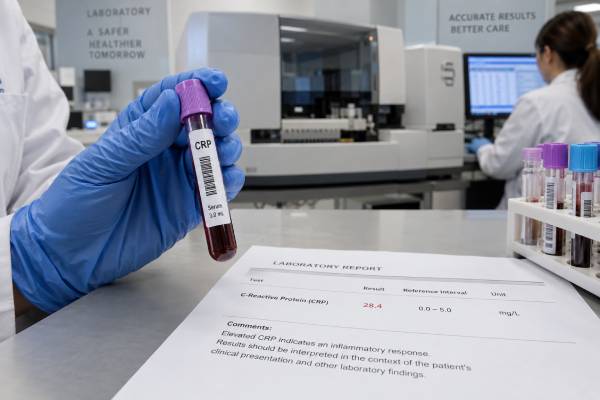
C-reactive protein is one of the most widely used blood markers of inflammation. The liver releases CRP when immune signals indicate infection, tissue injury, or another inflammatory process. Because CRP can rise quickly and fall as the trigger improves, clinicians often use it to judge whether inflammation is active and to follow change over time. However, a high CRP result is not a diagnosis. It cannot identify the exact organ involved, prove that an infection is bacterial, or show whether a chronic condition is flaring without other evidence. Interpretation also depends on which test was ordered: a standard CRP test evaluates active inflammation, while a high-sensitivity CRP test measures much lower concentrations for selected cardiovascular-risk assessments. This guide explains common ranges, units, causes of high and low results, test limitations, and the practical questions that help turn a CRP number into useful clinical information.
- Fast responder: CRP often changes more quickly than many other inflammation markers.
- Broad signal: A high result shows inflammatory activity but not its location or cause.
- Lab-specific range: Normal limits vary by method, and mg/L must not be confused with mg/dL.
- Two test types: Standard CRP and high-sensitivity CRP serve different clinical purposes.
- Best interpreted as a trend: Symptoms, examination, and companion tests give the result meaning.
Table of Contents
- What CRP Measures and How It Changes
- Standard CRP Versus High-Sensitivity CRP
- Normal Range, Units, and Result Categories
- Common Causes of High CRP
- Infection, Autoimmune Disease, and Other Patterns
- Interpreting CRP With Other Tests and Trends
- Testing, Follow-Up, and Lowering CRP Safely
What CRP Measures and How It Changes
CRP is a protein produced mainly by liver cells. Its production increases when inflammatory cytokines—especially interleukin-6—signal that the body is dealing with tissue damage, infection, or immune activation. CRP belongs to the group called positive acute-phase proteins because its blood concentration rises during the acute-phase response.
This response is part of normal defense. CRP can bind to damaged cell surfaces and certain microbial components, helping activate complement and mark material for removal by immune cells. The test does not measure those actions directly. It measures how much CRP is circulating in a blood sample.
In healthy people, standard CRP is generally low. After a substantial inflammatory trigger, levels may begin rising within hours, increase markedly over the next day or two, and then fall relatively quickly when production signals stop. CRP has a fairly consistent biological half-life, so changes in concentration largely reflect changes in liver production. That makes serial results useful for following a rapidly changing illness.
A single value is a snapshot. A person tested near the beginning of an infection may have a lower result than someone tested later, even if both ultimately have similar illness severity. A person recovering from surgery may still have an elevated result that is already moving downward. Timing should therefore be considered alongside the number.
CRP is sensitive but nonspecific. It can be raised by pneumonia, a urinary infection, rheumatoid arthritis, inflammatory bowel disease, surgery, trauma, a heart attack, or many other conditions. It may also rise modestly with obesity, smoking, poor sleep, pregnancy, or chronic metabolic inflammation. The result confirms neither a particular disease nor the need for a particular treatment.
The test is often discussed with the erythrocyte sedimentation rate. ESR responds more indirectly and can remain elevated longer. CRP generally changes faster, while ESR may be useful in selected chronic inflammatory disorders. Neither test should replace a clinical assessment.
Standard CRP Versus High-Sensitivity CRP
Standard CRP and high-sensitivity CRP, often written hs-CRP, measure the same protein. The difference is the assay’s measuring range and intended use.
A standard CRP assay is designed for concentrations commonly seen in active inflammation. It is used when a clinician is evaluating possible infection, an inflammatory flare, tissue injury, or response to treatment. An hs-CRP assay can measure much smaller concentrations with greater precision. It is most often used as one part of cardiovascular-risk assessment in people who do not currently have an acute infection or major inflammatory illness.
| Feature | Standard CRP | High-sensitivity CRP |
|---|---|---|
| Main purpose | Detect and monitor active inflammation | Assess low-grade vascular inflammation as one cardiovascular risk factor |
| Typical clinical setting | Symptoms of infection, autoimmune activity, injury, or postoperative complications | Apparently stable person undergoing cardiovascular risk review |
| Concentration focus | Moderate to large inflammatory increases | Very low concentrations that standard assays may not quantify precisely |
| Key caution | Cannot identify the cause alone | Should not be interpreted for heart risk during acute illness, trauma, or a flare |
Cardiovascular guidance has used different hs-CRP cutoffs depending on the clinical question. Some frameworks describe less than 1 mg/L as lower risk, 1–3 mg/L as intermediate risk, and above 3 mg/L as higher relative risk. Other modern risk discussions use 2 mg/L or higher as a risk-enhancing factor. These categories do not mean that CRP itself proves arterial disease. Cholesterol, blood pressure, diabetes, smoking, age, family history, and overall risk calculation remain central.
An hs-CRP above 10 mg/L usually prompts consideration of acute or chronic non-cardiovascular inflammation and may be repeated when the person is well. Using a temporarily high value from a respiratory infection to estimate long-term heart risk would be misleading.
The report should state which assay was used. Do not assume that “CRP” and “hs-CRP” are interchangeable simply because both use mg/L. The clinical question determines which one is appropriate.
Normal Range, Units, and Result Categories
The safest definition of normal is the reference interval printed by the laboratory that performed the test. Different laboratories may use an upper limit of 5, 8, or 10 mg/L for standard CRP, depending on assay and population. MedlinePlus notes that approximately 0.8–1.0 mg/dL or lower is often considered a healthy amount, which equals 8–10 mg/L.
Unit conversion is important:
- 1 mg/dL equals 10 mg/L.
- 0.5 mg/dL equals 5 mg/L.
- 10 mg/dL equals 100 mg/L.
Confusing the units can create a tenfold interpretation error. Always copy both the number and the unit when discussing a result.
The following broad categories can help organize a standard CRP result, but they are not universal diagnostic thresholds:
| Approximate standard CRP level | General meaning | Interpretive caution |
|---|---|---|
| Within the laboratory range | No substantial systemic CRP response at that moment | Does not exclude early, localized, or weakly CRP-producing disease |
| About 10–40 mg/L | Mild to moderate inflammation is possible | Seen with many viral and bacterial infections, chronic disease, and noninfectious triggers |
| About 40–100 mg/L | More significant inflammatory activity | Infection is one possibility, but tissue injury and inflammatory disease can overlap |
| Above 100 mg/L | Marked systemic inflammation | Serious bacterial infection becomes more likely in the right setting, but the value is not specific |
These bands should never be used as a home diagnosis chart. A low CRP does not guarantee that an infection is harmless, and a very high value does not prove sepsis. Some severe infections produce less CRP in people who are immunosuppressed or have impaired liver function. Certain autoimmune disorders can also show surprisingly modest CRP despite active disease.
A result below the test’s detection limit is usually not a problem. CRP has no recognized deficiency syndrome in routine care. “Low CRP” generally means there is no measurable systemic acute-phase response, which is usually reassuring when the person feels well.
Common Causes of High CRP
A high CRP is a sign that inflammatory signaling is occurring. The cause may be short-lived, chronic, infectious, noninfectious, or a combination.
Infections are frequent causes. Bacterial pneumonia, kidney infection, skin infection, abdominal infection, bone or joint infection, and bloodstream infection can produce large increases. Viral infections may cause modest or substantial rises as well, so CRP alone cannot reliably label an illness bacterial or viral.
Autoimmune and inflammatory disorders can raise CRP during active disease. Examples include rheumatoid arthritis, giant cell arteritis, polymyalgia rheumatica, vasculitis, inflammatory bowel disease, and some inflammatory skin or lung conditions. In these settings, CRP may help monitor activity, but disease-specific symptoms and tests are still needed.
Tissue injury triggers the same acute-phase pathway. Surgery, major trauma, burns, pancreatitis, and heart muscle injury can elevate CRP without infection. After an operation, clinicians often expect an initial increase. Concern grows when the value fails to decline as expected or rises again with symptoms such as fever, worsening pain, drainage, or low blood pressure.
Cancer can be associated with high CRP through tumor-related inflammation, tissue breakdown, infection, treatment effects, or advanced disease. CRP is not suitable as a general cancer screening test because many benign conditions cause the same pattern.
Metabolic and lifestyle factors can contribute to persistent low-grade elevations. Excess visceral fat produces inflammatory mediators. Smoking, poorly controlled diabetes, sleep disturbance, sedentary behavior, and chronic periodontal disease may also influence CRP. These associations are strongest when confirmed on repeat testing rather than inferred from one result during a minor illness.
Pregnancy, estrogen exposure, and age can shift expected values. Oral contraceptives or hormone therapy may raise CRP in some people. These factors should be noted, but a substantial elevation should not automatically be dismissed as hormonal.
A useful way to approach a high result is to ask what happened around the test. Recent vaccination, strenuous exercise, injury, dental infection, a flare of known disease, or an acute respiratory illness may supply context. Persistent unexplained elevation requires a broader medical assessment rather than repeated CRP testing alone.
Infection, Autoimmune Disease, and Other Patterns
CRP can support clinical reasoning, but overlap is extensive. There is no number that cleanly separates bacterial infection from viral infection or autoimmune disease in every patient.
In a person with fever, rapid breathing, low oxygen, focal chest findings, and a high CRP, bacterial pneumonia may be a strong possibility. In someone with swollen joints, prolonged morning stiffness, and rising CRP, inflammatory arthritis may be more likely. The same laboratory value has different meaning because the surrounding evidence differs.
Point-of-care CRP testing has been studied in respiratory infections to reduce unnecessary antibiotics. Some guidelines use ranges such as below 20 mg/L, 20–100 mg/L, and above 100 mg/L as one input when deciding whether antibiotics are unlikely, should be considered, or are more strongly indicated. These are decision aids for selected patients after clinical examination, not general rules for self-treatment. Age, duration, vital signs, comorbidities, and signs of pneumonia remain essential.
CRP also behaves differently among autoimmune diseases. It often tracks rheumatoid arthritis, inflammatory bowel disease, and large-vessel vasculitis. In systemic lupus erythematosus, CRP can remain relatively low during some flares but rise with infection or certain manifestations. A normal result therefore cannot be used to rule out autoimmune activity.
Very high CRP can occur in serious bacterial infection, but sepsis is diagnosed from organ dysfunction and clinical assessment, not from CRP. Recent systematic reviews emphasize limited diagnostic and prognostic accuracy when CRP is used alone in adult sepsis. A rapidly deteriorating patient needs urgent care regardless of whether the CRP is 30 or 300 mg/L.
A high white blood cell count, neutrophilia, procalcitonin, cultures, lactate, imaging, and organ-function tests may help define an infectious pattern. None is perfect by itself. The goal is convergence of evidence.
Interpreting CRP With Other Tests and Trends
CRP is most useful when it answers a focused question: Is inflammation present? Is it increasing or decreasing? Does the pattern fit the suspected diagnosis? Is treatment having the expected effect?
A clinician may compare CRP with:
- ESR: Often slower to rise and fall and strongly affected by anemia, age, pregnancy, fibrinogen, and immunoglobulins.
- Complete blood count: Shows white-cell, neutrophil, lymphocyte, platelet, and anemia patterns.
- Procalcitonin: Sometimes used in selected bacterial infection and sepsis decisions, especially for antibiotic stewardship.
- Ferritin: Reflects iron stores but also rises during inflammation and can be extreme in certain hyperinflammatory syndromes.
- Fibrinogen: Links the acute-phase response with coagulation and affects ESR.
- Liver and kidney tests: Identify organ involvement and factors that alter protein production or clearance.
The inflammatory marker panel is not a single diagnosis-producing test. Discordant results can be informative. CRP may normalize quickly after effective treatment while ESR remains raised. Ferritin may be high because of iron overload, liver injury, or inflammation. Procalcitonin may be low in localized infection or elevated for noninfectious reasons in severe physiological stress.
Serial CRP values should be compared using the same units and, ideally, the same laboratory method. A change from 150 to 70 mg/L may support improvement even though the result remains high. A change from 12 to 18 mg/L may fall within biological and analytical variation unless symptoms also worsen.
Treatment decisions should not chase a perfect number. In chronic disease, symptom control, physical findings, imaging, organ function, and validated disease-activity scores may matter more. In acute infection, clinical stability and source control are essential. CRP is supporting evidence.
Testing, Follow-Up, and Lowering CRP Safely
A CRP test requires a small blood sample. Fasting is usually unnecessary for standard CRP. Fasting may be requested when cholesterol, glucose, or other tests are drawn at the same time. Tell the clinician about recent illness, injury, surgery, strenuous exercise, pregnancy, hormone use, and medications. Do not stop prescribed medicines or supplements unless specifically instructed.
Minor bruising or tenderness can occur after the blood draw. Results may be available quickly, especially when a point-of-care device is used. The next step depends on why the test was ordered.
For an unexpected mild elevation in a person who feels well, a clinician may review temporary causes and repeat the test after recovery. For a high result with symptoms, investigation may include examination, urine testing, cultures, imaging, or disease-specific tests. For monitoring, the direction of change may be more important than reaching the laboratory range immediately.
There is no responsible way to “treat CRP” without understanding its source. Antibiotics do not help nonbacterial inflammation. Steroids can suppress CRP while worsening an untreated infection. Aspirin or supplements should not be started solely to lower a laboratory marker.
When persistent low-grade inflammation is related to cardiometabolic risk, evidence-based measures may lower CRP as overall health improves: stopping smoking, regular physical activity, adequate sleep, dental care, weight reduction when appropriate, and a dietary pattern rich in vegetables, fruit, legumes, whole grains, nuts, fish, and unsaturated fats. Control of diabetes, blood pressure, cholesterol, and inflammatory disease is more important than targeting a specific CRP number.
Seek urgent medical assessment for high CRP accompanied by confusion, breathing difficulty, blue or mottled skin, severe chest or abdominal pain, fainting, very low urine output, persistent vomiting, rapidly spreading redness, or marked deterioration. A normal CRP should not delay care when symptoms are severe.
The practical interpretation is simple: CRP is a responsive alarm, not a map. It can show that an inflammatory process is active and whether that signal is changing. Finding the source requires the rest of the clinical picture.
References
– C-Reactive Protein (CRP) Test 2025 – C-Reactive Protein: Clinical Relevance and Interpretation 2025 – C-Reactive Protein Test 2025 – The Clinical Significance and Potential Role of C-Reactive Protein in Chronic Inflammatory and Neurodegenerative Diseases 2024 – Guidance on C-Reactive Protein Point-of-Care Testing and Complementary Strategies to Improve Antibiotic Prescribing for Adults with Lower Respiratory Tract Infections in Primary Care 2023 – C-Reactive Protein in Adult Sepsis: Systematic Review and Meta-Analysis 2025
Disclaimer
This article provides general education about CRP testing and cannot determine the cause or urgency of an individual result. Laboratories use different methods and reference intervals, and CRP must be interpreted with symptoms, examination, medical history, and other tests. Do not start, stop, or change antibiotics, anti-inflammatory medicine, or cardiovascular treatment based on CRP alone.