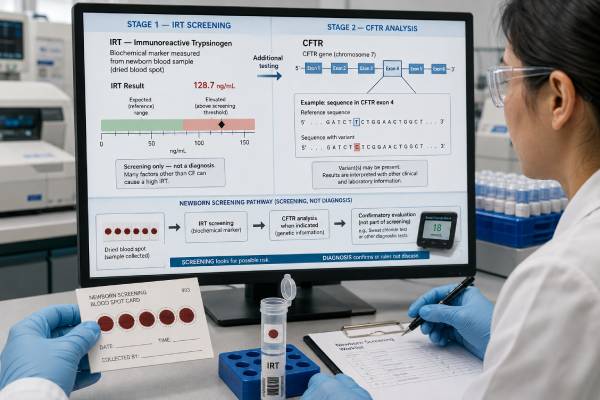
Newborn cystic fibrosis screening starts with a few drops of blood collected on a filter-paper card. The laboratory first measures immunoreactive trypsinogen, or IRT, a pancreatic protein that is often high in newborns with cystic fibrosis. Depending on the state or country, an elevated IRT may trigger a second IRT test, a panel of CFTR gene variants, CFTR sequencing, or direct referral for a sweat chloride test. This layered process helps identify babies before lung or nutrition problems become obvious, but the newborn screen is not a diagnosis. High IRT can occur in babies without cystic fibrosis, and a limited gene panel can miss disease-causing variants. The result must be interpreted according to the exact screening algorithm used. A positive or out-of-range report should lead to timely sweat testing at an experienced center, even when a baby appears healthy.
- IRT is the first screening marker, but it is not specific for cystic fibrosis.
- Newborn screening algorithms vary by location, so the same IRT or CFTR finding may trigger different next steps.
- One CFTR variant often indicates carrier status, but sweat testing is still needed after an out-of-range screen.
- Two CFTR variants increase concern, yet variant classification and whether they are on opposite gene copies matter.
- Sweat chloride is the main diagnostic test after a positive newborn screen.
- A normal screen does not override symptoms such as meconium ileus, poor growth, persistent cough, or unusually salty skin.
Table of Contents
- How Newborn Cystic Fibrosis Screening Works
- Understanding IRT Results
- How CFTR Variant Testing Is Used
- Common Newborn Screen Result Patterns
- Sweat Testing and Diagnostic Confirmation
- CRMS/CFSPID and Other Inconclusive Results
- Care After Screening and Signs That Need Evaluation
- Carrier Status, Family Testing, and Future Pregnancies
How Newborn Cystic Fibrosis Screening Works
Cystic fibrosis, or CF, is caused by disease-related variants in both copies of the CFTR gene. The CFTR protein controls movement of chloride and water across cell surfaces. When function is greatly reduced, secretions become unusually thick, affecting the lungs, pancreas, intestines, sinuses, reproductive tract, and sweat glands.
Early treatment can improve nutrition, growth, and respiratory care, so CF is included in newborn blood-spot screening throughout the United States and in many other programs. Screening identifies babies who need diagnostic evaluation; it does not establish the diagnosis from the dried blood spot alone.
The blood-spot sample
A heel-prick sample is usually collected during the first days after birth. Drops of blood are placed on a special card, allowed to dry, and sent to a state or regional laboratory. Collection timing, feeding, prematurity, transfusion, specimen quality, and transport time can affect newborn screening in general. Hospitals and outpatient clinicians should verify that a valid specimen was obtained and that results reached the baby’s medical home.
Every current U.S. CF screening algorithm begins with IRT. What happens next differs. Common approaches include:
- IRT/IRT: A high first IRT leads to a second blood-spot IRT measurement, often on a later specimen. Persistently high IRT prompts sweat testing.
- IRT/DNA: A high IRT triggers testing for selected CFTR variants. Referral depends on the number and type of variants and sometimes how high the IRT is.
- IRT/DNA/SEQ: A high IRT triggers a CFTR panel, followed in selected samples by broader sequencing and sometimes deletion/duplication analysis.
- IRT/DNA with a “very high IRT” safety net: Even when no panel variant is found, an extremely high IRT can trigger referral to reduce the chance of missing rare variants.
Some programs automatically collect two routine newborn specimens and incorporate the second IRT into their algorithm. Others use one specimen unless follow-up is requested. Families should use the result letter and local newborn screening program instructions rather than a generic online flowchart.
Why algorithms differ
Programs balance sensitivity, false-positive results, cost, laboratory capacity, population diversity, and speed. A small CFTR panel is fast but may miss variants that are uncommon in the population on which the panel was designed. Broader sequencing finds more variants but can identify changes whose health effects are uncertain, increasing the number of families with an inconclusive result.
The Cystic Fibrosis Foundation’s 2025 newborn screening guideline recommends broader, more equitable variant detection and supports a sequencing tier after IRT and panel testing. Programs are still implementing different methods. Therefore, “CF screen positive” is not one uniform laboratory result.
Understanding IRT Results
Trypsinogen is made by the pancreas and converted to digestive enzymes in the intestine. In many newborns with CF, pancreatic injury or blocked ducts release more trypsinogen into the bloodstream, producing a high IRT result.
IRT is measured from the dried blood spot. Laboratories usually compare the value with an age- and program-specific cutoff or percentile. The report may show a concentration, a percentile, or only an interpretation such as “elevated.” A cutoff can change by season or daily population distribution in some programs, so numbers from different laboratories are not directly interchangeable.
High IRT does not equal CF
Many babies with elevated IRT do not have cystic fibrosis. Possible reasons include:
- Prematurity or low birth weight
- A stressful delivery or illness around birth
- Reduced oxygen, infection, or intensive-care treatment
- Pancreatic stress unrelated to CF
- Early specimen collection
- Normal biological variation
- A collection or analytical issue
Conversely, some babies with CF do not have a sufficiently high IRT to cross the screening cutoff. IRT falls with age, and certain CFTR genotypes may produce a lower signal. Meconium ileus, a bowel obstruction strongly associated with CF, can also occur with a false-negative newborn screen. Clinical signs always matter.
Repeat IRT requests
In an IRT/IRT program, an elevated first result may lead to a request for a second blood spot rather than immediate DNA testing. A second high value keeps CF in consideration and leads to sweat testing. A lower repeat value may close the screen under that program’s rules.
Families should complete the repeat promptly. Waiting to see whether the baby develops symptoms defeats the purpose of newborn screening. At the same time, a repeat request should not be described as a diagnosis. Most repeat screens do not end in confirmed CF.
“Very high IRT” with no variant
Some IRT/DNA programs refer babies whose IRT is extremely high even when the panel detects no CFTR variant. This safety-net category recognizes that targeted panels do not cover every ancestry equally and cannot find every disease-causing change. The next step may be a sweat test, a repeat blood spot, broader CFTR analysis, or a combination, according to local policy.
The lack of a panel variant lowers the chance of CF but does not reduce it to zero. A newborn screen panel is not the same as comprehensive diagnostic CFTR testing.
How CFTR Variant Testing Is Used
Humans usually have two copies of CFTR, one inherited from each biological parent. Classic cystic fibrosis is autosomal recessive: a baby generally needs disease-causing variants affecting both copies. A person with one disease-causing variant is usually a healthy carrier.
Targeted panels versus sequencing
A targeted panel tests a set of named variants. It can efficiently detect common CF-causing variants, including F508del, but panel size and content vary widely. “No mutation detected” means none of the variants on that panel were found; it does not mean the entire CFTR gene was normal.
Sequencing reads the coding regions and nearby boundaries of CFTR and can find many more single-letter changes and small insertions or deletions. Separate deletion/duplication analysis may be needed to identify missing or extra sections. Even broad testing can leave uncertainty because not every rare variant has enough evidence for confident classification.
Variant panels historically performed less well in people with African, Asian, Indigenous, Middle Eastern, Hispanic, or mixed ancestry because many panels emphasized variants common in people of European ancestry. A screening method should not assume CF occurs only in White infants. High IRT and suggestive symptoms deserve appropriate follow-up regardless of race or ethnicity.
Variant classification matters
A report may classify a CFTR change as:
- CF-causing: Strong evidence shows that the variant can cause CF when paired with another CF-causing variant on the opposite gene copy.
- Variant of varying clinical consequence: Some people with the variant combination develop CF while others do not.
- Variant of uncertain significance: Available evidence cannot determine whether the change affects health.
- Non-CF-causing or benign: Evidence indicates that the variant does not cause CF.
The CFTR2 database is commonly used to support disease-specific classification. A generic laboratory label and a CF-specific interpretation may not always be identical, so review by a CF center or genetics professional can be important.
In cis and in trans
Two variants found in a baby may be in trans, with one on each CFTR copy, or in cis, both on the same copy. CF generally requires relevant variants in trans. Parental testing can sometimes determine phase: if one variant came from each parent, they are usually in trans; if both came from one parent, they are usually in cis.
A screen that reports two variants without phase, sweat chloride, and clinical interpretation has not necessarily completed the diagnostic process. The same pair can carry different implications depending on classification and arrangement.
Common Newborn Screen Result Patterns
The wording of reports varies, but several patterns recur. The table below is a guide, not a substitute for the local program’s instructions.
| Screening pattern | What it may mean | Usual next step |
|---|---|---|
| IRT not elevated | Screen negative under the program’s cutoff | Routine care; evaluate symptoms if they appear |
| IRT elevated, repeat requested | First biochemical marker was out of range | Prompt second blood spot or specified follow-up |
| IRT elevated, no panel variant | Often a false positive, but rare CFTR variants are not excluded | Follow local very-high-IRT rule; sweat test or further analysis may be needed |
| IRT elevated, one CF-causing variant | Baby may be a carrier; CF remains possible because a second variant may have been missed | Sweat chloride test and sometimes expanded CFTR testing |
| IRT elevated, two CF-causing variants | CF is strongly suspected, especially if variants are in trans | Urgent CF-center referral and sweat test |
| IRT elevated, uncertain or varying-consequence variants | Diagnosis cannot be determined from screening alone | Sweat test, expert variant review, phase testing, and follow-up |
| Unsatisfactory specimen | Result cannot be interpreted | Repeat blood spot promptly |
Elevated IRT and one variant
This is a common reason for referral. Many babies in this category are carriers and have a normal sweat chloride result. However, the screen may have detected only one of two relevant variants because the second is not on the panel, lies in a region not covered, or is a type the assay does not detect.
Do not tell a family that the baby “only carries CF” before the diagnostic sweat test is complete. Likewise, do not tell them the baby has CF merely because one variant was found.
Elevated IRT and two variants
Two CF-causing variants in trans are consistent with CF, but current diagnostic guidance still calls for sweat chloride testing after a positive newborn screen. The sweat result documents CFTR dysfunction and can reveal an unexpected discrepancy that needs investigation.
If one or both variants have varying or uncertain consequences, two variants may lead to an inconclusive category rather than immediate CF diagnosis. The variant names should be copied exactly, including letters, numbers, and transcript notation. Similar-looking CFTR names can represent different changes.
Screen negative
A negative result means the baby did not meet that program’s referral criteria. It makes CF less likely but cannot exclude it. False negatives can result from IRT below the cutoff, rare variants, specimen problems, delayed collection, or algorithm limitations.
A baby with meconium ileus, persistent greasy stools, poor weight gain, recurrent lower-respiratory symptoms, electrolyte disturbances, or a sibling with CF should receive diagnostic evaluation even after a negative screen.
Sweat Testing and Diagnostic Confirmation
The quantitative pilocarpine iontophoresis sweat chloride test is the main diagnostic test for cystic fibrosis. A small electrical current helps pilocarpine stimulate sweat on the arm or leg. The sweat is collected and the chloride concentration is measured. The current is mild, and the test does not use needles after the newborn screen.
A positive newborn screen should be referred to a center experienced in infant sweat collection. For babies born at or beyond 36 weeks and weighing more than 2 kilograms, the Cystic Fibrosis Foundation recommends testing as soon as possible after 10 days of age, ideally by the end of the newborn period. Premature or very small infants may need to wait until enough sweat can be collected safely and reliably.
Sweat chloride ranges
Current CF Foundation interpretation uses:
- 29 mmol/L or less: CF is unlikely, although rare genotypes can be associated with lower values.
- 30–59 mmol/L: Intermediate; CF is possible and additional evaluation is needed.
- 60 mmol/L or more: Consistent with CF in a baby with a positive screen, symptoms, or family history.
A diagnostic laboratory should collect adequate sweat from two sites when possible, follow quality standards, and report whether the quantity was sufficient. “Quantity not sufficient,” sometimes abbreviated QNS, is not a normal result. The test must be repeated.
What confirms the diagnosis
Diagnosis combines evidence of CFTR dysfunction with the screening, genetic, family, and clinical context. A sweat chloride of 60 mmol/L or more generally confirms CF in a screen-positive infant. Two CF-causing variants on opposite CFTR copies also strongly support the diagnosis, but sweat testing remains important.
An intermediate result usually leads to repeat sweat testing, expanded CFTR sequencing and deletion/duplication analysis if not already completed, and CF-center evaluation. Rarely, specialized tests of CFTR function, such as nasal potential difference or intestinal current measurement, are used at validated centers.
A normal sweat result with one CFTR variant generally supports carrier status rather than CF. If symptoms later emerge, the diagnosis can be reconsidered. Newborn screening and sweat testing are highly useful, but neither should prevent clinicians from reassessing a changing child.
Do not delay care in a sick baby
A baby with meconium ileus, severe malabsorption, dehydration with low salt, or other strong signs may need CF-focused treatment while diagnostic work continues. Pancreatic enzyme evaluation, nutrition support, salt guidance, and respiratory care should be directed by specialists. Waiting for every genetic detail is not appropriate when the clinical evidence is strong.
CRMS/CFSPID and Other Inconclusive Results
Some babies have a positive newborn screen but do not clearly meet criteria for CF. In the United States, this is called CFTR-related metabolic syndrome (CRMS). Internationally, the term CF screen-positive, inconclusive diagnosis (CFSPID) is common. The combined term CRMS/CFSPID acknowledges that they describe the same diagnostic gray zone.
A typical CRMS/CFSPID pattern is either:
- Sweat chloride below 30 mmol/L with two CFTR variants, at least one of which has uncertain clinical consequences, or
- Sweat chloride 30–59 mmol/L with one or no CF-causing variants
This label does not mean the child has classic CF, and it should not be presented as a harmless false positive. Most children remain healthy, but a minority later meet CF criteria or develop a CFTR-related problem. The goal is measured follow-up without imposing the full burden of CF treatment on a well child.
Follow-up in the gray zone
The 2024 CF Foundation guideline recommends evaluation by clinicians with CF expertise, additional CFTR sequencing and deletion/duplication testing when fewer than two disease-causing variants are known, and parental testing when phase would clarify the result. It also recommends repeat sweat chloride testing at 6 months and annually at least through age 8.
Routine broad laboratory panels, imaging, airway-clearance treatments, or CF medications are not automatically recommended for every asymptomatic child with CRMS/CFSPID. Care is tailored to growth, respiratory cultures, symptoms, and evolving evidence. The primary clinician and CF center should share a clear plan so families are not left between “nothing is wrong” and “your child definitely has CF.”
Communicating uncertainty
Parents need the exact variant names, sweat chloride values, and follow-up schedule in writing. Terms such as “borderline CF” can be misleading because the uncertainty may come from variant interpretation, sweat physiology, or both. Explain which facts are established and what future testing is expected to resolve.
Families should also know whom to call for prolonged cough, poor weight gain, recurrent pancreatitis, unusual dehydration, or other concerns. Repeated testing is not a prediction that the child will become ill; it is a way to detect the uncommon child whose classification changes.
Care After Screening and Signs That Need Evaluation
When CF is confirmed, early referral to an accredited or experienced CF center allows coordinated nutrition, pulmonary, microbiology, social work, pharmacy, and genetic counseling care. The team may assess pancreatic function with stool elastase, monitor growth closely, recommend pancreatic enzymes when needed, and teach age-appropriate airway and infection-prevention practices.
CFTR modulator medicines target specific protein defects and have changed CF care. Eligibility depends on the baby’s genotype, age, regulatory approval, and clinical plan. A newborn screening variant result can therefore become relevant to treatment, but therapy should not be inferred from a variant name without specialist review.
Symptoms that override a reassuring screen
Ask for diagnostic CF evaluation when a baby or child has findings such as:
- Meconium ileus or intestinal obstruction soon after birth
- Poor weight gain despite adequate feeding
- Frequent bulky, greasy, or foul-smelling stools
- Persistent cough, wheeze, or recurrent pneumonia
- Rectal prolapse
- Very salty-tasting skin
- Dehydration or low sodium during heat or illness
- Recurrent pancreatitis
- A close relative with CF or a known familial CFTR genotype
These symptoms are not specific to CF, but they warrant assessment. A sweat test can be ordered because of symptoms or family history even when the newborn screen was negative.
Avoiding delays and lost follow-up
An out-of-range newborn screen is time-sensitive, not because every baby is sick, but because confirmed CF benefits from early care. Families should know the date and location of the sweat test, whether the center can test a small infant, and who will communicate results. The primary care office should confirm completion rather than assuming the screening program closed the loop.
If a family moves, gives birth outside its home jurisdiction, or has a prolonged NICU stay, records may not transfer automatically. Keep a copy of the newborn screen and any CFTR report. A repeat specimen may be required after transfusion or when the first card was inadequate, according to program rules.
Carrier Status, Family Testing, and Future Pregnancies
When a baby has one CF-causing variant and a normal sweat test, the usual conclusion is CF carrier status. Carriers generally do not have cystic fibrosis. The finding matters because it identifies a variant present in the family.
At least one biological parent usually carries the same variant. Testing the parents can clarify inheritance and, when two variants were found in the baby, determine whether they are in cis or in trans. Testing should target the exact familial variant first, with broader carrier screening considered according to reproductive goals and professional guidance.
If both parents are carriers of disease-causing CFTR variants, each pregnancy has a:
- 25% chance of a child with CF
- 50% chance of a carrier child
- 25% chance of a child who inherited neither familial variant
These chances reset with each pregnancy. If one parent has CF and the other is a carrier, the reproductive probabilities differ. A genetic counselor can calculate the family-specific situation and discuss partner testing, prenatal diagnosis, or embryo genetic testing when desired.
A carrier result should be saved for the child’s future reproductive care. It does not require treating the child as ill. Relatives may choose carrier testing because siblings, aunts, uncles, and cousins can share the variant.
Questions to ask after an abnormal screen
- Which screening algorithm was used: IRT/IRT, IRT/DNA, or IRT/DNA/sequencing?
- What was the IRT value or percentile, and was it in the “very high” range?
- Which CFTR variants were found, and how are they classified in CFTR2?
- Was the test a limited panel, full sequencing, and deletion/duplication analysis?
- Is sweat testing scheduled at an experienced center, and what happens if the sample is insufficient?
- Do the variants need parental phase testing?
- Does the current result indicate CF, carrier status, or CRMS/CFSPID?
- What symptoms should prompt a call before the next appointment?
- Who will give the final interpretation and written follow-up plan?
The newborn screen is designed to start a pathway, not to finish it. IRT identifies biochemical risk, CFTR testing refines that risk, and sweat chloride establishes whether CFTR function is abnormal. Keeping those roles separate leads to faster diagnosis for affected babies and clearer reassurance for families whose follow-up is normal.
References
- Newborn Screening Clinical Care Guidelines — 2025, Cystic Fibrosis Foundation.
- Cystic Fibrosis — 2025, HRSA Newborn Screening Information Center.
- Sweat Test Clinical Care Guidelines — 2025, Cystic Fibrosis Foundation.
- Cystic Fibrosis Foundation Evidence-based Guidelines for the Management of CRMS/CFSPID — 2024, clinical guideline.
- ACT Sheets and Algorithms — 2024, American College of Medical Genetics and Genomics.
- About Cystic Fibrosis — 2024, Centers for Disease Control and Prevention.
Disclaimer
This article is general education about newborn cystic fibrosis screening and cannot interpret a baby’s individual IRT, CFTR, or sweat chloride result. Screening algorithms and referral thresholds vary by jurisdiction. An out-of-range result, concerning symptom, or family history should be reviewed promptly with the baby’s clinician and an experienced cystic fibrosis center.