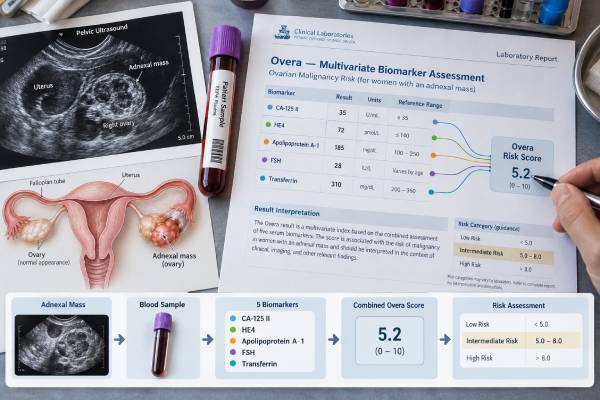
The Overa test is a blood-based multivariate index assay used before surgery in women with an adnexal or ovarian mass. It combines five serum biomarkers into a score that helps estimate whether the mass has a higher or lower likelihood of malignancy. Overa is intended as an aid to clinical evaluation when surgery is already planned; it is not an ovarian cancer screening test, cannot diagnose cancer by itself, and should not be used to decide whether surgery is needed. The five markers are CA-125, HE4, apolipoprotein A1, follicle-stimulating hormone (FSH), and transferrin. The result is reported on a 0-to-10 scale, with a score of 5.0 or higher classified as elevated risk in the FDA-cleared test. A higher score can support referral to a gynecologic oncologist before surgery, while a lower score reduces—but does not eliminate—the possibility of cancer. Imaging, examination, menopause status, symptoms, and pathology remain essential.
- Overa combines five blood biomarkers: CA-125, HE4, apolipoprotein A1, FSH, and transferrin are integrated into one risk score.
- The FDA-cleared cutoff is 5.0: a score of 5.0 or higher is classified as higher risk; a score below 5.0 is lower risk.
- It is for women with an adnexal mass when surgery is planned: it is not designed for screening people without a known mass.
- A high score does not prove ovarian cancer: benign conditions and biomarker variation can still produce an elevated result.
- A low score does not rule out malignancy: suspicious imaging or clinical findings can still justify gynecologic oncology referral.
Table of Contents
- What the Overa Test Is and Who It Is For
- The Five Biomarkers in the Overa Score
- Overa Score Range and Cutoff Meaning
- What High and Low Overa Results Mean
- Overa vs OVA1 and ROMA
- Accuracy, Limitations, and Common Misinterpretations
- What Happens After an Overa Test
What the Overa Test Is and Who It Is For
Overa is a multivariate index assay, meaning it does not interpret one tumor marker in isolation. A computer algorithm combines the concentrations of five serum proteins or hormones into a single numerical result. The test was cleared by the U.S. Food and Drug Administration as an aid in estimating malignancy risk in women with an ovarian or adnexal mass who are already scheduled for surgery.
That intended use is important. Overa is not meant for:
- routine screening in people without an adnexal mass;
- determining whether a mass exists;
- proving that a mass is benign or malignant;
- deciding whether surgery should be performed;
- replacing imaging, physical examination, pathology, or specialist judgment.
Its main clinical purpose is preoperative triage. When an adnexal mass has already been identified and surgery is planned, the team wants to know whether the patient may benefit from having a gynecologic oncologist involved from the start. Specialist involvement can matter because appropriate staging and cytoreductive surgery are important when ovarian cancer is present.
The test is used together with the clinician’s preoperative assessment. An ultrasound showing solid components, papillary projections, ascites, bilateral masses, or other concerning features may already create substantial suspicion. Conversely, a simple cyst with reassuring features may have a low clinical risk. Overa adds biomarker information to that picture rather than replacing it.
This is the same general clinical niche as other adnexal-mass assessment tools, including the original OVA1 ovarian cancer risk test and the ROMA ovarian malignancy risk score. The assays are not interchangeable, however, because they use different biomarkers, algorithms, and cutoffs.
The Five Biomarkers in the Overa Score
Overa combines CA-125, HE4, apolipoprotein A1, FSH, and transferrin. Each marker contributes information, but the commercial test is validated as a combined algorithm. Patients should not try to recreate the score from individual laboratory values.
CA-125 is the most familiar ovarian cancer serum marker. It can be elevated in many epithelial ovarian cancers, but also in benign conditions such as endometriosis, menstruation, fibroids, pelvic inflammation, pregnancy, and liver disease. Some early ovarian cancers have normal CA-125. A dedicated CA-125 ovarian cancer test therefore has important uses but cannot serve as a stand-alone diagnostic test.
HE4, or human epididymis protein 4, is another protein that can be elevated in epithelial ovarian cancer. It may be less affected than CA-125 by some benign gynecologic disorders, but kidney impairment can increase HE4 substantially. Age and smoking can also affect the result. This is one reason a multianalyte score can sometimes provide different information from CA-125 alone.
Apolipoprotein A1 is a major protein component of high-density lipoprotein. In multivariate ovarian-mass models, lower concentrations can contribute to a risk pattern associated with malignancy. It is not an ovarian-specific tumor marker and can vary for many metabolic or inflammatory reasons.
Follicle-stimulating hormone (FSH) helps reflect reproductive and menopausal physiology. FSH generally rises after menopause, although individual values can vary. Its inclusion gives the algorithm biologic information related to hormonal status without requiring the user to apply separate premenopausal and postmenopausal cutoffs.
Transferrin is an iron-transport protein made mainly by the liver. Its concentration can change with nutrition, inflammation, iron status, liver function, and other conditions. As with apolipoprotein A1, the value is not interpreted as an ovarian tumor marker by itself in this context.
The important point is that Overa does not assume each marker must be “abnormal” in the conventional sense. The algorithm recognizes a pattern across all five biomarkers. A person may have a normal CA-125 yet still receive an elevated overall score because of the combined pattern.
Overa Score Range and Cutoff Meaning
The FDA-cleared Overa assay reports a score from 0.0 to 10.0. The primary decision threshold is simple:
- Below 5.0: lower-risk classification.
- 5.0 or higher: higher-risk classification.
Unlike the original OVA1 assay, which uses different referral cutoffs according to menopausal status, Overa uses the same 5.0 threshold for premenopausal and postmenopausal women. That does not mean menopause is irrelevant to ovarian cancer assessment; rather, the biomarker combination already includes FSH and was validated with a single cutoff.
The score is not a percentage probability of cancer. A result of 7.0 does not mean there is a 70% chance of malignancy, and a result of 3.0 does not mean 30%. It is an algorithmic index on its own scale. Converting it into an intuitive probability without the test’s validated performance data would be misleading.
The cutoff is designed to support triage. In practical terms, an elevated score is a signal that malignancy risk is high enough to strengthen consideration of gynecologic oncology involvement before the planned operation. The result should be considered with imaging and clinical risk factors, not used as a veto over them.
Patients sometimes compare an Overa number with a CA-125 concentration or an HE4 concentration. That comparison is not meaningful. CA-125 may be reported in units per milliliter, HE4 in picomoles per liter, and Overa on a unitless 0-to-10 scale. The combined index is generated by a proprietary validated calculation.
If the report does not clearly state the interpretation, the ordering clinician or laboratory can confirm whether the result is classified as elevated or lower risk and how it should be incorporated into the surgical referral decision.
What High and Low Overa Results Mean
A high Overa result, meaning 5.0 or above in the FDA-cleared assay, indicates that the five-biomarker pattern is associated with a higher risk of malignancy among women who fit the intended-use population. It does not identify the cancer type, stage, or exact tissue of origin.
An elevated result can occur in someone who ultimately has a benign mass. That is expected in any test designed to emphasize sensitivity. The clinical tradeoff is intentional: when the consequence of missing a malignancy before surgery is important, a triage test may accept more false-positive referrals in order to identify more cancers.
A low result, below 5.0, lowers concern but does not exclude cancer. No blood-based adnexal-mass score can safely overrule very suspicious imaging, rapid mass growth, ascites, metastatic findings, or other strong clinical evidence. Some ovarian cancers release little CA-125 or HE4, and any algorithm can miss a subset of malignancies.
The result also does not distinguish between common epithelial ovarian cancer and every less common ovarian tumor. Ovarian masses can include germ-cell tumors, sex-cord stromal tumors, metastatic tumors from other organs, borderline tumors, and many benign lesions. Some of these have different biomarker profiles. For example, AFP, beta-hCG, LDH, inhibin, or AMH may be more relevant to specific non-epithelial ovarian tumors.
A practical interpretation framework is:
- High score + suspicious imaging: strengthens the case for gynecologic oncology referral and careful oncologic surgical planning.
- High score + relatively reassuring imaging: prompts review of the entire clinical picture rather than an assumption of cancer.
- Low score + reassuring imaging: supports a lower-risk assessment in the intended-use setting.
- Low score + strongly suspicious imaging: should not delay specialist assessment.
The final diagnosis comes from pathology after tissue is removed or biopsied. Overa is therefore best understood as a routing and risk-assessment tool, not a definitive diagnostic endpoint.
Overa vs OVA1 and ROMA
Overa, OVA1, and ROMA all help assess malignancy risk in women with an adnexal mass, but they are built differently.
OVA1 was the earlier five-marker multivariate index assay. It combines CA-125 II, transthyretin (prealbumin), apolipoprotein A1, beta-2 microglobulin, and transferrin. Its FDA-cleared interpretation uses different cutoffs for premenopausal and postmenopausal women.
Overa, sometimes described as a second-generation multivariate index assay, replaced several components. It uses CA-125, HE4, apolipoprotein A1, FSH, and transferrin and applies a single 5.0 cutoff.
ROMA uses only CA-125 and HE4 plus menopause status in a mathematical algorithm. It may be reported as a percentage or platform-specific index, with thresholds that vary by assay implementation. A detailed comparison therefore cannot rely on one universal ROMA cutoff.
Studies of multivariate assays suggest that combining biomarkers can improve sensitivity compared with CA-125 alone in the intended preoperative population. A 2023 study also evaluated a reflex strategy in which an initial OVA1 result in an intermediate range was followed by Overa. In the study datasets, the reflex approach improved specificity compared with OVA1 alone while preserving high sensitivity. Because the investigation involved assay-company authors and a selected clinical dataset, the findings should be interpreted as evidence about one strategy rather than proof that the approach is best for every patient.
The choice among tests depends on local availability, clinician experience, laboratory platform, the patient population in which the assay has been validated, and whether the result will change referral planning. None should be ordered as a general “ovarian cancer blood test” in a person without an adnexal mass simply because of vague symptoms or anxiety.
For a broader view of how serum markers, germline genetics, HRD, and tumor testing fit together after diagnosis, an ovarian cancer biomarker panel addresses a different and much wider set of clinical questions than Overa alone.
Accuracy, Limitations, and Common Misinterpretations
Overa’s value is tied to its intended-use population. Performance numbers from women with known adnexal masses and planned surgery should not be applied to average-risk screening. Disease prevalence changes positive and negative predictive values dramatically, so a test that works for surgical triage can perform poorly when used in a low-risk population.
Several factors can affect interpretation of the underlying biomarkers:
- kidney dysfunction can raise HE4;
- inflammatory or gynecologic conditions can raise CA-125;
- FSH changes with menopause, hormonal medications, ovarian function, and some treatments;
- liver disease, inflammation, nutritional status, and iron balance can affect apolipoprotein A1 or transferrin.
The algorithm is designed to combine biomarkers despite biologic variation, but it cannot eliminate all confounding.
Another limitation is that an adnexal mass can represent many diseases. A blood test optimized for common epithelial malignancies may have different performance in borderline tumors, rare ovarian histologies, metastatic cancers to the ovary, or unusual benign conditions.
Common interpretation errors include:
- treating 5.0 as a diagnostic boundary between “benign” and “cancer”;
- interpreting the 0-to-10 score as a percentage risk;
- ordering the test for screening without a known adnexal mass;
- using a low score to cancel concern raised by highly suspicious imaging;
- comparing an Overa number directly with OVA1 or ROMA values;
- assuming a high result determines cancer stage or prognosis.
The FDA labeling specifically frames this type of test as an adjunct. A result should supplement the preoperative assessment, not replace it. If the clinical situation falls outside the intended population—such as pregnancy, an age group not covered by labeling, no planned surgery, or surveillance after treated ovarian cancer—the ordering team should consider whether another test or evaluation is more appropriate.
What Happens After an Overa Test
Overa requires a blood sample. Special fasting is generally not the central preparation issue, although patients should follow the laboratory’s instructions and disclose medicines, hormonal treatments, pregnancy status, kidney disease, liver disease, and other conditions that may affect biomarkers.
The most important step comes after the number is reported: deciding whether the surgical team and setting are appropriate for the estimated risk.
If the score is elevated, the clinician may recommend preoperative consultation or referral to a gynecologic oncologist, especially when imaging or examination is also concerning. That does not mean cancer has been diagnosed. The goal is to avoid discovering an unexpected malignancy only after surgery has begun in a setting that is not optimized for oncologic staging or cytoreduction.
If the score is lower risk, the clinician still reviews ultrasound characteristics, mass size, symptom pattern, age, family history, physical findings, and other laboratory data. Referral can still be appropriate when these factors create substantial concern.
After surgery, the pathology report determines whether the mass is benign, borderline, primary ovarian cancer, metastatic cancer, or another diagnosis. If epithelial ovarian cancer is confirmed, Overa generally stops being the central biomarker. Management then shifts toward stage, histology, surgical findings, germline genetic testing, tumor BRCA status, homologous recombination deficiency, and other treatment-relevant tumor markers.
Questions worth asking after receiving an Overa result include:
- Does my result fall above or below the validated 5.0 cutoff?
- How does the score fit with my ultrasound or other imaging?
- Is surgery already indicated for reasons independent of the test?
- Should a gynecologic oncologist perform or participate in the operation?
- Are there medical conditions that could have influenced one of the five biomarkers?
- What will the pathology and genetic-testing plan be if cancer is found?
The safest interpretation is decision-focused. Overa is useful when it helps the care team choose the right surgical expertise before pathology is known. It is not meant to provide certainty before tissue diagnosis.
One additional point is that the result is best documented together with the date, imaging impression, and reason surgery is planned. If a mass is followed over time before surgery, a later ultrasound may change the overall risk assessment even though the original Overa score remains the same. The test is not designed as a serial trend marker, so repeating it simply to see whether the number rises or falls has not been validated in the same way as its preoperative triage use.
References
- 510(k) Summary 2016 (FDA)
- Diagnostic biomarkers in ovarian cancer: advances beyond CA125 and HE4 2024 (Review)
- A reflex testing protocol using two multivariate index assays improves the risk assessment for ovarian cancer in patients with an adnexal mass 2023
- Current and Emerging Methods for Ovarian Cancer Screening and Diagnostics: A Comprehensive Review 2022 (Review)
- Current clinical application of serum biomarkers to detect and monitor ovarian cancer – update 2022 (Review)
Disclaimer
This article provides general information about the Overa test and is not a substitute for individualized medical advice. An Overa score should be interpreted only in the intended clinical setting and together with imaging, examination, medical history, and the planned surgical approach. Only pathology can establish the diagnosis of an ovarian or adnexal mass.