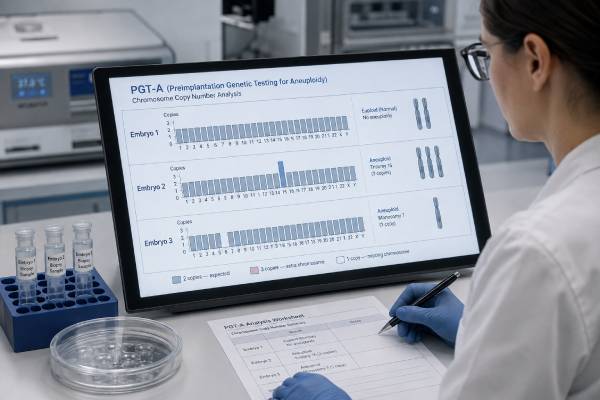
Preimplantation genetic testing for aneuploidy, or PGT-A, screens cells from an IVF embryo for extra or missing chromosomes. The test may help identify embryos with a chromosome pattern more likely to implant and continue as a pregnancy, but it is not a test of every gene, every birth defect, or the entire embryo. Modern PGT-A usually analyzes several trophectoderm cells from a blastocyst and reports results such as euploid, aneuploid, mosaic, segmental, or no result.
The clinical benefit is not the same for every IVF patient. A euploid embryo often has a higher chance of implantation per transfer and a lower miscarriage risk than an untested embryo of the same age group. However, routine PGT-A has not been shown to improve cumulative live birth for all patients, and testing can leave some cycles with no embryo classified for transfer. The report also reflects a small placental-lineage sample, so mosaicism and laboratory thresholds create uncertainty. Decisions should consider age, expected embryo number, prior treatment, the clinic’s laboratory performance, cost, and how the clinic manages mosaic or inconclusive embryos.
- PGT-A screens all 23 chromosome pairs for copy-number abnormalities in a small embryo biopsy.
- A euploid result means no tested chromosome gain or loss was detected; it does not guarantee a healthy baby.
- Aneuploid embryos usually have one or more extra or missing chromosomes and often have low reproductive potential.
- Mosaic results are intermediate signals and do not prove that the whole embryo contains the reported cell mixture.
- PGT-A may improve outcomes per transfer, but it does not reliably raise cumulative live birth for every IVF population.
- Prenatal screening or diagnostic testing should still be offered after pregnancy.
Table of Contents
- How PGT-A Measures Embryo Chromosomes
- What Euploid, Aneuploid, and Mosaic Mean
- Who May Benefit and Who May Not
- Results Per Transfer Versus Per Retrieval
- Mosaic, Segmental, and No-Result Embryos
- Embryo Transfer and Prenatal Follow-Up
- Risks, Costs, and Informed Consent
How PGT-A Measures Embryo Chromosomes
Aneuploidy means that a cell has an abnormal number of chromosomes. A human embryo is expected to have two copies of each autosome and two sex chromosomes. An extra chromosome is a trisomy; a missing chromosome is a monosomy. Many aneuploid embryos do not implant, miscarry, or result in a chromosome condition if pregnancy continues.
PGT-A is performed only in an IVF cycle. Eggs are retrieved, fertilized, and cultured until embryos reach the blastocyst stage, usually on day 5, 6, or 7. An embryologist removes several cells from the trophectoderm, the outer layer that contributes mainly to the placenta. The embryo is vitrified while the genetics laboratory amplifies and analyzes the tiny DNA sample.
Most laboratories use next-generation sequencing or a comparable genome-wide copy-number method. The test estimates whether chromosome regions are present in expected, increased, or decreased amounts. It can usually identify whole-chromosome aneuploidies and may report large segmental gains or losses. It does not perform a high-resolution diagnostic sequence of every gene.
The biopsy is not a complete census of embryo cells. Early embryos can contain different cell lines because chromosome errors may arise after fertilization. Cells may also be distributed unevenly between trophectoderm and inner cell mass. The result therefore describes the sampled DNA signal, not a direct count of all fetal cells.
Laboratory steps can introduce uncertainty. Whole-genome amplification may produce uneven coverage, and the algorithm must decide whether a signal fits euploid, aneuploid, or an intermediate category. Different laboratories use different cutoffs and reporting rules. Before testing, patients should know which platform is used, whether segmental and mosaic results are reported, and how those categories affect transfer eligibility.
PGT-A evolved from older cleavage-stage biopsy and fluorescence methods. Current blastocyst biopsy generally provides more DNA and removes cells from outside the inner cell mass, but it still requires expertise. Embryo survival after biopsy and warming is high in experienced programs, not perfect. The clinic’s own rates matter more than broad claims about the technology.
What Euploid, Aneuploid, and Mosaic Mean
A PGT-A report usually assigns each tested embryo to one of several categories. The exact wording should be interpreted with the laboratory’s definitions.
| Category | Laboratory interpretation | Clinical caution |
|---|---|---|
| Euploid | No tested whole-chromosome or reportable segmental imbalance was detected. | Other genetic conditions, mosaicism, structural anomalies, and IVF failure remain possible. |
| Aneuploid | The sample shows a chromosome gain, loss, or complex abnormal pattern. | The call comes from a few cells and may not represent every cell, especially near reporting thresholds. |
| Mosaic | The copy-number signal lies between expected euploid and aneuploid levels. | The result can reflect true mosaicism, sampling, DNA amplification, or algorithmic variation. |
| Segmental | Part of a chromosome appears duplicated or deleted. | Segmental calls may have different confirmation rates and may need specialized review. |
| No result | The sample did not produce enough reliable data for classification. | Rebiopsy may be possible but adds another manipulation and freeze-thaw exposure. |
A euploid embryo is often prioritized because it has the strongest average reproductive potential. Yet euploid embryos can fail to implant, miscarry, or result in a child with a condition that PGT-A does not test. Embryo morphology, uterine factors, age, sperm and egg biology, and chance still affect outcome.
An aneuploid result may involve a single chromosome, a segment, or several chromosomes. Some whole-chromosome abnormalities are incompatible with ongoing development. Others, such as trisomy 21, 18, or 13, can result in a live birth. Many clinics do not transfer embryos classified as fully aneuploid, but policies and legal standards vary.
A mosaic label is not a direct microscopic finding of two cell populations. It is an inference from an intermediate DNA signal. Laboratories may define low-level and high-level mosaicism using different percentage ranges. These percentages are estimates of the biopsy signal, not a measured proportion throughout the fetus.
A complex abnormal result may show several chromosome changes. Such embryos generally have poor reproductive potential, but patients should still receive the actual report and an explanation of laboratory confidence. Embryo disposition should not be based on a verbal summary alone.
Who May Benefit and Who May Not
PGT-A is often offered to patients of advanced maternal age because the proportion of aneuploid eggs rises with age. If several blastocysts are available, testing may identify a euploid embryo sooner and reduce transfers that would predictably fail or miscarry. The benefit may be shorter time to an ongoing pregnancy rather than a higher total chance of a baby from all embryos created.
Other commonly discussed indications include recurrent miscarriage, repeated implantation failure, severe male-factor infertility, embryo banking, and a desire for single-embryo transfer. Evidence is mixed, and none of these labels automatically proves benefit. The cause of prior losses or failed transfers matters. PGT-A cannot correct uterine disease, immune conditions, embryo culture problems, or every genetic cause.
Potentially favorable circumstances include:
- A patient likely to produce several blastocysts, creating a meaningful selection problem
- Older maternal age with a high expected aneuploidy rate
- A strong preference to reduce the number of embryo transfers or miscarriage risk per transfer
- A need to rank embryos before fertility preservation or family-building over several years
- A clinic and genetics laboratory with validated biopsy, vitrification, and reporting performance
Potentially unfavorable circumstances include:
- Very low ovarian reserve with an expectation of one or no blastocysts
- A cycle in which every embryo would be transferred sequentially regardless of testing
- Inability or unwillingness to accept mosaic or uncertain results
- A clinic that reports only per-transfer success and does not disclose outcomes per retrieval
- Financial strain that reduces the ability to complete further retrievals or transfers
For a patient with one blastocyst, PGT-A may add cost, delay, and a risk of an inconclusive or uncertain result without creating a selection advantage. Transferring the embryo without testing and using prenatal testing later may be a reasonable alternative. For a patient with ten blastocysts at age 41, PGT-A may prevent several transfers of aneuploid embryos and shorten the path to a euploid transfer.
Recurrent pregnancy loss requires careful distinction between random aneuploid losses and other causes. Testing embryo chromosomes may reduce aneuploid transfers, but it does not treat antiphospholipid syndrome, uterine anomalies, endocrine disease, or a parental balanced translocation. A parental rearrangement calls for PGT-SR, not ordinary PGT-A alone.
Patients should be counseled using age-specific estimates of eggs, blastocysts, and euploid embryos. An average “euploid rate” cannot predict an individual cycle, and age at egg retrieval is more relevant than age at embryo transfer.
Results Per Transfer Versus Per Retrieval
PGT-A often improves implantation and lowers miscarriage per transfer because embryos labeled aneuploid are not transferred. This can make clinic statistics look impressive. The more patient-centered question is whether testing increases cumulative live birth from all eggs or embryos generated in one retrieval.
Per-transfer outcomes count only patients who have an embryo selected for transfer. They exclude those whose embryos all arrest, test aneuploid, or receive results the clinic will not transfer. Per-retrieval outcomes include those patients and therefore capture the full impact of testing.
A major randomized trial in women with several good-quality blastocysts found that conventional IVF was not inferior to PGT-A for cumulative live birth within the study period, although PGT-A reduced pregnancy loss and the number of transfers. The result does not prove PGT-A has no value. It shows that faster selection and better per-transfer efficiency do not necessarily translate into more babies from the entire embryo cohort.
Time to pregnancy can still matter. Each failed transfer involves medication, procedures, waiting, expense, and emotional distress. Avoiding a transfer of a clearly aneuploid embryo may be valuable even when cumulative live birth is unchanged. Conversely, a mosaic or false-positive classification could withhold an embryo that might have produced a healthy birth.
When comparing programs, ask for:
- Live birth per retrieval start
- Live birth per egg retrieval
- Cumulative live birth after all transfers from one retrieval
- Implantation and live birth per euploid transfer
- Proportion of cycles with no euploid embryo
- No-result and mosaic rates
- Outcomes after mosaic embryo transfer
- Embryo survival after biopsy, freezing, and warming
Cost-effectiveness also depends on which outcome is valued. PGT-A may reduce the cost of repeated transfers in some patients but add substantial testing cost in others. Insurance coverage, local transfer costs, age, embryo number, and willingness to do another retrieval all change the calculation.
Mosaic, Segmental, and No-Result Embryos
Mosaic embryo results require the most nuanced counseling. Healthy births have occurred after transfer of embryos labeled mosaic, but implantation and live-birth rates are generally lower than after euploid transfer. Outcomes vary by level, chromosome, whole-chromosome versus segmental finding, and whether one or several abnormalities are reported.
A mosaic embryo may be considered when no euploid embryo is available or after discussion of alternatives. Ranking systems are not perfectly standardized. Some programs prioritize lower-level, segmental, or single-chromosome mosaic results, while others evaluate each case with a genetic counselor and maternal-fetal medicine specialist.
Before transfer, patients should understand:
- The laboratory’s mosaic thresholds
- Whether the signal was whole-chromosome or segmental
- Whether the chromosome is associated with a viable trisomy or uniparental disomy concern
- The chance that the result reflects confined placental mosaicism
- The clinic’s outcome data for comparable transfers
- The recommended prenatal diagnostic plan
A segmental result may arise from a true chromosome break, mosaicism, or technical noise. Confirmatory rates can differ from whole-chromosome calls. If a recurring segmental finding appears across embryos, clinicians may consider parental chromosome testing to look for a balanced rearrangement.
A no-result embryo is not the same as an abnormal embryo. DNA quantity, biopsy quality, sample transport, or amplification failure may prevent classification. Options include transfer without a result, rebiopsy, or leaving the embryo in storage. Rebiopsy requires thawing, another biopsy, refreezing, and later rewarming. Many embryos survive, but each step adds risk and may be less suitable for a poor-quality or previously fragile embryo.
Clinics should not use the word “abnormal” as a blanket category that hides distinctions among aneuploid, mosaic, segmental, and inconclusive results. Patients need the full report because these categories have different evidence and transfer implications.
Embryo Transfer and Prenatal Follow-Up
A euploid result helps rank embryos but does not replace embryo morphology. Among euploid embryos, developmental day, expansion, inner cell mass, trophectoderm appearance, and clinical history may guide selection. Most programs recommend transferring one embryo to reduce twin pregnancy risk.
After implantation, ordinary obstetric risks still apply. IVF pregnancies require routine prenatal care, and PGT-A does not prevent neural tube defects, congenital heart disease, growth problems, preeclampsia, or de novo genetic conditions.
Prenatal genetic screening should still be offered. Cell-free DNA can screen for common aneuploidies, although a low-risk result is not diagnostic. CVS or amniocentesis can provide a fetal or placental chromosome diagnosis. The choice depends on the PGT-A result, ultrasound findings, gestational age, and how much certainty the family wants.
After mosaic embryo transfer, many specialists favor diagnostic testing rather than screening alone. Amniocentesis is often preferred over CVS because CVS samples placenta, which may reflect the same lineage sampled in the embryo biopsy. Even amniocentesis has limits for very low-level or tissue-specific mosaicism, so ultrasound remains important.
After a euploid embryo transfer, a discordant high-risk cfDNA result should not be dismissed. Placental mosaicism, maternal factors, sample errors, or an incorrect embryo result are possible. Diagnostic testing and review of the original PGT report are appropriate. The broader prenatal genetic testing plan should be discussed early enough to preserve all options.
Patients should keep the embryo report and provide it to prenatal clinicians. “PGT normal” is too vague; the obstetric team needs to know whether the embryo was euploid, mosaic, segmental, or tested for additional conditions.
Risks, Costs, and Informed Consent
PGT-A adds laboratory procedures and financial costs to IVF. Fees may include biopsy, genetic analysis, embryo freezing, storage, and a later frozen transfer. Some laboratories charge per embryo and others per batch. A cycle with many embryos may have a different cost structure from one with a single biopsy.
Physical risk to the patient comes mainly from IVF, including ovarian stimulation, egg retrieval, and rare ovarian hyperstimulation. The genetic test itself acts on embryos, not the patient. Embryo risks include biopsy injury, failure to survive warming, contamination, mislabeling, and misclassification. Accredited laboratories use safeguards, but no process is error-free.
Informed consent should address the possibility that:
- No embryo reaches biopsy
- All tested embryos are reported aneuploid
- Only mosaic or inconclusive embryos remain
- A euploid embryo does not implant
- A pregnancy miscarries despite a euploid result
- Prenatal testing disagrees with PGT-A
- Clinic policy prevents transfer of certain embryos
- Stored embryos create future financial and ethical decisions
Ask whether the clinic will transfer a mosaic embryo, a no-result embryo, or an embryo previously labeled aneuploid under any circumstances. Policies differ and can change. A patient who would consider transfer should know the rules before testing and before choosing where embryos are stored.
Clinics should also explain data retention and future reinterpretation. Raw sequencing data may not be kept indefinitely, and an embryo classified under one laboratory’s current thresholds may not be reclassified automatically when standards change. Patients who move embryos between clinics should confirm that the receiving program can access the original report, biopsy date, assay platform, and embryo identifiers.
The decision can be revisited between retrievals. Someone who receives only one blastocyst in a first cycle may choose transfer without testing, while a later cycle with several blastocysts may create a stronger selection rationale. Conversely, a patient who repeatedly receives mosaic or no-result calls may decide that untested transfer with prenatal diagnosis better matches personal priorities. Informed consent is an ongoing process rather than a one-time signature.
PGT-A is best understood as a selection test with imperfect sampling, not as quality control for creating “normal” children. It can reduce unproductive transfers for some patients and create uncertainty or lost opportunities for others. A sound decision uses realistic embryo-yield estimates, cumulative outcome data, transparent laboratory thresholds, and a plan for every possible result—not only a euploid one.
References
- The use of preimplantation genetic testing for aneuploidy: a committee opinion (2024) 2024 (Position Statement)
- Live Birth with or without Preimplantation Genetic Testing for Aneuploidy 2021 (RCT)
- Good practice recommendations on add-ons in reproductive medicine 2023 (Guideline)
- Clinical management of mosaic results from preimplantation genetic testing for aneuploidy (PGT-A) of blastocysts: a committee opinion 2023 (Position Statement)
- PGDIS position statement on the transfer of mosaic embryos 2021 2022 (Position Statement)
- A systematic review and meta-analysis of the diagnostic accuracy after preimplantation genetic testing for aneuploidy 2025 (Systematic Review)
Disclaimer
This article is for education and does not replace individualized IVF, embryology, genetics, or prenatal advice. PGT-A classifications and transfer policies vary by laboratory, and the value of testing depends on age, embryo number, treatment history, and personal priorities. Do not discard, transfer, or rebiopsy an embryo without reviewing the complete report and alternatives with qualified specialists.