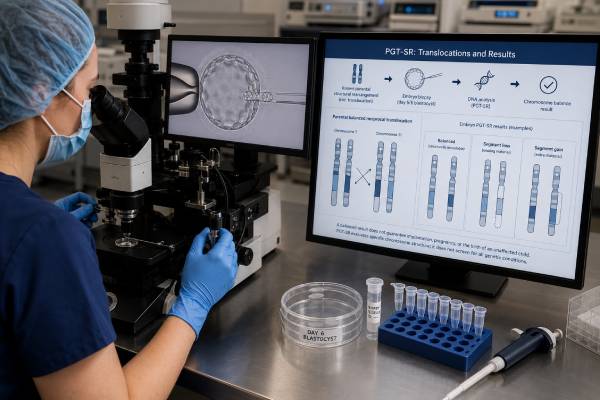
Preimplantation genetic testing for structural rearrangements, or PGT-SR, examines IVF embryos for chromosome gains and losses related to a known parental translocation, inversion, or other structural rearrangement. A carrier can be healthy because the rearrangement is balanced, meaning no major chromosome material is visibly missing or duplicated. During egg or sperm formation, however, the rearranged chromosomes can separate unevenly and produce embryos with an unbalanced result.
PGT-SR is intended to reduce transfer of embryos with those unbalanced combinations. It does not guarantee a normal embryo, pregnancy, or live birth, and many cycles produce fewer transferable embryos than patients expect. Standard copy-number PGT-SR often groups truly normal embryos with embryos carrying the same balanced rearrangement as the parent. More advanced haplotype or breakpoint-based methods may distinguish them, but only when the laboratory validates that capability for the family. Maternal age also adds unrelated whole-chromosome aneuploidy risk. Before IVF, the genetics laboratory should review the exact karyotype, define what the assay can detect, and explain whether prenatal diagnosis will still be recommended.
- PGT-SR tests embryos for unbalanced chromosome material caused by a known parental structural rearrangement.
- A balanced-carrier parent may be healthy but can produce normal, balanced, or unbalanced embryos.
- Reciprocal translocation carriers often have a lower proportion of transferable embryos than Robertsonian translocation carriers.
- Standard PGT-SR may not distinguish a normal embryo from a balanced-carrier embryo.
- A “normal/balanced” result does not exclude unrelated aneuploidy, small variants, or every birth defect unless those analyses were included.
- CVS or amniocentesis should be discussed after transfer because embryo biopsy is not a fetal diagnostic test.
Table of Contents
- Why Balanced Rearrangements Create Unbalanced Embryos
- Which Karyotype Findings Lead to PGT-SR
- How the Laboratory Designs and Performs PGT-SR
- Normal, Balanced, Unbalanced, and Inconclusive Results
- Estimating the Number of Transferable Embryos
- Transfer, Prenatal Diagnosis, and Family Testing
- Limitations, Costs, and Decisions Before IVF
Why Balanced Rearrangements Create Unbalanced Embryos
Chromosomes are long packages of DNA. A structural rearrangement forms when chromosome segments break and rejoin in a different configuration. If all major material remains present, the result may be balanced. The carrier often has typical development and health, although a breakpoint can occasionally disrupt a gene or a small imbalance may escape standard karyotype detection.
The reproductive issue appears during meiosis, when eggs or sperm receive one set of chromosomes. Normal chromosome pairs align in a straightforward way. Rearranged chromosomes may need to form a three- or four-part structure to match corresponding regions. Several separation patterns are possible.
A gamete may receive:
- A normal chromosome set
- The same balanced arrangement as the carrier parent
- A duplication of one chromosome segment and deletion of another
- A whole-chromosome gain or loss in some Robertsonian rearrangements
- A more complex combination when three or more chromosomes are involved
After fertilization, an unbalanced embryo may stop developing, fail to implant, miscarry, or continue with congenital anomalies and developmental disability. The outcome depends on which segments are gained or lost and how large they are. Some imbalances are not compatible with pregnancy; others can result in a liveborn child.
Reciprocal translocations exchange segments between two nonhomologous chromosomes. During meiosis, the four relevant chromosome pieces align in a quadrivalent. Alternate segregation can produce normal or balanced gametes, while adjacent and more complex segregation patterns produce imbalance.
Robertsonian translocations join the long arms of two acrocentric chromosomes, usually chromosomes 13, 14, 15, 21, or 22. A carrier commonly has 45 chromosomes but no important loss of coding material. Unbalanced conceptions can include trisomy or monosomy for the involved chromosomes. A rob(14;21) carrier, for example, may have an embryo with translocation trisomy 21.
Inversions reverse a segment within one chromosome. A paracentric inversion does not include the centromere; a pericentric inversion does. Recombination within the inverted segment can create duplications and deletions. Risk depends heavily on inversion size and breakpoint location. Some inversions have little measurable reproductive effect, so PGT-SR feasibility should be assessed rather than assumed.
Which Karyotype Findings Lead to PGT-SR
PGT-SR begins with a laboratory-confirmed parental chromosome result. Common pathways to diagnosis include recurrent pregnancy loss, infertility, an unbalanced result in miscarriage tissue, prenatal testing showing a fetal rearrangement, or a family member known to carry a translocation.
A standard blood karyotype usually provides the chromosome numbers and breakpoints. The report may look like 46,XX,t(4;11)(q21;q23) for a reciprocal translocation or 45,XY,rob(13;14)(q10;q10) for a Robertsonian translocation. The PGT laboratory needs the original report, not only a patient description such as “balanced translocation.”
PGT-SR may be considered for:
- Balanced reciprocal translocations
- Robertsonian translocations
- Pericentric or paracentric inversions with a meaningful predicted imbalance risk
- Insertional translocations
- Complex chromosome rearrangements involving several breakpoints
- Some marker chromosomes or derivative chromosomes after detailed characterization
Not every karyotype finding is suitable. Common chromosome variants, such as certain heterochromatin differences, may not have established reproductive significance. A rearrangement may also be too small for the laboratory’s copy-number resolution. Breakpoints near chromosome ends or segments below the reporting threshold can limit detection.
If a miscarriage or fetus had an unbalanced rearrangement, comparing that result with both parental karyotypes can clarify the exact risk. Genetic testing of miscarriage tissue may show which unbalanced products are viable long enough to be recognized clinically.
A parental karyotype can be normal even when one embryo has a de novo structural change. PGT-SR is generally designed for a recurring, defined parental rearrangement, not for a random fetal event with low recurrence. Germline mosaicism and cryptic rearrangements may require specialist review.
Before treatment, a genetic counselor should explain natural-conception outcomes as well as IVF. Many balanced carriers can have a healthy pregnancy without PGT-SR. The alternatives include natural conception with CVS or amniocentesis, donor gametes, embryo donation, adoption, or no further pregnancy attempts. PGT-SR reduces a specific embryo risk but brings IVF burdens and may not increase cumulative live birth for every couple.
How the Laboratory Designs and Performs PGT-SR
The genetics laboratory first evaluates whether the expected unbalanced segments are large enough for its assay. It reviews breakpoints, the carrier’s sex, family history, and any prior pregnancy results. Some cases need fluorescence in situ hybridization, chromosomal microarray, optical genome mapping, or sequencing to define the rearrangement more precisely before embryo testing.
The IVF process includes ovarian stimulation, egg retrieval, fertilization, blastocyst culture, trophectoderm biopsy, and vitrification. Several cells are removed from the outer blastocyst layer. Their DNA is amplified and analyzed while the embryo remains frozen.
Most PGT-SR uses genome-wide copy-number analysis. The laboratory looks for extra or missing chromosome segments associated with the rearrangement and usually evaluates unrelated whole-chromosome aneuploidies at the same time. A result without detected imbalance may be called normal/balanced, euploid for the tested regions, or transferable.
Copy-number analysis alone cannot see a balanced rearrangement because the total amount of DNA is unchanged. To distinguish normal embryos from balanced carriers, the laboratory needs another strategy, such as:
- Single-nucleotide polymorphism haplotyping linked to the rearranged chromosomes
- Breakpoint-spanning sequencing when the exact junction is known
- Long-read or low-coverage sequencing methods that map chromosome structure
- Family-based linkage using samples from relatives or previous pregnancies
This distinction may matter to parents who want to avoid passing the reproductive issue to the next generation. It does not usually change childhood health when the rearrangement is truly balanced. Refusing balanced-carrier embryos can also reduce the chance of transfer, so the choice deserves discussion before assay design.
PGT-SR resolution is not unlimited. A laboratory may reliably detect imbalances above a stated size, such as several megabases, while smaller changes may be below threshold. The relevant size depends on platform, DNA quality, chromosome location, and validation. Patients should ask for the case-specific detectable region rather than a general brochure number.
Quality controls address contamination, DNA amplification failure, and sample identity. Embryo identifiers must remain consistent across biopsy, shipping, reporting, storage, and transfer. The final report should state the assay, resolution, limitations, and whether normal-versus-balanced distinction was attempted.
Normal, Balanced, Unbalanced, and Inconclusive Results
PGT-SR terminology varies. A result should be understood in relation to the known rearrangement and any simultaneous aneuploidy screening.
| Result | Usual meaning | Important limitation |
|---|---|---|
| Normal | No rearrangement or related imbalance was detected, when the assay can distinguish normal from balanced. | Does not exclude all genetic disorders or small changes below resolution. |
| Balanced carrier | The embryo appears to carry the parental rearrangement without detected gain or loss. | Usually healthy but may face similar reproductive issues as an adult. |
| Normal/balanced | No unbalanced copy-number change was found, but the method cannot separate normal from balanced. | The child could inherit the parental rearrangement. |
| Unbalanced | A duplication, deletion, or chromosome-number change related to the rearrangement was detected. | Severity cannot always be predicted from the embryo biopsy alone. |
| Aneuploid, unrelated | A chromosome abnormality not directly caused by the parental rearrangement was found. | Risk rises with egg age and can occur in any IVF cohort. |
| Mosaic | An intermediate copy-number signal suggests mixed cell populations or assay uncertainty. | The sampled trophectoderm may not represent the whole embryo. |
| No result | The laboratory could not issue a reliable classification. | The embryo is not proven unbalanced; rebiopsy or transfer without a result may be considered. |
“Transferable” is a clinic category, not a guarantee. A normal/balanced embryo can fail to implant or miscarry for reasons unrelated to the known rearrangement. It can also have a single-gene condition, de novo variant, or structural anomaly outside the test’s scope.
An unbalanced result should identify the gained and lost regions. Some reports show the derivative chromosome mechanism; others list only copy-number coordinates. Genetic counseling can connect the result to the parental karyotype and explain whether similar imbalances were found in prior pregnancies.
Mosaic calls deserve separate review. An intermediate signal involving the rearranged segments may represent true embryonic mosaicism, a mixture in the biopsy, or technical noise. A clinic should not apply a generic mosaic-transfer policy without considering the specific duplicated and deleted regions.
A no-result embryo may be thawed and rebiopsied, but this adds another manipulation, freeze, and warming step. Transfer without a result is another option when the couple accepts prenatal diagnosis. Embryo quality and clinic policy influence the choice.
Estimating the Number of Transferable Embryos
PGT-SR cycles often produce a smaller transferable pool than ordinary IVF because embryos must pass several filters: develop to blastocyst, have no unbalanced product of the rearrangement, avoid unrelated aneuploidy, survive biopsy and warming, and meet clinic quality criteria.
Large datasets suggest that roughly one quarter of tested blastocysts from reciprocal translocation carriers may be normal or balanced, while Robertsonian translocation carriers may have a higher average proportion. These are population averages, not predictions for one couple. Rates vary by the exact chromosomes, breakpoints, carrier sex, maternal age, and laboratory reporting.
Reciprocal translocations can generate many segregation products. Robertsonian translocations involve fewer chromosome arms and often yield a larger normal/balanced fraction, though certain rearrangements carry specific viable trisomy risks. Inversions vary widely; a small inversion may produce few recombinant embryos, while a large inversion can create substantial imbalance risk.
The carrier’s sex can affect embryo distribution because abnormal sperm or eggs may be selected differently during development. Maternal age independently lowers the euploid fraction through nondisjunction. A 28-year-old translocation carrier and a 41-year-old carrier with the same karyotype may have similar rearrangement-related risks but very different unrelated aneuploidy rates.
A realistic estimate starts with expected mature eggs, fertilization, and blastocyst formation, then applies a broad normal/balanced range. For example, ten mature eggs may yield only three blastocysts. If one quarter are normal/balanced on average, that cohort may contain zero, one, or more transferable embryos. The average does not ensure one embryo.
Several retrievals may be needed, especially with low ovarian reserve or a complex rearrangement. Embryo banking can increase the total cohort before transfer, but it adds cost and delays pregnancy. The team should compare this strategy with natural conception and prenatal diagnosis, including the couple’s prior live births and losses.
Claims that PGT-SR “prevents miscarriage” should be qualified. It can reduce transfer of embryos with detected unbalanced rearrangements, but miscarriage can still result from unrelated aneuploidy, uterine factors, placental problems, or other causes. Cumulative live birth and time to live birth are more informative than the proportion of positive pregnancy tests.
Transfer, Prenatal Diagnosis, and Family Testing
Embryo transfer usually occurs in a later frozen cycle. When several normal or balanced embryos are available, the clinic may rank them by blastocyst development and morphology. Single-embryo transfer minimizes twin pregnancy risk.
Prenatal diagnostic testing should be offered after pregnancy because PGT-SR analyzes a few trophectoderm cells and has a small residual error risk. CVS samples placenta in the first trimester; amniocentesis samples amniotic-fluid cells later. The prenatal laboratory should receive the parental karyotype and PGT-SR report so it can choose the correct method.
A fetal karyotype can show whether the pregnancy is normal, balanced, or unbalanced. Chromosomal microarray can define gains and losses but generally cannot identify a balanced translocation. If normal-versus-balanced status matters, karyotyping or a targeted structural assay is needed. A prenatal karyotype may therefore be more informative than microarray alone for a known balanced rearrangement.
Cell-free DNA screening is not a substitute for diagnostic testing of a familial translocation. Standard cfDNA focuses on common whole-chromosome aneuploidies and may not detect the specific segmental imbalance. Even genome-wide cfDNA remains a screening test based on placental DNA.
If a child inherits a balanced rearrangement, testing in childhood may or may not be medically necessary. Some families defer until the child can participate in the decision, unless the rearrangement has possible health implications. Documentation should be preserved so the child can receive reproductive counseling later.
When a balanced rearrangement is found in one parent, siblings and other relatives may also be carriers. Cascade testing is optional but can clarify reproductive risks before pregnancy. A genetics professional can identify which relatives are biologically at risk without pressuring them to test.
Limitations, Costs, and Decisions Before IVF
PGT-SR is highly targeted to large chromosome imbalances. It does not read all genes, reliably detect every small copy-number change, or guarantee that the embryo’s inner cell mass matches the biopsy. Balanced rearrangements can be invisible to copy-number methods, and embryo mosaicism can create discordance.
Costs may include karyotype clarification, genetic counseling, assay review or custom development, IVF medication, retrieval, ICSI, embryo biopsy, analysis, freezing, storage, and frozen transfer. Insurance may cover testing for a defined chromosome risk while excluding IVF, or the reverse. Written estimates should include what happens if no blastocyst is available.
Before treatment, ask:
- What exact rearrangement is present, and is it truly balanced?
- Which possible duplications and deletions can the assay detect?
- What is the smallest reportable segment for this case?
- Will the test distinguish normal embryos from balanced carriers?
- Is unrelated aneuploidy screening included?
- What normal/balanced rate is expected for this rearrangement and maternal age?
- How often does the laboratory report mosaic or no-result findings?
- Will the clinic transfer a balanced-carrier, mosaic, or untested embryo?
- What prenatal diagnostic test will be recommended?
- How do cumulative live-birth expectations compare with natural conception?
The most useful PGT-SR plan is built around the exact karyotype rather than the broad word “translocation.” It should define what the laboratory can see, what it cannot distinguish, how many embryos may realistically remain, and what the family would do with each result category. That preparation turns a technically complex test into a clearer reproductive choice.
References
- Preimplantation genetic testing for structural rearrangements using a haplotype-based approach to distinguish embryos with normal karyotypes from balanced translocation carriers 2024 (Review)
- Analysis of clinical outcomes and meiotic segregation modes following preimplantation genetic testing for structural rearrangements using aCGH/NGS in couples with balanced chromosome rearrangement 2022 (Review)
- PGT for structural chromosomal rearrangements in 300 couples reveals specific risk factors but an inter-chromosomal effect is unlikely 2023 (Review)
- Preimplantation genetic testing in couples with balanced chromosomal rearrangement: a four-year retrospective multicenter study 2024 (Review)
- Robust evidence reveals the reliable rate of normal/balanced embryos for identifying reciprocal translocation and Robertsonian translocation carriers 2024 (Review)
- Impact of Chromosomal Structural Rearrangements on IVF Laboratory Outcomes in PGT-SR Cycles: A Propensity Score-Matched Study 2025 (Review)
Disclaimer
This article provides general information and does not replace case-specific reproductive genetics or IVF advice. PGT-SR feasibility, resolution, transferable-embryo rates, and recurrence risks depend on the exact rearrangement, maternal age, assay, and laboratory policy. Review the original karyotype and full embryo report with qualified specialists before transfer or embryo-disposition decisions.