Quaker bonnet, botanically known as Baptisia australis, is a striking North American perennial better known in authoritative plant references as blue false indigo or blue wild indigo. It belongs to the bean family and has a long history as a dye plant, a pollinator-friendly ornamental, and a source of traditional Indigenous and folk uses. That history can make it sound like a straightforward medicinal herb, but the modern picture is more complicated. Unlike better-studied herbal staples, Baptisia australis is not supported by strong human clinical research, and its chemistry includes compounds that raise real safety questions when the plant is taken internally.
That does not mean the plant is irrelevant. It has meaningful ethnobotanical value, distinctive alkaloid chemistry, and a small body of toxicology and phytochemical research that helps explain both its historical use and its risks. The most helpful way to understand quaker bonnet is not as a casual wellness herb, but as a plant with limited medicinal evidence, notable bioactive compounds, and a narrower safety margin than many readers expect.
Key Facts
- Historical use points to mild antimicrobial and immune-related interest, but direct human evidence for Baptisia australis is weak.
- External or short-term traditional use is more plausible than unsupervised internal use, especially because toxicity concerns rise with larger amounts.
- No evidence-based oral self-care dose in g, mL, or drops has been established for Baptisia australis.
- Avoid home use if you are pregnant, breastfeeding, taking nicotine-acting medicines, or considering fresh root, seed, or concentrated homemade preparations.
Table of Contents
- What Quaker Bonnet Is and Why the Name Matters
- Key Ingredients and Medicinal Properties of Quaker Bonnet
- Potential Health Benefits and What the Evidence Actually Supports
- Traditional and Modern Uses of Baptisia australis
- Why Dosage Is Uncertain and What Cautious Practice Looks Like
- Common Mistakes Identification Problems and When Not to Self-Experiment
- Safety Side Effects Interactions and Who Should Avoid It
What Quaker Bonnet Is and Why the Name Matters
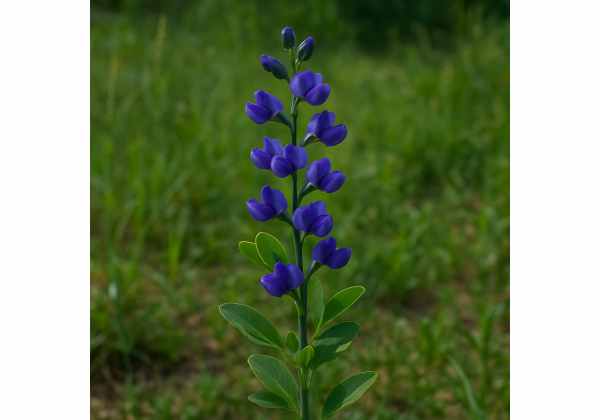
Baptisia australis is a long-lived herbaceous perennial native to parts of eastern and central North America. It belongs to the Fabaceae family, the same broad family that includes peas, beans, and lupins. In the garden, it is admired for its upright stems, blue-violet pea-like flowers, bluish green foliage, and charcoal-black seed pods. It is one of the most durable native perennials in ornamental horticulture, but when the discussion shifts from landscaping to herbal use, precision becomes much more important.
The first issue is the common name. The title here uses “quaker bonnet,” but the standard common names recognized in major U.S. plant references are blue false indigo, blue wild indigo, false indigo, and wild indigo. That matters because uncommon names can blur the plant’s identity and make it harder to distinguish from other species or from unrelated traditional remedies. In herbal writing, naming confusion often leads to medicinal claims being transferred from one plant to another without enough botanical care.
The second issue is species confusion within the Baptisia genus. Many medicinal claims tied to “wild indigo” in older North American herbal literature refer more often to Baptisia tinctoria than to Baptisia australis. The two plants are related, and some older writers treated them as broadly similar, but they are not identical. B. tinctoria has a much stronger footprint in older herbal and Eclectic medicine sources, while B. australis is better documented as an ornamental, dye source, and ethnobotanical plant. That means a careful article on quaker bonnet should not automatically import every historic “wild indigo” claim and present it as established specifically for B. australis.
The third issue is safety. Although garden databases often classify the plant as a low-severity poison if eaten in quantity, that does not mean it is a free-use herb. All parts of the plant are considered poisonous when ingested in sufficient amounts, and toxicology reports point to alkaloid-related effects involving the gut and nervous system. So while quaker bonnet may look calm and decorative in the border, it is not a casual edible or a forgiving self-treatment herb.
It is best understood through three lenses:
- as a native ornamental and dye plant,
- as a plant with documented ethnobotanical and historical medicinal use,
- as a bioactive species whose safety profile is more important than its popular herbal reputation.
That framing keeps expectations realistic. Readers looking for a gentle daily immune herb will usually do better with something like echinacea for immune support, which has much more direct modern herbal visibility and product standardization. Quaker bonnet belongs in a more cautious category: historically interesting, chemically active, and not well suited to casual home experimentation.
Key Ingredients and Medicinal Properties of Quaker Bonnet
The medicinal profile of Baptisia australis begins with its alkaloid chemistry. Like other members of the broader Baptisia and quinolizidine-alkaloid-producing legume group, it contains compounds that function as plant defense chemicals. These are not mild culinary phytochemicals. They are biologically active molecules that help explain both the plant’s historical medicinal interest and its toxic potential.
The best-known compound associated with Baptisia toxicology is cytisine, a quinolizidine alkaloid that acts on nicotinic acetylcholine receptors. In pharmacology, cytisine is a serious molecule. It has even been developed in purified form for smoking cessation in regulated medical contexts. That does not make the plant itself safe to self-dose. In raw plant material, cytisine-type activity contributes to the risk of nausea, vomiting, weakness, dizziness, ataxia, and other signs of nicotinic toxicity after ingestion.
Another named toxic principle often listed in plant references is baptisin. In practical terms, this means that older herbal descriptions of quaker bonnet as bitter, stimulating, emetic, or purgative were not imagining an inert root. The plant’s bitter and physiologically active reputation reflects real chemistry, even if the exact profile varies by plant part, maturity, and preparation.
Older phytochemical work on Baptisia australis also points to triterpenoid-type constituents in the roots, alongside the alkaloid-centered chemistry that dominates safety discussions. In addition, the plant’s deep taxonomic relationship to other bioactive legumes suggests a chemically complex profile rather than a single active compound. Still, when it comes to practical herbal use, the alkaloids matter most because they shape the risk profile.
These constituents help explain several traditional medicinal properties historically attributed to Baptisia plants:
- bitter tonic action,
- emetic and purgative action in stronger preparations,
- possible immune-signaling or antimicrobial interest,
- topical cleansing or astringent use in washes and mouth preparations.
The problem is that pharmacological plausibility is not the same as safe modern use. A plant can have immune-active or antimicrobial interest and still be a poor candidate for unsupervised self-care. Quaker bonnet fits that description well. Its chemistry suggests that the plant can do something, but it does not prove that it can do it safely or predictably in home herbal practice.
This is where comparisons become useful. Readers who want gentle topical support often do better with calendula for skin support, because calendula’s tradition and safety profile are much easier to work with. By contrast, quaker bonnet’s chemistry pushes it toward caution. The same compounds that make the plant medicinally intriguing also narrow the margin between “possibly active” and “not a good idea for self-treatment.”
That is the central truth of its ingredients profile. Baptisia australis contains real bioactive compounds, but the most important thing those compounds tell us is not that the plant is broadly useful. They tell us that the plant deserves respect, restraint, and very careful interpretation.
Potential Health Benefits and What the Evidence Actually Supports
When people search for the health benefits of quaker bonnet, they often expect the same kind of answer they might get for chamomile, ginger, or peppermint. That expectation does not fit the evidence. The strongest honest answer is that Baptisia australis has historical medicinal use and interesting chemistry, but very limited direct modern clinical evidence for safe everyday benefit.
The first potential benefit category is traditional infection and immune support. Older North American herbal traditions associated Baptisia plants with sore throats, mouth complaints, septic or putrid-feeling infections, and low-vitality states. In later herbal traditions, “wild indigo” became linked with throat formulas, mouth rinses, and mixed immune products. The complication is that many of these claims attach more clearly to Baptisia tinctoria or to mixed formulas than to modern human studies on B. australis itself. So while the historical record exists, the species-specific evidence remains thin.
The second category is topical cleansing and surface support. Some traditional uses involved washes, poultices, or topical preparations for irritated tissues. This is more plausible than casual internal dosing because external use lowers systemic exposure. Even so, modern clinical proof is lacking, and the best way to describe this area is as historically plausible rather than strongly established.
The third category is bitter digestive and purgative action. This appears in historical records, but it is not a modern health advantage. A plant that can provoke nausea or purging is not automatically beneficial simply because it is active. In current practice, this old use is more relevant as a warning than as a recommendation.
A fourth category involves antimicrobial and immune-signaling potential inferred from related Baptisia research and older laboratory work. This is one reason quaker bonnet still appears in some herbal discussions. But it is essential to keep the scale of the evidence in view. A plant may have interesting immune-related chemistry without being appropriate for routine self-treatment. If the goal is evidence-aligned immune support, people generally have clearer options than quaker bonnet, including echinacea with better-defined modern immune use.
So what does the evidence really support?
- It supports the plant’s historical medicinal significance.
- It supports the presence of bioactive compounds that could explain those traditions.
- It supports concern about toxicity after ingestion.
- It does not strongly support routine modern oral use for infections, immunity, digestion, or daily wellness.
This may feel unsatisfying, but it is clinically useful. Not every medicinal plant with a history deserves a modern wellness recommendation. Some plants belong more in the categories of ethnobotany, pharmacognosy, and toxicology than in the everyday supplement shelf.
For quaker bonnet, the most balanced conclusion is this: the plant may have limited health-related potential rooted in older traditions and bioactive chemistry, but its evidence base is too weak and its safety profile too uncertain to promote it as a standard self-care herb. Its “benefits” are best described as historical, tentative, and secondary to the larger question of whether it should be used at all without expert oversight.
Traditional and Modern Uses of Baptisia australis
The uses of Baptisia australis are broader than medicine, and that broader context actually helps make sense of the plant. Quaker bonnet is not just an herb. It is also an ornamental perennial, a dye plant, a pollinator resource, and a historical cultural species. In fact, its non-medicinal uses are often clearer and better supported than its internal herbal uses.
The strongest modern use is ornamental and ecological. Blue false indigo is widely grown in native and pollinator gardens because it is drought tolerant, long-lived, handsome through several seasons, and attractive to bees and butterflies. It also contributes nitrogen to the soil as a legume. These are not health benefits in the usual supplement sense, but they are real plant uses and part of why B. australis remains valued.
The second major use is dye. Historical records describe B. australis as a source of blue dye for clothing and related practical applications, especially in Indigenous and early settler contexts. The name “false indigo” comes from this role. It was not equal to true indigo, but it was important enough to shape the plant’s identity. This use is still relevant to ethnobotanical history and natural dye traditions.
The third use is traditional medicine, which should be understood carefully. Historical sources describe teas, tooth-related applications, eyewashes, and preparations used differently depending on whether they were hot or cold. This diversity shows that the plant was regarded as active and worthy of respect. It does not mean those uses should be copied directly in modern home practice. Traditional use tells us the plant mattered. It does not automatically prove safety or effectiveness under present-day standards.
In more recent herbal thinking, Baptisia species have sometimes appeared in formulas aimed at mouth-throat complaints, low-grade infections, or “toxic” constitutional pictures. Again, much of that literature centers on Baptisia tinctoria, not specifically on B. australis. That distinction should be kept visible whenever the plant is marketed medicinally.
A practical way to think about current uses is to divide them into three tiers:
- Clear and appropriate uses
ornamental planting, native landscaping, pollinator support, and historical dye interest - Historically meaningful but cautious uses
ethnobotanical teas, mouth applications, and traditional external preparations - Weak or risky modern uses
casual immune support, homemade tinctures, infection self-treatment, or unsupervised internal dosing
That hierarchy matters. A plant can be culturally valuable and scientifically interesting without being a good everyday herb. Quaker bonnet is a good example.
If someone wants a plant with a clearer modern place in skin care or simple external herbal use, calendula for topical support is far easier to justify than quaker bonnet. Baptisia australis has a more specialized role. Its main modern value lies in horticulture and history, while its medicinal use remains narrow, cautious, and better suited to professional or academic interest than to home experimentation.
Why Dosage Is Uncertain and What Cautious Practice Looks Like
Dosage is the section where quaker bonnet differs most sharply from ordinary “benefits and uses” herbs. For Baptisia australis, there is no well-established, evidence-based oral self-care dose supported by modern clinical research. That is not a gap to paper over with guesswork. It is one of the central facts readers need to know.
Historical records show that the plant was prepared as teas and other remedies, sometimes with very different effects depending on temperature and preparation. A hot tea was used one way, a cold tea another. That kind of variation tells us something important: the plant was treated as potent, not casual. It also tells us that traditional use was contextual and practitioner-informed in ways that are hard to reproduce safely from fragments of old herb lore.
Modern consumers often expect herbs to come with a neat range such as “300 to 500 mg twice daily.” Quaker bonnet does not fit that pattern. Even when related Baptisia preparations appear in historical tincture traditions, they are usually treated as low-dose or narrowly dosed substances rather than broad-use tonics. That alone is a signal that self-dosing is a poor match for this plant.
The most responsible practical guidance is simple:
- there is no validated oral self-care dose for Baptisia australis,
- fresh root, seed, and concentrated homemade extracts should not be self-tested,
- external handling is very different from internal dosing,
- product identity matters because Baptisia species are often conflated.
So what does cautious practice look like in the real world?
First, it means recognizing that the safest default dose for unsupervised internal use is none. That may sound restrictive, but it is clearer and more useful than offering an invented range. The plant’s alkaloid content, poisoning case reports, and weak human evidence do not support a do-it-yourself dosing culture.
Second, it means understanding that historical use does not equal modern dosage guidance. A plant can have a long past and still lack a present-day safe oral framework.
Third, it means preferring non-medicinal engagement with the plant when possible. Growing it, studying it, appreciating its dye history, or using it as a pollinator perennial are much lower-risk ways to value quaker bonnet than trying to turn it into a household internal remedy.
Fourth, it means being careful with the tendency to substitute. Some herbal discussions treat B. australis as interchangeable with B. tinctoria. That is not a solid basis for home dosing. Species substitution can change both activity and safety.
If someone is seeking a better-defined respiratory or infection-support herb, a gentler and more traditionally aligned option such as mullein for respiratory support will generally make more sense than experimenting with a toxic legume. Quaker bonnet is simply not a plant where “start low and see how you feel” is wise advice.
That is the clearest dosage conclusion: uncertainty here is not a minor editorial gap. It is a safety message.
Common Mistakes Identification Problems and When Not to Self-Experiment
Most problems around quaker bonnet do not begin with complicated toxicology. They begin with ordinary mistakes: confusing species, trusting folklore without context, assuming ornamental plants are automatically mild, or treating a low-severity poison label as a sign of safety.
The first common mistake is species confusion. People read about “wild indigo” and assume all Baptisia species have the same medicinal value. They do not. Baptisia australis and Baptisia tinctoria are related, but they are not interchangeable in a casual way. When an herb already has a thin evidence base, mixing species makes the information even less reliable.
The second mistake is misreading the word low in toxicity summaries. Some horticultural sources describe B. australis as low-severity poison if eaten in quantity. Readers sometimes turn that into “basically safe.” That is the wrong interpretation. Low severity in a gardening database does not mean pleasant, beneficial, or appropriate for self-medication. It means the plant is not ranked with the most catastrophic ornamentals. It still contains toxic principles, and real poisoning cases show that neurologic and gastrointestinal effects are possible.
The third mistake is foraging or tasting without context. Young Baptisia growth has been mistaken for edible plants, including asparagus-like shoots in poisoning reports. This is a practical reminder that ornamental and native plants should not be tasted casually just because they look familiar or springlike. That rule matters especially for children, beginner foragers, and anyone harvesting mixed spring growth.
The fourth mistake is borrowing strong herbal claims from weaker sources. A person may see claims that quaker bonnet “boosts immunity,” “fights infection,” or “cleanses the blood,” then assume the plant works like a modern supplement. Those phrases mostly come from historical herbal language or from related Baptisia traditions. They do not amount to a reliable self-care prescription.
The fifth mistake is ignoring better options. If the goal is mild topical astringency, there are easier plants to work with, including witch hazel for topical astringency. If the goal is throat support, there are gentler herbs. If the goal is immune support, there are better-studied products. Quaker bonnet becomes attractive mostly when people romanticize rarity, danger, or historical lore.
There are also situations where self-experimentation is especially unwise:
- if the plant is homegrown but the species label is uncertain,
- if the intended use is internal rather than external,
- if the preparation is homemade and concentrated,
- if the person taking it uses regular medications,
- if the target symptom is significant infection, fever, dehydration, or neurologic change.
In short, quaker bonnet is a plant where mistakes come easily and benefits are uncertain. The safest mindset is not “how can I make this work medicinally?” but “do I really need to use this medicinally at all?” In most self-care situations, the answer is no.
Safety Side Effects Interactions and Who Should Avoid It
Safety is the most important section in any article on Baptisia australis. The plant’s medicinal uncertainty would already justify restraint, but its toxicology makes restraint even more important. A helpful safety section should be plain: all parts of the plant can be poisonous if ingested in sufficient amounts, and symptoms can involve both the digestive system and the nervous system.
The most common expected effects are nausea, vomiting, and diarrhea. These are the symptoms most often listed in plant safety references, and they align with the plant’s older reputation as an emetic or purgative in stronger preparations. In other words, historical “activity” and modern side-effect descriptions are telling the same story from different angles.
More concerning signs may include weakness, dizziness, ataxia, sweating, and other nicotinic-type symptoms, especially after meaningful exposure. This is where cytisine matters. Because cytisine acts on nicotinic acetylcholine receptors, poisoning is not just a matter of an upset stomach. It can also involve neurologic disturbance and altered motor control.
Interactions are not as well mapped as they are for mainstream drugs, but caution is justified in several groups. People using smoking-cessation medicines, nicotine products, or other substances that affect the autonomic or nervous system should be particularly careful. The plant should also be avoided by those using complex medication regimens unless a knowledgeable clinician specifically advises otherwise.
The groups who should avoid quaker bonnet altogether for self-treatment include:
- pregnant people,
- breastfeeding people,
- children,
- anyone with a history of severe nausea or plant poisoning,
- people with neurologic disorders,
- people using nicotine-acting or centrally active medicines,
- anyone considering concentrated root, seed, or fresh-plant preparations.
External contact is not the same as ingestion, and the plant is not chiefly known for causing contact dermatitis. Even so, topical use should remain cautious, especially on broken skin or mucous membranes, because the plant is not a well-standardized topical remedy.
Another safety point is diagnostic timing. A person with sore throat, mouth inflammation, or fatigue may be tempted by historical “wild indigo” language. But symptoms serious enough to make someone consider a potent, bitter, potentially toxic herb are often symptoms that deserve proper medical evaluation instead. Quaker bonnet should never delay care for dehydration, persistent vomiting, high fever, confusion, severe infection, or breathing difficulty.
The most useful final safety message is simple. Quaker bonnet is a plant to respect more than to consume. Its ornamental, ecological, and historical value are real. Its internal self-care value is far less certain. When a plant offers unclear benefit, unclear dose, and clear toxicity concerns, the safest modern conclusion is not cautious enthusiasm. It is caution, full stop.
References
- Development of phytochemical genomics: From decoding metabolome to functional genomics and biotechnology of plant metabolism – PMC 2025. (Review)
- Quinolizidine-Type Alkaloids: Chemodiversity, Occurrence, and Bioactivity – PubMed 2023. (Review)
- Development of an HPLC-MS/MS Method for the Determination of Alkaloids in Lupins – PMC 2023. (Analytical Study)
- Baptisia poisoning: a new and toxic look-alike in the neighborhood – PubMed 2015. (Case Report)
- BLUE WILD INDIGO 2006. (USDA Plant Guide)
Disclaimer
This article is for educational purposes only and is not medical advice. Baptisia australis is not a well-supported everyday self-care herb, and its chemistry includes toxic principles that can cause gastrointestinal and neurologic symptoms when the plant is ingested. Do not use quaker bonnet as a substitute for professional care for infection, mouth or throat inflammation, digestive symptoms, or any chronic condition. Seek guidance from a qualified healthcare professional or poison center if exposure occurs or if you are considering any medicinal use of this plant.
If you found this article useful, please consider sharing it on Facebook, X, or another platform you prefer.