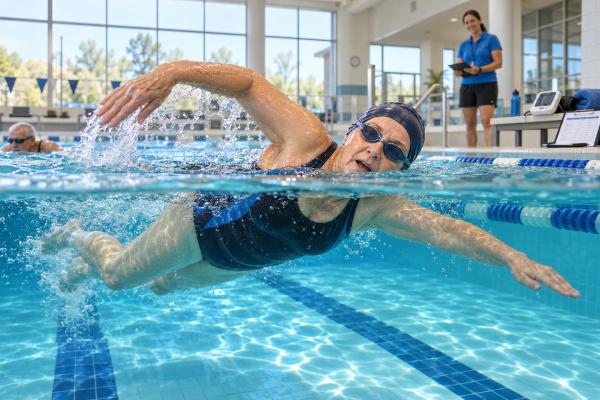
Swimming can be an excellent heart-healthy exercise because it trains the cardiovascular system while the water supports much of your body weight. Regular aerobic exercise helps lower blood pressure, improve cardiorespiratory fitness, increase endurance, and reduce long-term cardiovascular risk. Swimming can provide those benefits while placing less impact on the knees, hips, and ankles than running or many land-based workouts.
There is one important nuance: much of the strongest research on blood pressure and joint symptoms involves aquatic exercise—such as water walking, water aerobics, and pool-based interval training—rather than lap swimming alone. The overall evidence still supports water-based aerobic exercise as a useful option, but it is more accurate to view swimming as one way to meet proven aerobic-exercise goals, not as a uniquely superior treatment. The best routine is one you can perform safely, at an appropriate intensity, and often enough to build fitness over time.
Table of Contents
- How Swimming Supports Heart Health
- Swimming and Blood Pressure
- Why Water Exercise Is Joint-Friendly
- How Hard and How Long to Swim
- A Beginner Swimming Plan
- Safety With High Blood Pressure or Heart Disease
- How to Make Swimming a Sustainable Habit
How Swimming Supports Heart Health
Swimming is primarily an aerobic activity when you keep moving continuously or in repeated intervals. Your working muscles need more oxygen, so your heart pumps more blood and your breathing increases. With regular training, the cardiovascular system becomes more efficient.
Over time, aerobic training can improve:
- Cardiorespiratory fitness and endurance
- Resting and exercise blood pressure
- Insulin sensitivity and blood sugar control
- Triglycerides and other metabolic risk factors
- Exercise capacity for daily activities
- Weight management when paired with an appropriate diet
- Stress, sleep, and overall physical function
Higher cardiorespiratory fitness is strongly associated with lower cardiovascular and all-cause mortality. Swimming can help build that fitness because it uses large muscle groups in the arms, trunk, and legs for sustained periods.
The water itself changes circulation. Hydrostatic pressure—the pressure of water around the body—pushes blood from the limbs toward the chest. This increases central blood volume and can change heart rate, stroke volume, and blood pressure responses compared with the same effort on land. That is one reason your heart rate in the pool may not match what you expect from running or cycling at a similar perceived effort.
Swimming also gives you options. Continuous easy laps can function like steady aerobic training. Faster repeats with rest can create interval training. Water walking, aqua jogging, and water aerobics can provide cardiovascular work for people who do not swim confidently.
Because swimming uses the upper body more than walking or cycling, beginners may feel locally tired in the shoulders and back before the heart and lungs reach a sustained training load. That is normal. As technique and muscular endurance improve, it becomes easier to keep moving long enough for a stronger aerobic effect. This is one reason short repeats with planned recovery often work better than trying to force nonstop laps from day one.
Swimming can also be useful when heat makes outdoor exercise difficult. Water carries heat away from the body efficiently, so many people tolerate longer sessions in a pool than in hot weather. Even so, dehydration is still possible because sweat is less noticeable in water. Drink before and after longer sessions, and consider fluids during prolonged workouts.
For general heart health, the key target is not a specific stroke. It is accumulating enough moderate or vigorous aerobic activity each week. Current cardiovascular guidance continues to support at least 150 minutes per week of moderate-intensity aerobic activity or about 75 minutes of vigorous activity, with greater benefits possible at higher volumes.
If you prefer steady, conversational exercise, Zone 2 cardio for heart health offers another useful way to think about sustainable aerobic intensity.
Swimming and Blood Pressure
Regular aerobic exercise is one of the most effective lifestyle tools for blood pressure control. Contemporary hypertension guidelines report that aerobic exercise can lower systolic blood pressure by roughly 7–8 mmHg and diastolic pressure by about 4–5 mmHg in people with hypertension, although individual responses vary.
Water-based exercise appears to work as well. Recent reviews of aquatic exercise in people with hypertension have found meaningful reductions in systolic and diastolic blood pressure. A 2026 meta-analysis of nine randomized trials reported an average reduction of about 10.7 mmHg systolic and 5.9 mmHg diastolic compared with control conditions. Those numbers are encouraging, but they should not be interpreted as a guaranteed result from lap swimming because the included programs varied and often used water walking, calisthenics, mobility work, or aquatic intervals.
That distinction matters. The most accurate conclusion is:
Swimming is a reasonable aerobic exercise for blood pressure control, while the strongest pool-based evidence includes several forms of aquatic exercise, not swimming alone.
Blood pressure can also fall temporarily after a workout, a response called post-exercise hypotension. Repeating exercise regularly may help improve the average 24-hour blood pressure profile. This is one reason frequent moderate sessions can be useful rather than concentrating all exercise into one day.
If you have hypertension, consistency matters more than swimming as hard as possible. A moderate 30-minute swim performed four or five days per week may be more useful and easier to sustain than one exhausting session followed by several inactive days.
Do not stop prescribed blood pressure medication because exercise is helping. Lifestyle changes and medication often work together. If home readings begin running lower after you become more active, share the log with your clinician so treatment can be adjusted safely if needed. For a broader exercise approach, see how exercise can lower blood pressure over time.
For home tracking, compare weekly averages rather than a single reading taken right after a swim. Exercise can temporarily change blood pressure, hydration, and body temperature. A more useful comparison is a calm reading taken under the same conditions on several nonconsecutive days. That makes it easier to see whether your overall trend is actually improving.
Why Water Exercise Is Joint-Friendly
Water reduces the amount of body weight your joints must support, which is why pool exercise can feel easier on the knees, hips, feet, and spine. Buoyancy lowers impact while water resistance still makes muscles work through each stroke or movement.
This can be especially helpful for people with:
- Knee or hip osteoarthritis
- Higher body weight that makes impact exercise uncomfortable
- Foot or ankle pain
- Reduced balance
- Deconditioning after a period of inactivity
- Difficulty tolerating running or brisk walking
Systematic reviews of aquatic exercise in knee osteoarthritis show improvements in pain, stiffness, and physical function compared with no exercise. In many analyses, water-based exercise is not clearly better than land-based exercise when both are tolerated. Its advantage is often comfort and feasibility: if the pool lets you exercise with less pain, you may be able to move longer or more consistently.
“Joint-friendly” does not mean that swimming cannot cause overuse problems. Freestyle, butterfly, and backstroke involve thousands of repeated shoulder movements. Poor technique, a rapid jump in yardage, or weak shoulder stabilizers can lead to swimmer’s shoulder. Breaststroke can irritate some knees because of its whip kick.
Choose the movement that fits your joints. Someone with knee pain may tolerate freestyle or backstroke better than breaststroke. Someone with shoulder pain may prefer water walking, aqua jogging, or a carefully modified pool program rather than forcing laps.
Aquatic exercise also does not provide the same bone-loading stimulus as walking, stair climbing, or resistance training. For complete fitness, it is useful to combine swimming with strength work and, when tolerated, some weight-bearing activity. Strength training for heart health and blood pressure can complement pool workouts well.
How Hard and How Long to Swim
A practical starting goal is 20–30 minutes of pool exercise, two to three days per week, then build toward the standard aerobic target of at least 150 minutes of moderate activity per week. You do not have to swim nonstop. Rest intervals count as part of a structured workout, and beginners often make faster progress by alternating work and recovery.
Use more than one measure of intensity because heart rate behaves differently in water.
The talk test
At moderate intensity, you should be breathing faster but still able to speak in short sentences. At vigorous intensity, talking becomes difficult and you may manage only a few words at a time. This is often the simplest method in the pool.
Rating of perceived exertion
On a 0–10 effort scale:
- 2–3: easy warm-up or recovery
- 4–6: moderate aerobic work
- 7–8: vigorous intervals
- 9–10: near-maximal effort, usually unnecessary for general heart health
Most beginners should spend most of their time around 4–6 rather than turning every lap into a race.
Heart rate
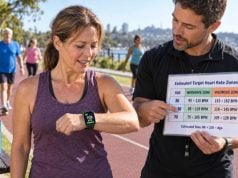
Age-predicted heart-rate zones can be helpful, but they are estimates. Water temperature, body position, stroke technique, fitness, and medications such as beta-blockers can alter heart rate. Wrist wearables may also be less reliable in the water depending on the device and stroke.
If you use heart-rate zones, combine the number with breathing and perceived effort rather than treating it as an exact target. target heart rate by age explains how to estimate zones and when the formulas become less useful.
| Workout level | Perceived effort | Breathing | Typical use |
|---|---|---|---|
| Easy | 2–3/10 | Comfortable | Warm-up, recovery, technique |
| Moderate | 4–6/10 | Faster but controlled | Most heart-health training |
| Vigorous | 7–8/10 | Deep, rapid breathing | Shorter intervals for fitter swimmers |
A Beginner Swimming Plan
If you can swim but have not trained regularly, begin with short repeats. This keeps technique from falling apart when you are tired and makes the session less intimidating.
A simple 30-minute session might look like this:
- Warm up for 5 minutes. Easy swimming, water walking, or alternating both.
- Swim 8–12 short repeats. Swim for 30–60 seconds at a comfortable-moderate pace, then recover for 30–60 seconds by resting or moving easily.
- Add 5–10 minutes of steady work. Swim easy continuous laps, use a kickboard only if it is comfortable for your shoulders and neck, or alternate swimming with water walking.
- Cool down for 5 minutes. Move slowly until breathing is close to normal.
When that feels comfortable, progress one variable at a time. Add a few minutes, increase the number of repeats, or slightly shorten the rest. Avoid increasing distance and intensity sharply in the same week.
A simple weekly structure for a new swimmer might include one easy technique-focused session, one moderate continuous or broken swim, and one mixed session with a few brisk intervals. Keeping at least one session clearly easy reduces the temptation to race every workout and helps protect the shoulders. If soreness lasts more than a day or changes your stroke mechanics, reduce volume and address technique before adding more distance.
A useful progression is to build duration before speed. Someone starting at 15 minutes may add 5 minutes every week or two until sessions reach 30–40 minutes. Once that volume feels routine, one session can include faster intervals.
Technique lessons can be a cardiovascular investment. Poor technique wastes energy, makes breathing stressful, and increases shoulder strain. A few sessions with a qualified instructor can help you learn relaxed exhalation, body position, and efficient strokes so your lungs or shoulders do not become the limiting factor before your cardiovascular system gets useful training.
If lap swimming is not comfortable, water aerobics and aqua jogging are valid alternatives. The heart responds to sustained muscular work, not to whether you are performing a formal swim stroke.
Safety With High Blood Pressure or Heart Disease
Most people can exercise safely in a pool, but swimming has features that deserve extra care if you have known cardiovascular disease, poorly controlled blood pressure, fainting, significant rhythm problems, or major exercise symptoms.
Water immersion shifts blood toward the chest. Cold water can also trigger a sudden rise in breathing, heart rate, and blood pressure. For people with cardiovascular disease, abrupt cold-water immersion is different from exercising in a temperature-controlled pool and can create more cardiovascular stress.
Use these precautions:
- Choose a supervised pool when you are new to exercise, have a medical condition, or are not a strong swimmer.
- Enter the water gradually rather than jumping into very cold water.
- Warm up for at least 5 minutes before harder laps.
- Avoid breath-holding contests or prolonged underwater swimming. These can cause dangerous loss of consciousness.
- Do not swim alone in open water if you have a history of fainting, serious arrhythmias, seizures, or unstable heart symptoms.
- Stop for chest pressure, unusual shortness of breath, faintness, or palpitations with weakness or dizziness. Seek urgent evaluation when symptoms suggest a heart problem.
People with uncontrolled hypertension should get individualized advice before vigorous exercise. European hypertension guidance notes that resting blood pressure above 200/110 mmHg is a relative contraindication to high-intensity exercise. Very high readings or symptoms such as chest pain, severe headache, neurologic symptoms, or shortness of breath need medical assessment rather than a hard workout.
If you have coronary artery disease, heart failure, a valve problem, an implanted cardiac device, or a recent cardiac event, ask your care team what intensity and water temperature are appropriate. Cardiac rehabilitation may be the safest place to establish exercise limits before you train independently.
How to Make Swimming a Sustainable Habit
The cardiovascular benefit comes from months and years of regular activity, so convenience matters. Choose a pool you can reach easily, identify quieter times, and keep goggles and swim gear ready. A perfect training plan that is hard to access is less useful than a simple plan you perform consistently.
Build your week around recovery as well as exercise. For example, you might swim Monday, Wednesday, and Saturday; strength train Tuesday and Friday; and walk on other days. This distributes the workload and gives shoulders time to recover.
Track progress with measures that matter: total comfortable swim time, number of laps at the same effort, shorter rest periods, improved technique, lower home blood pressure, or easier breathing during daily activities. Calorie estimates from pool watches are too imprecise to be the main scorecard.
For blood pressure, compare trends rather than single readings. Measure at similar times and under similar conditions, because exercise, caffeine, stress, sleep, and recent meals can all shift the result. If several weeks of consistent swimming coincide with lower home readings, that is useful information to bring to a medical visit. It does not prove that swimming caused every change, but it helps your clinician judge whether the overall plan is working.
If weight loss is a goal, remember that swimming can increase appetite in some people. Exercise supports energy balance and metabolic health, but it does not automatically create weight loss. A heart-healthy eating pattern still matters.
Finally, do not assume you need to become a fast swimmer. A moderate pool workout that leaves you energized enough to return two days later can be excellent cardiovascular training. Swimming is especially valuable when its low-impact environment removes a barrier that kept you from exercising on land. Combine it with strength training and some weight-bearing movement when possible, and it can become a durable part of a heart-healthy fitness routine.
References
- Effect of aquatic exercise on blood pressure and related physiological indicators in hypertensive patients: a systematic meta-analysis of randomized controlled trials. 2026 (Meta-analysis)
- Benefits of aquatic exercise in adults with and without chronic disease-A systematic review with meta-analysis 2022 (Systematic Review)
- Efficacy and safety of aquatic exercise in knee osteoarthritis: A systematic review and meta-analysis of randomized controlled trials 2023 (Systematic Review)
- Effects of Aquatic Exercise in Older People with Osteoarthritis: Systematic Review of Randomized Controlled Trials 2025 (Systematic Review)
- 2024 ESC Guidelines for the management of elevated blood pressure and hypertension 2024 (Guideline)
Disclaimer
This article is for general education and does not replace medical advice or an individualized exercise prescription. If you have uncontrolled high blood pressure, known heart disease, a serious rhythm disorder, fainting, or recent cardiovascular symptoms, ask your clinician about safe exercise intensity before starting a swimming program. Seek urgent care for chest pressure, severe breathing difficulty, fainting, or new neurologic symptoms during or after exercise.