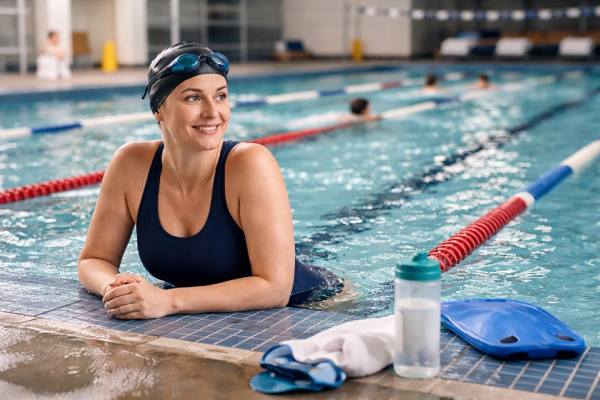
Swimming can be an excellent tool for weight loss, but it works best when you treat it like real training rather than casual time in the pool. It burns calories, challenges large muscle groups, and gives many people a low-impact way to do hard cardio without the pounding of running or jump-based workouts. It also has limits: technique matters, intensity varies a lot, and easy laps alone may not create enough training stress to change your body quickly.
This guide explains how swimming supports fat loss, what kinds of sessions are most effective, how to use sets and drills instead of just endless laps, and how to build a weekly plan that fits weight-loss goals without burning you out.
Table of Contents
- Can swimming help you lose weight?
- How many calories does swimming burn?
- What kind of swimming works best?
- Best swimming sets for fat loss
- Drills that improve results
- Weekly swimming plan for weight loss
- Common mistakes that slow progress
Can swimming help you lose weight?
Yes, swimming can help you lose weight, but not because water somehow melts fat faster than land-based exercise. It works for the same basic reason any effective cardio works: it raises energy expenditure, improves fitness, and can help you sustain the calorie deficit required for fat loss.
What makes swimming especially useful is the combination of resistance and cardio. You are moving your body against water, which is much denser than air, while also keeping your heart and lungs working continuously. That can make swimming feel like a full-body effort in a way that many machines do not. Arms, shoulders, back, chest, core, hips, and legs all contribute, especially when you swim continuously instead of stopping at every wall to chat or catch your breath.
Swimming is also attractive because it is low impact. For people with heavier body weight, sore joints, or a history of impact-related discomfort, that matters a lot. A hard swim session may feel tough on the lungs and muscles without beating up the knees and ankles the way running can. That gives many people a way to train hard enough for fitness and calorie burn without dreading recovery the next day.
Still, the important word is can. Swimming does not guarantee weight loss.
A few reasons swimmers sometimes stall include:
- They overestimate calorie burn from an easy session.
- They swim with long breaks and little sustained effort.
- They get hungry afterward and eat back the workout.
- They rely on swimming alone without looking at total food intake.
- Their technique is so inefficient that they fatigue early and cannot accumulate much work.
That last point is one of the biggest differences between swimming and more accessible cardio like brisk walking. A beginner can usually walk continuously for 30 minutes on day one. A beginner swimmer often cannot swim continuously for 10 minutes without losing rhythm, breath, or confidence. So swimming can be fantastic for fat loss, but it often works best after some technique improvement and basic conditioning.
This is why the smartest approach is to view swimming as one piece of a complete plan. It can cover a big share of your cardio. It can help you train consistently. But it still works better when paired with a realistic diet, plenty of daily movement, and at least some strength work. If you want the broader picture, a guide to effective exercise choices for weight loss can help place swimming in context rather than treating it like a miracle answer.
The other key point is adherence. Some people love the pool and will train there for years. Others find swimming inconvenient, technically frustrating, or hard to track. The best exercise for weight loss is not just the one with the highest theoretical calorie burn. It is the one you can perform hard enough, often enough, and consistently enough to matter.
So the honest answer is simple: swimming helps with weight loss when it turns into regular, purposeful training that supports a real calorie deficit.
How many calories does swimming burn?
Swimming can burn a lot of calories, but there is no single number that fits everyone. The calorie cost of a swim depends on body size, stroke choice, pace, efficiency, water temperature, rest intervals, and whether you are truly training or mostly floating between short efforts.
In practical terms, most people burn more when they:
- Swim continuously for longer blocks
- Use harder strokes or faster pacing
- Reduce idle time at the wall
- Improve technique enough to maintain pace
- Add structured intervals instead of random laps
Broadly speaking, a moderate swim session often lands somewhere in the same general calorie range as other moderate-to-vigorous cardio. But because swimming intensity varies so much, one 45-minute “swim” may burn far less than another 45-minute “swim.”
A rough real-world estimate looks like this:
| Session | Lighter effort | Moderate to hard effort |
|---|---|---|
| 30 minutes | About 180 to 280 calories | About 250 to 400 calories |
| 45 minutes | About 275 to 400 calories | About 375 to 600 calories |
| 60 minutes | About 350 to 550 calories | About 500 to 750 or more calories |
These are broad estimates, not promises. A technically skilled swimmer doing intervals of freestyle may burn substantially more than a beginner doing relaxed breaststroke with long rests. Butterfly and hard freestyle usually cost more than easy backstroke or very gentle breaststroke. Kick sets can feel brutally hard on the legs and heart rate, while drill-heavy technique sessions may burn less overall but still improve long-term performance.
One important caution: trackers and watches are often shaky in the pool. Waterproof devices can be useful for comparing your own sessions over time, but they are not precise enough to justify eating back everything they say you burned. If your watch says 700 calories and your real number is closer to 500, that gap matters.
Swimming also has one quirk worth knowing: some people get noticeably hungrier after it, especially after colder or harder sessions. That does not mean swimming is bad for fat loss. It just means you need a plan for what happens after the pool. A recovery meal with enough protein and sensible portions is usually better than finishing ravenous and grabbing whatever is around. That is one reason many swimmers do better when they think ahead about post-workout meals that support fat loss.
The bigger picture matters more than any single session anyway. A 500-calorie swim sounds impressive, but fat loss is created by the whole week, not one workout. If swimming helps you hit your cardio target regularly and keeps you active on days when running or impact work would feel miserable, its value is larger than the raw calorie number suggests.
So yes, swimming can burn a lot. But the more useful question is not “What is the perfect calorie number?” It is “Am I swimming hard and often enough to make this matter across the week?”
What kind of swimming works best?
The best swimming for weight loss is not necessarily the longest or the prettiest. It is the kind that lets you accumulate enough quality work to improve fitness and create meaningful weekly energy expenditure.
For most people, that means structured moderate-to-hard sessions rather than aimless laps.
Steady swimming has value. It builds aerobic fitness, improves comfort in the water, and teaches pacing. But once you can swim continuously for a while, intervals usually become more effective. Shorter work blocks with controlled rest let you swim faster, hold better technique, and spend more time at a challenging effort than you could in one nonstop block.
A few common styles work well:
Steady aerobic swimming
This is continuous swimming at a sustainable pace. It is useful for beginners building endurance and for recovery days. The problem is that many people keep it too easy for too long. If you can sing in your head without effort and stop every 25 meters, it may be more of a light movement session than a true cardio workout.
Interval swimming
This is usually the best fat-loss format for intermediate swimmers. You alternate work and rest, such as 10 x 50 meters with 20 to 30 seconds rest or 6 x 100 meters at a strong but repeatable pace. Intervals allow higher-quality effort without total form breakdown.
Technique plus conditioning
For beginners, this is often smarter than trying to grind through long swims. A session might include drills, short repeats, and easy aerobic work. It burns fewer calories than an advanced interval session, but it can improve technique enough to make future workouts far more effective.
Mixed-stroke sessions
Changing strokes can spread the load across different muscle groups and reduce boredom. For many recreational swimmers, freestyle will still be the main workhorse because it is efficient and easy to structure, but adding backstroke or kick work can make training more balanced.
The common mistake is assuming that harder always means better. In swimming, “hard” with terrible form can become survival rather than training. When technique falls apart, you may spend more time gasping than actually swimming effectively. That is why the most productive approach is controlled intensity: challenging enough to raise effort, but not so sloppy that every length becomes a fight.
If fat loss is the goal, swimming also works better when it is paired with the right amount of total weekly cardio. A broader guide to how much cardio per week supports weight loss can help you decide whether the pool is covering enough of your aerobic training or whether you need to add walking, cycling, or another low-stress option.
And because swimming is not a complete strength program, it is usually smart to combine it with resistance work. A guide on strength-training frequency for fat loss can help you round out your week without letting cardio dominate everything.
In short, the best kind of swimming for weight loss is the format that gives you repeatable, purposeful effort. For most people, that means a mix of steady aerobic work, structured intervals, and technique practice rather than endless random laps.
Best swimming sets for fat loss
If you want better results in the pool, stop thinking only in terms of “I swam for 40 minutes” and start thinking in sets. Sets make the workout measurable, progressive, and easier to repeat.
Below are practical fat-loss-friendly templates. Distances can be done in meters or yards.
Beginner conditioning set
Good for people who can swim short repeats but are not ready for long continuous work.
- 8 x 25 easy to moderate, rest 20 to 30 seconds
- 4 x 50 at steady pace, rest 30 seconds
- 4 x 25 a little faster, rest 20 seconds
Why it works: short repeats keep form from collapsing while still building volume.
Simple aerobic ladder
Useful once you can handle moderate continuous work.
- 50 easy
- 100 steady
- 150 steady
- 100 steady
- 50 easy
Rest 20 to 30 seconds between each swim.
Why it works: the middle block builds endurance, while the shorter segments keep pacing under control.
Classic fat-loss interval set
A strong option for recreational swimmers who can hold freestyle for repeated efforts.
- 10 x 50 at moderately hard effort
- Rest 15 to 25 seconds after each
Why it works: it pushes heart rate up, keeps total session density high, and is easy to progress by adding repeats or trimming rest.
Threshold-style set
Best for intermediate swimmers.
- 6 x 100 at hard but sustainable pace
- Rest 20 to 30 seconds
Why it works: this develops the ability to hold a strong pace repeatedly, which raises the overall training effect of the session.
Kick and swim combo
This adds variety and leg fatigue without needing highly advanced strokes.
- 4 x 50 kick with board
- 4 x 50 swim steady
- 4 x 25 faster swim
Why it works: kick sets raise effort, challenge the lower body, and make the swim portions feel demanding.
A full session can be built from four parts:
- Warm-up
- Drill block
- Main set
- Cool-down
Here is a simple structure:
| Part | Example | Purpose |
|---|---|---|
| Warm-up | 200 easy swim | Raise temperature and loosen up |
| Drills | 4 x 25 technique drill | Improve efficiency |
| Main set | 8 to 12 repeats of 50 or 100 | Drive fitness and calorie burn |
| Cool-down | 100 to 200 easy | Recover and reset breathing |
Progression matters too. The easiest way to improve is to change just one variable at a time:
- Add one or two repeats
- Reduce rest slightly
- Hold the same pace more consistently
- Swim the same distance with better technique
- Add one extra workout per week if recovery is good
This is swimming’s version of progressive overload. If you want a general explanation of how to keep challenging your body while staying in a fat-loss phase, progressive overload during weight loss is a useful principle to understand.
The best set is not the flashiest one. It is the one you can repeat, track, and gradually improve.
Drills that improve results
Drills do not usually burn the most calories in the session, but they can make the rest of your workout much more effective. Better technique means you can swim longer, move faster, and waste less energy fighting the water.
For weight loss, that matters. An efficient swimmer can accumulate more high-quality work than someone who loses rhythm every length.
Here are some practical drills that help most adult swimmers.
Catch-up drill
One arm stays extended in front until the other “catches up.”
Best for:
- Improving body line
- Slowing rushed freestyle timing
- Teaching longer strokes
Why it helps fat loss workouts:
If your freestyle is frantic and short, you waste energy without holding pace. Catch-up drill helps clean that up.
Single-arm freestyle
Swim with one arm while the other stays extended or at your side.
Best for:
- Body rotation
- Balance
- Feeling the catch phase
Why it helps:
Many swimmers struggle to connect rotation, pull, and breathing. This drill makes the weak points obvious.
Kick on side
Kick while lying on one side, with one arm extended.
Best for:
- Body position
- Core control
- Better breathing setup
Why it helps:
Poor body position creates drag, and drag makes swimming harder than it needs to be.
Fingertip drag
During recovery, drag fingertips lightly across the water.
Best for:
- Relaxed recovery
- Better elbow position
- Smoother stroke rhythm
Why it helps:
A smoother recovery can lower unnecessary tension in shoulders and neck.
Pull buoy work
Use a pull buoy between the thighs for short repeats.
Best for:
- Focusing on upper-body pull
- Body alignment
- Building feel for the water
Why it helps:
It can teach a cleaner freestyle line, though it should not replace normal swimming.
A practical drill block might look like this:
- 4 x 25 catch-up drill
- 4 x 25 kick on side
- 4 x 25 single-arm freestyle
- 4 x 25 regular swim trying to keep the improved feel
That last step is important. Drills only matter if they carry over into normal swimming. If you do beautiful drills and then return to chaotic freestyle immediately after, you miss the point.
One more caution: do not let drills become a hiding place from hard work. Some swimmers stay in “technique mode” forever because it feels safer than real conditioning. Technique matters, but weight-loss swimming still needs enough total effort. Drills should support the main set, not replace it.
It also helps to prepare the body before the pool, especially if shoulders, hips, or ankles feel stiff. A short mobility routine or dry-land warm-up can make the early part of a swim feel smoother and safer. That is where warm-up and recovery basics can make a difference, especially for adults returning to exercise after a layoff.
Think of drills as skill practice that makes your conditioning sets more productive. They are not the whole workout, but they can make the whole workout better.
Weekly swimming plan for weight loss
For most people, swimming for weight loss works best at 2 to 4 sessions per week. That is enough to build fitness and accumulate meaningful weekly cardio without making recovery, schedule friction, or pool access the main problem.
If swimming is your main exercise, a balanced weekly setup should still leave room for strength work and general daily movement.
Here is a practical sample week:
| Day | Session | Main focus |
|---|---|---|
| Monday | Swim session | Technique plus aerobic intervals |
| Tuesday | Strength training | Muscle retention and full-body strength |
| Wednesday | Walking or easy movement | Low-stress calorie burn and recovery |
| Thursday | Swim session | Main interval day |
| Friday | Strength training or rest | Support body composition |
| Saturday | Longer steady swim or mixed cardio | Volume and endurance |
| Sunday | Rest or easy walk | Recovery |
A few different versions can work well.
Beginner version
- 2 swim sessions per week
- 2 to 4 brisk walks
- 1 to 2 strength sessions
This is usually enough to start losing weight if nutrition is aligned and daily activity is decent.
Intermediate version
- 3 swim sessions per week
- 2 strength sessions
- Regular walking on non-swim days
This is a strong sweet spot for many adults.
Pool-limited version
If you only get pool access once or twice per week, use swimming as your high-quality cardio and fill the gaps with walking, cycling, or another accessible option. A broader weekly workout schedule can help you blend those pieces together without guessing.
The weekly plan should also respect recovery. Swimming is low impact, but hard swimming is still demanding. Shoulders, upper back, hips, and overall fatigue can build quickly if every session becomes a race. That is why a good weekly plan usually includes:
- One moderate technique-focused swim
- One harder interval swim
- One optional longer steady swim
The final piece is nutrition. If you want swimming to change body composition, food quality and portion control still matter. Protein becomes especially important when you are using exercise to lose weight because it helps preserve lean mass and supports recovery. A guide to macros for fat loss and muscle retention can help if you want to set that side up more precisely.
The best weekly plan is not the one with the most pool time. It is the one you can repeat for months while staying consistent, recovered, and aligned with your calorie deficit.
Common mistakes that slow progress
Swimming can be highly effective, but a few common mistakes make it look less useful than it really is.
Doing only easy laps
Easy swimming has a place, especially for recovery and beginners. But if every session is comfortable, progress will be slow. Weight-loss swimming usually needs at least some moderate-to-hard work.
Resting too long between lengths
A lot of recreational swimmers unknowingly turn a workout into a series of short efforts separated by long breaks. That lowers total training density and often cuts calorie burn more than expected.
Ignoring technique
Bad technique wastes energy, shortens sessions, and makes hard swimming feel harder than it should. A little drill work usually pays off.
Relying on swimming alone
Swimming is great cardio, but it is not a complete body-composition plan by itself. Strength training and enough total weekly movement still matter. Some people also find better results when they combine the pool with simple walking goals, similar to the logic behind using walking to raise daily calorie burn.
Eating back the session
Swimming can increase appetite for some people. If every workout is followed by large “earned” meals or snacks, the deficit can disappear quickly.
Not progressing the workouts
If the session looks the same month after month, your body adapts. You do not need constant novelty, but you do need progression in repeats, pace, rest, or weekly volume.
Expecting dramatic scale changes from short programs
Swimming improves fitness before it always changes the mirror or scale. Technique, endurance, and work capacity often improve first. Fat loss follows when the weekly pattern stays strong and food intake supports it.
Finally, remember that plateaus are rarely caused by one workout choice alone. If progress slows, review the whole picture:
- Are you still training with intention?
- Has daily movement dropped?
- Has hunger increased portion sizes?
- Are you recovering well enough to train hard?
- Are you expecting the pool to do the work your diet is undoing?
That broader review is often more useful than blaming the activity itself. If results stall after early success, a guide to fat-loss workout plateaus can help you troubleshoot what changed.
Swimming is a legitimate weight-loss tool. It can burn a meaningful number of calories, improve cardiovascular fitness, spare the joints, and make cardio more enjoyable for people who dislike land-based options. But the best results come from structured training, not random laps; from weekly consistency, not one heroic session; and from combining the pool with smart eating and some strength work.
Treat swimming like training, and it becomes much more than just time in the water.
References
- Adult Activity: An Overview 2023 (Official Guidance)
- The effects of water-based exercise on body composition: A systematic review and meta-analysis 2023 (Systematic Review)
- Effects of water aerobics on body composition in obesity and overweight people: a systematic review and meta-analysis 2025 (Systematic Review)
- The Effects of an Eight-Week Swimming Program on Body Composition and Assessment of Dietary Intake in Post-COVID-19 Patients 2024 (Intervention Study)
- An acute bout of swimming increases post-exercise energy intake in young healthy men and women 2020 (Controlled Trial)
Disclaimer
This article is for general educational purposes only and is not a substitute for medical advice, diagnosis, or treatment. If you have a heart condition, breathing issues, shoulder pain, balance problems, or any medical concern that could affect safe exercise in the water, speak with a qualified healthcare professional before starting a new swimming program or increasing training intensity.
If this article helped you, share it on Facebook, X, or your preferred platform so more readers can find a realistic, joint-friendly way to use swimming for fat loss.