Many people start exercising for weight loss by looking for the workout that burns the most calories in the moment. That usually leads them straight to cardio. Cardio matters, but strength training solves a different problem that is just as important: it helps you keep muscle while you lose body fat. That changes how you look, how you function, and often how sustainable your results feel over time.
A good beginner lifting plan does not need to be complicated. It needs to be structured, repeatable, and appropriate for your current fitness level. That is why a 3-day plan works so well. It gives you enough frequency to learn the main movements, enough recovery to come back stronger, and enough flexibility to fit around work, family, and daily life. This guide explains why strength training supports fat loss, how to start safely, what to do on each of your three training days, how to progress without burning out, and how to combine lifting with steps, cardio, and nutrition.
Table of Contents
- Why strength training helps fat loss
- How to start the right way
- Your 3-day beginner plan
- How to progress without burning out
- How to combine lifting with fat loss
- Mistakes beginners should avoid
Why strength training helps fat loss
Strength training helps weight loss in a way the scale does not always show right away. When you eat in a calorie deficit, your body usually loses a mix of fat, water, glycogen, and some lean tissue. Resistance training helps tilt that mix in a better direction by giving your body a reason to hold on to muscle. That matters because most people do not just want to weigh less. They want to look leaner, feel stronger, and keep their metabolism and function in a good place while dieting.
This is why strength training deserves a central role in a weight-loss plan, not a supporting cameo. A person who loses 20 pounds while keeping more muscle often ends up looking and performing very differently from someone who loses the same amount without lifting. The second person may see the number drop but feel flatter, weaker, and more prone to regain. The first is more likely to keep strength, improve shape, and come out of the diet in a better place.
Another advantage is adherence. People often assume lifting is only about appearance or gym culture, but it can improve everyday life quickly. Carrying groceries feels easier. Stairs feel less punishing. Knees and hips may feel more supported as strength improves. Even better, beginner gains often come fast enough to be motivating. You may notice improved confidence and capability before dramatic scale change shows up.
Strength training also has a useful relationship with appetite and recovery. Compared with pounding yourself with hard cardio every day, lifting three times per week is often easier to recover from while still giving you a strong return. That makes it a practical base for many adults. It also pairs well with walking and moderate cardio instead of competing with them.
That said, strength training alone is not a shortcut around energy balance. It supports fat loss, but it does not replace the need for a sensible eating pattern. If your nutrition is disorganized, lifting will still help your body composition and fitness, but scale results may be slower than expected. That is why most successful plans connect training to a sustainable calorie deficit rather than treating workouts as compensation for random eating.
It is also helpful to frame lifting as part of the broader picture of exercise choices for weight loss. Cardio and steps are valuable, but strength training changes the quality of the weight you lose. It helps you preserve the things you want to keep while losing the things you want to lose.
That is the real reason to start with lifting. It is not because it burns the most calories per minute. It is because it helps make the whole process more favorable, more functional, and more durable.
How to start the right way
The best beginner plan is one you can learn, recover from, and repeat. Most people do not need fancy exercise pairings, maximal loads, or exhausting circuits in their first month. They need clear movement patterns, controlled effort, and enough practice to feel competent without feeling crushed.
Start by focusing on the major movement categories rather than chasing individual muscles. A beginner full-body plan should usually include some version of these:
- A squat pattern
- A hip hinge pattern
- A horizontal push
- A horizontal pull
- A vertical push or pull
- A single-leg movement
- Basic core stability
This gives you coverage of the major muscle groups without turning the plan into a body-part split. Full-body training works especially well for beginners because it gives you more chances each week to practice the basics.
For most exercises, a practical starting range is 2 to 3 sets of 6 to 15 repetitions. That wide range is useful because not every movement behaves the same way. Goblet squats and rows often feel good in the 8 to 12 range. Machine leg curls or presses may work well from 10 to 15. Core work is often timed or done for controlled reps. What matters more than the exact number is effort and technique. You want the last few reps to feel challenging while still looking controlled.
A simple effort rule helps: finish most sets feeling like you could do 1 to 3 more good reps if you had to. That keeps the training productive without turning every set into a grind. Beginners often make one of two errors. They either stop too early and never challenge themselves, or they go too hard too soon and spend the next three days wrecked. Both slow progress.
Session length should also stay reasonable. A beginner does not need 90 minutes in the gym. Around 45 to 60 minutes is enough for most people. That keeps the plan realistic and encourages consistency.
Before each session, do a short warm-up. Five to eight minutes is plenty for most people:
- Easy cardio for 2 to 3 minutes
- A few dynamic movements for hips, shoulders, and ankles
- One or two lighter practice sets before your first big exercise
If you struggle with stiffness, joint discomfort, or not knowing what to do before lifting, a more detailed look at warm-up and recovery basics can make training feel much better.
Equipment does not need to be perfect either. A good beginner can make progress with dumbbells, machines, cables, barbells, or even bodyweight. The main goal is to pick options that let you learn good positions and increase challenge over time. If you are training at home and your setup is limited, a simple dumbbell-based full-body setup can cover almost everything this article is trying to accomplish.
Start simple. Master a few basic movements. Leave the gym feeling trained, not destroyed. That is what makes a beginner plan sustainable.
Your 3-day beginner plan
A 3-day beginner plan works best when the days are spaced out. Monday, Wednesday, and Friday is the classic setup, but Tuesday, Thursday, and Saturday works too. The exact days matter less than having recovery between sessions.
The plan below uses full-body training each day. That gives beginners frequent practice without overwhelming any single muscle group. Start with 2 working sets per exercise for the first 2 weeks if you are new to lifting. After that, move to 3 sets on the main lifts if recovery feels good.
Day 1
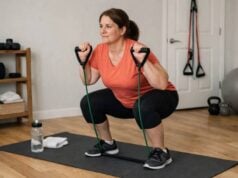
- Goblet squat — 2 to 3 sets of 8 to 10
- Dumbbell bench press or machine chest press — 2 to 3 sets of 8 to 12
- Seated cable row or chest-supported row — 2 to 3 sets of 8 to 12
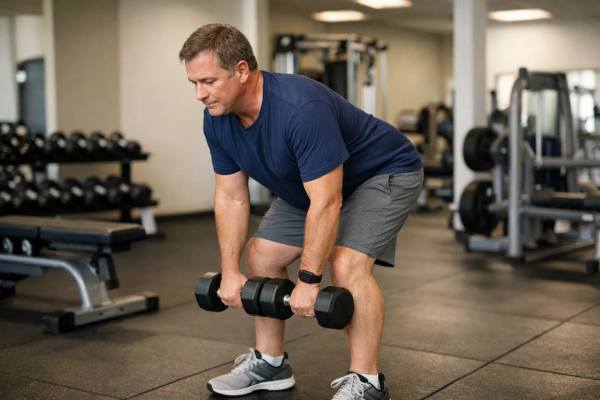
- Romanian deadlift with dumbbells — 2 to 3 sets of 8 to 10
- Split squat or assisted reverse lunge — 2 sets of 8 per side
- Front plank — 2 sets of 20 to 40 seconds
Day 2
- Leg press or bodyweight box squat — 2 to 3 sets of 10 to 12
- Lat pulldown or assisted pull-up — 2 to 3 sets of 8 to 12
- Dumbbell shoulder press or machine shoulder press — 2 to 3 sets of 8 to 10
- Hip hinge pattern, such as kettlebell deadlift — 2 to 3 sets of 8 to 10
- Glute bridge or hip thrust — 2 to 3 sets of 10 to 12
- Dead bug or bird dog — 2 sets of 6 to 10 controlled reps per side
Day 3
- Step-up or split squat — 2 to 3 sets of 8 to 10 per side
- Incline dumbbell press or push-up variation — 2 to 3 sets of 8 to 12
- One-arm dumbbell row or seated row — 2 to 3 sets of 8 to 12
- Leg curl machine or sliding hamstring curl — 2 to 3 sets of 10 to 15
- Dumbbell carry or farmer carry — 2 to 3 rounds of 20 to 40 meters
- Pallof press or side plank — 2 sets per side
A few rules make this plan work better:
- Rest 60 to 120 seconds between most sets
- Move with control on the lowering phase
- Record weights and reps so you can see progress
- Stop any rep that loses position badly
If an exercise bothers your joints, swap the pattern, not the whole plan. For example, if reverse lunges feel awkward, use step-ups. If barbell pressing feels unstable, use dumbbells or a machine. The plan is built around movement patterns, not specific brand-name exercises.
If you train at home with almost no equipment, you can adapt this structure with a bodyweight routine or resistance bands. If lower-body work is your weak link, building confidence with glute and leg training can make the full plan feel stronger and more balanced.
This kind of program is not flashy. That is the point. It covers the basics, gives you enough frequency to learn, and leaves room for progress.
How to progress without burning out
Beginners improve quickly, but only if the training is progressive. That does not mean you must add weight every workout. It means the plan needs to become slightly more demanding over time in a way your body can absorb.
The simplest way to progress is double progression. Pick a rep range for each lift, such as 8 to 10 or 10 to 12. Start with a weight that lets you hit the lower end with good form. Over the next sessions, add reps until you can complete all your planned sets at the top of the range. Then increase the load slightly and start again at the lower end.
For example:
- Week 1: goblet squat 20 pounds for 8, 8, 8
- Week 2: 20 pounds for 9, 8, 8
- Week 3: 20 pounds for 10, 9, 8
- Week 4: 20 pounds for 10, 10, 10
- Week 5: move to 25 pounds and return to 8 reps
This works well for beginners because it builds skill and confidence before you rush heavier. It also keeps the plan from becoming random.
You can also progress in other small ways:
- Add a third set after the first two weeks
- Improve range of motion or control
- Reduce reliance on assistance
- Shorten rest slightly on smaller lifts
- Use a more challenging variation once the current one feels easy
What you do not want is constant exhaustion. Strength training for weight loss should feel challenging, but it should not flatten your energy for the rest of the week. If your motivation is falling, soreness lasts too long, or your numbers are dropping across several sessions, the problem may be recovery rather than discipline. That is when it helps to examine your rest-day structure instead of adding more work automatically.
A smart beginner also knows when not to progress. If form gets messy, if your lower back keeps taking over a movement, or if life stress is unusually high, repeating last week’s load is not failure. It is good programming.
Progress should also be judged by more than the scale. In the first month, you may notice:
- Better technique
- More reps with the same weight
- More stable balance
- Less soreness after sessions
- Better posture and confidence in daily movement
Those are real improvements. A closer look at non-scale progress markers can help you notice when the plan is working even if water weight or normal fluctuations hide it on the scale.
The goal is not to prove how hard you can train in week one. The goal is to still be training productively in week twelve. That is what progression is for.
How to combine lifting with fat loss
A good lifting plan works best when the rest of your routine supports it. Beginners often make the mistake of thinking the 3-day program is the whole strategy. It is not. It is the backbone. Fat loss still depends on your overall energy balance, recovery, and how active the rest of your week is.
The first support pillar is nutrition. If you want strength training to preserve muscle during weight loss, protein matters. So does consistency. You do not need a perfect diet, but you do need enough structure that your training has something to work with. A useful place to start is a realistic daily protein target paired with meals that make the calorie deficit easier to maintain, not harder.
The second support pillar is daily movement. Many people assume three lifting sessions per week will be enough to drive all the fat loss they want. In practice, it helps a lot to stay active on nonlifting days. Walking is especially useful because it raises total calorie burn without interfering much with recovery. That can be as simple as a daily step target, a walk after dinner, or several short walks through the workday. If you want a concrete framework, walking for weight loss fits extremely well alongside beginner lifting.
The third support pillar is optional cardio. Cardio is not required for weight loss, but it can be helpful. One or two moderate sessions per week, or a few short bouts after lifting, can improve fitness and make the overall calorie gap easier to create. The mistake is adding so much cardio that your lifting quality drops. For beginners, strength training should usually remain the priority on the gym side of the plan, with cardio added in a dose you can recover from.
A simple weekly template might look like this:
- Monday: lift
- Tuesday: walk or easy cardio
- Wednesday: lift
- Thursday: walking and normal activity
- Friday: lift
- Saturday: longer walk, easy bike, or active errands
- Sunday: rest with light movement
This layout works because the activities do not fight each other. Lifting protects muscle. Walking increases daily output. Moderate cardio improves fitness. Nutrition drives the deficit.
One more point matters here: consistency beats intensity. A slightly conservative plan followed for 12 weeks is much more effective than an aggressive one followed for 12 days. If you find yourself trying to “make up” for missed meals, missed workouts, or weekends by doubling sessions, the structure is probably too fragile. Build something you can repeat on ordinary weeks, not only ideal ones.
Mistakes beginners should avoid
Most beginner lifting plans fail for simple reasons, not mysterious ones. The person is often working hard, but the structure is off. A few common errors can make a good 3-day plan feel ineffective or unnecessarily frustrating.
The first mistake is chasing soreness instead of progress. Soreness can happen, especially early on, but it is not proof of a better workout. If every session leaves you limping for three days, the plan is too aggressive for a beginner. The goal is to build enough stimulus to improve, not so much damage that the rest of your week collapses.
The second mistake is changing exercises constantly. Beginners often hop from program to program or switch movements every session because they think novelty is the same as effectiveness. It is not. Repeating the main lifts for several weeks is how you learn them and create measurable progress.
The third mistake is doing too much too soon. This can show up as extra sets, extra finishers, daily ab circuits, or cardio layered on top of every lifting day. More work is not always more results. In a fat-loss phase, recovery matters.
Other common problems include:
- Using weights that are too light to create adaptation
- Using weights so heavy that form falls apart
- Skipping lower-body training
- Treating warm-ups as optional
- Expecting visible body changes in two weeks
- Ignoring protein, sleep, and daily movement
Another major mistake is judging the plan only by scale change. Strength training can increase muscle glycogen and training-related water retention, especially in the first weeks. That can hide fat loss temporarily. If you quit too early, you may stop just before the plan starts to show clearer results. This is one reason people often believe they are “doing everything right” but not seeing the expected return. Looking into why exercise does not always show up clearly on the scale can help you interpret the process more accurately.
It is also important not to compare your beginner phase to someone else’s advanced routine. You do not need six days per week, fancy supersets, or maximal lifts to get leaner and stronger. You need steady practice, decent effort, and a plan you can live with.
If progress slows later, the answer is not always to slash calories or train harder. Sometimes you need better adherence, better sleep, or a more honest look at what is happening outside the gym. A structured plateau checklist is often more useful than panic.
A good beginner program is supposed to feel almost boring in its reliability. That is a strength, not a flaw. The people who get results are often the ones who keep showing up, keep the basics in place, and let time do its work.
References
- Resistance training effectiveness on body composition and body weight outcomes in individuals with overweight and obesity across the lifespan: A systematic review and meta-analysis 2022 (Systematic Review and Meta-Analysis)
- Physical activity and exercise for weight loss and maintenance in people living with obesity 2023 (Review)
- Aerobic Exercise and Weight Loss in Adults: A Systematic Review and Dose-Response Meta-Analysis 2024 (Systematic Review and Meta-Analysis)
- Minimalist Training: Is Lower Dosage or Intensity Resistance Training Effective to Improve Physical Fitness? A Narrative Review 2024 (Review)
- WHO guidelines on physical activity and sedentary behaviour 2020 (Guideline)
Disclaimer
This article is for general educational purposes only and is not a substitute for medical, physical therapy, or individualized exercise advice. If you have significant joint pain, a recent injury, heart disease, uncontrolled blood pressure, or symptoms that worsen during lifting, speak with a qualified clinician before starting a strength training program.
If this article helped you, please share it on Facebook, X, or another platform you use so more beginners can start lifting for weight loss with a plan that is practical and sustainable.