Resistance bands are one of the easiest ways to build a weight-loss workout that feels practical instead of complicated. They are light, inexpensive, easy to store, and surprisingly effective when you use them with enough tension and structure. That matters if you want full-body training at home, need a joint-friendly option, or want a plan you can actually repeat three times a week without a long commute or a room full of equipment.
The real value of band training is not that it does something magical to body fat. It is that it helps you train consistently, preserve muscle while dieting, and raise the overall effort of your week in a small amount of time. This guide explains why resistance bands can help with weight loss, what kind of bands work best, which exercises give the most return, and how to use a clear 30-minute plan that fits beginner and intermediate levels. You will also see how to progress the workouts so results do not stall after the first few weeks.
Table of Contents
- Why resistance bands work for weight loss
- What equipment and setup you need
- Best band exercises to prioritize
- 30-minute resistance bands workout plan
- How to progress from beginner to intermediate
- Weekly schedule, recovery and common mistakes
Why resistance bands work for weight loss
Resistance bands can support weight loss for the same reason other good strength tools do: they make it easier to train hard enough, often enough, to matter. Weight loss still depends mainly on a sustainable calorie deficit, but exercise helps by increasing energy expenditure, protecting lean mass, improving fitness, and making daily movement feel easier. Bands fit that job well because they lower the barriers that often derail exercise plans.
A 30-minute band workout is realistic for people who are busy, training at home, or returning to exercise after a long break. You do not need a rack, bench, or large room. You can move quickly from one exercise to the next, which keeps training density high without turning the session into frantic cardio. That density matters. When you can squat, row, press, hinge, and move continuously with short rests, you get both a muscular challenge and a noticeable cardiovascular response.
Bands are also more joint-friendly than many impact-heavy workouts. That can be helpful if you are carrying extra body weight, dealing with mild knee discomfort, or trying to build consistency before moving into harder forms of training. Unlike fixed-weight dumbbells, bands also change resistance across the range of motion. In many exercises, the resistance rises as you stretch the band, which can make the top of the rep feel demanding without requiring very heavy load at the bottom.
A few reasons band workouts work well in practice:
- They allow full-body training in little space.
- They are easy to scale from very light to quite challenging.
- They suit circuits, straight sets, and timed intervals.
- They travel well, which helps on busy weeks.
- They pair well with walking and other low-stress activity.
Another important advantage is adherence. Many people stick with bands longer than they expect because setup is so simple. That matters more than novelty. The best exercise plan for fat loss is usually not the most advanced one. It is the one you can repeat consistently for months.
Still, bands are not a substitute for every form of strength training. Very strong trainees may eventually outgrow lighter bands on some lower-body exercises. Bands also require good control; if you rush reps, momentum can take over and reduce the training effect. For that reason, a resistance band workout works best when you treat it as real strength training, not just a quick burn.
Think of bands as a highly usable tool. They can help you maintain muscle, increase weekly training volume, and make your routine easier to sustain. When paired with enough protein, steady daily movement, and realistic food intake, they can be much more effective than their simple appearance suggests.
What equipment and setup you need
One reason people get poor results from resistance bands is that they try to do everything with one light band. A proper setup makes a big difference. You do not need a giant collection, but you do need enough tension options to make major muscle groups work hard.
The three most useful band types are:
- Mini loop bands for glute activation, lateral steps, and shorter-range leg work
- Long loop bands for rows, presses, squats, deadlifts, assisted pull patterns, and anchor-based exercises
- Tube bands with handles for presses, rows, curls, and travel-friendly workouts
For most people, a basic starter setup includes one light band, one medium band, and one heavier band. That lets you use different resistance levels for different exercises. A band that feels right for biceps curls will probably feel too easy for squats or deadlifts.
A few setup basics matter more than people think:
- Check the band for cracks, tears, or thinning before every session.
- Anchor door-mounted bands on the hinge side so the door does not pull open toward you.
- Wear training shoes for standing-on-band exercises instead of slippery socks.
- Control the return phase of each rep instead of letting the band snap back.
- Give yourself enough floor space that the band will not catch on furniture.
The other big piece is exercise position. Bands create resistance from the direction they pull, so body angle matters. A slight shift in stance can change how an exercise feels. That is normal. Spend the first week learning how to set up each movement cleanly instead of rushing to add more volume.
Warm-up still matters, even with bands. Because band workouts often feel “lighter” than gym sessions, people skip preparation and go straight into hard reps. That usually makes the first circuit feel clumsy and shortens the useful part of the workout. A five-minute primer borrowed from a good warm-up and recovery routine can improve performance right away.
A practical pre-workout sequence includes:
- Marching in place for 60 seconds
- Bodyweight squats for 10 reps
- Hip hinges for 10 reps
- Arm circles and band pull-aparts for 10 to 15 reps
- One light rehearsal set of your first two exercises
If impact bothers your knees or ankles, band work can also be a good complement to lower-impact training for sore knees. It allows you to create a muscular challenge without repeated jumping or pounding.
The key idea is simple: bands are only as good as the setup behind them. When tension, anchoring, and body position are right, they can produce a serious workout. When setup is sloppy, even a well-written plan feels awkward and underpowered.
Best band exercises to prioritize
A good resistance bands workout for weight loss should train major movement patterns, not just isolated muscles. That means building the session around squats, hinges, pushes, pulls, and trunk-stability work. If you only do curls, kickbacks, and random pulses, the workout may feel busy without giving your larger muscle groups enough stimulus.
The strongest band exercises are usually the simplest ones.
Lower-body priority moves
Band squat
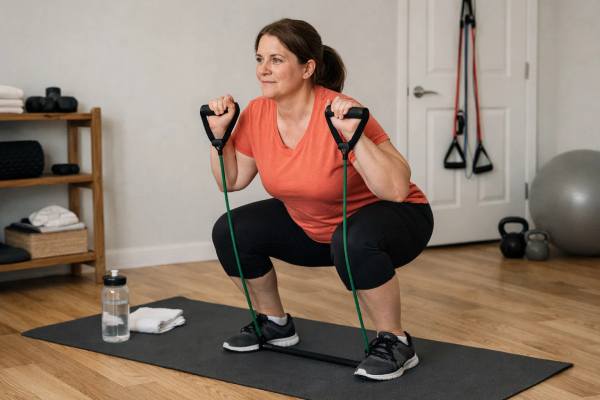
Stand on the band and hold the handles or loop at shoulder height. This trains the quads, glutes, and trunk together. It is one of the best band exercises for a full-body session because it raises heart rate quickly while still feeling like strength work.
Band Romanian deadlift
Stand on the band and hold the ends. Push the hips back, keep the spine neutral, and drive up through the feet. This is a strong hinge pattern for glutes and hamstrings.
Lateral band walk
Using a mini band around the ankles or above the knees, step side to side with control. This is not a main strength lift, but it helps wake up the glutes and adds useful hip work.
Split squat or reverse lunge with band resistance
These are excellent for single-leg strength and balance. They also expose side-to-side differences you may not notice during regular squats.
Upper-body priority moves
Standing row
Anchor the band at chest height and row toward your ribs. Rows are one of the best uses of bands because the resistance curve usually feels smooth and shoulder-friendly.
Chest press
Press the band away from your chest from a standing split stance or a floor position. This gives you a push pattern without needing a bench.
Overhead press
Stand on the band and press overhead with control. Keep the ribs down instead of leaning back into a loose arch.
Face pull or pull-apart
These are useful accessory moves for upper-back and rear-shoulder work, especially if your posture tends to collapse during long desk days.
Core and full-body support moves
Pallof press
Anchor the band at chest height, step out, and press straight forward without letting your torso rotate. This is excellent anti-rotation work and fits naturally into weight-loss circuits.
Band dead bug or band-resisted march
These improve trunk control and teach you to brace while the limbs move.
Band training can also pair well with a wider plan that includes core training during fat loss and more targeted glute and leg work on other days.
The common thread is that the best exercises ask a lot from large muscle groups while staying easy to set up. A band squat, row, press, hinge, and anti-rotation hold will do more for body composition than a long list of small isolation drills. Start with that base, then add variety only after those patterns feel strong and repeatable.
30-minute resistance bands workout plan
This 30-minute resistance bands workout is designed for weight loss, but it is built like real full-body training. The goal is not to race through random reps. The goal is to challenge major muscles, keep rest periods short enough to maintain training density, and finish feeling worked rather than wrecked.
Minutes 0 to 5: Warm-up
Move continuously for five minutes:
- March in place or brisk walk for 60 seconds
- Bodyweight squats for 10 reps
- Hip hinges for 10 reps
- Band pull-aparts for 12 to 15 reps
- Reverse lunges for 6 reps per side
- Light row and press rehearsal for 8 reps each
Minutes 5 to 23: Main circuit
Perform the following six exercises for 40 seconds of work and 20 seconds of transition or rest. Complete 3 rounds.
- Band squat
- Standing band row
- Band Romanian deadlift
- Standing chest press
- Reverse lunge or split squat
- Pallof press hold or repeated presses
Rest 60 seconds between rounds.
This creates an 18-minute main block. The lower-body work raises heart rate, while the rows and presses keep the session balanced. Because the timer is fixed, choose a band tension that allows steady reps with good form for most of the interval.
Minutes 23 to 28: Short finisher
Do 2 rounds of:
- 20 band high pulls or fast rows
- 12 squat-to-press reps
- 20 seconds mountain climbers or brisk marching
- 30 seconds rest
If you prefer a lower-impact option, replace mountain climbers with step jacks or fast feet in place. If you want extra movement on another day, a separate bodyweight session can pair well with band training without duplicating all the same loading patterns.
Minutes 28 to 30: Cool-down
Use the final two minutes for:
- Slow breathing
- Gentle hip flexor stretch
- Chest-opening stretch
- Calf stretch or easy marching
Beginner modifications
- Use 30 seconds work and 30 seconds rest
- Perform 2 rounds instead of 3 for the first week
- Choose static split squats instead of alternating lunges
- Use lighter bands on pressing exercises
Intermediate options
- Move to 45 seconds work and 15 seconds rest
- Add a fourth round
- Use thicker bands for squats, rows, and hinges
- Turn the finisher into 3 rounds
This workout works because it respects both strength and conditioning. It is not quite a traditional lift-only session and not quite a cardio circuit either. That middle ground is what makes band training so useful when time is limited and the goal is body-fat loss without sacrificing muscle.
How to progress from beginner to intermediate
The biggest mistake people make with resistance bands is assuming progression only means buying a thicker band. Resistance matters, but it is only one way to make the workout harder. A better approach is to progress the training step by step so technique improves at the same time.
Start by mastering the basic positions. Your squat should feel stable through the feet. Your hinge should come from the hips rather than a rounded back. Rows should finish with the elbows near the ribs, not the shoulders shrugging toward the ears. If those basics are still inconsistent, harder bands will usually make the workout worse, not better.
A useful progression ladder looks like this:
- Improve setup and range of motion
Clean mechanics come first. Better reps often increase the challenge without changing the band. - Add reps within the same interval
If you can do 10 quality rows in 40 seconds, aim for 11 or 12 before increasing tension. - Use thicker bands on the largest movements
Squats, hinges, rows, and presses usually progress first. - Reduce rest slightly
Move from 20 seconds rest to 15 seconds, or from 60 seconds between rounds to 45. - Add one more round
This increases total work without changing every other variable. - Use unilateral variations
Single-arm rows, single-arm presses, split squats, and offset stances increase challenge with the same equipment. - Combine movements carefully
Examples include squat-to-press, hinge-to-row, or lunge plus press. These are effective only when the separate patterns already look good.
A simple four-week example:
- Week 1: 2 rounds, 30 seconds work, moderate tension
- Week 2: 3 rounds, 30 seconds work, same tension
- Week 3: 3 rounds, 40 seconds work, moderate to slightly heavier tension
- Week 4: 3 rounds, 45 seconds work, or 4 rounds at 40 seconds
That is enough progression for many beginners. You do not need new exercises every week. Repeating the same core movements lets you compare performance honestly.
If you want to build a larger training week around bands, you can also combine them with a structured strength training plan mindset: a few core lifts, repeated weekly, with gradual overload. The equipment is different, but the principle is the same.
Another useful rule is to progress difficulty without turning every session into a gasping interval class. Band training should still feel like resistance training. There is nothing wrong with a tough circuit, but if technique breaks down in round one, the load, tempo, or exercise choice is off.
Intermediate trainees often do best when they mix two kinds of sessions:
- One more controlled strength-focused band workout
- One faster-paced metabolic workout
- Optional third session that sits between the two
That balance usually produces better long-term results than doing every session at maximum speed. Progress is not only about making the workout harder. It is about making it more productive.
Weekly schedule, recovery and common mistakes
A 30-minute resistance bands workout works best when it fits into a week that includes recovery and general movement. For most people, two to four band sessions per week is enough. More is not automatically better, especially if the workouts are dense and full-body.
A practical weekly structure might look like this:
- Monday: Band workout
- Tuesday: Walk or easy cardio
- Wednesday: Band workout
- Thursday: Off or mobility
- Friday: Band workout or shorter circuit
- Saturday: Longer walk, bike ride, or errands on foot
- Sunday: Off
That kind of plan works because it leaves room for daily movement outside formal workouts. Fat loss is rarely driven by workouts alone. Walking more, sitting a bit less, and keeping everyday activity up often determine whether the weekly calorie gap is large enough to matter.
Recovery also deserves more attention than people usually give band workouts. Because the equipment looks simple, people assume they can train hard every day. But if you are doing full-body circuits with limited rest, the sessions still create meaningful muscular and cardiovascular stress. Plan your rest days with the same seriousness you would use for gym training.
A few signs your schedule is working:
- You recover well enough to train again within 24 to 48 hours
- Reps feel cleaner over time
- You can increase band tension or volume gradually
- Soreness is manageable rather than constant
- Energy stays stable outside the workouts
Common mistakes to avoid:
- Using bands that are too light for legs and back
- Rushing reps so momentum replaces muscle tension
- Skipping rows and pulls while overdoing presses and squats
- Doing only “burn” exercises instead of training big movement patterns
- Treating the band workout as permission to overeat
- Changing exercises every session so nothing is measurable
Nutrition still matters here. During weight loss, enough protein helps preserve lean mass and supports recovery, which is one reason a solid protein intake pairs well with band training. Sleep matters too. A poor night of sleep can make a 30-minute session feel much harder and can increase the hunger that follows it.
Finally, do not judge progress only by body weight. Track waist measurements, how your clothes fit, the band level you use, the number of good reps you can complete, and how fast you recover between circuits. Those markers often improve before the scale moves dramatically.
Resistance bands are simple, but simplicity is not a weakness. When the program is structured well, bands can deliver the kind of regular, repeatable training that weight loss usually needs most.
References
- World Health Organization 2020 guidelines on physical activity and sedentary behaviour 2020 (Guideline)
- Exercise training in the management of overweight and obesity in adults: Synthesis of the evidence and recommendations from the European Association for the Study of Obesity Physical Activity Working Group 2021 (Review and Recommendations)
- Resistance training effectiveness on body composition and body weight outcomes in individuals with overweight and obesity across the lifespan: a systematic review and meta-analysis 2022 (Systematic Review and Meta-Analysis)
- Effect of resistance exercise on body composition, muscle strength and cardiometabolic health during dietary weight loss in people living with overweight or obesity: a systematic review and meta-analysis 2025 (Systematic Review and Meta-Analysis)
- Effects of resistance training with elastic bands on bone mineral density, body composition, and osteosarcopenic obesity in elderly women: A meta-analysis 2024 (Meta-Analysis)
Disclaimer
This article is for general educational purposes only and is not a substitute for medical advice, diagnosis, or treatment. If you have significant shoulder, back, knee, or cardiovascular issues, or you develop pain, dizziness, chest symptoms, or unusual shortness of breath during exercise, get individual medical guidance before starting a resistance band program.
If this article helped, please share it on Facebook, X, or any other platform where it might help someone build a safer, more sustainable weight-loss routine.