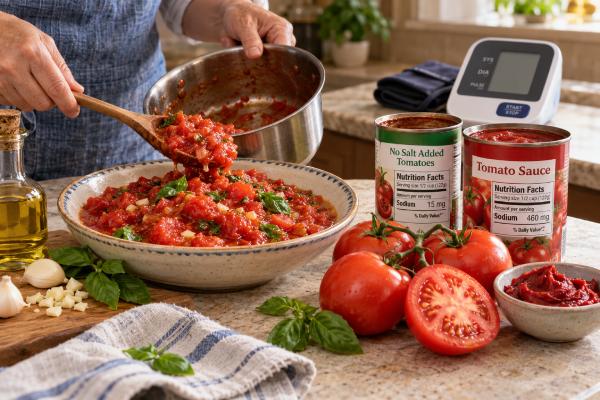
Tomatoes can fit very well into a blood-pressure-friendly diet, but they are not a stand-alone treatment for hypertension. Their strongest nutritional advantages are simple: fresh tomatoes are naturally low in sodium, provide potassium, and supply lycopene and other plant compounds. Recent research suggests tomato-derived lycopene may have a modest blood-pressure benefit, although studies are not completely consistent. Observational data also link higher tomato intake with lower hypertension risk, but that type of study cannot prove that tomatoes caused the improvement.
What matters most is how tomatoes are used. Fresh tomatoes, no-salt-added canned tomatoes, and lower-sodium tomato sauces can support a DASH- or Mediterranean-style eating pattern. By contrast, pizza sauce, ketchup, canned soups, salsa, and jarred pasta sauces may contain enough sodium to work against the goal. Cooking can make lycopene more bioavailable, especially when tomatoes are eaten with a small amount of healthy fat. For high blood pressure, however, the overall diet—and especially sodium, potassium, weight, activity, and prescribed treatment—matters more than any single tomato product.
Table of Contents
- Why Tomatoes May Help Blood Pressure
- What the Research Shows
- Lycopene: Helpful Compound, Not a Blood Pressure Drug
- Potassium, Sodium, and the Bigger Blood Pressure Picture
- Fresh, Cooked, Canned, Sauce, or Juice: What Is Best?
- How Much Tomato to Eat
- Safety, Medication Concerns, and Practical Tips
Why Tomatoes May Help Blood Pressure
Tomatoes are useful for blood pressure because they combine several favorable features in one ordinary food.
First, a plain tomato is naturally low in sodium. Replacing a salty side dish, processed meat topping, or packaged snack with tomatoes can lower the sodium density of a meal even before considering any special plant compound.
Second, tomatoes provide potassium, a mineral that helps regulate fluid balance, nerve signaling, muscle function, and vascular tone. Higher potassium intake from food is associated with better blood-pressure control in many people, particularly when sodium intake is high.
Third, tomatoes are the major dietary source of lycopene, the red carotenoid pigment also found in watermelon, pink grapefruit, guava, and some other foods. Lycopene has antioxidant properties and may influence vascular function, oxidative stress, inflammatory signaling, and nitric-oxide-related pathways. Those mechanisms are plausible, but they do not prove that lycopene supplements prevent cardiovascular disease.
Tomatoes also contribute vitamin C, folate, and other carotenoids and polyphenols. A whole tomato therefore delivers a package of nutrients rather than one isolated ingredient.
The larger benefit may be what tomatoes replace. A tomato-and-bean salad dressed with olive oil is very different from a pepperoni pizza with a thin layer of tomato sauce. Both contain tomato, but the sodium, saturated fat, fiber, potassium, calorie density, and overall dietary context are completely different.
That is why tomatoes make the most sense as part of a dietary pattern such as DASH for high blood pressure or the Mediterranean diet for heart health. These patterns improve the entire nutrient environment rather than asking one food to do all the work.
What the Research Shows
The research on tomatoes, lycopene, and blood pressure is promising but mixed.
A 2024 observational analysis from the PREDIMED trial followed 7,056 older adults at high cardiovascular risk. Researchers found that people consuming more tomato and tomato products had some favorable blood-pressure associations. Among 1,097 participants who did not have hypertension at baseline, those consuming more than 110 grams of tomato per day had a lower observed risk of developing hypertension than those in the lowest-intake group. Because this was an observational analysis, it cannot prove cause and effect. Higher tomato intake may travel with other healthy behaviors.
Randomized evidence is less straightforward. A 2023 systematic review and meta-analysis of 34 trials found that tomato and lycopene interventions did not significantly lower systolic or diastolic blood pressure overall, although lycopene improved one marker of oxidative stress. That review highlights the inconsistency between individual small trials and pooled results.
A newer 2026 umbrella review took a different approach by evaluating previous systematic reviews and meta-analyses. After assessing study quality and certainty, it concluded that tomato-derived lycopene was associated with blood-pressure improvement, with stronger certainty for blood pressure than for lipid outcomes. The authors described a potentially useful daily lycopene range, but the underlying studies varied substantially in product, dose, duration, and participant health.
How can both conclusions be true? They use different evidence sets, methods, inclusion criteria, and statistical approaches. Some trials use whole tomatoes, others use tomato extract or purified lycopene. Participants may have normal blood pressure, prehypertension, or established hypertension. Doses and study lengths differ. A pooled effect can therefore change when newer trials or differently selected reviews are included.
The safest conclusion is not “tomatoes lower blood pressure by a guaranteed amount.” It is that tomatoes are a heart-healthy food, lycopene may contribute a modest blood-pressure benefit, and the total evidence is not strong enough to treat tomatoes or lycopene as medication.
That distinction is particularly important for someone with readings in the hypertensive range. If blood pressure remains high, food changes should support—not delay—appropriate monitoring and treatment.
Lycopene: Helpful Compound, Not a Blood Pressure Drug
Lycopene is fat-soluble, which affects how the body absorbs it. In raw tomatoes, much of the lycopene is held within plant cell structures. Chopping, crushing, and cooking can disrupt that matrix and make lycopene easier to absorb. Processing also changes some lycopene from the all-trans form toward cis forms that are generally more bioavailable.
This creates an unusual nutrition lesson: cooked tomato products are not automatically nutritionally inferior to raw tomatoes. Tomato paste, cooked tomatoes, and sauce can provide highly bioavailable lycopene. Eating them with some dietary fat can further support absorption because carotenoids are fat-soluble.
A practical combination is cooked tomato with a modest amount of extra-virgin olive oil. That does not require flooding the meal with oil. A tablespoon used across a sauce or vegetable dish can add flavor and unsaturated fat while helping with carotenoid absorption. For more context on the fat itself, see extra-virgin olive oil benefits and practical amounts.
But lycopene bioavailability and blood-pressure benefit are not the same thing. Absorbing more lycopene does not guarantee a larger fall in blood pressure. Clinical outcomes depend on far more than blood carotenoid levels.
There is also no official daily requirement for lycopene. Research uses widely different amounts. The 2026 umbrella review suggested benefits within a broad intake range, but translating supplement milligrams into “number of tomatoes” is imprecise because lycopene content changes with tomato variety, ripeness, processing, and serving size.
For most people, there is no compelling reason to choose a high-dose lycopene supplement instead of food. Whole and processed tomatoes provide potassium and multiple phytochemicals, while supplements isolate one component. Supplement quality and dose also vary, and high-dose products do not have the same depth of long-term cardiovascular evidence as established hypertension therapies.
If you enjoy tomatoes, use them because they improve the quality of the diet—not because you need to hit a specific lycopene number every day.
A practical approach is to rotate forms instead of chasing a single “best” tomato. Use fresh tomatoes in salads and sandwiches, canned no-salt-added tomatoes in soups, and a simple cooked sauce for pasta or beans. This gives you different textures and preparation methods while keeping the bigger goal in view: eating more minimally processed plant foods consistently.
Potassium, Sodium, and the Bigger Blood Pressure Picture
For blood pressure, potassium and sodium have more established clinical relevance than lycopene alone.
Potassium helps counterbalance some of sodium’s effects and supports normal vascular function. A 2025 dose-response meta-analysis of randomized trials found that increasing potassium lowered blood pressure, with a larger average response among participants who had hypertension than among those with normal blood pressure.
Tomatoes contribute potassium, but they are not the richest source. Potatoes, beans, lentils, leafy greens, squash, bananas, yogurt, and many other foods can provide substantial amounts. The benefit comes from a potassium-rich overall diet, not from relying on tomatoes as the only source. potassium-rich foods for blood pressure can help diversify intake.
Sodium is where tomato products can become confusing. A raw tomato contains very little sodium, but commercially prepared products can be heavily salted. One serving of some tomato sauces, soups, juices, salsas, or canned tomato products can contribute hundreds of milligrams of sodium. If the portion on your plate is larger than the label’s serving size, the intake rises further.
This means “contains tomatoes” is not enough information. Compare the sodium line on similar products and look for no-salt-added, unsalted, or genuinely lower-sodium choices when available. Rinsing canned diced tomatoes is less practical than rinsing beans, so choosing the lower-sodium can at the store matters.
Ketchup deserves perspective. A tablespoon is not inherently harmful, but ketchup can add sodium and sugar without providing the volume of vegetables you would get from fresh tomato or a minimally processed sauce. The same principle applies to barbecue sauce and tomato-based condiments.
If sodium is a major issue in your diet, how much sodium is too much for blood pressure is a more important question than whether a specific tomato variety has slightly more lycopene.
People with kidney disease need a different potassium conversation. If kidney function is reduced or blood potassium is high, aggressively increasing tomatoes, potatoes, beans, salt substitutes, and other potassium-rich foods may be unsafe. Potassium goals should then be individualized.
Fresh, Cooked, Canned, Sauce, or Juice: What Is Best?
There is no single best form. The healthiest choice depends on the rest of the product.
| Tomato food | Potential advantage | What to watch |
|---|---|---|
| Fresh tomatoes | Very low sodium, hydrating, potassium and vitamin C | Little concern unless individually restricted |
| Cooked tomatoes | More accessible lycopene; easy to combine with vegetables and legumes | Added salt, butter, cream, or fatty meats |
| No-salt-added canned tomatoes | Convenient, inexpensive, useful year-round | Check label; sodium varies widely |
| Tomato paste | Concentrated flavor and lycopene | Some brands add salt; portions are small |
| Jarred pasta sauce | Convenient way to add cooked tomato | Often high sodium and sometimes added sugar |
| Tomato juice | Provides tomato compounds in a drinkable form | Regular versions can be very high in sodium |
| Ketchup | Small amount of tomato concentrate | Sodium and added sugar; not a vegetable serving substitute |
For everyday use, rotate forms. Put fresh tomato on sandwiches and salads. Use no-salt-added canned tomatoes in chili and lentil soup. Simmer tomato sauce with onions, garlic, herbs, beans, vegetables, and olive oil. Add tomato paste to stews for concentrated flavor without depending on salty bouillon.
Cooking at home gives you the biggest advantage: you control the sodium. A homemade tomato sauce made from crushed tomatoes, garlic, onion, basil, and olive oil can be much lower in sodium than a restaurant marinara or packaged sauce.
Restaurant dishes are harder to judge. Pizza, lasagna, meatballs in sauce, enchiladas, and tomato soup may all contain tomato while delivering a large sodium load. The tomato does not cancel that out.
If your goal is lower blood pressure, the “best” tomato food is usually the one that lets you eat more vegetables without adding a large amount of sodium, saturated fat, or excess calories.
How Much Tomato to Eat
There is no medical requirement to eat a specific number of tomatoes for blood pressure. Research does not support prescribing “one tomato per day” as if it were a dose of medication.
Still, observational research offers a practical reference point. In the 2024 PREDIMED analysis, the highest tomato-consumption category was more than 110 grams per day—roughly around the weight of a medium-to-large tomato, depending on variety. Higher intake was associated with lower hypertension risk among participants who did not already have hypertension. Again, association is not proof of benefit from that exact amount.
For everyday eating, a serving might be:
- one medium tomato;
- a cup of cherry tomatoes;
- about half a cup of cooked tomatoes or lower-sodium sauce;
- a few tablespoons of tomato paste used across a meal.
You do not need all of these in one day. The bigger goal is meeting an overall vegetable target with variety. Dark leafy greens, cruciferous vegetables, carrots, peppers, squash, onions, and legumes provide nutrients that tomatoes do not.
This is also why adding tomatoes to an unhealthy base has limits. A burger with bacon, cheese, salty sauce, and fries does not become a blood-pressure meal because it includes two tomato slices. By contrast, a grain bowl with beans, roasted vegetables, tomato salsa made with little salt, avocado, and herbs changes the entire nutritional profile.
If you enjoy tomatoes, eating them most days is reasonable for many people. If you dislike them or cannot tolerate them, there is no need to force them. Potassium, fiber, carotenoids, and a heart-healthy dietary pattern can come from many other foods.
Safety, Medication Concerns, and Practical Tips
Tomatoes are safe for most people, but a few situations deserve attention.
Kidney disease or high potassium: Tomatoes and tomato products can contribute meaningful potassium. People on a medically prescribed low-potassium diet should follow individualized limits rather than increasing tomatoes for blood-pressure reasons.
Medications that raise potassium: ACE inhibitors, angiotensin receptor blockers, mineralocorticoid receptor antagonists, and some other drugs can increase potassium. Most people can still eat normal amounts of potassium-containing food, but those with kidney impairment or previous hyperkalemia may need monitoring.
Reflux: Tomatoes are acidic and can trigger heartburn in some people. Cooked sauces can be especially troublesome when combined with large, fatty meals. Adjusting portion size or form may help.
Allergy: True tomato allergy is uncommon but possible. Oral itching can also occur in some people with pollen-food allergy syndrome.
Lycopene supplements: Do not use a supplement as a substitute for prescribed blood-pressure therapy. Because supplement doses can be much higher than typical food exposure and product quality varies, discuss concentrated products with a clinician if you take several medications or have chronic illness.
For practical blood-pressure benefit, focus on the meal around the tomato. Use tomatoes to replace salty ingredients. Pair them with beans, whole grains, vegetables, fish, or lean protein. Flavor with herbs, garlic, citrus, vinegar, pepper, and a modest amount of olive oil rather than automatically adding large amounts of salt.
Also track the outcome that matters. If you have hypertension, use a validated home blood-pressure monitor and look at averages over several days. A healthy meal can support long-term control, but you cannot tell whether lycopene is “working” from one reading.
If home blood pressure remains above your personalized target, discuss it with your clinician rather than continually adding more tomato products or supplements. The highest-yield changes may be reducing sodium, improving medication adherence, increasing activity, managing sleep apnea, losing excess weight when appropriate, and following an overall DASH-style pattern.
Tomatoes can be a very good part of that plan. Their advantage is not that they are a cure; it is that they make a potassium-rich, lower-sodium, plant-forward diet easier and more flavorful to sustain over months and years.
References
- Role of lycopene from tomato on cardiovascular risk: an umbrella review of systematic reviews and meta-analyses of intervention studies 2026 (Umbrella review)
- Effect of changes in potassium intake on blood pressure: a dose-response meta-analysis of randomized clinical trials (2000-2024) 2025 (Systematic review and dose-response meta-analysis)
- Association between tomato consumption and blood pressure in an older population at high cardiovascular risk: observational analysis of PREDIMED trial 2024 (Prospective observational analysis)
- The Effects of Lycopene and Tomato Consumption on Cardiovascular Risk Factors in Adults: A Grade Assessment Systematic Review and Meta-analysis 2023 (Systematic review and meta-analysis)
- 2025 AHA/ACC/AANP/AAPA/ABC/ACCP/ACPM/AGS/AMA/ASPC/NMA/PCNA/SGIM Guideline for the Prevention, Detection, Evaluation, and Management of High Blood Pressure in Adults: A Report of the American College of Cardiology/American Heart Association Joint Committee on Clinical Practice Guidelines 2025 (Clinical practice guideline)
Disclaimer
This article is for general education and does not replace individualized medical or nutrition advice. If you have chronic kidney disease, high blood potassium, or take medications that affect potassium, ask your clinician or dietitian how tomato products fit your diet. Do not stop blood-pressure medication or replace prescribed treatment with tomatoes, tomato extract, or lycopene supplements.