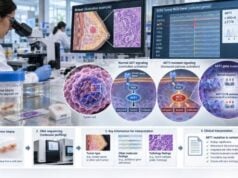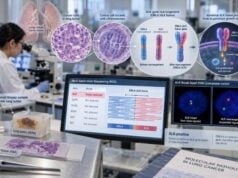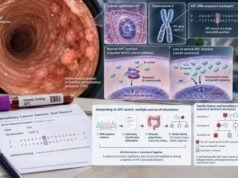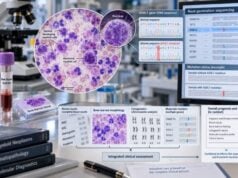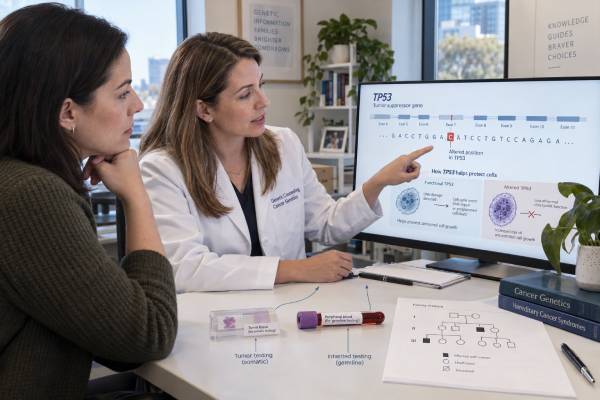
A germline TP53 mutation test is used to evaluate Li-Fraumeni syndrome (LFS) and the broader spectrum of heritable TP53-related cancer predisposition. TP53 is a tumor suppressor gene that helps prevent damaged cells from becoming cancerous. A confirmed pathogenic or likely pathogenic germline TP53 variant can explain unusually early cancers, multiple primary cancers, or a family pattern involving cancers such as sarcoma, premenopausal breast cancer, brain tumors, adrenocortical carcinoma, and leukemia. The result has lifelong implications because cancer risk can begin in childhood and extend across many organs. It can also affect screening choices, treatment planning, and testing for relatives. However, TP53 interpretation requires special care: a TP53 variant found on a tumor test or in a blood sample is not automatically inherited, and age-related clonal hematopoiesis can sometimes imitate a germline finding. Genetic counseling, appropriate specimen selection, variant classification, and the patient’s personal and family history are therefore central to a reliable diagnosis.
- A pathogenic germline TP53 variant supports a diagnosis of Li-Fraumeni syndrome or heritable TP53-related cancer predisposition and is associated with a very high lifetime cancer risk.
- LFS can cause many different cancers and often at young ages. Sarcomas, breast cancer, brain tumors, adrenocortical carcinoma, and leukemia are classic examples, but the spectrum is broader.
- A tumor TP53 mutation does not by itself diagnose LFS. TP53 mutations are common somatic changes in cancer and must be distinguished from constitutional germline variants.
- Surveillance is intensive and starts early. Modern protocols commonly include annual whole-body MRI, brain MRI, age- and sex-specific screening, and regular clinical assessment.
- A variant of uncertain significance is not a positive LFS diagnosis. Medical and family decisions should be based on pathogenicity, clinical context, and genetics expertise.
Table of Contents
- What the TP53 Germline Test Measures
- What a Positive TP53 Result Means
- Cancer Risks in Li-Fraumeni Syndrome
- Screening and Surveillance
- Treatment and Radiation Considerations
- Negative, VUS, and Mosaic Results
- Family Testing and Inheritance
What the TP53 Germline Test Measures
TP53 provides instructions for making p53, a protein that responds to DNA damage and other cellular stress. When a cell is seriously damaged, p53 can slow cell division, activate DNA repair, or trigger cell death. A pathogenic germline change in one TP53 copy weakens this protective system in cells throughout the body, creating a lifelong predisposition to cancer.
A germline test asks whether the TP53 variant is constitutional—present from conception in essentially all cells—or, in some cases, present as constitutional mosaicism in a subset of tissues. This is different from tumor sequencing. Tumors frequently acquire somatic TP53 mutations during cancer development, so finding TP53 on a tumor NGS report is common and usually does not mean the person has LFS.
Testing methods generally sequence the TP53 coding regions and splice boundaries and may assess deletion or duplication of larger gene segments. The report should classify identified variants as pathogenic, likely pathogenic, uncertain, likely benign, or benign according to current evidence. A pathogenic or likely pathogenic germline variant is the clinically actionable category for LFS management. A variant of uncertain significance (VUS) is not treated as a confirmed diagnosis.
Specimen choice can be unusually important with TP53. Blood is routinely used for hereditary testing, but a TP53 variant detected in blood can sometimes arise from clonal hematopoiesis, an acquired expansion of blood cells carrying a mutation. This becomes more common with age and after some cancer treatments. A blood finding can therefore mimic a germline variant. Saliva may not solve the problem because it can contain blood-derived cells.
When the laboratory, family history, VAF, age, or treatment history raises uncertainty, a genetics team may recommend confirmation using a validated non-hematopoietic specimen, such as cultured skin fibroblasts. This helps distinguish germline disease, constitutional mosaicism, tumor-related change, and clonal hematopoiesis.
The test should be ordered with a clear clinical question. In someone with a known familial TP53 pathogenic variant, targeted familial testing can be appropriate. In a person with an unexplained hereditary-cancer pattern, TP53 may be tested as part of a multigene panel because several inherited syndromes can produce overlapping cancer histories.
What a Positive TP53 Result Means
A positive germline result means a pathogenic or likely pathogenic TP53 variant has been confirmed in a constitutional sample or has otherwise been established as germline by an appropriate laboratory process. In the right clinical setting, this supports LFS or heritable TP53-related cancer syndrome.
The result is important even if the person has never had cancer. TP53-associated risk can begin in childhood, and some carriers develop more than one independent primary cancer during their lifetime. For a person who already has cancer, germline status may change future screening, surgery or radiation discussions, and the way clinicians evaluate new symptoms or imaging findings.
The result does not predict exactly which cancer will occur, at what age, or whether cancer is inevitable at a particular time. Risk varies between families and individuals. Variant type, sex, modifying genes, exposures, previous cancer treatment, and chance can all contribute. Some pathogenic TP53 variants are associated with very early or classic LFS patterns, while others show lower penetrance or later onset.
A report may use the term Li-Fraumeni syndrome or a broader phrase such as heritable TP53-related cancer syndrome. The broader terminology recognizes that not everyone with a pathogenic TP53 variant fits the historical “classic” family criteria. Molecular diagnosis can identify carriers whose family is small, whose relatives are young, or whose cancer pattern is less typical.
A positive result should trigger genetics-based care rather than isolated interpretation. The genetics professional can confirm the test source, review whether the variant truly meets pathogenic criteria, construct a three-generation pedigree, and help coordinate surveillance. The person’s oncology team can then integrate hereditary risk with the treatment plan for any existing cancer.
Importantly, a positive tumor-only TP53 result is a different finding. Tumor sequencing is designed to characterize the cancer, not necessarily the inherited genome. If a tumor result raises suspicion for germline TP53 disease, confirmatory hereditary testing is needed before the individual or relatives are labeled with LFS.
Cancer Risks in Li-Fraumeni Syndrome
LFS is one of the highest-risk hereditary cancer syndromes. Contemporary reviews estimate lifetime cancer risk above 70% for males and above 90% for females, with the higher female estimate driven in part by the high risk of early-onset breast cancer. These numbers describe groups, not an individual guarantee.
The classic LFS tumor spectrum includes:
- Soft-tissue sarcomas and bone sarcomas, including osteosarcoma.
- Premenopausal breast cancer, often occurring much younger than sporadic breast cancer.
- Central nervous system tumors.
- Adrenocortical carcinoma, particularly important in childhood.
- Leukemia and other hematologic malignancies.
The recognized spectrum is broader. Lung cancer, colorectal and gastric cancers, melanoma, thyroid cancer, and several other malignancies can occur more often than expected. Some carriers develop multiple primary cancers, which is why surveillance continues even after successful treatment of one cancer.
Age pattern matters. Childhood cancers such as adrenocortical carcinoma, certain sarcomas, and brain tumors can be the first sign in a family. Young-onset breast cancer or sarcoma can lead to diagnosis in adulthood. In other families, the first recognized cancers occur later. The absence of an obvious family history therefore does not exclude LFS; de novo variants, small families, incomplete penetrance, early deaths from unrelated causes, and missing family information can obscure the pattern.
Risk estimates should not be applied as if every TP53 variant behaves identically. Some variants have strong classic LFS associations, while others have more variable penetrance. Genetics teams may use variant-specific and family-specific evidence when counseling a carrier, but surveillance recommendations are usually intentionally broad because the consequences of missing an early cancer can be serious.
Because multiple organs are at risk, organ-by-organ screening alone is insufficient. This is the main reason modern surveillance combines targeted screening with whole-body MRI. The approach aims to find cancers earlier while limiting repeated exposure to ionizing radiation.
Screening and Surveillance
Surveillance for a confirmed TP53 carrier is more intensive than routine population screening. Programs differ somewhat by country and age, but major guidelines share a common principle: begin early, screen repeatedly, and use radiation-free imaging where it is effective.
Annual whole-body MRI is a central component of many current LFS protocols. It surveys much of the body without ionizing radiation. A 2024 systematic review and meta-analysis found that whole-body MRI can detect cancers in asymptomatic TP53 carriers, including many at early stages. More recent prospective and observational programs continue to support its practical role, although surveillance can also generate indeterminate findings that require follow-up.
Brain MRI is commonly performed annually. The first examination may use contrast, with later protocols individualized according to guideline and prior findings. Brain imaging matters because central nervous system tumors are part of the core LFS spectrum.
For women, breast surveillance begins substantially earlier than routine population mammography schedules. Breast MRI is emphasized because it is highly sensitive and avoids ionizing radiation. Clinical breast examination and discussions about risk-reducing bilateral mastectomy may also be appropriate. The exact timing should follow a current hereditary-cancer protocol and the individual’s history.
Children require age-specific surveillance. Regular physical examination pays attention to growth, neurologic findings, signs of hormone excess, and symptoms that could signal sarcoma or adrenocortical disease. Pediatric protocols may include abdominal and pelvic ultrasound and biochemical evaluation for adrenocortical carcinoma in addition to whole-body and brain MRI.
Adults may also undergo dermatologic examination, gastrointestinal screening such as colonoscopy and upper endoscopy beginning earlier than average-risk populations, and other testing based on family history and local guidelines. Surveillance is not a substitute for symptom evaluation; a new persistent mass, neurologic symptom, unexplained weight change, or other concerning feature should be assessed even if the most recent annual MRI was normal.
Whole-body MRI has limitations. It can miss some small or organ-specific cancers and can identify benign abnormalities that cause anxiety or additional testing. A surveillance center familiar with LFS is valuable because radiologists and clinicians can compare serial studies and avoid unnecessary procedures when findings are stable.
Treatment and Radiation Considerations
A germline TP53 result can influence cancer treatment, but it does not create one universal therapy. The cancer’s type and stage remain central. The hereditary result adds information about future cancer risk and about the potential long-term consequences of treatments that damage DNA.
One important issue is ionizing radiation. People with LFS are thought to have increased susceptibility to radiation-associated second cancers. As a result, surveillance strategies favor MRI and ultrasound rather than repeated CT scans or other radiation-based studies when those alternatives are clinically appropriate. In breast cancer, mastectomy may be discussed more strongly than breast-conserving surgery followed by radiotherapy because avoiding therapeutic radiation can be desirable when oncologically reasonable.
However, “avoid radiation” should not be interpreted as “never use radiation.” Diagnostic CT, nuclear medicine imaging, or radiotherapy can sometimes provide major or lifesaving benefit. The decision should compare the immediate benefit of accurate staging or cancer control with the long-term second-cancer risk. A multidisciplinary team can choose the least radiation-intensive strategy that still provides adequate care.
Chemotherapy also requires individualized planning. Some cytotoxic therapies can increase later therapy-related cancer risk, but withholding effective treatment from an existing aggressive cancer can be more dangerous. LFS treatment decisions therefore balance cure probability, alternative modalities, and long-term toxicity rather than applying a blanket prohibition.
Surgery can have added preventive value in selected settings. For example, risk-reducing bilateral mastectomy may be considered by women with TP53 pathogenic variants. For a person already diagnosed with unilateral breast cancer, surgical planning may account for both the current tumor and the very high future breast-cancer risk.
After cancer treatment, surveillance remains essential because a new lesion may represent recurrence, a treatment-related malignancy, or a completely new primary cancer. The threshold for evaluating new symptoms is therefore appropriately low. Survivorship planning should be coordinated between oncology and a hereditary-cancer program whenever possible.
Negative, VUS, and Mosaic Results
A negative germline TP53 test means the laboratory did not identify a reportable pathogenic TP53 alteration using the methods performed. It lowers the likelihood of classic TP53-related disease, but it does not erase a strong personal or family cancer history. Another hereditary gene may be responsible, or the family pattern may remain unexplained. Multigene panel testing and updated genetics review can sometimes be useful.
A VUS means there is not enough evidence to determine whether the variant increases cancer risk. A VUS should not be used as if it were a pathogenic TP53 mutation. Predictive testing of healthy relatives solely for a VUS is generally not the same as testing for a known familial pathogenic variant, and major prophylactic surgery should not be justified by the VUS alone. The laboratory may reclassify it as evidence accumulates.
Mosaic TP53 findings require more specialized interpretation. Constitutional mosaicism means the pathogenic variant arose after conception and is present in only a proportion of the body’s cells. Cancer risk may still be important, but it can depend on tissue distribution and cannot always be estimated precisely.
A different phenomenon is clonal hematopoiesis, in which an acquired TP53 mutation exists in a clone of blood-forming cells. It may be age-related or treatment-related and can create an apparently “germline-looking” result in blood. This is why unexpectedly low VAF, older age, previous chemotherapy, or a discordant family history can lead to testing of another tissue.
The distinction has major consequences. True germline or constitutional mosaic TP53 can affect surveillance across the body and may have implications for children and siblings. A blood-limited clonal hematopoiesis finding does not create the same inherited risk. Results should therefore be resolved before relatives undergo predictive testing.
Family Testing and Inheritance
Li-Fraumeni syndrome caused by a germline TP53 pathogenic variant is typically autosomal dominant. Each child of a carrier has a 50% chance of inheriting the familial variant, regardless of sex. Siblings may also be at risk if a parent carries the variant. If the change arose de novo in the affected person, parental tests may be negative, although mosaicism can complicate recurrence-risk estimates.
Once a familial pathogenic variant is known, relatives can usually have targeted testing for that exact variant. This is more informative than broad screening because a negative result for the known familial variant can often return the relative to risk management based on their own history rather than the LFS surveillance program.
Testing children is appropriate in this syndrome because surveillance and cancer risk begin in childhood. This differs from hereditary cancer conditions in which risk appears only in adulthood. Pediatric testing should still be accompanied by age-appropriate counseling and a clear plan for what will change if the result is positive.
Adults may also discuss reproductive options. These can include natural conception with prenatal diagnosis, in vitro fertilization with preimplantation genetic testing, donor gametes, adoption, or choosing not to test an embryo or pregnancy. Genetics professionals provide information without assuming that one option is right for every family.
Family communication can be emotionally complex because one result may affect many relatives and may reveal that cancer risks began before the family knew a syndrome was present. Written family letters and genetics-clinic resources can make disclosure easier. A confirmed result should ideally lead to coordinated surveillance rather than fear without a plan.
The most important distinction for relatives is whether the finding is truly germline. A TP53 mutation detected only in a tumor or leukemia sample should not be used for predictive family testing until constitutional status is established. In hereditary cancer care, the source and biology of the result are just as important as the gene name.
References
- Li-Fraumeni Syndrome — 2025 update, GeneReviews.
- SIGNIFIED: whole-body MRI screening in Li-Fraumeni syndrome in the UK — 2026, observational study.
- Baseline surveillance in Li Fraumeni syndrome using whole-body MRI: a systematic review and updated meta-analysis — 2024, systematic review and meta-analysis.
- Li-Fraumeni Syndrome: Imaging Features and Guidelines — 2024, review.
- SEOM clinical guideline on heritable TP53-related cancer syndrome (2022) — 2023, clinical guideline.
Disclaimer
This article is for general education and does not replace personalized genetic counseling, cancer screening, diagnosis, or treatment. TP53 results can be difficult to distinguish among germline disease, mosaicism, tumor mutations, and clonal hematopoiesis, so interpretation should be performed by qualified genetics and oncology professionals. Surveillance recommendations should follow current guidelines and the individual’s age, sex, family history, and prior cancers.