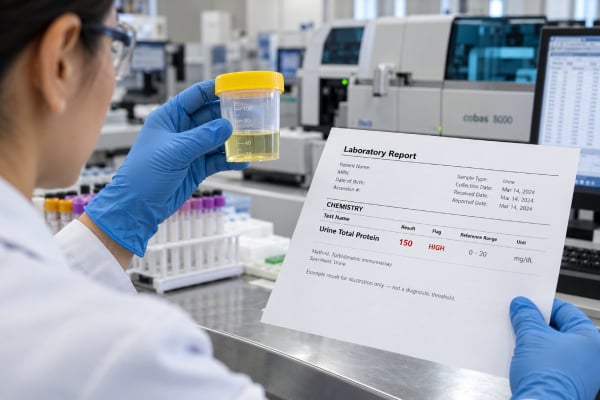
A urine total protein test measures the combined amount of protein present in urine rather than albumin alone. It can help detect and quantify proteinuria, but the meaning depends heavily on how the sample was collected and how the result was reported. A random urine protein concentration may be given in mg/dL or mg/L and changes with hydration, while a urine protein-creatinine ratio (UPCR) corrects for urine concentration and is often more useful clinically. A 24-hour collection reports the total amount of protein excreted during a full day. In healthy adults, daily total urinary protein is generally low—often less than about 150 mg/day—but laboratories use their own reference intervals. Persistent high total protein can occur with glomerular disease, tubular injury, diabetes, hypertension, monoclonal light chains, urinary inflammation, or other conditions. A high result should therefore be interpreted with uACR, urinalysis, eGFR, symptoms, and repeat testing rather than treated as a diagnosis by itself.
- Urine total protein includes albumin plus many non-albumin proteins, so it is broader than a urine albumin test.
- A 24-hour total protein result below about 150 mg/day is commonly considered normal in adults, but laboratory reference ranges vary.
- A random protein concentration can rise simply because urine is concentrated; UPCR reduces this hydration effect.
- A high total protein result can come from glomerular, tubular, overflow, or urinary tract sources.
- Persistent heavy proteinuria, falling eGFR, blood in urine, swelling, or suspected monoclonal protein needs more focused evaluation.
Table of Contents
- What urine total protein measures
- Normal values, units, and reporting methods
- Total protein versus albumin testing
- Causes of high urine total protein
- Spot, ratio, and 24-hour collections
- How to interpret an abnormal result
- Follow-up and warning signs
What urine total protein measures
Urine normally contains small quantities of proteins from several sources. Some are filtered from plasma, some are secreted by kidney and urinary tract cells, and some arise from normal turnover within the urinary system. A urine total protein assay measures these proteins together rather than identifying each one separately.
Albumin is often the dominant abnormal protein in glomerular kidney disease, but it is not the only protein that matters. Low-molecular-weight proteins can increase when proximal kidney tubules are injured. Immunoglobulin free light chains can appear in plasma cell disorders. Inflammation or bleeding in the urinary tract can also add protein to a urine sample.
That broad coverage is both the strength and the limitation of total protein testing. It can reveal protein that an albumin-specific test would not capture, but a high number does not tell you which protein is present or why it is there. If the protein pattern matters, a clinician may add albumin measurement, electrophoresis, immunofixation, or specific tubular markers.
The term “urine total protein test” can refer to a direct concentration measurement, a timed total excretion, or the protein component used to calculate a ratio. Because these formats answer slightly different questions, the units on the report are essential for interpretation.
Normal values, units, and reporting methods
A result is only meaningful when matched to the correct unit. A spot concentration in mg/dL cannot be compared directly with a 24-hour result in mg/day or a UPCR in mg/g.
| Report type | Common units | Practical interpretation |
|---|---|---|
| Spot total protein concentration | mg/dL or mg/L | Highly affected by urine concentration; use the laboratory reference range. |
| UPCR | mg/g or g/g creatinine | Corrects for urine concentration and estimates overall protein excretion. |
| 24-hour total protein | mg/day or g/day | Measures protein collected over the full timed period. |
For 24-hour collections, many adult laboratories consider less than roughly 150 mg/day to be within the normal range. Some use slightly different upper limits. Values above that can represent proteinuria, but the magnitude and persistence determine clinical importance.
For UPCR, many labs use an upper reference limit around 150–200 mg/g in adults. A protein-creatinine ratio is usually more useful than a raw spot protein concentration because it reduces the influence of hydration.
Very heavy protein loss is often called nephrotic-range proteinuria. Traditionally, total excretion around 3.5 g/day or more has been used as a classic adult threshold. Spot UPCR values in a similar g/g range can approximate that burden, but the relationship is imperfect and nephrotic syndrome also requires clinical context.
Total protein versus albumin testing
Total protein and albumin are related tests, not substitutes in every situation. Modern CKD guidelines usually prefer the urine albumin-creatinine ratio for routine detection and risk classification because albuminuria is a well-validated marker of glomerular damage and cardiovascular risk.
A uACR can detect modest albumin leakage even when a general total-protein test or dipstick is still negative. This is especially useful in diabetes and hypertension, where early albuminuria may precede a major fall in filtration.
Total protein becomes particularly informative when non-albumin proteins may be important. For example, proximal tubular injury can produce low-molecular-weight proteinuria. A plasma cell disorder can produce monoclonal light chains that contribute substantial urine protein but may not register strongly on an albumin-focused dipstick.
Comparing UPCR with uACR can provide a clue about composition. If UPCR is 800 mg/g and uACR is 700 mg/g, albumin makes up most of the measured protein. If UPCR is 800 mg/g but uACR is 60 mg/g, a large amount of non-albumin protein is present. That does not identify the protein, but it can prompt more specific testing.
This distinction is one reason a broad urine protein evaluation may use more than one assay rather than relying on a single number.
Causes of high urine total protein
High total urine protein can arise through four main pathways.
Glomerular proteinuria occurs when the kidney filtration barrier becomes abnormally permeable. Albumin usually dominates. Diabetes, hypertension, IgA nephropathy, focal segmental glomerulosclerosis, membranous nephropathy, lupus nephritis, and other forms of glomerulonephritis can produce this pattern. The amount ranges from modest albuminuria to several grams of protein per day.
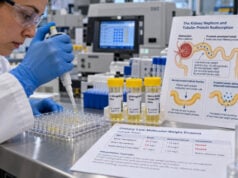
Tubular proteinuria occurs when proximal kidney tubules fail to reabsorb smaller proteins normally filtered from the blood. Tubulointerstitial nephritis, certain medications and toxins, inherited tubular disorders, and other tubular injuries can cause it. The total protein may be elevated even when albumin is only modestly increased. Specialized tests for low-molecular-weight proteinuria can clarify this pattern.
Overflow proteinuria occurs when a small circulating protein is produced in such large amounts that the kidney’s reabsorptive capacity is exceeded. Monoclonal immunoglobulin free light chains are the classic example. This pattern is clinically important because standard urine dipsticks may underestimate the protein burden. UPEP, urine immunofixation, and serum free light-chain testing may be used when a monoclonal disorder is suspected.
Post-renal proteinuria can occur when inflammation, infection, or bleeding adds protein after urine leaves the kidneys. Urinary tract infection, gross hematuria, and severe lower urinary tract inflammation can increase total protein.
Temporary proteinuria is also common. Fever, strenuous exercise, acute illness, dehydration, seizures, and marked short-term blood pressure elevation can increase urinary protein without proving chronic structural disease. In adolescents and young adults, orthostatic proteinuria can produce daytime protein loss with a normal first-morning sample.
Spot, ratio, and 24-hour collections
A random spot urine total protein test is convenient but strongly affected by urine dilution. Someone who drank a large amount of water may have a low concentration, while the same person after overnight fluid restriction may have a much higher concentration even if daily protein excretion is unchanged.
UPCR solves much of this problem by dividing protein by creatinine. A first-morning spot sample is often preferred when confirming mild proteinuria because it reduces variation from exercise and daytime activity. Random samples are still widely used and can be clinically useful.
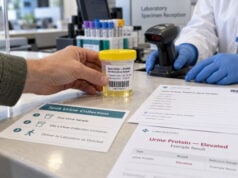
A 24-hour collection directly measures total protein excreted during a full day. To collect it correctly, the patient typically discards the first urine at the start time, then saves all urine for the next 24 hours, including the final void at the end time. Missing a sample causes undercollection; collecting beyond the interval causes overcollection. The common 24-hour urine collection errors are a major reason spot ratios are attractive.
No special fasting is usually needed for routine protein testing. Normal hydration is best. Heavy exercise should be avoided for about a day before repeat testing when practical. Menstruation, urinary infection, fever, or acute illness should be reported because these can alter the result.
A clinician may choose a timed collection when a spot ratio conflicts with the clinical picture, when exact excretion is important, or when monitoring a disease that has traditionally used daily protein output.
How to interpret an abnormal result
The key questions are how high, how persistent, what type of protein, and what else is abnormal?
A mildly high spot concentration in very concentrated urine may not represent significant daily protein loss. A high UPCR on several first-morning samples is more persuasive. A high 24-hour result is only as reliable as the completeness of the collection.
Urinalysis helps identify blood, white cells, casts, glucose, and other clues. Red blood cell casts or substantial dysmorphic hematuria can suggest glomerular inflammation. Pyuria and bacteria may point toward infection. A bland sediment with heavy albumin-dominant proteinuria may fit a different set of diseases.
Serum creatinine and eGFR indicate whether filtration is impaired. Serum albumin can show whether protein loss is severe enough to affect blood protein levels. Blood pressure, diabetes control, medications, autoimmune symptoms, infections, family history, and systemic findings all shape interpretation.
When total protein is disproportionately high compared with urine albumin, clinicians may investigate non-albumin proteins. UPEP separates urinary proteins by electrical mobility; immunofixation can identify monoclonal heavy- or light-chain patterns; serum free light chains add complementary information.
A single unexpected result should often be repeated after transient triggers resolve. Large or rapidly rising values need more urgent attention. A change from 180 to 220 mg/day may reflect ordinary biological or analytical variation, while a rise from 200 mg/day to 3 g/day is a major clinical change.
Follow-up and warning signs
Persistent high urine protein is managed by identifying the cause and reducing kidney risk. For albumin-dominant proteinuria related to diabetes or hypertension, blood pressure control is central. ACE inhibitors or angiotensin receptor blockers are commonly used when appropriate. SGLT2 inhibitors can reduce CKD progression and cardiovascular risk in many eligible people with CKD. Other treatments depend on diabetes status, eGFR, potassium, cardiovascular disease, and the underlying diagnosis.
Glomerulonephritis may require disease-specific therapy, sometimes after kidney biopsy. Tubular proteinuria requires attention to the cause, including medication or toxin exposure when relevant. Monoclonal light-chain proteinuria may require hematology and nephrology evaluation because even a small plasma cell or B-cell clone can produce kidney-damaging proteins.
Nephrology referral is often appropriate for nephrotic-range proteinuria, rapidly increasing protein, active urine sediment, declining eGFR, uncertain cause, resistant hypertension, or a large unexplained gap between total protein and albumin. Significant proteinuria in pregnancy needs obstetric evaluation because the thresholds and implications differ.
Seek prompt care for severe swelling, sudden shortness of breath, very low urine output, visible blood in urine, severe hypertension, confusion, or other signs of acute illness. A urine total protein value is most useful when it leads to the right next test, not when it is interpreted in isolation.
Common interpretation pitfalls and practical examples
One of the easiest mistakes is to treat a spot total protein concentration as though it were a daily excretion rate. A value of 30 mg/dL in a highly concentrated morning sample does not mean the person loses 30 mg of protein per day, and it cannot be compared directly with the 150 mg/day reference used for 24-hour collections. The sample volume and creatinine concentration matter.
For example, two people can both excrete the same amount of protein over a day, yet one may have a spot concentration of 8 mg/dL after drinking plenty of fluid while the other has 35 mg/dL after overnight fluid restriction. A UPCR can make the samples more comparable by normalizing protein to creatinine.
Another common issue is assuming that “total protein high” means albuminuria. Albumin can dominate in glomerular disease, but substantial non-albumin protein can come from tubular injury or monoclonal light chains. Comparing total protein with uACR is a practical way to decide whether albumin explains most of the result. A large discrepancy is not diagnostic, but it is an important clue.
Consider a person with UPCR 900 mg/g and uACR 820 mg/g. Most of the excess protein is albumin, so a glomerular pattern is likely. Now consider UPCR 900 mg/g and uACR 70 mg/g. That second pattern suggests that roughly 830 mg/g is non-albumin protein and makes tubular or overflow proteinuria more important in the differential diagnosis.
A third pitfall is overinterpreting small changes. A 24-hour result of 220 mg/day followed by 260 mg/day may reflect biological variation or collection differences. A rise from 250 mg/day to 4,000 mg/day is qualitatively different. Trends should be interpreted with the collection method, serum albumin, eGFR, blood pressure, and urinalysis.
Finally, total protein is not a good screening substitute for uACR in every patient. Early diabetic kidney disease can produce modest albuminuria that is clinically important before total protein crosses a laboratory threshold. Conversely, monoclonal light-chain disease can produce important non-albumin protein. The best test is the one aligned with the suspected mechanism rather than the one that simply sounds most comprehensive.
Total protein can also be useful when monitoring a known glomerular disease whose treatment targets are expressed in grams per day or g/g. In that setting, repeating the same measurement method matters. Switching back and forth among raw concentration, UPCR, and 24-hour collections can create apparent changes that reflect method rather than disease.
If a 24-hour collection is repeatedly inconsistent, a spot UPCR may actually provide a more reproducible clinical trend. Conversely, a carefully performed timed collection can be valuable when a spot ratio is distorted by unusual muscle mass or when exact daily excretion is needed for a specialist decision. The methods are complementary rather than one being universally superior.
Patients should avoid trying to lower a test value by excessive water intake before sampling. Dilution can change a raw concentration but does not treat protein loss. Stable hydration and correct collection produce a more useful result for clinical decision-making.
If a total protein result is unexpected, repeating the test after fever, infection, intense exercise, or menstruation has resolved can prevent unnecessary workup. Persistence is especially important when the elevation is modest. Marked proteinuria or associated kidney dysfunction, however, should not be delayed simply to obtain a perfectly timed sample.
References
- KDIGO 2024 Clinical Practice Guideline for the Evaluation and Management of Chronic Kidney Disease 2024 (Guideline)
- Methods for Diagnosing Proteinuria-When to Use Which Test and Why: A Review 2025 (Review)
- Measuring albuminuria or proteinuria: does one answer fit all? 2023 (Review)
- The urine protein/creatinine ratio as a reliable indicator of 24-h urine protein excretion across different levels of renal function and proteinuria: the TUNARI prospective study 2024
- Protein handling in kidney tubules 2025 (Review)
Disclaimer
This article is for general education and cannot diagnose the cause of an abnormal urine total protein result. Interpretation depends on the reporting method, repeat testing, uACR or UPCR, eGFR, urinalysis, symptoms, medications, pregnancy status, and medical history. Seek prompt care for severe swelling, shortness of breath, visible blood in urine, very low urine output, or acute illness.