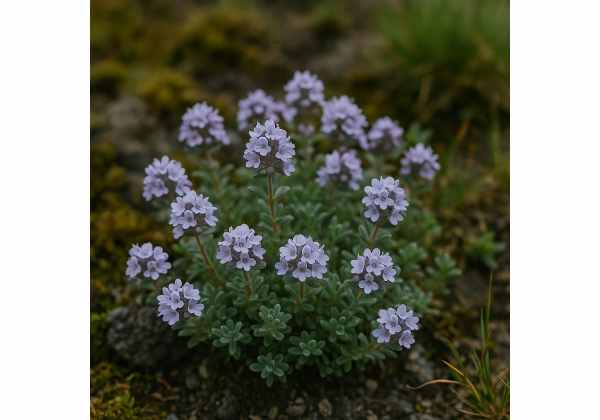
Vatnajokull thyme is best understood as a fragrant creeping thyme cultivar with the low, mat-forming habit people expect from Thymus praecox and the broader medicinal character associated with wild and garden thymes. It is valued first as an aromatic groundcover and culinary herb, but it also belongs to a plant group long used for coughs, colds, digestion, and gentle household herbal care. When the leaves or flowering tops are crushed, they release the warm, resinous scent that signals the presence of volatile compounds such as thymol and carvacrol, along with polyphenols like rosmarinic acid.
The important nuance is that this named cultivar itself has not been studied as a separate medicinal product. In practice, its health discussion is drawn from the broader evidence on thyme species, especially wild thyme and official thyme-herb preparations. That means its most credible uses are supportive rather than dramatic: easing a chesty cough, adding antioxidant-rich flavor to food, and serving as a mild aromatic tea for short-term self-care. Used thoughtfully, it can be both a beautiful garden plant and a practical herb.
Essential Insights
- Vatnajokull thyme may offer mild support for productive coughs and upper-respiratory discomfort.
- Its aromatic compounds may contribute antimicrobial and antioxidant activity.
- A practical adult tea range is 1 to 2 g dried herb in 150 mL boiling water, 3 to 4 times daily.
- Medicinal use is not a good fit for pregnancy, breastfeeding, mint-family allergy, or casual use in very young children.
Table of Contents
- What Vatnajokull thyme is
- Key compounds and medicinal properties
- Potential health benefits and what the evidence supports
- Traditional and modern uses
- How to prepare and use Vatnajokull thyme
- Dosage, timing, and duration
- Safety, side effects, and who should avoid it
What Vatnajokull thyme is
Vatnajokull thyme is a named creeping-thyme selection within the Thymus praecox group, a branch of thyme known for its low, spreading habit, small aromatic leaves, and pink to rosy summer flowers. In the garden, that means a dense carpet rather than an upright kitchen herb. In herbal terms, it means you are dealing with a plant that shares family traits with better-known medicinal thymes but is not identical to the standardized thyme products used in monographs and commercial cough remedies.
That distinction matters. When herbal medicine texts discuss “thyme,” they often mean preparations based on Thymus vulgaris or Thymus zygis, because those are the types most often standardized for pharmacy use. A creeping thyme cultivar such as Vatnajokull can still be aromatic, useful, and traditionally relevant, but it should be approached as a related herb rather than as a one-to-one substitute for every official thyme medicine on the shelf.
From a practical point of view, this cultivar sits in a very appealing middle ground:
- It is ornamental enough for paths, rock gardens, and sunny edges.
- It is aromatic enough to use in small culinary amounts.
- It is herbal enough to make a mild tea from clean, unsprayed material.
- It is variable enough that you should not assume every plant or harvest has the same strength.
The name also suggests an Icelandic or arctic creeping-thyme association, which fits the broader T. praecox pattern of hardy, close-growing, cold-tolerant thyme forms. Garden descriptions emphasize its dense habit and rosy flowers, but for medicinal readers the more important point is that the useful part is still the aerial portion: leaves and flowering tops.
So what should a reader expect from it? Not a miracle herb, and not a blank slate either. Think of Vatnajokull thyme as a pleasantly potent aromatic herb whose best medicinal identity is “thyme-like supportive care.” It is most believable when used the same way thyme has long been used: in modest amounts, for short periods, for everyday problems such as a congested cough, post-meal heaviness, or as a strongly scented seasoning that adds more than flavor.
That grounded view keeps expectations realistic and makes the rest of the discussion clearer. The plant’s value comes from overlap with the broader thyme tradition, not from a special body of research on this cultivar alone.
Key compounds and medicinal properties
The medicinal reputation of thyme comes from a layered chemistry rather than a single “magic” ingredient. In Vatnajokull thyme, as in other creeping and wild thymes, the exact balance can vary with growing conditions, harvest stage, and chemotype. Even so, the main families of compounds are familiar.
The first group is the volatile oil fraction. This is where the strong scent lives, and it includes compounds commonly associated with thyme, especially thymol and carvacrol. These aromatic phenols help explain why thyme has been discussed for antimicrobial, cleansing, and respiratory uses for so long. Other volatile constituents such as p-cymene, gamma-terpinene, and linalool can also shape the aroma and activity.
The second group is the nonvolatile polyphenol fraction. This includes compounds such as rosmarinic acid, caffeic-acid derivatives, and flavonoids including luteolin and apigenin derivatives. These are especially relevant when the herb is taken as a tea or gentle extract rather than as distilled essential oil. They contribute much of the plant’s antioxidant and broader anti-inflammatory reputation.
Put together, those compounds give thyme several traditional medicinal properties:
- Aromatic and warming: useful in teas for a sense of movement and relief rather than heaviness.
- Mildly expectorant: relevant to chesty coughs where mucus needs loosening.
- Carminative: helpful for gas, fullness, or sluggish digestion after meals.
- Antimicrobial in laboratory settings: especially in essential-oil-rich preparations.
- Antioxidant: most relevant as part of food use and whole-herb infusions.
- Mildly soothing to irritated tissues: especially when used as a warm infusion or gargle.
Form matters a great deal. A whole-herb tea gives a gentler and broader profile. A tincture or extract may pull a stronger mix of soluble compounds. An essential oil is far more concentrated and behaves differently from the leaf itself. That is why dried thyme sprinkled on food, thyme tea, and thyme oil should never be treated as interchangeable.
This chemistry also explains why thyme is often grouped with other aromatic mint-family herbs such as oregano. They share some of the same fragrant phenols and many of the same traditional talking points, yet each plant still has its own personality, intensity, and safety profile.
For readers trying to make sense of “key ingredients,” the most useful takeaway is simple: thymol and carvacrol give thyme much of its pungent antimicrobial identity, while rosmarinic acid and related polyphenols give it much of its whole-herb depth. The plant’s medicinal value comes from that combination, not from a single isolated molecule.
Potential health benefits and what the evidence supports
The strongest way to talk about Vatnajokull thyme is to separate three things: traditional use, laboratory evidence, and human clinical evidence. When those are blended carelessly, thyme starts sounding stronger than the evidence really allows.
The most credible benefit is short-term support for productive coughs associated with colds. Official European herbal guidance for thyme herb focuses on chesty cough, and human research on thyme-containing combinations has found meaningful symptom improvement in acute bronchitis and cough settings. That does not prove that this exact cultivar has been clinically tested on its own, but it does support the broader thyme pattern: aromatic thyme preparations can be sensible supportive care when mucus is present and symptoms are mild.
A second believable benefit is digestive comfort. Thyme tea has long been used after meals when there is bloating, heaviness, or a sense of sluggish digestion. This is one of those uses that fits both the plant’s aroma and its traditional role. The evidence here is more traditional and mechanistic than clinically definitive, but it is a realistic, low-drama use.
A third area is antimicrobial potential. In laboratory work, thyme extracts and especially thyme essential oils show activity against a range of bacteria and fungi. This helps explain the herb’s old reputation for cleansing, preserving food, and supporting oral or skin hygiene. Still, lab activity is not the same as proven internal treatment in people. A petri dish result should not be translated into “this cures infection.”
A fourth area is antioxidant and anti-inflammatory support. Whole thyme and thyme-derived compounds contain phenols and flavonoids that can help explain the herb’s reputation for tissue protection and general resilience. In practical terms, this matters most when thyme is used regularly in food or modestly in tea, not when people chase extreme doses.
The evidence is weaker or more preliminary when claims become broader. There is interesting preclinical discussion around metabolic health, immune modulation, and topical uses, but these areas are not yet solid reasons to treat Vatnajokull thyme as a disease-focused remedy.
A good way to rank the benefits is this:
- Best supported: short-term support for productive cough and thick mucus in mild upper-respiratory illness.
- Reasonably traditional and practical: digestive comfort, especially after heavy meals.
- Promising but mainly preclinical: antimicrobial, antioxidant, and anti-inflammatory effects.
- Not well supported: sweeping claims about curing infections, replacing antibiotics, or treating serious chronic disease.
Readers often compare thyme with peppermint for digestive and respiratory support. That comparison is useful because peppermint tends to feel cooler and more soothing, while thyme feels warmer, sharper, and more drying. In other words, thyme often makes more sense when mucus and heaviness are part of the picture.
The most honest conclusion is that Vatnajokull thyme has real herbal potential, but its strongest role is modest, short-term, and supportive.
Traditional and modern uses
Thyme has survived in household herbal practice because it is easy to use, pleasant to smell, and relevant to ordinary complaints. Vatnajokull thyme fits that pattern well, especially for readers who grow their own herbs and want one plant that can move between the garden, kitchen, and teacup.
Traditionally, thyme was used in several overlapping ways:
- As a warm tea for coughs, colds, and throat discomfort
- As a digestive herb after rich or greasy meals
- As a gargle for mild mouth or throat irritation
- As a culinary seasoning that also supported preservation and digestion
- As an aromatic topical ingredient when properly diluted
Those uses still make sense today, but the modern version should be more careful about concentration and preparation.
A few realistic uses for Vatnajokull thyme include:
- Culinary use: finely chopped fresh leaves in roasted vegetables, potatoes, fish, beans, and savory broths
- Herbal tea: a short-term infusion during a chesty cold or after meals
- Gargle: a cooled strained infusion for mild throat irritation
- Aromatic steam from the infusion itself: used cautiously for a sense of respiratory openness
- Garden-to-kitchen herbal support: harvesting a small amount from a clean, unsprayed plant
What it is not well suited for is casual essential-oil experimentation. Many people hear “thyme is antimicrobial” and jump directly to swallowing drops of oil or applying strong homemade mixtures to skin. That is not a traditional-strength use of the herb; it is a concentrated modern shortcut, and it is where many safety problems begin.
Because this cultivar is also a decorative groundcover, one practical question matters: was the plant grown for eating? If it has been sprayed, fertilized heavily for ornament, or planted where pets walk or road dust settles, it is better admired than brewed. Medicinal use should come only from clean, intentionally harvested aerial parts.
In spirit, Vatnajokull thyme belongs to the same kitchen-medicine tradition as sage as a traditional aromatic household herb. Both can season food, both can be brewed, and both work best when used with restraint rather than exaggerated expectation.
That dual identity is part of its appeal. You do not need a complicated protocol to benefit from it. A little thyme in food can be a daily habit. A short course of thyme tea during a cold can be a simple act of self-care. A gargle made from the same herb can support the throat without turning the plant into a pharmaceutical fantasy.
How to prepare and use Vatnajokull thyme
The safest and most useful way to work with Vatnajokull thyme is to choose preparations that stay close to the herb itself. For most people, that means food, tea, and simple infusion-based preparations.
Tea or infusion
For mild respiratory or digestive use, tea is the best starting point.
- Measure 1 to 2 g dried herb, or a modest equivalent amount of fresh clean flowering tops.
- Pour over 150 mL freshly boiled water.
- Cover and steep for about 10 minutes.
- Strain before drinking.
Covering the cup matters because the aromatic fraction is part of the point, and leaving the cup open lets some of that aroma escape.
Gargle for throat comfort
Make the same infusion, let it cool until warm rather than hot, then gargle and spit. This is a simple use when the throat feels coated or mildly irritated.
Culinary use
Fresh or dried Vatnajokull thyme can be used in:
- soups and broths
- roasted root vegetables
- bean dishes
- fish and poultry
- herb butter or olive-oil infusions for food
Food use is the mildest way to benefit from its antioxidant and aromatic character.
Steam from the herb infusion
Some people enjoy inhaling the steam from a bowl or mug of hot thyme infusion. Keep this gentle and brief, and avoid getting too close. This should never be treated as a reason to put essential oil on the face or near the nostrils of children.
What to avoid
Avoid improvising with essential oil unless you are using a professionally made product with clear directions. The herb and the oil are not equal in strength. Do not assume that “natural” means “safe at any concentration.”
For people who prefer a softer, more lemony cup, lemon balm is often an easier everyday tea, while thyme is the more pungent and purpose-driven option.
The larger principle is to match the preparation to the goal. Tea and food are appropriate first-line uses. Strong oil-based experimentation is not.
Dosage, timing, and duration
Dosage with thyme can be confusing because different products use different plant species, extraction methods, and strengths. That is especially true for a cultivar such as Vatnajokull thyme, which is best understood through broader thyme guidance rather than through its own standardized monograph. For that reason, whole-herb tea is the most practical place to begin.
Practical whole-herb dosing
A commonly used adult herbal-tea range is:
- 1 to 2 g dried herb
- in 150 mL boiling water
- taken 3 to 4 times daily
This is the clearest short-term home-use range for cough-related self-care.
Timing
Timing depends on the goal:
- For a productive cough, space doses through the day so the herb is present when symptoms are most bothersome.
- For digestion, drinking the tea after meals often makes more sense than taking it on an empty stomach.
- For throat comfort, warm freshly made tea or gargle is usually more useful than a single large dose.
Duration
Short courses fit thyme best. If you are using it for a cold or chesty cough, think in days, not months. A good practical rule is to reassess after about a week. If symptoms are persisting, worsening, or becoming more intense, home treatment has reached its limit.
Commercial products
Liquid extracts, tinctures, syrups, and dry extracts can vary enormously. Some official thyme-herb monographs list ranges such as:
- tinctures taken several times daily
- dry extracts in the tens to low hundreds of milligrams per dose
- liquid extracts measured in milliliters several times daily
Those numbers can be useful background, but they are not interchangeable across brands. Follow the label on the exact product you buy, especially if it combines thyme with other herbs such as ivy or primula.
Children
This is where extra caution is needed. Some thyme liquid preparations have child-specific directions, but many thyme-herb forms are not recommended for younger children. For a homegrown cultivar, that means adult use is the clearest default unless a pediatric clinician advises otherwise.
The simplest dosing philosophy is this: start with the herb, not the oil; start with tea, not concentrated extracts; and keep the duration short and purposeful.
Safety, side effects, and who should avoid it
Vatnajokull thyme is usually easy to tolerate in culinary amounts, but medicinal use deserves more care. The whole herb is gentler than the essential oil, and most safety mistakes happen when that distinction is ignored.
The most common side effect from thyme-herb use is simple stomach upset. Some people feel warmth in the stomach in a good way; others find the same effect irritating. If nausea, burning, or persistent digestive discomfort appears, the dose is probably too much or the herb is simply not a good fit.
Allergy is another important concern. Thyme belongs to the mint family, Lamiaceae. Anyone with known sensitivity to mint-family herbs should avoid medicinal experimentation. That matters even more with concentrated products.
People who should be especially cautious or avoid medicinal use include:
- pregnant or breastfeeding people, because medicinal-strength safety has not been well established
- young children, especially with concentrated preparations
- people with known Lamiaceae allergy
- anyone considering essential-oil ingestion
- people with severe or worsening respiratory symptoms
Concentrated thyme oil deserves its own warning. It is far more irritating than the herb itself and can be harsh on skin and mucous membranes. It should not be applied casually to the face, the inside of the nose, or used undiluted. Babies and infants are especially poor candidates for strong aromatic oils near the airway.
Interactions are not well documented for simple thyme-herb preparations, which sounds reassuring but should not be misunderstood. “None reported” is not the same as “anything goes.” Herbal cough products may contain alcohol, sugar, or other herbs, and concentrated preparations deserve label-level caution.
Seek medical care rather than self-treat when any of the following appear:
- shortness of breath
- high fever
- worsening cough
- coughing with pus-like or foul sputum
- chest pain
- symptoms lasting beyond about one week without improvement
The safest summary is that Vatnajokull thyme is a reasonable short-term herb for adults when used as food or tea, but not a herb to push aggressively. Respect the form, keep the dose moderate, and treat essential oil as a separate and much more concentrated substance.
References
- Phytochemical Profiling and Therapeutic Potential of Thyme (Thymus spp.): A Medicinal Herb 2024 (Review)
- Wild thyme (Thymus serpyllum L.): a review of the current evidence of nutritional and preventive health benefits* 2024 (Review)
- Anti-Inflammatory and Antimicrobial Properties of Thyme Oil and Its Main Constituents 2023 (Review)
- Herbal Medicine for Cough: a Systematic Review and Meta-Analysis 2015 (Systematic Review)
- Community herbal monograph on Thymus vulgaris L. and Thymus zygis L., herba 2013 (Guideline)
Disclaimer
This article is for educational purposes only and does not diagnose, treat, or replace professional medical care. Herbal self-care is best limited to mild, short-term symptoms. Persistent cough, breathing difficulty, fever, chest pain, purulent sputum, pregnancy, breastfeeding, childhood use, and any plan to use concentrated thyme oil should be discussed with a qualified healthcare professional.
If you found this article helpful, please consider sharing it on Facebook, X, or your preferred platform.