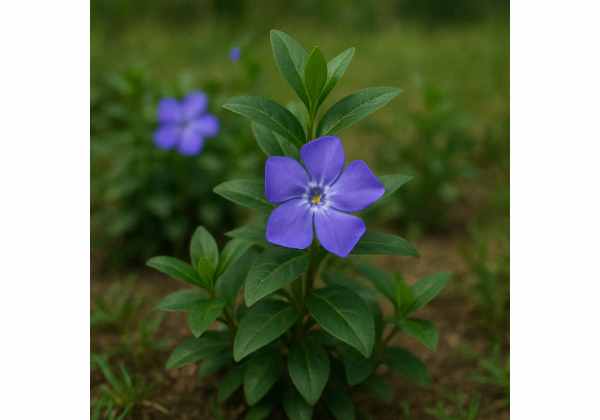
Vinca, usually referring to Vinca minor or lesser periwinkle, is an evergreen groundcover with a long but often misunderstood herbal history. It has been used traditionally for its astringent, vasotonic, and tissue-tightening qualities, especially in topical preparations and older European herbal practice. Modern interest in the plant centers on its indole alkaloids, particularly vincamine, along with tannins and flavonoids that may help explain some of its traditional uses. Yet this is also a plant that needs careful framing. The strongest modern attention around “vinca” often belongs not to the whole herb itself, but to isolated alkaloids or synthetic derivatives related to it.
That distinction matters. Vinca minor has traditional uses and intriguing phytochemistry, but it is not a casual wellness herb, and it is not interchangeable with prescription cancer drugs from related plants. The most reasonable way to approach it is with balanced expectations: possible topical and circulatory support, limited direct clinical proof for whole-herb use, and a stronger need for caution than with gentler household botanicals.
Quick Overview
- Vinca minor is best known for astringent topical use and traditional support for minor tissue irritation.
- Its alkaloid profile has driven interest in circulation and cognitive support, but whole-herb evidence remains limited.
- Traditional tincture use is often around 5 mL up to 3 times daily in a mixed formula rather than as a stand-alone herb.
- Avoid it during pregnancy, with low blood pressure, kidney concerns, or unsupervised use of concentrated extracts.
Table of Contents
- What Is Vinca and Why It Needs Careful Framing
- Key Ingredients and Medicinal Properties of Vinca minor
- Potential Health Benefits and Traditional Uses
- What Modern Research Suggests and What It Does Not
- How Vinca minor Is Used in Practice
- Dosage, Timing, and Duration
- Safety, Side Effects, Interactions, and Who Should Avoid It
What Is Vinca and Why It Needs Careful Framing
Vinca minor is a low-growing perennial in the dogbane family, valued horticulturally for its glossy leaves and violet-blue flowers. In herbal history, however, it has carried a more serious reputation. European traditions used lesser periwinkle for its tightening, drying, and toning actions, especially where tissues were boggy, irritated, or mildly bleeding. Those traditional uses gave the plant a place in older herbal medicine for minor mouth irritation, topical care, and selected circulation-related complaints.
Still, Vinca is one of those herbs that cannot be discussed responsibly without clearing away a few common confusions.
The first confusion is between Vinca minor and related pharmaceutical chemistry. People often hear the word “vinca” and immediately think of cancer drugs such as vincristine or vinblastine. Those medicines are historically linked to the broader periwinkle story, but they are not the same thing as the whole herb Vinca minor. They also should never be used as a shortcut to make the herb seem stronger or more proven than it is. A garden plant with medicinal alkaloids is not the same as a purified or modified drug used under oncology supervision.
The second confusion involves vincamine and vinpocetine. Vinca minor naturally contains vincamine, an alkaloid that has attracted attention for vascular and neurocognitive research. Vinpocetine, by contrast, is a synthetic compound derived from vincamine and marketed separately in some supplement settings. That means claims made for vinpocetine should not automatically be treated as proof for the whole herb. This is one of the most important distinctions in the entire topic.
The third issue is fit. Vinca minor is not a beginner’s tea herb. It is not in the same casual household category as chamomile, lemon balm, or culinary mint. Its alkaloid content is exactly why it has attracted interest, but also why self-prescribing deserves restraint. In practical terms, that means Vinca is better approached as a specialist herb rather than a daily tonic.
A helpful comparison is witch hazel for classic topical astringent support. Both plants can be discussed around tissue toning and topical care, but witch hazel has a much more familiar and approachable public use profile. Vinca is more chemically complex and less suitable for casual experimentation.
So what is Vinca, really? It is a traditional astringent and alkaloid-containing medicinal plant with interesting vascular and tissue-level actions, but with limited modern clinical proof for whole-herb use. That makes it neither useless nor fully validated. It places the herb in a careful middle ground: worthy of attention, but only when its limitations and risks are kept in view from the start.
Key Ingredients and Medicinal Properties of Vinca minor
The chemistry of Vinca minor is the reason this plant remains interesting long after many traditional herbs have faded from serious discussion. Its best-known constituents are monoterpene indole alkaloids, especially vincamine, along with other related alkaloids such as vincine, isomajdine, majdine, and minor constituents that differ across plant parts and growing conditions. These alkaloids are not decorative details. They are central to the plant’s medicinal identity.
Vincamine is the compound most often discussed because it has been associated with cerebral blood flow, vasodilatory effects, and neuropharmacologic interest. That does not mean the whole herb reliably reproduces every isolated-compound effect in humans, but it does explain why Vinca has a long-standing association with circulation, alertness, and older “cerebral tonic” traditions.
Alongside alkaloids, Vinca minor also contains:
- tannins,
- flavonoids,
- phenolic acids,
- and other polyphenolic compounds.
These matter because they help broaden the herb’s profile beyond circulation alone. Tannins support the plant’s traditional astringent use. Flavonoids and phenolic compounds contribute antioxidant behavior in laboratory studies. Together, they help explain why Vinca has been used both externally and internally in older herbal systems.
From a practical standpoint, the main medicinal properties commonly associated with Vinca minor are:
- astringent action,
- mild vasotonic or vasodilatory interest depending on the constituent emphasized,
- antioxidant activity,
- tissue-toning support,
- and possible antimicrobial or anti-inflammatory potential.
That list sounds broad, but the herb works best when interpreted narrowly. Its tannin content points toward surface-level tissue tightening, while its alkaloids point toward pharmacologic potency. That is a rare combination, and it is exactly why the herb can seem attractive on paper but still require caution in practice.
One useful way to think about Vinca is to separate traditional whole-herb properties from alkaloid-driven research interest. Traditional whole-herb use tends to emphasize astringency, topical care, and older bleeding-related applications. Alkaloid-driven research tends to emphasize circulation, cognition, and cellular pharmacology. Both belong in the conversation, but they are not interchangeable.
This also explains why comparisons with ginkgo for circulation and cognitive support sometimes appear in herbal discussions. The two plants are not the same, but both occupy the borderland between traditional use and modern neurovascular interest. The difference is that ginkgo has far broader public familiarity and a more established research culture, while Vinca remains more niche and more constrained by safety considerations.
If there is one key takeaway from the chemistry, it is this: Vinca minor is not merely an ornamental with a few folk uses. It is a biologically active plant with a real pharmacologic profile. That is precisely why discussions of benefits should stay measured, dosage should stay conservative, and safety should never be treated as an afterthought.
Potential Health Benefits and Traditional Uses
When people search for the health benefits of Vinca minor, they are usually looking for a simple list. The problem is that a simple list would be misleading. The best way to understand this herb is to divide its possible benefits into three levels: traditional use, plausible benefit, and poorly proven claim.
The most grounded traditional uses center on astringency and tissue support. In older herbal practice, lesser periwinkle was used for situations where tissues were relaxed, mildly inflamed, or lightly bleeding. That included occasional topical use for small wounds, irritation of the mouth or gums, and older folk applications for hemorrhoidal or mucosal complaints. These uses make sense pharmacologically because tannin-rich herbs tend to tighten surface tissues and reduce weeping or excessive secretion.
A second traditional theme is circulatory support, especially in relation to the head and small vessels. This is where vincamine becomes relevant. Older herbal traditions and later alkaloid interest connected Vinca to cerebral circulation and vascular tone. In modern language, that translates into interest around mental clarity, vascular support, and brain perfusion. But this area demands caution because much of the enthusiasm comes from constituent research rather than robust trials of the whole herb.
A third potential area is topical skin support. Laboratory and formulation studies have explored Vinca minor extracts in dermato-cosmetic preparations and wound-related settings. The idea is not that Vinca is a miracle skin herb, but that its alkaloids and polyphenols may contribute antioxidant, surface-protective, and tissue-repair effects when used appropriately in topical formulas.
Reasonable traditional and emerging benefit categories include:
- minor tissue-tightening support,
- topical care for irritated skin,
- mild support for oral or gum irritation in traditional contexts,
- and exploratory vascular or cognitive support linked mainly to alkaloids.
Less reasonable claims include sweeping promises about dementia reversal, major blood pressure treatment, or broad cancer support from home use of the herb. Those claims overstep the evidence and confuse the plant with either isolated alkaloids or prescription-level pharmacology.
A useful practical comparison is calendula for gentler topical skin support. Calendula is often the friendlier first choice when the goal is soothing minor skin irritation. Vinca enters the conversation when someone is specifically interested in astringency and alkaloid complexity, not when a simple household topical herb would do.
So, does Vinca have health benefits? Yes, potentially, but they are best described as selective rather than broad. It may have value where tissue tone, mild topical support, or vascular-phytochemical interest are relevant. What it does not have is a strong modern clinical record proving broad oral benefit for common self-care. That difference is not minor. It is the difference between using the herb intelligently and using it on reputation alone.
What Modern Research Suggests and What It Does Not
Modern research on Vinca minor is genuinely interesting, but it is also easy to overread. The strongest recent work has focused on phytochemical analysis, alkaloid mapping, extract behavior in laboratory systems, and exploratory drug-discovery potential. That tells us the plant is chemically rich and biologically active. It does not automatically tell us how well a home tincture or tea will work in people.
Recent studies have helped clarify several points.
First, Vinca minor clearly contains a diverse alkaloid profile, with vincamine as one prominent component. That supports long-standing interest in neurovascular and pharmacologic actions. Second, extracts have shown antioxidant, antibacterial, and cytotoxic activity in laboratory settings. Third, topical and dermato-cosmetic research suggests the plant may have future relevance in skin-oriented formulations. Fourth, some newly characterized alkaloids and alkaloid scaffolds have attracted attention in neurodegenerative research, especially in relation to enzyme targets involved in cognitive decline.
All of that is meaningful. But none of it should be turned into a blanket statement that the whole herb is clinically proven for cognition, wound healing, or circulation disorders.
This is where evidence grading matters:
- Phytochemical evidence tells us what is in the plant.
- Preclinical evidence tells us what extracts or compounds can do in cells, assays, or animal models.
- Clinical evidence tells us what actually seems to help people in real-life treatment.
For Vinca minor, levels one and two are far stronger than level three. That is why the herb is best discussed as promising, mechanistically interesting, and still only partly validated for whole-herb use.
The cognitive angle deserves special caution. Some readers encounter claims that lesser periwinkle “improves memory” or “supports dementia.” Much of that enthusiasm traces back to research on vincamine or the synthetic derivative vinpocetine, not high-quality evidence on standard Vinca minor preparations. Even where vinpocetine has been studied, results have been mixed, and regulatory as well as safety questions remain. In other words, the headline is narrower than the marketing.
The circulation angle is similar. It is reasonable to say Vinca has a history of vascular interest and contains alkaloids that have inspired cerebral-circulation research. It is not reasonable to present the whole herb as a proven treatment for cerebrovascular disease or age-related cognitive decline.
This is why Vinca is better compared with gotu kola for broader traditional microcirculatory support only in a very qualified way. Gotu kola is typically used more gently and more widely, whereas Vinca sits closer to a pharmacologically sharp edge.
The most responsible summary of the research is this: Vinca minor is a scientifically interesting medicinal plant whose compounds justify attention, especially in pharmacognosy and topical formulation work. But the whole herb still lacks the kind of strong, direct human evidence that would justify bold public claims. The plant deserves respect, not exaggeration.
How Vinca minor Is Used in Practice
In traditional and modern herbal settings, Vinca minor is not usually treated as an all-purpose infusion herb. It is more often handled as a specialist ingredient, especially in tincture formulas or topical products. That alone tells you something important: experienced herbal practice tends to use the plant with structure, not casually.
The most common real-world approaches include:
- tincture formulas,
- topical lotions or creams,
- diluted preparations for local tissue support,
- and far less commonly, internal solo use.
Topical use tends to make the most practical sense for general readers. When the aim is local tissue toning, mild astringent support, or skin-focused application, a topical format keeps the use targeted. This aligns with both the herb’s tannin content and the direction of newer formulation work. It also reduces the temptation to treat the plant like a routine daily oral supplement.
Internal use is a different matter. Traditional European herbalism has used Vinca minor in oral preparations, but modern practice is often more restrained because of the alkaloid profile. When it is used internally, it is commonly included as part of a mixed formula rather than taken alone in high amounts. That mixed-formula approach helps moderate intensity and place the herb in a clearer therapeutic context.
Practical use decisions often depend on the goal:
- For topical support: a professionally formulated cream, lotion, or external preparation makes more sense than homemade concentrated extracts.
- For vascular or cognitive interest: self-treatment is less appropriate, because the evidence is not strong enough and the pharmacology is more complex.
- For minor oral or mucosal uses in traditional practice: professional guidance is preferable because dose and preparation matter.
One of the most common mistakes is assuming that “natural” equals simple. With Vinca, that is not true. It is also a mistake to jump from constituent research to self-treatment. A reader might see that Vinca alkaloids have intriguing lab effects and conclude that stronger homemade preparations are better. In reality, that is exactly where risk rises faster than benefit.
A more sensible comparison for everyday use would be chamomile when a gentler anti-inflammatory herb is enough. Chamomile often suits routine self-care; Vinca usually does not. That does not make Vinca inferior. It makes it more specialized.
In short, how Vinca minor is used matters almost as much as why it is used. The plant fits best in cautious, targeted practice. Topical use is generally the most approachable. Internal use is better left to people who understand the herb’s alkaloid profile or who are working with a qualified clinician or experienced herbal professional.
Dosage, Timing, and Duration
Dosage is the section where many herb articles become overly confident, and Vinca minor is a perfect example of why that is a problem. There is no widely accepted, evidence-based modern clinical dosing framework for whole-herb Vinca minor comparable to the kind of dosing guidance available for better-studied botanicals. That means any dosage discussion should be framed as traditional or practice-based, not as firmly established clinical fact.
In traditional Western herbal practice, Vinca minor is often used as an alcoholic tincture rather than as a simple tea. One common practice limit is to include it as no more than about 25 percent of a tincture formula rather than making it the entire formula. Within that context, a traditional adult amount is often around 5 mL of the blended tincture up to three times daily. This conservative, mixed-formula approach reflects the herb’s potency and the desire not to over-rely on it alone.
Topical use is less standardized but often easier to justify. In that setting, the most sensible approach is not to improvise a dose by weight, but to use a prepared product according to its label instructions. For many topical herbal products, that means a thin application once or twice daily, watching the skin for irritation and stopping if redness or discomfort increases.
A careful dosing framework for Vinca minor looks like this:
- Choose the lowest-complexity form that matches the goal.
- Prefer topical use over internal use for unsupervised home care.
- If using internally, avoid high-dose stand-alone preparations.
- Use it for a limited trial period rather than indefinitely.
- Stop quickly if unwanted effects appear.
Duration matters as much as dose. Vinca minor is not a herb that invites casual long-term use. If someone is trying it for a defined purpose and sees no clear benefit within a short period, that is a strong reason to stop rather than escalate. The risk with alkaloid-containing plants is often not one dramatic event, but the slow drift from careful use into overly confident use.
Another sensible rule is to match the herb to the seriousness of the problem. Mild topical irritation is one thing. Persistent bleeding, major cognitive symptoms, chronic dizziness, or significant vascular complaints are something else entirely. Those are not situations for extended self-experimentation.
This is also why people looking mainly for vein or vascular self-care may be better served by horse chestnut for better-known venous support questions rather than trying to force Vinca into a role where it has less clear consumer guidance.
The best dosing principle for Vinca minor is restraint. Use the smallest reasonable amount, in the safest reasonable form, for the shortest reasonable time. With this herb, that is not timidity. It is simply good judgment.
Safety, Side Effects, Interactions, and Who Should Avoid It
Safety is where Vinca minor stops being a curiosity and becomes a real medicinal plant. Its alkaloids are not trivial, and that is why this herb deserves more caution than its delicate appearance suggests. A responsible article on Vinca cannot end with “generally safe.” The safer conclusion is narrower: it may be used cautiously in the right context, but it is not appropriate for broad unsupervised use.
The groups most clearly suited to avoidance or professional-only use include:
- pregnant or potentially pregnant adults,
- breastfeeding adults,
- people with low blood pressure,
- people with kidney concerns,
- children,
- and anyone using multiple cardiovascular or nervous-system active products.
This caution becomes even more important when products are marketed around cognition or circulation. Some consumers assume they are buying a natural plant extract when, in reality, a product may contain vinpocetine, a synthetic compound derived from vincamine rather than the whole herb itself. That difference matters for both safety and expectations.
Possible side effects or problems from poorly chosen use may include:
- dizziness,
- excessive lowering of blood pressure,
- digestive upset,
- irritation from concentrated topical use,
- and concerns related to nervous-system or kidney stress at higher exposures.
Interaction concerns are not fully mapped, but a few practical patterns deserve attention. Because Vinca minor has been associated with hypotensive activity, it may not combine well with other blood-pressure-lowering agents. Caution also makes sense around digoxin, surgery, and complex supplement stacks aimed at cognition or circulation. Even when hard interaction data are limited, prudent use still matters.
A second safety issue is diagnosis drift. Because Vinca has an old reputation for circulation and tissue support, some people may be tempted to use it for symptoms that should be evaluated properly, such as chronic headaches, persistent dizziness, recurrent mouth bleeding, or suspected vascular disease. That is not a wise role for this herb.
Topical use is often the lower-risk path, but even there, a patch test mindset is useful. If the skin becomes more irritated rather than calmer, that is a sign to stop. Stronger plants are not always better plants.
As a contrast, oak bark for classic astringent support is often easier to frame for local tissue-toning uses because its action is less bound up with alkaloid pharmacology. Vinca can play in the same broad astringent territory, but it carries more baggage and deserves more respect.
The cleanest safety summary is simple. Vinca minor is not the right herb for pregnancy, low blood pressure, casual long-term oral use, or unsupervised concentrated dosing. It may have legitimate traditional uses and intriguing chemistry, but the margin for careless use is smaller than many readers might expect. When uncertainty exists, the safer answer is to choose another herb or get professional guidance.
References
- The Phytochemical Analysis of Vinca L. Species Leaf Extracts Is Correlated with the Antioxidant, Antibacterial, and Antitumor Effects 2021 (Preclinical Study)
- Monoterpene indole alkaloids from Vinca minor L. (Apocynaceae): Identification of new structural scaffold for treatment of Alzheimer’s disease 2022 (Preclinical Study)
- Development of New Dermato-Cosmetic Therapeutic Formulas with Extracts of Vinca minor L. Plants from the Dobrogea Region 2023 (Preclinical and Formulation Study)
- Alkaloids from the genus Vinca L. (Apocynaceae): a comprehensive biological and structural review 2025 (Review)
- Vinpocetine in Dietary Supplements 2023 (Regulatory Safety Notice)
Disclaimer
This article is for educational purposes only and does not replace medical advice, diagnosis, or treatment. Vinca minor contains biologically active alkaloids and is not a routine self-care herb for everyone. Evidence for whole-herb use is limited, and some claims associated with Vinca are actually based on isolated compounds or synthetic derivatives rather than the plant itself. Speak with a qualified healthcare professional before using it internally, especially if you are pregnant, breastfeeding, have low blood pressure, kidney disease, or take prescription medicines.
If you found this article useful, please consider sharing it on Facebook, X, or another platform you prefer.