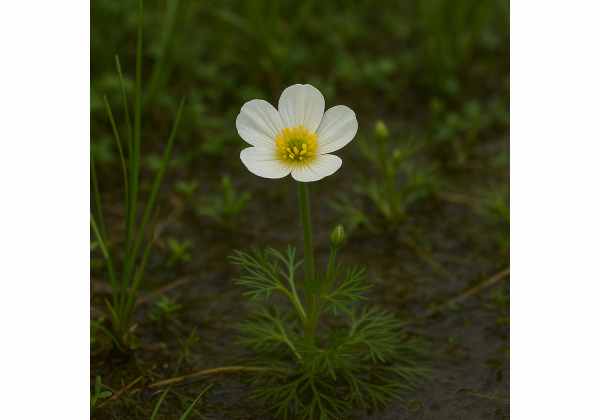
Water crowfoot, also called Ranunculus aquatilis, is an aquatic buttercup that grows in ponds, ditches, and slow streams. It is visually delicate, with white flowers and finely divided underwater leaves, yet its medicinal profile is far less gentle than its appearance suggests. In traditional plant lore, members of the Ranunculus group were sometimes used as external counter-irritants for aches, skin problems, and minor infections. Modern interest comes less from established clinical use and more from the chemistry behind the family, especially ranunculin, protoanemonin, and anemonin.
That chemistry creates a mixed picture. On one side, related buttercup compounds have shown anti-inflammatory, antimicrobial, and antioxidant potential in laboratory research. On the other, the fresh plant is well known for its acrid, blistering sap and its ability to irritate the skin, mouth, and digestive tract. This is why water crowfoot is best approached as a botanically interesting but high-caution herb rather than a casual home remedy.
For most readers, the practical question is not how to take more of it, but how to understand its limited benefits, uncertain dosage, and real safety concerns.
Quick Facts
- Water crowfoot is studied more for irritant chemistry than for safe everyday herbal use.
- Related buttercup compounds show anti-inflammatory and antimicrobial potential in laboratory settings.
- For self-care, 0 g of fresh plant by mouth is the safest guidance because no standardized therapeutic oral range has been established.
- Pregnant or breastfeeding people, children, and anyone with sensitive skin, mouth ulcers, or digestive irritation should avoid it.
Table of Contents
- What Water Crowfoot Is and Why It Stands Out
- Key Ingredients and Why Fresh Plants Can Irritate
- Potential Health Benefits and Medicinal Properties
- Traditional Uses and Modern Practical Context
- What the Evidence Actually Shows
- Dosage, Preparation, and Why Standard Guidance Is Missing
- Safety, Side Effects, and Who Should Avoid Water Crowfoot
What Water Crowfoot Is and Why It Stands Out
Water crowfoot is a member of the buttercup family, Ranunculaceae, a group that includes many plants admired for their beauty, but also known for their biochemical sharpness. Unlike common garden herbs, this is not a dry-land aromatic plant grown mainly for tea, seasoning, or routine wellness. It is an aquatic or semi-aquatic species that lives in cool, shallow water and often forms floating mats or loose patches near the surface.
Botanically, it is notable for having two kinds of leaves. The submerged leaves are finely cut and thread-like, while the floating leaves, when present, are broader and more rounded. The flowers are small, white, and bright, which makes the plant appear harmless. That appearance can be misleading. Like many buttercups, water crowfoot is freshest and most reactive during active growth and flowering, which is also when its irritant potential matters most.
Historically, buttercup-family plants occupied an unusual place in traditional medicine. They were not always chosen because they were gentle. Sometimes they were selected because they were strong enough to provoke a visible reaction. In older folk medicine, a blistering or warming plant might be applied externally to draw blood flow to the surface, distract from deeper pain, or “move” stagnation. This older idea is called counter-irritation. It helps explain why some ranunculaceous plants were used for joint pain, skin sores, and rheumatic complaints even though they could also burn the skin.
That historical context matters because many modern readers equate “medicinal herb” with “safe herbal tea.” Water crowfoot does not fit that pattern. It sits in a narrower category: a plant with ethnobotanical interest, chemically active constituents, and limited room for casual self-treatment.
It also stands out because modern herbalism has mostly moved past it. Safer, better-characterized herbs now fill most of the roles once assigned to sharp or blistering folk remedies. That does not make water crowfoot irrelevant. It remains useful for understanding how traditional herbal medicine often balanced benefit and harm more directly than modern consumers expect. But it does mean the plant should be read with caution first, curiosity second.
In practical terms, water crowfoot matters for three reasons:
- it shows how botanical beauty can hide chemical defense
- it helps explain the ranunculin to protoanemonin pathway found in buttercups
- it illustrates why older use does not automatically translate into modern suitability
That is the frame for the rest of the article. Water crowfoot has a real medicinal story, but it is a restricted and risk-aware one.
Key Ingredients and Why Fresh Plants Can Irritate
The most important thing to know about water crowfoot chemistry is that the fresh plant is not chemically stable once it is bruised, crushed, or chewed. The key precursor is ranunculin, a glucoside found across much of the buttercup family. When plant tissue is damaged, enzymes help convert ranunculin into protoanemonin, the compound most responsible for the plant’s acrid, irritating behavior.
Protoanemonin is the main reason fresh buttercup-family plants can sting, redden, and blister the skin. If taken internally, it can irritate the mouth, throat, and digestive tract as well. That same reactivity is why these plants attracted medicinal use in older traditions. A compound that is irritating at one dose or in one form may also produce a strong physiologic effect that healers once interpreted as therapeutic.
Over time, especially with drying or further chemical change, protoanemonin can dimerize into anemonin. This conversion is a major reason dried material is generally less irritating than the fresh plant. It is also one reason discussions of water crowfoot can become confusing. The fresh plant and the dried plant are not pharmacologically identical, even if they come from the same species.
From a medicinal perspective, the main compounds to understand are these:
- Ranunculin
This is the stored precursor. By itself, it is less dramatic than what it becomes after plant damage. - Protoanemonin
This is the sharp, vesicant, highly reactive compound associated with blistering, burning, and mucosal irritation. - Anemonin
This is a downstream compound formed after protoanemonin changes. It is less irritant and has drawn scientific interest for anti-inflammatory and related bioactivity.
Broader Ranunculus literature also describes other plant constituents in related species, including:
- flavonoids
- phenolic compounds
- glycosides
- sterols
- small amounts of other secondary metabolites
The problem is that water crowfoot itself is not one of the best chemically characterized medicinal members of the genus. That means much of what is said about its “key ingredients” comes from family-level and genus-level knowledge, not from a rich body of species-specific standardization work.
This distinction matters because people often hear that a compound such as anemonin may have anti-inflammatory or antimicrobial promise and then assume the whole fresh plant is useful in the same way. That shortcut is unsafe. A raw plant that generates protoanemonin is not equivalent to a purified or transformed compound studied under laboratory conditions.
That is why water crowfoot belongs in a category of herbs that require chemical humility. Some of its most interesting molecules come from a transformation process that also creates its biggest hazards. The plant’s medicinal promise and its toxic potential are closely linked, not neatly separated.
For readers comparing it with better-known herbs, that makes water crowfoot unusual. Many herbs are used because their active compounds are relatively gentle in culinary or tea-level doses. Water crowfoot is different. Its central chemistry is defensive, reactive, and difficult to standardize, which is exactly why modern self-care use is so limited.
Potential Health Benefits and Medicinal Properties
Water crowfoot is sometimes searched for as though it were a standard wellness herb, but the evidence does not support that kind of positioning. Its potential health benefits are best described as limited, mostly indirect, and often inferred from broader Ranunculus or Ranunculaceae research rather than from robust human studies on Ranunculus aquatilis itself.
The first possible medicinal property is counter-irritant action. In older herbal systems, a plant that mildly irritated the skin could sometimes be used to distract from deeper muscular or joint pain. That sounds strange today, but it was once a recognizable therapeutic idea. A local burning or warming effect was thought to stimulate circulation and alter pain perception. Water crowfoot and its relatives fit this historical model better than they fit the modern model of a soothing anti-inflammatory herb.
The second possible property is anti-inflammatory potential after chemical transformation. Once protoanemonin changes into anemonin, the resulting compound appears much more interesting from a pharmacologic standpoint. Modern reviews describe anemonin as having anti-inflammatory, anti-infective, and antioxidant potential in experimental settings. This is one of the most important nuances in the whole water crowfoot story. The family’s chemistry may contain useful leads, but those leads do not justify raw, fresh-plant self-treatment.
A third area of interest is antimicrobial activity. Protoanemonin has been associated with antimicrobial effects, which helps explain why some buttercup-family plants were applied to infected or inflamed skin in traditional practice. Again, that does not mean the raw plant is a good modern antiseptic. It means the plant contains reactive compounds that can inhibit microbes and injure human tissue at the same time.
A fourth area is antioxidant activity, though this is the weakest to assign directly to water crowfoot. Some broader family and genus studies show antioxidant potential in various extracts, but the evidence is highly uneven and often species-specific.
Taken together, the most realistic “benefits” picture looks like this:
- possible external counter-irritant effects in older folk practice
- possible anti-inflammatory value from transformed or isolated compounds
- possible antimicrobial effects tied to reactive buttercup chemistry
- limited antioxidant promise in the wider family literature
What is missing is just as important:
- no solid evidence for routine oral wellness use
- no recognized role as a daily tonic
- no reliable clinical proof for digestion, immunity, or chronic pain management
- no well-established commercial herbal standard
That is why readers should separate chemical promise from practical herbal use. Those are not the same thing. A plant may yield a medically interesting compound and still be a poor choice as a home remedy. Water crowfoot is a strong example of that difference.
If a person is actually looking for a safer herbal option for aches and inflammation, something like white willow bark for pain-focused support fits modern herbal use far better than a blistering aquatic buttercup. Water crowfoot’s benefits are real mainly as a topic in ethnobotany and phytochemistry, not as a first-line self-care plant.
Traditional Uses and Modern Practical Context
Traditional use of water crowfoot is limited and often best understood through the broader behavior of buttercup-family remedies. In folk medicine, ranunculaceous plants were commonly used in ways that modern herb users may find surprising. Rather than being brewed as mild tonics, they were often applied for strong local effects. External poultices, crushed plant applications, washes, or carefully processed preparations appear much more often in older records than gentle long-term internal use.
The classic traditional themes include:
- rheumatic pain
- muscular aches
- skin sores or rough lesions
- feverish or inflammatory complaints
- strong “reviving” or stimulating actions in some folk systems
These uses reflect an older therapeutic logic. Healers often accepted some irritation if the plant seemed to provoke warmth, circulation, or surface response. In that sense, water crowfoot belongs to a family of herbs once treated almost like controlled irritants.
There are two major problems with transferring that history into modern practice.
First, traditional processing was inconsistent. Some preparations relied on boiling, drying, or brief external contact to reduce harshness. Others used the fresh plant. Those are not interchangeable. A species whose chemistry changes quickly after cutting cannot be assumed to behave the same way across all preparations.
Second, older use did not come with modern toxicology, dermatology, or dosage control. The fact that people once used a plant on sore knees or damaged skin does not mean it was safe. In many cases, the treatment probably worked because it irritated the body strongly enough to create a temporary sense of heat, numbness, or altered sensation. That is not the same as clean therapeutic benefit.
In modern practical terms, water crowfoot has a narrow role. It is more relevant to:
- ethnobotanical study
- phytochemical research
- historical herbal education
- very cautious professional discussion of high-risk plants
It is much less relevant to ordinary home herbalism.
That shift is important because modern readers often search a plant name expecting a direct “how to use it” answer. For water crowfoot, the useful modern answer is usually restraint. The better question is not how to recreate an old poultice, but why herbal practice has largely replaced such remedies with safer alternatives.
For example, when the goal is simple topical comfort, barrier support, or mild skin calming, calendula for topical skin support makes far more sense than experimenting with a fresh buttercup-family plant. The same principle applies more broadly: modern herbalism usually favors herbs whose benefits are separable from their irritant potential.
So the traditional uses of water crowfoot are worth knowing, but mainly as context. They tell us how earlier medical systems thought about pain, skin disease, and plant strength. They do not provide a dependable template for present-day self-care.
That is the practical middle ground: respect the historical record, understand the chemistry behind it, and recognize that many older uses have been set aside for good reasons.
What the Evidence Actually Shows
The modern evidence base for water crowfoot is thin. That single fact explains almost every practical recommendation around this plant. The published literature does support medicinal interest in the Ranunculus genus and the Ranunculaceae family more broadly, but direct, clinically useful evidence for Ranunculus aquatilis remains sparse.
What the evidence does support fairly well is the following:
- buttercup-family plants contain chemically active compounds with real biologic effects
- ranunculin-derived compounds can be strongly irritant in the fresh state
- anemonin and related transformed compounds deserve pharmacologic attention
- some Ranunculus species show antimicrobial, anti-inflammatory, antioxidant, or antiparasitic activity in preclinical work
What the evidence does not support well is this:
- a validated modern medicinal role for water crowfoot itself
- a standardized extract or routine product category for consumers
- human clinical trials showing clear benefit for common conditions
- a confident, evidence-based oral dosing framework
This gap between family-level promise and species-level proof is the most important insight to keep in mind. It is tempting to read a broad review of Ranunculus research and assume the benefits apply evenly across every crowfoot or buttercup. They do not. Some species are much better studied than others, and some have been used precisely because they are harsh, not because they are broadly safe.
There is also a second gap: compound research versus whole-plant use. Anemonin may look promising in laboratory work, but that does not mean a fresh water crowfoot poultice or homemade preparation is a sensible way to obtain benefit. In fact, the whole-plant route is the part most likely to create trouble.
A realistic evidence summary looks like this:
- Ethnobotanical support exists, but it is limited and uneven.
Water crowfoot belongs to a medicinally noticed family, but it is not among the strongest modern herbal candidates in that family. - Preclinical promise exists, especially at the chemistry level.
Reviews of ranunculin, protoanemonin, and anemonin show why researchers remain interested. - Species-specific clinical guidance is largely missing.
That means health claims should stay modest. - Safety concerns are better established than therapeutic outcomes.
This is often the decisive point for self-care decisions.
That balance is why many responsible plant profiles for lesser-known herbs end up sounding cautious. It is not because the herb is uninteresting. It is because the best-supported facts do not justify broad consumer claims.
If someone searching for water crowfoot is really looking for a mild herb to settle the stomach or support everyday wellness, a better-studied option such as ginger for digestive and anti-nausea support usually offers a much clearer evidence-to-risk ratio. Water crowfoot remains scientifically interesting, but the current evidence does not elevate it into routine herbal practice.
Dosage, Preparation, and Why Standard Guidance Is Missing
This is one of the rare herb profiles where the most honest dosage answer is mostly negative: there is no well-established modern therapeutic dosage for water crowfoot that can be recommended for routine self-care.
That does not mean the plant has never been used. It means the available literature does not provide a safe, standardized, clinically supported range in grams, milligrams, or milliliters that readers can apply with confidence. For a plant with significant irritant potential, that absence matters more than it would for a culinary herb or a well-studied standardized extract.
Historically, buttercup-family plants were prepared in ways intended to blunt their harshness. These methods included:
- drying
- boiling
- brief external application
- combining with other materials in poultices or washes
The logic behind these methods was simple. Fresh plant material is usually the most reactive. Drying and heating can reduce the sharpness of protoanemonin-related effects by altering the chemistry. But there are two important limits to that idea.
First, “less irritating” does not mean “safe enough to recommend.”
Second, preparation methods were not standardized, so one person’s traditional decoction may have behaved very differently from another’s.
For practical use, the safest dosage guidance looks like this:
- Fresh plant by mouth: 0 g recommended for unsupervised use
- Fresh plant on skin: avoid self-application because blistering can occur
- Dried or boiled material: still not recommended without expert supervision because no validated dosage standard exists
- Commercial extracts: rare, not well standardized, and not a dependable shortcut to safety
Timing and duration are equally uncertain. There is no strong evidence-based answer for whether water crowfoot should be taken before meals, after meals, once daily, or in short courses. That lack of structure is itself a warning sign. Well-established herbal remedies usually accumulate at least some practical consensus around timing, dose, and treatment length. Water crowfoot has not.
This is also why it should not be treated as a “lost traditional herb” waiting to be rediscovered by home users. Some plants disappear from common practice because they are obscure. Others disappear because better options replace them. Water crowfoot is much closer to the second category.
If the user’s real goal is gentle topical soothing, better options exist. If the goal is digestion, pain relief, or mild inflammation control, other herbs have clearer ranges, better tolerability, and more reliable preparation methods. In other words, the missing dosage guidance is not a minor inconvenience. It is part of the central risk profile.
So while historical processing deserves mention, it does not create a modern recommendation. The most accurate dosage statement is simple: no standardized self-care dose has been established, and fresh oral use should be avoided.
Safety, Side Effects, and Who Should Avoid Water Crowfoot
Safety is the main decision point with water crowfoot. Whatever medicinal curiosity the plant inspires has to be weighed against the fact that fresh buttercup-family plants are well known for causing irritation.
The primary risk is contact irritation. Fresh sap can redden the skin, sting, and in some cases blister. This is not merely a theoretical concern. Related Ranunculus case reports document phytocontact dermatitis that can resemble a chemical burn. The eyes, lips, and other delicate tissues are especially vulnerable.
The second major risk is mucosal and digestive irritation if the fresh plant is chewed or swallowed. Likely symptoms include:
- burning in the mouth or throat
- nausea
- stomach pain
- vomiting
- diarrhea
- marked acrid taste and irritation
The risk is generally higher with fresh, actively growing plant material. Drying reduces some of the problem, but that should not be mistaken for a green light to self-dose. Reduced irritancy is not the same as clinically verified safety.
People who should avoid water crowfoot altogether include:
- pregnant or breastfeeding people
- infants, children, and older adults with fragile skin
- anyone with eczema, dermatitis, broken skin, or chronic wounds
- people with mouth ulcers, reflux, gastritis, or inflammatory bowel irritation
- anyone who is unsure of the plant’s identity
- people who want an herb for routine daily use rather than specialist discussion
There is also a practical identification issue. Aquatic buttercups can be taxonomically tricky, and misidentification is a real concern. If someone cannot identify the plant with confidence, medicinal use should stop before it starts.
Possible side effects and warning signs include:
- redness, stinging, or tingling after skin contact
- blistering or erosions
- burning in the mouth after tasting the plant
- vomiting or significant stomach upset
- persistent pain after a topical application
If these occur, stop exposure, rinse the area well, and seek medical advice when symptoms are significant or involve the eyes, large skin areas, or swallowing.
One of the most useful modern lessons from water crowfoot is that not every traditional remedy deserves revival. Some plants are better appreciated as research subjects or historical examples than as hands-on home treatments. For mild skin irritation, bites, or surface discomfort, a gentler option such as witch hazel for astringent topical use is usually a much better fit.
The overall safety conclusion is straightforward. Water crowfoot is not a beginner herb, not a casual tea herb, and not a sensible plant for unsupervised fresh use. Its medicinal story is real, but the margin between chemical activity and unwanted irritation is too narrow for ordinary self-care.
References
- Therapeutic Potential of Ranunculus Species (Ranunculaceae): A Literature Review on Traditional Medicinal Herbs 2022 (Review)
- Traditional Medicinal Ranunculaceae Species from Romania and Their In Vitro Antioxidant, Antiproliferative, and Antiparasitic Potential 2024 (In Vitro Study)
- Ranunculin, Protoanemonin, and Anemonin: Pharmacological and Chemical Perspectives 2025 (Review)
- Phytocontact dermatitis due to Ranunculus arvensis: Report of three cases 2018 (Case Reports)
- Counter-irritant and other medicinal uses of plants in Ranunculaceae by native peoples in British Columbia and neighbouring areas 1984 (Review)
Disclaimer
This article is for educational purposes only and is not a substitute for medical advice, diagnosis, or treatment. Water crowfoot is not a routine self-care herb, and fresh plant material may irritate the skin, mouth, and digestive tract. Do not use it internally or topically for treatment without qualified professional guidance, especially during pregnancy, breastfeeding, childhood, or when skin or digestive tissues are already inflamed.
If you found this article useful, please share it on Facebook, X, or your preferred platform.