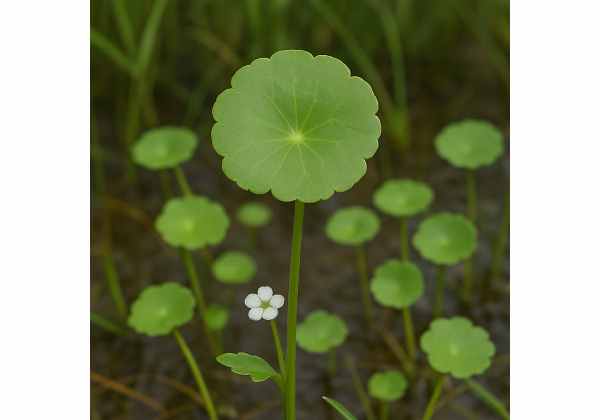
Water Pennywort, also called marsh pennywort or common pennywort, is a low-growing wetland herb with rounded leaves and creeping stems that root as they spread. It belongs to the Hydrocotyle genus, which often gets confused with gotu kola, but Water Pennywort is not the same plant and should not be treated as if it carries the same level of research or the same traditional reputation. Its real interest lies in its long-standing folk use, its adaptable wetland ecology, and its emerging phytochemical profile.
Traditional practice has linked Water Pennywort with topical wound care, minor skin irritation, mild urinary support, and general soothing use. Modern work on the species is still limited, yet recent phytochemical and laboratory studies suggest that it contains flavonoids, phenolic compounds, saponins, terpenoids, and related bioactives that may help explain its antioxidant and anti-inflammatory reputation. Even so, this is not a herb with strong clinical trial support. The most helpful way to approach it is with curiosity, caution, and a clear distinction between traditional use, early lab evidence, and well-proven medical treatment.
Essential Insights
- Water Pennywort is most plausible as a traditional herb for minor skin support and mild topical wound care.
- Its strongest modern interest comes from antioxidant, phenolic, and saponin-rich chemistry rather than human clinical trials.
- A cautious traditional-style serving is about 3 to 5 fresh leaves or 1 cup of a mild decoction once daily.
- Avoid Water Pennywort during pregnancy, breastfeeding, and in children unless a qualified clinician advises otherwise.
Table of Contents
- What Water Pennywort Is and How It Differs from Gotu Kola
- Water Pennywort Key Ingredients and Medicinal Properties
- Water Pennywort Health Benefits and What the Evidence Suggests
- Traditional Uses and Practical Ways to Prepare It
- Water Pennywort Dosage Timing and Duration
- Side Effects Safety and Who Should Avoid It
- Interactions Quality Tips and When Medical Care Matters
What Water Pennywort Is and How It Differs from Gotu Kola
Water Pennywort, Hydrocotyle vulgaris, is a creeping perennial herb that thrives in marshes, wet meadows, shallow ditches, pond edges, and other damp habitats. Its leaves are round to kidney-shaped, held on long petioles, and spread along stolons that root at the nodes. Because it forms low mats and likes moisture, it is sometimes valued as much for ornamental or ecological interest as for herbal use. That dual identity matters. Many people first encounter it as a wetland groundcover rather than as a medicinal plant.
The main point of confusion is its resemblance in name and general appearance to gotu kola. Both belong to the broader pennywort group, and both have rounded leaves. Yet they are not the same species, and they do not share the same evidence base. Gotu kola, or Centella asiatica, has a much more developed modern herbal profile, especially around skin healing, collagen support, and microcirculation. Water Pennywort is better understood as a related but less studied herb whose uses remain more traditional and less standardized. For readers who want the more researched comparison herb, gotu kola for skin and circulation support offers a very different level of evidence and product standardization.
This difference is not just academic. One of the easiest ways to overstate Water Pennywort is to borrow gotu kola’s research and apply it to Hydrocotyle vulgaris. That is not a sound herbal or scientific shortcut. Some overlap in chemistry and traditional themes may exist, but species identity still matters.
Botanically, Water Pennywort belongs to the Araliaceae family in current classification and has a broad distribution in wet habitats. It is native to parts of Europe, Africa, and other moist temperate regions, and it has also spread or been cultivated elsewhere. Its ecological resilience is striking. It tolerates fluctuating water depth, spreads vegetatively, and adapts to disturbed wet ground. Those traits help explain both its survival and a practical caution: wetland plants can accumulate environmental contaminants, so gathering it casually from drainage channels, roadside ditches, or polluted ponds is not wise.
Traditional use has varied by region, but the herb is usually associated with mild internal use and more practical external applications. Folk medicine has described it for cuts, minor wounds, irritation, mild heat patterns, and some urinary or fever-related complaints. None of that makes it a first-line treatment for disease. It simply explains why Water Pennywort still attracts interest among readers who value lesser-known herbs.
The most useful starting view is this: Water Pennywort is a genuine traditional herb, but a modest one. It is not a miracle plant, and it is not best understood through marketing language. Its real value lies in careful identification, species-specific respect, and a willingness to keep expectations grounded.
Water Pennywort Key Ingredients and Medicinal Properties
Water Pennywort does not appear to rely on a single signature compound. Instead, its medicinal interest comes from a mix of phytochemicals that together support its traditional reputation. Recent phytochemical profiling of Hydrocotyle vulgaris leaves has identified broad classes such as flavonoids, phenolics, saponins, tannins, terpenoids, alkaloids, quinones, glycosides, and steroids. More detailed screening has also pointed to compounds such as ferulic acid, vanillic acid, quercetin-related signals, and other plant markers consistent with antioxidant activity.
This matters because medicinal herbs often make the most sense when their chemistry fits their traditional uses. In Water Pennywort, that fit is fairly plausible. If a plant is historically used for minor skin complaints, tissue irritation, and supportive cleansing or cooling roles, the presence of phenolic compounds and saponins gives that tradition more credibility than folklore alone would provide.
The most useful medicinal properties of Water Pennywort can be grouped into five themes.
First, it appears to have antioxidant potential. Antioxidants are often discussed loosely, but in this context the idea is simple: phenolic and flavonoid compounds may help limit oxidative stress in laboratory systems. That does not prove a large effect in humans, yet it supports the view that Water Pennywort is chemically active rather than inert.
Second, the herb may have mild anti-inflammatory behavior. This claim should remain cautious. Water Pennywort itself lacks strong clinical evidence, but plant compounds such as quercetin-type flavonoids, ferulic acid, and some saponins are commonly associated with inflammation-modulating effects in preclinical work. That is one reason the plant remains interesting for topical and soothing uses.
Third, Water Pennywort has a traditional tissue-supportive reputation. In plain language, that means it has been used where tissues feel irritated, inflamed, or slow to recover. This is especially relevant for minor skin use and wound-related folk applications.
Fourth, it may have mild antimicrobial or cleansing value. The current evidence here is suggestive rather than firm. The phytochemical profile contains compounds that often show antimicrobial relevance in other plants, but Water Pennywort should not be treated as an herbal antibiotic.
Fifth, older and more local traditions describe mild diuretic or urinary-support effects. That claim is not strongly established by modern clinical research, yet it appears often enough in folk practice to be worth mentioning with care.
An older layer of the literature also points to glycosidic and saponin constituents in Hydrocotyle vulgaris. That is a valuable reminder that the herb’s chemistry was noticed long before recent HPTLC work. Even when the pharmacology was not fully mapped, researchers had already identified that Water Pennywort was not just a watery marsh plant. It contained structurally interesting compounds with the potential to affect membranes, tissue response, and surface irritation.
Still, chemistry is not destiny. A plant can contain promising compounds and still lack reliable real-world clinical outcomes. That is exactly where Water Pennywort stands. Its chemistry supports measured interest, but not extravagant claims. The best reading of its medicinal properties is that they are coherent, plausible, and worth respecting, while still far from the level of certainty attached to better studied herbs.
Water Pennywort Health Benefits and What the Evidence Suggests
When people search for Water Pennywort health benefits, they usually want a clean list. The problem is that the clean list can become misleading if it does not separate traditional use from demonstrated clinical effectiveness. For Water Pennywort, that distinction is especially important. The plant does have meaningful traditional uses and interesting lab-based clues, but it does not yet have a strong human evidence base.
The most credible benefit area is minor skin and tissue support. Traditional practice has used Water Pennywort leaves or preparations on cuts, wounds, irritated skin, and localized discomfort. This fits well with the plant’s phenolic and saponin content and with the broader pennywort family pattern of tissue-oriented herbal use. That said, this is still supportive care territory, not proof of wound-healing efficacy on the level of a medical dressing or a well-studied topical botanical. For readers seeking a more established topical herb, calendula for skin comfort and minor irritation is usually the more practical and better-known option.
A second plausible benefit is antioxidant support. Experimental work suggests Water Pennywort can mount antioxidant responses under stress and that its extracts contain free-radical-scavenging compounds. The practical meaning of that is limited but still useful. It helps explain why the herb is discussed for tissue resilience, skin aging concepts, and inflammatory balance in early-stage research.
A third possible benefit is mild anti-inflammatory support. Here again, the wording matters. The herb may help calm minor irritation or inflammatory tone, especially in topical use or short-term traditional use. That is very different from claiming it treats arthritis, autoimmune disease, or chronic inflammatory skin disorders.
A fourth area is mild urinary support or fluid movement. Ethnobotanical records include decocted leaf use and occasional diuretic-style applications. A small animal study also suggests diuretic potential, though this is not enough to justify strong claims. The most accurate way to phrase it is that Water Pennywort has a tradition of gentle urinary support, but not established clinical proof.
Some readers may also come across claims about fever, blood sugar, blood pressure, or general detox support. These uses do appear in folk records, but they should be handled conservatively. Traditional use can point to direction, but it does not confirm effectiveness for modern disease categories.
So what does the evidence actually support?
- The herb contains compounds consistent with antioxidant and tissue-supportive activity.
- Traditional use supports interest in minor wounds, skin irritation, and gentle internal use.
- Direct human clinical research is sparse.
- Benefits are best viewed as plausible and supportive rather than proven and therapeutic.
That balance matters because Water Pennywort sits in a category of herbs that are easy to oversell. It has just enough chemistry and tradition to sound impressive, but not enough clinical data to justify confident disease claims. The most helpful position is to treat it as a modest herb with a coherent profile, not as a hidden cure.
In everyday practice, that means Water Pennywort may be reasonable for cautious, short-term, traditional-style use in minor situations. It is not the herb to rely on for infected wounds, persistent urinary symptoms, chronic inflammatory disease, or unexplained swelling. In those contexts, its biggest benefit is not what it treats, but what it teaches: some herbs are most useful when approached with proportion, not enthusiasm alone.
Traditional Uses and Practical Ways to Prepare It
Traditional Water Pennywort use tends to be straightforward. This is not a herb with a long modern supplement industry behind it, so most of its practical uses come from food-like folk preparations, fresh-plant use, or simple household herbal methods. That simplicity is part of its appeal.
Externally, Water Pennywort has been used as a poultice, leaf sap, crushed-leaf application, or mild wash for cuts, minor wounds, and irritated skin. These uses are consistent with the herb’s reputation as a cooling, soothing, and tissue-friendly plant. Fresh leaves are typically the most intuitive format in traditional settings because they can be crushed directly. In modern practice, hygiene matters more than romance. Any fresh-plant application should be reserved for intact, clean skin or very minor situations, and the herb should never be applied from questionable wetland environments.
Internally, the herb has been taken as fresh leaves, light decoction, or simple tea-style preparation. Ethnobotanical records describe the leaves eaten fresh or decocted in a cup-sized serving. This suggests that Water Pennywort was often approached as a mild herb rather than as a strong medicinal extract. That is a useful clue for modern readers. A plant traditionally taken in food-like amounts should not automatically be converted into a concentrated, high-dose extract.
The most practical ways to prepare Water Pennywort today are:
- Mild infusion or tea
This is the gentlest internal method and the easiest way to test tolerance. - Short decoction
A brief simmer may extract more of the tougher components, but bitterness and unpredictability rise with strength. - Fresh leaf use
Historically common, but only sensible when identification is certain and the plant is clean. - Topical wash or compress
This fits the herb’s traditional role better than aggressive internal use. - Tincture or extract
Possible, but harder to standardize because Water Pennywort products are not common or well regulated.
Source quality matters more with Water Pennywort than with common commercial herbs. Because it grows in wet places and can help with pollutant uptake, foraging from drainage zones, ornamental water features, roadside ditches, or contaminated wetlands is a poor idea. Choose cultivated or carefully sourced material whenever possible.
Preparation should also match the goal. If the aim is simple skin support, a cooled wash or gentle topical use is more logical than swallowing large quantities. If the aim is short internal exploration, a light tea is more appropriate than a concentrated extract. For people who mainly want a familiar herb for minor topical support, plantain leaf for soothing topical use is often easier to identify, source, and use with confidence.
One final point is easy to miss: Water Pennywort is better used alone at first. Multi-herb blends sound sophisticated, but they make it difficult to judge effect, tolerance, or irritation. With a lesser-known herb, clarity matters more than complexity. That means simple preparation, low intensity, and careful observation are the best practical rules.
Water Pennywort Dosage Timing and Duration
Water Pennywort does not have a standardized modern clinical dose. That is the single most important dosing fact to keep in mind. There are traditional use patterns, ethnobotanical records, and a few experimental directions, but there is no well-established monograph that gives a universally accepted adult dose for Hydrocotyle vulgaris.
Because of that, dosage should be guided by three principles: stay low, keep use short, and match the form to the purpose.
For fresh traditional use, ethnobotanical documentation includes servings of about 3 to 5 leaves eaten directly or one cup of leaf decoction once daily or as needed. That is useful because it shows the herb was commonly used in modest amounts rather than in aggressive medicinal doses.
For dried herb, a cautious translation into present-day practice would be about 2 to 4 g of dried aerial parts in 200 to 250 mL of hot water, taken once daily at first. If well tolerated, some people may use the same amount twice daily for a brief period. This should be viewed as a conservative traditional-style range, not a clinical standard.
Timing matters too. Morning or midday is usually better than late evening. If the herb has any mild fluid-moving or digestive effect for you, earlier use makes it easier to observe and less likely to interrupt sleep. Topical use is more flexible and can be used once or twice daily in a short course when the skin tolerates it.
Duration should remain brief unless there is professional guidance. A practical structure is:
- start with one small daily serving
- use it for 3 to 5 days
- reassess your response
- avoid extending self-directed internal use beyond about 1 to 2 weeks
That short-course approach fits both the evidence and the herb’s traditional character. Water Pennywort is not well suited to indefinite daily use as a wellness tonic.
A few common dosing mistakes are worth avoiding. One is borrowing gotu kola doses and applying them to Water Pennywort. Another is assuming that a wetland herb must be harmless because it looks mild. A third is combining Water Pennywort with several diuretic, detox, or skin herbs at once. If you want a more familiar herb for gentle fluid support, dandelion for mild fluid and digestive support is usually easier to dose and understand.
It is also wise to stay cautious with extracts. If you come across a Water Pennywort tincture or concentrated product, remember that the dose may not translate cleanly from traditional leaf use. With lesser-known herbs, extracts increase uncertainty as much as they increase convenience.
The best dosing summary is simple: use the smallest practical amount, start with traditional-style formats, keep the trial short, and stop quickly if the herb does not suit you. With Water Pennywort, restraint is not an afterthought. It is the core of safe use.
Side Effects Safety and Who Should Avoid It
Water Pennywort is often described as a mild herb, but mild does not mean risk-free. In fact, the biggest safety issue is uncertainty. When an herb has limited direct clinical research, the sensible position is cautious use rather than casual reassurance.
Possible side effects from internal use include stomach upset, nausea, loose stool, dizziness, headache, and unusual fatigue. Some traditional records also warn that excess use may cause weakness or anemia-like complaints, though those warnings are not backed by modern clinical confirmation. Even so, they are useful as practical cautions. If a folk tradition repeatedly tells you not to overuse a plant, that is worth respecting.
Topical side effects are also possible. Fresh plant sap or crushed leaves may irritate sensitive skin, especially in people prone to contact reactions. A patch test on a small area is a reasonable precaution before broader use.
Some groups should avoid Water Pennywort unless a qualified healthcare professional recommends it.
Pregnant people should avoid it because pregnancy safety has not been established. The same caution applies during breastfeeding.
Children are another group for restraint. Traditional use in communities does not automatically create a modern pediatric safety standard.
People with kidney disease, significant liver disease, chronic anemia, or unexplained fatigue should also avoid self-prescribing it. Even a mild herb can complicate an unclear clinical picture.
Anyone with infected wounds, fever, spreading redness, persistent urinary pain, or rectal bleeding should not rely on Water Pennywort. Those situations need evaluation, not experimentation.
Another major safety issue is environmental contamination. Because Water Pennywort grows in wet places and can interact strongly with pollutants, plant quality matters more than usual. This is not a herb you should gather from urban runoff channels, ornamental water installations, or unknown marshes and then apply to broken skin.
It is also wise not to confuse Water Pennywort with other pennywort-type plants sold under loose common names. Misidentification is not rare in this category. If the Latin name is missing, assume the product is not reliable enough for medicinal use.
For readers who are mainly interested in topical astringent support around minor hemorrhoidal discomfort or external irritation, witch hazel for topical astringent care is often easier to use and better understood in modern practice. That does not make Water Pennywort irrelevant. It simply shows where it belongs: as a niche traditional herb, not the most straightforward first choice.
The safest overall summary is this: Water Pennywort may be tolerated in small, short, careful use by some healthy adults, but the lack of strong human research means the herb should be treated with more caution than its gentle appearance suggests.
Interactions Quality Tips and When Medical Care Matters
Water Pennywort has no fully mapped modern interaction profile, which means the most honest guidance is to think in terms of plausible risk rather than named confirmed interactions. That is often how good herbal safety starts: not with certainty, but with disciplined caution.
The first concern is combining Water Pennywort with other herbs or medicines aimed at fluid balance. If you are already using diuretics, urinary herbs, or multiple “cleansing” formulas, adding Water Pennywort could make the overall effect harder to predict. Even when a plant is mild, stacking several mild agents can create a non-mild result.
The second concern is combining it with many topical products at once. If a rash, wound, or irritated patch of skin is already being treated with medicated creams, essential oils, steroid preparations, or other herbs, adding Water Pennywort can confuse the picture. If irritation worsens, you will not know what caused it.
The third concern is product quality. Since Water Pennywort is not a mainstream commercial herb, the chance of poor labeling or species confusion is higher than average. Good products should list the full Latin name, the plant part, and ideally the source or batch information. Products labeled only as “pennywort” are not good enough.
Storage also matters. Because wetland-associated herbs can degrade or mold if dried badly, avoid material that smells musty, looks gray or dusty, or has obvious moisture damage. A good dried herb should have a clean plant smell and consistent appearance.
One of the most practical quality rules is this: the more unusual the herb, the less room there is for vague sourcing. Lesser-known herbs deserve better identification, not looser standards.
As for medical care, Water Pennywort should never delay it. Seek evaluation instead of continuing self-treatment if you have:
- fever with wound symptoms
- increasing redness, swelling, or drainage
- persistent urinary pain
- blood in urine or stool
- unexplained fatigue or weight loss
- a skin problem that lasts beyond a brief trial period
- any symptom that seems deeper than minor irritation
This herb may have a place in careful self-care, but only when the problem is small, clearly non-urgent, and improving. If the picture is unclear, the herb’s best role is often to step aside.
For readers who are drawn to Water Pennywort because of old ideas about cleansing, blood cooling, or gentle elimination, it can help to compare it with burdock as a more familiar traditional alterative herb. Water Pennywort remains interesting, but it is the more specialized and less studied choice.
In the end, Water Pennywort is most useful when four things are true at once: the species is correct, the source is clean, the dose is small, and the expectations are modest. When any of those four conditions is missing, the herb becomes much less helpful and much less safe.
References
- HPTLC Profiling of Hydrocotyle vulgaris L. Leaves for Identification of Bioactive Compounds 2025.
- The complete chloroplast genome sequence of Hydrocotyle vulgaris L. (Araliaceae) 2024.
- Quantitative ethnopharmacological documentation and molecular confirmation of medicinal plants used by the Manobo tribe of Agusan del Sur, Philippines 2020 (Ethnopharmacology Study).
- Potential of Hydrocotyle vulgaris for phytoremediation of a textile dye: Inducing antioxidant response in roots and leaves 2013.
- The Glycosidic Constituents of Hydrocotyle Vulgaris L 1959.
Disclaimer
This article is for educational purposes only and is not medical advice. Water Pennywort is a traditionally used herb with limited direct human research, so its benefits, dosing, and safety are not established to the same standard as well-studied medicines or leading herbal monographs. Do not use it to self-treat infected wounds, persistent urinary symptoms, unexplained swelling, chronic skin disease, or any severe or worsening condition. Speak with a qualified healthcare professional before using Water Pennywort if you are pregnant, breastfeeding, taking prescription medicines, living with a chronic illness, or planning to use it for a child.
If you found this article helpful, please share it on Facebook, X, or your preferred platform.