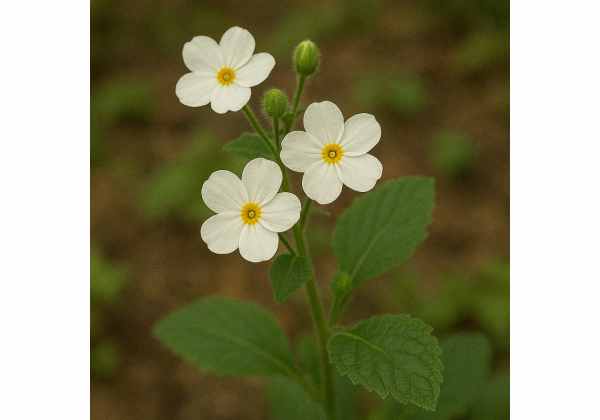
White Navelwort, listed here under the botanical name Omphalodes cappadocica, is a small evergreen perennial in the borage family. In practice, it is far better known as an ornamental woodland groundcover than as a standard medicinal herb, and it is more commonly called Cappadocian navelwort or creeping forget-me-not. That distinction is important from the start. People looking for its health benefits often expect a familiar herbal profile with long-standing therapeutic use, clear dosing rules, and modern human studies. This plant does not fit that pattern.
What makes it interesting is its position between horticulture and pharmacology. Species-specific research is limited, but laboratory work suggests that Omphalodes cappadocica contains volatile compounds and phenolic constituents that may show antimicrobial or cytotoxic activity under experimental conditions. That gives the plant scientific interest, but not enough evidence to support confident self-treatment.
The most helpful way to approach White Navelwort is with restraint: understand what the plant is, what the chemistry may suggest, where the evidence stops, and why safety and accuracy matter more here than bold claims.
Core Points
- White Navelwort is mainly known as a shade-loving ornamental rather than a clinically validated medicinal herb.
- Early laboratory studies suggest possible antimicrobial and cytotoxic activity, but human evidence is lacking.
- No standardized human oral dose in mg or mL has been established for this species.
- Pregnant or breastfeeding people, children, and anyone with chronic illness or prescription drug use should avoid self-dosing it.
Table of Contents
- What White Navelwort Is and How It Is Actually Known
- Key Ingredients and Medicinal Properties
- White Navelwort Benefits and What the Evidence Really Says
- Traditional Uses Modern Interest and Common Misunderstandings
- Dosage Timing and Duration
- White Navelwort Safety Side Effects and Interactions
- When to Avoid It and What to Consider Instead
What White Navelwort Is and How It Is Actually Known
Omphalodes cappadocica is a perennial member of the Boraginaceae, or borage, family. It is native to parts of Turkey and the Caucasus and is best known in gardens as a low, shade-tolerant plant with heart-shaped leaves and small spring flowers that resemble forget-me-nots. In horticultural writing it is usually described as an evergreen or semi-evergreen groundcover for moist, humus-rich soil in partial shade. That gardening identity is not a minor detail. It is the plant’s main modern identity.
This matters because names can confuse people. “White Navelwort” is not the most widely used common name for Omphalodes cappadocica. In botanical and horticultural sources, “Cappadocian navelwort” is far more common. Some cultivars have white edges or pale variations, and the genus as a whole includes species with different flower shades, but O. cappadocica itself is typically discussed as a blue-flowering ornamental. When a plant enters health-content searches under a less standard common name, readers can easily assume it has a stronger medicinal history than it really does.
It also helps to know what kind of plant this is not. It is not a mainstream culinary herb. It is not a common tea herb. It is not a standard phytotherapy product sold in the way chamomile, peppermint, or calendula are sold. And it is not supported by a strong body of human clinical literature. That does not make it uninteresting. It simply changes the kind of guidance that is responsible.
Within the borage family, some plants have richer medicinal traditions, including external wound-care, soothing, or anti-inflammatory associations. That family resemblance may tempt people to assume White Navelwort works the same way. But plant families are not prescriptions. Closely related plants can share useful traits, neutral traits, or toxic traits, and a species with limited study should not be treated as interchangeable with better-known relatives.
That is why the best first description of White Navelwort is not “healing herb.” A better description is “ornamental Boraginaceae species with emerging phytochemical interest.” That sounds less exciting, but it is more accurate. It also prepares the reader for the central reality of this article: most of the meaningful discussion will come from species-specific lab research, family-level phytochemistry, and cautious interpretation rather than from established human herbal use.
For readers who know the borage family through topical herbs, it may help to compare the gap in evidence with a better-defined relative such as comfrey in topical herbal practice. The comparison is useful not because the plants should be used the same way, but because it highlights how much more evidence and tradition one plant can have than another within the same family.
Key Ingredients and Medicinal Properties
The most promising reason White Navelwort appears in medicinal discussions is its chemistry. Although Omphalodes cappadocica has not been studied nearly as deeply as many famous medicinal plants, the available work suggests that it contains volatile compounds and phenolic molecules worth scientific attention. This gives the plant pharmacological interest even if it does not yet justify confident self-care use.
One species-specific study examined the essential oil and volatile constituents of O. cappadocica and identified a complex mixture dominated by compounds such as benzaldehyde, nonanal, 2E-nonenal, tricosane, octanal, and 2-pentyl furan. Those names are not especially marketable, but they matter because volatiles often help explain why a plant shows antimicrobial or biochemical activity in laboratory tests. In plain language, the plant contains aromatic and semi-aromatic molecules that may participate in defense-related effects.
A newer 2026 study adds another layer. It reported that methanol extracts from the aerial parts and roots contained phenolic acids such as rosmarinic acid, quinic acid, vanillic acid, and fumaric acid. This is more immediately relevant to medicinal discussion because rosmarinic acid, in particular, is a well-known plant polyphenol associated in broader phytochemical research with antioxidant and anti-inflammatory behavior. Quinic and vanillic acids also fit a pattern seen in many plants that attract early pharmacological interest.
From the wider Boraginaceae family, we also know that plants in this group often contain useful classes of compounds such as phenolic acids, flavonoids, tannins, saponins, mucilages, essential oils, and in some taxa more concerning alkaloids. That family context does not prove that White Navelwort contains each of these in therapeutically meaningful amounts, but it does explain why the plant deserves chemical study rather than dismissal.
The most defensible medicinal properties to discuss for White Navelwort are therefore not proven clinical actions. They are plausible laboratory-level properties, including:
- Antimicrobial potential linked to volatile constituents
- Antioxidant potential linked to phenolic compounds
- Early cytotoxic activity in cancer-cell models
- General Boraginaceae-style relevance to skin, inflammation, and plant defense chemistry
The phrase “plausible laboratory-level properties” is important. This is not the same thing as saying the herb is an effective antimicrobial or anticancer remedy in humans. It means only that the chemistry provides enough reason for further study.
For perspective, many plant articles overstate the leap from compound presence to therapeutic usefulness. A plant can contain rosmarinic acid or aromatic volatiles and still be unsuitable as a home remedy because extraction, dose, bioavailability, and safety are unknown. That is exactly why White Navelwort needs careful framing. The chemistry is interesting, but it is not yet a consumer-ready story.
Readers who want a better-known antioxidant herb with clearer traditional use will usually find a stronger evidence path in plants such as rosemary for antioxidant support. White Navelwort may eventually earn a more precise medicinal profile, but at present its ingredients are best understood as research signals, not as proof of reliable household benefit.
White Navelwort Benefits and What the Evidence Really Says
When people search for the health benefits of White Navelwort, they usually want answers in the language used for familiar herbs: digestion, immunity, skin, inflammation, sleep, circulation, or pain. The evidence for Omphalodes cappadocica does not support that kind of broad therapeutic checklist. What it supports is much narrower and more preliminary.
The clearest species-specific benefit area is antimicrobial potential. In the available essential-oil study, White Navelwort showed antibacterial activity against several tested organisms and fungicidal activity against certain yeasts in a laboratory setting. That is meaningful, because it suggests the plant is not chemically inert. But the finding remains experimental. Laboratory antimicrobial activity does not automatically translate into safe or useful internal use, topical treatment, or real-world infection management.
The second benefit area is cytotoxic activity in cancer-cell work. The 2026 comparative study of aerial parts and roots found notable in vitro effects against breast-cancer cell lines and identified phenolic acids that may contribute to those actions. This is scientifically interesting, particularly because the aerial parts appeared more active than the roots in that model. Still, cancer-cell studies are among the most frequently overstated parts of botanical research. Many plant extracts can affect isolated cells in a dish. Far fewer become safe or effective human therapies.
A third, more indirect benefit area is antioxidant potential. This is inferred from the plant’s phenolic content and from what is known about compounds such as rosmarinic acid. Antioxidant language is common in supplement marketing, but in responsible writing it should be kept proportionate. Antioxidant potential can help explain why a plant draws research interest, yet it does not justify sweeping claims about anti-aging, detoxification, or disease reversal.
So what benefits can be stated honestly?
- White Navelwort has species-specific laboratory evidence suggesting antimicrobial activity.
- It has early in vitro evidence suggesting cytotoxic effects in selected cancer-cell models.
- Its chemical profile suggests possible antioxidant relevance.
- It does not have strong human evidence supporting routine medicinal use.
That last point is the one most readers need. The evidence base is simply too thin for claims such as “supports immunity,” “heals the gut,” “protects the liver,” or “treats inflammation” to be presented as established outcomes. The plant may someday contribute to drug discovery or topical ingredient development, but that is different from being a proven herb today.
It is also useful to understand the difference between “promising” and “practical.” White Navelwort is promising in a laboratory sense. It is not practical in the same way as a better-characterized herb chosen for daily self-care. For example, if someone wants a gentler, better-known plant for topical soothing or superficial irritation, calendula is far easier to recommend responsibly.
The most balanced summary is that White Navelwort shows early pharmacological promise, especially in laboratory models, but its health benefits remain provisional and unconfirmed in humans. That may be less dramatic than the search query implies, yet it is exactly the kind of clarity that helps readers make better decisions.
Traditional Uses Modern Interest and Common Misunderstandings
One of the easiest mistakes in herbal writing is to assume that every plant with a Latin name and interesting chemistry must also have a rich traditional use record. White Navelwort does not appear to have a widely established medicinal tradition comparable to major folk herbs. That absence matters. In many cases, a weak traditional record is a clue that a plant’s practical medicinal role was limited, local, poorly recorded, or overshadowed by better-known relatives.
Modern interest in Omphalodes cappadocica seems to come less from historic herbalism and more from a combination of family affiliation and phytochemistry. Because it belongs to the Boraginaceae, a family that includes several medicinally discussed plants, it is easy for broad claims to migrate from one species to another. This is especially common online. A person sees that one borage-family herb has skin or anti-inflammatory relevance, then assumes another member of the family must do something similar. That shortcut is unreliable.
Another misunderstanding comes from ornamental familiarity. Plants used widely in gardens often gain an aura of safety and usefulness simply because they are attractive and easy to grow. In reality, ornamental popularity tells us much more about landscape value than about therapeutic value. White Navelwort is loved for shade tolerance, attractive spring bloom, and groundcover habit. None of those things tells us how to dose it, whether it is safe internally, or whether it helps a specific condition.
A third misunderstanding involves early cancer research. In vitro cytotoxic findings can sound dramatic in headlines. Words like “kills cancer cells” attract attention, but they often obscure what the experiment actually means. The most accurate interpretation is that the extract contains compounds worth further investigation. It does not mean the plant can treat cancer in people, improve outcomes in real patients, or replace established care.
This is where careful article structure matters. A useful piece on White Navelwort should not try to manufacture a folk history that is not clearly documented. Instead, it should explain why the plant is now interesting. That interest comes from:
- Species-specific chemical findings
The plant has been analyzed for volatile and phenolic constituents. - Early biological testing
Lab studies suggest antimicrobial and cytotoxic activity. - Family context
Boraginaceae species often contain medically interesting compounds. - Research potential
The plant may be relevant as a source of candidate molecules, not as a proven herb.
There is value in that kind of honesty. It helps readers understand the real status of lesser-known plants and reduces the risk of self-experimentation driven by inflated expectations. If a person truly wants a herb with clearer traditional digestive or soothing use, a much better fit would be something like chamomile, where both tradition and modern study are much easier to interpret.
So the modern story of White Navelwort is not “forgotten miracle herb.” It is “ornamental plant with emerging pharmacological interest.” That may sound modest, but it is the distinction that keeps the article both credible and genuinely helpful.
Dosage Timing and Duration
Dosage is the point where responsible writing becomes especially important, because White Navelwort does not have a validated human oral dose. There are no standard adult ranges in mL, mg, capsules, or tea preparations that can be recommended with confidence. That is not because the literature is hiding a useful answer. It is because the evidence simply does not support one.
This is a crucial difference between White Navelwort and better-known herbs. With a commonly used medicinal plant, even if the research is imperfect, there is usually some overlap between traditional use, commercial preparation, and clinical experience. With Omphalodes cappadocica, that overlap is missing. The published work is mostly laboratory-based and species-specific pharmacology is still too early-stage to produce a practical dosage framework.
That means several things for readers:
- There is no evidence-based home-use dose for tea, tincture, powder, or capsules.
- In vitro concentrations used in lab studies do not convert into safe human supplement doses.
- Essential-oil findings do not justify homemade essential-oil use.
- The absence of a dose is itself a warning sign, not an invitation to guess.
The temptation with lesser-known herbs is to borrow dosing logic from related plants. In this case, some readers may look to better-known Lobelia or Boraginaceae members and assume a similar strategy applies. It does not. Species-specific chemistry can vary enough to change both efficacy and safety, especially when the plant is not part of a living tradition of measured medicinal use.
Timing and duration are just as uncertain. Since there is no validated therapeutic target and no reliable home-use dose, it is not possible to responsibly say whether White Navelwort is best taken before meals, after meals, in short cycles, or as a longer course. Any such guidance would be invented rather than derived from evidence.
The most honest dosing answer is therefore not especially exciting: no standardized medicinal dose has been established, and self-dosing cannot be recommended. For some readers, that may feel like a gap in the article. In fact, it is one of the most useful pieces of information in the entire profile. Knowing that a plant lacks a real dosing standard protects people from treating curiosity as proof.
If the reader’s actual goal is not to study an unusual ornamental species but to support a specific body system, a different plant is usually the better path. For example, if the interest is gentle bitters or appetite support, gentian is a much more coherent herbal discussion. If the interest is skin support, other plants make more sense. If the interest is antimicrobial research, White Navelwort remains interesting, but that is a laboratory conversation, not a dosing one.
So the practical dosage summary is simple: there is no established human medicinal range for White Navelwort, and the safest amount for unsupervised internal use is no self-prescribed amount at all.
White Navelwort Safety Side Effects and Interactions
Because White Navelwort is not a standard medicinal herb, safety has to be approached from limited evidence, family-level context, and simple clinical caution. That means the absence of dramatic published toxicity reports should not be mistaken for confirmed safety. In lesser-studied plants, “not well documented” often means “not well characterized,” not “proven harmless.”
The first safety issue is basic uncertainty. There is little human data on internal use, no validated long-term use profile, and no consistent supplement standard. A plant can show promising in vitro actions and still be unsuitable for routine consumption because the dose-response relationship, metabolism, and organ-level effects are unknown.
The second issue is family context. Boraginaceae plants are chemically diverse. Many contain useful phenolics, mucilages, and other beneficial constituents, but the family also includes taxa known for more concerning compounds in certain cases. That does not prove White Navelwort contains harmful alkaloids at meaningful levels. It does mean the family does not justify casual assumptions of safety. With under-studied Boraginaceae members, caution is the better rule.
Possible adverse effects from experimental use could include:
- Nausea or stomach upset
- Mouth or throat irritation from poorly prepared material
- Allergic skin or respiratory reactions in sensitive individuals
- Unpredictable effects from concentrated extracts
- Interaction risk with medicines if active compounds are more potent than expected
Product form matters too. A raw garden plant, a dried extract, and a laboratory methanol extract are not equivalent. One of the biggest mistakes readers make is assuming that the activity seen in a solvent extract can be reproduced or safely imitated by home infusion or casual ingestion. That is not a safe assumption.
The people who should avoid medicinal experimentation with White Navelwort include:
- Pregnant people
- Breastfeeding people
- Children
- People with liver or kidney disease
- Anyone with a history of severe allergies to plant products
- Anyone taking prescription medicines for chronic disease
- People being treated for cancer or infection without medical supervision
Interaction concerns are mostly theoretical because the clinical data are limited, but that does not make them irrelevant. Any plant with phenolic and volatile activity deserves extra caution with drugs that have narrow safety margins. It also makes sense to avoid combining White Navelwort with multiple strong supplements simply because there is no clear way to predict synergy or burden.
This is also a case where topical experimentation should not be assumed safe. Readers sometimes think that if internal use is uncertain, topical use must be gentler. But skin exposure can still provoke irritation or allergy, especially with concentrated or poorly prepared plant material. If the real goal is a better-understood topical botanical, witch hazel offers a far clearer safety and usage discussion.
The practical message is straightforward: White Navelwort may be chemically interesting, but safety data are too limited for relaxed self-treatment. Until much more is known, caution is not pessimism. It is the most evidence-based position available.
When to Avoid It and What to Consider Instead
For most readers, the best decision is to avoid White Navelwort as a self-prescribed medicinal plant. That answer is not anti-herbal. It is simply matched to the evidence. The plant is intriguing, but the kind of intrigue it offers belongs more to botanical research than to everyday home use.
Avoid it if your real goal is symptom relief you can count on. White Navelwort is not a realistic first-line herb for digestion, sleep, stress, infections, inflammation, wound care, or immunity support. In each of those categories, there are other plants with clearer traditions, safer preparation patterns, and more useful dosing logic.
Avoid it if you are drawn to the idea that a rare or little-discussed plant must be more powerful. Herbal medicine does not work that way. Obscurity often reflects lack of study, lack of tradition, or lack of practical suitability. Novelty can be exciting, but it should not stand in for evidence.
Avoid it if you are tempted to use garden material as medicine. Ornamental plants are not automatically prepared, processed, or identified in the way medicinal plants should be. Soil treatments, plant confusion, and dose uncertainty all add avoidable risk.
Avoid it if you are managing a serious condition. The in vitro cancer work around White Navelwort is interesting, but it should never be translated into self-treatment for cancer or any other serious disease. The same principle applies to infections, chronic inflammatory problems, or unexplained symptoms.
So what should someone consider instead? That depends on the real reason for interest.
- For gentle topical plant care, calendula or witch hazel make more sense.
- For calming digestive discomfort, chamomile is easier to use responsibly.
- For antimicrobial-support conversations, better-known herbs with clearer traditions are more practical.
- For antioxidant support, many common culinary herbs or green foods have a safer and better-defined role.
If the reader’s interest is scholarly rather than practical, White Navelwort is still worthwhile. It offers a good example of how modern phytochemical research can uncover possible value in plants that were not previously central to clinical herbalism. That role matters. Some plants become important precisely because they reveal new molecules or mechanisms rather than because they have a long record of home use.
In that sense, White Navelwort is best appreciated as a plant of potential, not a plant of established utility. It belongs in the category of “watch this space,” not “add this to your routine.” The most helpful outcome of learning about it is not acquiring a new supplement. It is improving judgment: knowing how to tell the difference between early scientific promise and a herb that is genuinely ready for responsible everyday use.
References
- Omphalodes cappadocica (Willd.) DC. | Plants of the World Online | Kew Science 2026.
- Omphalodes cappadocica | Cappadocian navelwort Herbaceous Perennial/RHS 2026.
- Antimicrobial Activity and Volatile Constituents of Omphalodes cappadocica (Willd.) DC. 2011.
- Metabolites Obtained from Boraginaceae Plants as Potential Cosmetic Ingredients—A Review 2024. (Review)
- Investigating the Cytotoxic Potential of Omphalodes cappadocica (Willd.) DC. on Breast Cancer Cells by Phytochemical-Based Molecular Docking Studies: A Comparative Study of Aerial Parts and Roots 2026.
Disclaimer
This article is for educational purposes only and is not medical advice. White Navelwort is not a well-established medicinal herb, and current evidence does not support self-prescribing it for disease treatment or routine wellness use. Much of the available information comes from laboratory or phytochemical studies rather than human clinical trials. Speak with a qualified healthcare professional before using any unfamiliar plant internally or topically, especially if you are pregnant, breastfeeding, taking prescription medicines, or living with a chronic medical condition.
If you found this article helpful, please share it on Facebook, X, or another platform you prefer so more readers can approach lesser-known plants with accuracy, caution, and better context.