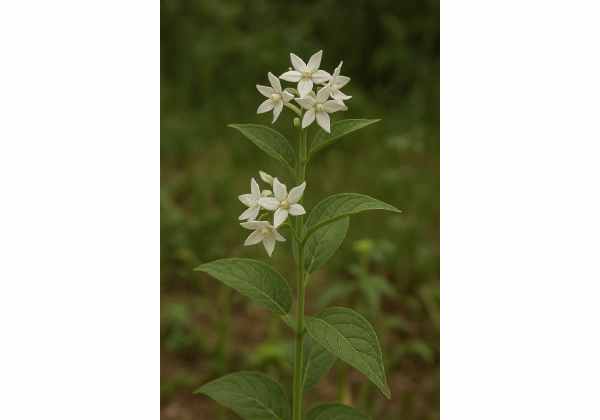
White Swallowwort, Vincetoxicum hirundinaria, is a perennial herb from the dogbane family with a long and somewhat contradictory history. In older European medicine it was praised as an antidote, an expectorant, and at times an external remedy for wounds, skin problems, and swelling. Yet the same plant also carries a strong reputation for toxicity, especially in its root, and modern herbal practice treats it far more cautiously than older texts did. That tension defines nearly everything worth knowing about it.
Today, White Swallowwort is better approached as a historically important but risky medicinal plant rather than a practical home remedy. Modern research has identified phenanthroindolizidine alkaloids, flavonoids, chlorogenic acid, catechin derivatives, and other bioactive compounds that may help explain its traditional uses and laboratory activity. Even so, the evidence for real human health benefits remains thin, while the safety concerns are much clearer. This guide looks at what White Swallowwort is, what its compounds may do, how it was traditionally used, and why modern self-treatment with the crude herb is generally not advised.
Key Facts
- White Swallowwort has a long folk history for external skin use, expectorant use, and antidote folklore, but modern clinical evidence is very limited.
- Its extracts show antioxidant, antimicrobial, and anti-inflammatory potential in laboratory studies.
- No standardized safe self-use dose is established for the crude herb, root, or extract.
- Avoid White Swallowwort during pregnancy, breastfeeding, childhood, and with any unsupervised internal use because of toxicity concerns.
Table of Contents
- What White Swallowwort Is and Why It Has Such a Cautious Reputation
- White Swallowwort Key Ingredients and Medicinal Properties
- White Swallowwort Health Benefits and What the Evidence Actually Allows
- Traditional Uses and How the Herb Was Prepared
- White Swallowwort Dosage and Why Modern Self-Dosing Is Not Recommended
- Safety Side Effects and Who Should Avoid It
- Interactions Product Quality and When Medical Care Matters
What White Swallowwort Is and Why It Has Such a Cautious Reputation
White Swallowwort is a perennial climbing or loosely twining herb native to much of Europe and parts of western Asia. It grows from a long-lived root system, produces opposite leaves and pale star-like flowers, and belongs to the Apocynaceae family, a botanical group that includes several plants known for biologically active and sometimes toxic constituents. In older books it may also appear under names such as white swallow-wort, dompte-venin, or even under older botanical synonyms including Cynanchum vincetoxicum and Vincetoxicum officinale. That naming history matters because people reading traditional herbals may not realize they are looking at the same plant.
The plant’s older medical reputation is striking. It was used in different regions as an antidote for poisoning, as an expectorant, as an emetic, and as an outward remedy for skin disorders, wounds, and swelling. Some traditions also associated it with bites, scabies, internal fever, and inflammatory complaints. That breadth is typical of historical materia medica, where one plant was often assigned many roles before modern toxicology or controlled trials existed.
At the same time, White Swallowwort has long been regarded as a poisonous herb. Older writings often describe it with a tone of respect mixed with warning. Modern summaries continue that pattern. The plant is not treated as a simple kitchen herb or mild daily tonic. Instead, it belongs in the category of medicinal plants that may contain useful compounds but cannot be assumed safe just because they are natural.
That reputation is even more important today because people often search herbs by benefits alone. With White Swallowwort, that can mislead. The question is not only what the plant might help with, but also whether it is appropriate to use at all. In many cases, the answer is no. Safer herbs are usually available for the same general aims, whether the goal is soothing a cough, calming irritated skin, or easing minor inflammation.
Part of White Swallowwort’s continued interest comes from research rather than modern practice. Its chemistry is unusual enough to attract phytochemical and pharmacologic study. Some extracts show antioxidant, antimicrobial, antibiofilm, and cytokine-modulating effects in laboratory models. That makes the plant scientifically interesting, but it does not automatically make it appropriate for self-care.
A good modern framework is this:
- as a historical herb, White Swallowwort is significant
- as a source of bioactive compounds, it is promising
- as a crude self-treatment, it is risky
- as a modern home remedy, it is usually not the best choice
That is why its reputation is cautious rather than enthusiastic. White Swallowwort is one of those plants where curiosity belongs in the lab and in historical study more than in the kitchen or medicine cabinet.
White Swallowwort Key Ingredients and Medicinal Properties
White Swallowwort contains a chemically diverse set of compounds, and that complexity helps explain both its historical appeal and its safety concerns. The most important constituents discussed in modern literature include phenanthroindolizidine alkaloids, flavonoids, chlorogenic acid, catechin derivatives, triterpenoids, sterols, acetophenones, pregnane glycosides, and other secondary metabolites found in different plant parts.
Among these, phenanthroindolizidine alkaloids attract the most attention. These compounds are one reason the genus Vincetoxicum continues to interest pharmacologists. They are associated with notable biological activity, including cytotoxic and antimicrobial potential, but that is also exactly why they raise caution. A compound with cell-active behavior can be medically interesting and toxic at the same time.
The leaves appear to contain flavonoids, chlorogenic acid, catechin derivatives, and lipophilic compounds. Recent species-level work has also highlighted phenolic and flavonoid content in flowers, leaves, seeds, and seed pods, with flowers and seeds showing measurable antioxidant and related activity in laboratory testing. Roots are a different story. Historical and phytochemical records point to more pharmacologically forceful constituents in the root system, including glycosidic and steroid-like compounds that help explain why the root was once used as an emetic and why modern unsupervised use deserves extra caution.
From an herbal perspective, White Swallowwort’s medicinal properties can be grouped into several broad categories.
First, it has antioxidant potential. Extract studies repeatedly show free-radical-scavenging activity, and the phenolic profile makes that unsurprising. Antioxidant findings do not prove real-world health outcomes on their own, but they support the idea that the plant is biologically active.
Second, it may have antimicrobial and antibiofilm properties. This is one of the more interesting modern directions because it aligns with some traditional external uses. Yet laboratory antibiofilm behavior is not the same as a safe topical medicine for everyday use.
Third, it shows anti-inflammatory or immunomodulatory signals in vitro. One recent study found that root extracts had a notable inhibitory effect on IL-6 release in a cell-based assay. That gives some scientific plausibility to historical use in irritated, inflamed, or swollen conditions. It also reminds us that the plant can alter biologic signaling in meaningful ways.
Fourth, it has cytotoxic potential. This is not a benefit in the ordinary wellness sense. It is a property that may be useful in pharmacologic investigation but is also a warning sign for crude herb use. A plant with measurable cytotoxicity in extracts is not something to treat casually.
The most accurate modern description of White Swallowwort is therefore mixed. It is not just toxic folklore, and it is not just a medicinal treasure. It is a chemically strong plant with:
- antioxidant constituents
- antimicrobial and antibiofilm activity in extracts
- anti-inflammatory laboratory signals
- cytotoxic and safety-relevant potency
If a reader wants a gentler herb with a clearer outward skin-care profile, calendula for skin support and minor irritation is a far more practical place to begin. White Swallowwort’s chemistry is fascinating, but fascination is not the same as suitability.
White Swallowwort Health Benefits and What the Evidence Actually Allows
The phrase “health benefits” needs careful handling with White Swallowwort because the plant’s danger profile is part of the answer. There are traditional uses and there are promising laboratory findings, but there is very little that supports modern self-treatment with confidence.
The first possible benefit area is external inflammatory and skin support. Historical sources describe the herb in washes, fumigants, and preparations for wounds, scabies, bruising, swelling, and other irritated conditions. A recent historical-recipe study also found that Vincetoxicum hirundinaria was selected from old dermatological material and showed a distinct IL-6 inhibitory effect in a cell-based screening assay. That gives some support to the idea that old skin-directed uses were not random. Still, in vitro cytokine effects do not prove that a home-made White Swallowwort preparation is safe or effective on human skin.
The second possible benefit area is respiratory use. In France and other traditional settings, White Swallowwort was used as an expectorant and sometimes as an emetic. That tells us more about its historical intensity than about its modern value. An herb that was once used to provoke vomiting or force chest clearance is not automatically an herb that should be revived for routine cough treatment today. Safer options exist, such as great mullein for chest and cough support, which is much easier to justify in self-care.
The third area is antidote folklore. The very name Vincetoxicum reflects the old belief that it could “conquer poison.” This is one of the most important places to be clear. Historical antidote use does not mean the herb is a reliable or appropriate antidote by modern standards. That belief belongs to medical history, not to emergency guidance.
The fourth area is antimicrobial and antibiofilm activity. Extracts from different plant parts have shown promising laboratory results, especially in more recent Turkish studies. This supports the plant’s scientific relevance and may help explain some external uses. But it does not make the crude herb a substitute for antiseptics, antibiotics, or proper wound care.
The fifth area is broader anti-inflammatory or anticancer interest based on cytotoxic and signaling effects. These findings belong firmly in the preclinical realm. They are valuable for researchers but can be misleading for the public. A toxic or cytotoxic plant is not automatically a useful therapeutic plant outside a carefully controlled context.
The most honest summary is this:
- White Swallowwort has historical medicinal uses worth documenting.
- It has real bioactivity in laboratory testing.
- It may yield interesting compounds for future research.
- It does not have well-established, modern, consumer-friendly health benefits that justify unsupervised use.
That last point is the most important. Many herbs can be described as underused treasures. White Swallowwort is better described as an underused research plant with a difficult safety profile. If readers approach it with that mindset, the article becomes more useful and more truthful.
Traditional Uses and How the Herb Was Prepared
Traditional use of White Swallowwort varied by region, but a few themes appear again and again: antidote use, expectorant use, emetic use, and external treatment for skin or inflammatory complaints. These uses involved different plant parts and different preparations, which is important because the plant was not treated as a single uniform remedy.
In some parts of Italy, infusions and decoctions of the whole plant or root were used in antidote traditions. In Catalonia, external uses of the aerial parts included infusion- or fumigant-type preparations with antiseptic intent. In France, it was known as an expectorant and emetic. In Turkey, roots were traditionally used in ways that emphasized their more forceful action, including emetic use. Ethnoveterinary traditions also mention the plant, especially the root, in applications that would be considered far too risky for casual modern use.
These traditional preparations can be grouped into four broad forms.
- Infusions
Usually milder than decoctions, infusions were used for aerial parts or whole-plant preparations. Their logic was often outward or mildly internal. - Decoctions
Roots and tougher plant material were commonly boiled. This usually indicates a stronger preparation and greater risk. - Fumigants and washes
External folk practice in some regions used the herb around skin and wound-related complaints rather than relying only on ingestion. - Root preparations
These were often the most forceful and historically tied to vomiting, antidote beliefs, and high-risk internal use.
For a modern reader, the most important lesson from those forms is not how to copy them. It is how to interpret them. Historical use shows what people believed the herb could do, not what is safe to reproduce at home. A decoction that made sense in a village antidote tradition is not automatically a responsible modern preparation.
This is especially relevant because White Swallowwort is sometimes discussed alongside more manageable bitter or skin herbs. That comparison is usually unhelpful if it implies interchangeability. The plant’s historical reach came partly from the fact that older medicine tolerated much harsher remedies than modern self-care should.
There is also another modern complication: homeopathic use. Some commercial homeopathic preparations include Vincetoxicum hirundinaria in highly diluted form. That is not the same thing as using the raw herb, the root, or a crude tincture. Readers should not confuse the safety of a highly diluted homeopathic product with the safety of the plant itself.
If the traditional-use section teaches one practical lesson, it is this: White Swallowwort belongs to history and to carefully controlled research more than to everyday herbal preparation. When people want an external herb with a traditional wound or irritation profile, plantain leaf for simple topical support is far more realistic. Traditional use gives White Swallowwort historical importance, but not a modern green light.
White Swallowwort Dosage and Why Modern Self-Dosing Is Not Recommended
This is the simplest dosage section to summarize honestly: there is no well-established safe modern self-use dose for White Swallowwort crude herb, root, tea, tincture, or extract. That statement is more useful than pretending otherwise.
Older medicinal systems clearly did use the plant internally. Roots were employed as emetics, expectorants, and antidote remedies, while whole-plant or aerial-part infusions and decoctions appear in several regional traditions. But those traditions developed before modern toxicology, before standardized products, and before the distinction between preclinical activity and safe human dosing was clear. Historical use does not equal validated dose.
Modern studies on White Swallowwort also do not solve this problem for ordinary users. Recent work measures phenolic content, antioxidant activity, antibiofilm effects, and cytotoxicity of extracts in laboratory systems. Those data are valuable for science, but they are not human dosing guides. Lab concentrations such as micrograms per milliliter or milligrams per milliliter cannot be converted into safe home use without proper clinical evidence.
For that reason, the most appropriate dosage advice is actually a safety framework:
- do not establish your own internal dose
- do not assume tea is automatically safe because it is weaker than an extract
- do not use the root casually
- do not extrapolate from homeopathic dilutions to crude-herb safety
- do not combine White Swallowwort with other strong herbs to “balance” it
If someone encounters a product marketed as White Swallowwort, they should ask several questions before even considering it:
- Is it the crude herb or a highly diluted homeopathic preparation?
- Is the plant part identified?
- Is there any standardized safety information?
- Is there a compelling reason to use this plant instead of a safer one?
In most cases, the final answer will be that a safer herb makes more sense. For example, if the interest is digestive bitterness rather than toxic historical intensity, gentian as a classic bitter herb has a much clearer place in herbal practice. If the interest is external tissue support, there are many less hazardous options.
It is also worth stating that “small dose” is not a reliable safety strategy here. With some herbs, beginning at the low end of a known range makes sense. With White Swallowwort, the main issue is not just potency but the absence of a modern validated range for unsupervised use.
So although this section is called dosage, its real message is about boundaries. White Swallowwort is a plant where modern dosing wisdom begins with refusal. Historical preparations belong to the record. Consumer guidance belongs on the side of restraint.
Safety Side Effects and Who Should Avoid It
Safety is the central topic for White Swallowwort, not a final footnote. The plant is widely described as poisonous or venomous in traditional and modern accounts, and that reputation is supported by both historical use patterns and modern toxicology concerns.
Possible side effects from crude internal use include nausea, vomiting, abdominal discomfort, diarrhea, dizziness, weakness, and other poisoning-type symptoms. This fits with the plant’s old reputation as an emetic. In other words, some of what earlier medicine described as therapeutic action would now be recognized as a toxic effect or at least a very harsh physiologic response.
Modern studies add further reasons for caution. Extracts from White Swallowwort have shown cytotoxic activity in different settings, and one genotoxicity study found DNA damage in the comet assay for Vincetoxicum hirundinaria extracts even though the extracts were not mutagenic in every test system. That does not mean casual exposure guarantees serious harm, but it is exactly the kind of signal that should stop people from experimenting with crude preparations.
There is also direct case-based evidence of toxicity in animals. A published veterinary case describes suspected White Swallowwort toxicity in a cat. One animal case report does not define all human risk, but it adds weight to the plant’s poisonous reputation and reminds readers that this is not just theoretical caution.
The groups who should clearly avoid White Swallowwort include:
- pregnant people
- breastfeeding people
- children and adolescents
- pets and livestock
- anyone with liver disease, kidney disease, or chronic gastrointestinal illness
- anyone taking multiple medications without professional review
Topical use is not automatically safe either. A plant with potent bioactive compounds and possible irritant effects should not be applied casually to broken skin, ulcers, infected lesions, or large irritated areas. Historical external use exists, but modern safety standards should be higher than historical ones.
If a reader is looking for an external herb around minor irritation or bruised-feeling tissue, witch hazel for topical astringent support is far more appropriate. White Swallowwort’s outward uses belong more to ethnobotany than to responsible self-care.
The best practical safety summary is this:
- raw herb use is not low-risk
- root use is especially concerning
- crude internal use should be avoided
- external use should also be approached with caution
- the plant is better studied than used
That may sound severe, but it is exactly the severity that makes the article honest. Many herbal profiles spend most of their space on benefits and only a few lines on risk. White Swallowwort deserves the reverse.
Interactions Product Quality and When Medical Care Matters
Because White Swallowwort lacks a modern validated therapeutic role in ordinary herbal practice, formal interaction data are limited. That does not make interaction risk irrelevant. It means the plant sits in a broad caution category rather than a neatly mapped one.
The first concern is combining White Swallowwort with other strong, irritant, emetic, or cytotoxic herbs. Even if a person believes the dose is small, mixing uncertain plants together increases unpredictability. The second concern is use alongside medications that already stress the liver, kidneys, gut, or immune system. A biologically active plant with limited safety data should not be layered casually onto a complex medical regimen.
Product quality is another major issue. White Swallowwort is not a mainstream, well-standardized herb. If sold at all, it may appear under different names or in mixed products. That raises several problems:
- species confusion
- uncertain plant part
- weak labeling
- unclear potency
- confusion between crude herb and homeopathic dilution
A product labeled only as “swallowwort” is not adequate. Even a correctly labeled product does not solve the larger safety problem. With this herb, good identification reduces one risk but does not erase the deeper issue of toxic potential.
Medical care matters more than herbal self-care whenever symptoms are serious, unclear, or worsening. This is particularly important because some of the old uses of White Swallowwort involve conditions people might still be tempted to self-treat, such as cough, swelling, bites, skin problems, and digestive upset. Seek proper medical evaluation instead of experimenting if you have:
- vomiting or diarrhea after ingesting the plant
- abdominal pain or weakness after exposure
- breathing difficulty
- swelling that is spreading
- an infected wound
- suspected poisoning or bite
- persistent skin lesions
- symptoms in a child or pet
This is also a good place to remember that an old antidote herb is not a modern antidote. White Swallowwort should never be used in place of poison-control guidance, emergency care, or veterinary help.
If the aim is a mild chest herb, a safer traditional direction would be something like elecampane for traditional respiratory support rather than a poisonous swallowwort. If the aim is outward skin support, again, safer choices exist.
White Swallowwort is most valuable today when it is handled as information rather than as a remedy. It teaches an important lesson: some medicinal plants are interesting precisely because they show where herbal tradition, toxicology, and modern caution must all be held together. That is not a failure of the herb. It is the truth about its place.
References
- Ethnobotany, phylogeny, phytochemistry and pharmacological applications of genus Vincetoxicum (Apocynaceae) 2024 (Review)
- Plants and their uses in dermatological recipes of the Receptarium of Burkhard III von Hallwyl from 16th century Switzerland – Data mining a historical text and preliminary in vitro screening 2024
- A Comparative Study on Some Biological Activities of Different Parts of Vincetoxicum hirundinaria 2025
- Genotoxic properties of Betonica officinalis, Gratiola officinalis, Vincetoxicum luteum and Vincetoxicum hirundinaria extracts 2019
- A case of suspected swallow wort (Vincetoxicum hirundinaria) toxicity in a cat 2014 (Case Report)
Disclaimer
This article is for educational purposes only and is not medical advice. White Swallowwort is a historically used but potentially poisonous plant, and modern self-treatment with the crude herb, root, or homemade extract is not considered a safe default. Do not use it to treat cough, wounds, bites, swelling, poisoning, or digestive symptoms without qualified professional guidance. Seek urgent help after suspected ingestion, poisoning, or animal exposure. Speak with a healthcare professional before using any product labeled with this plant name, especially if you are pregnant, breastfeeding, managing a chronic illness, taking medicines, or considering use around children or pets.
If this article helped clarify a complex herb, please share it on Facebook, X, or another platform your readers use.