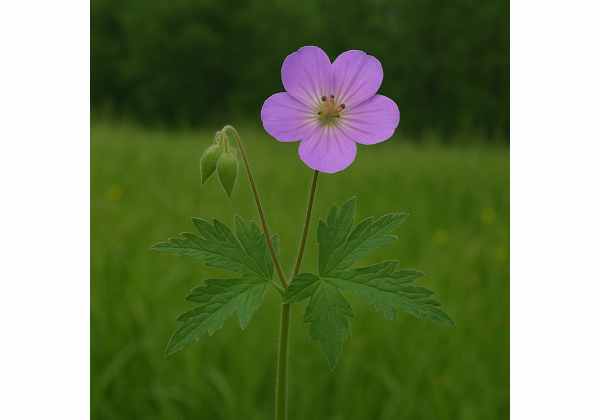
Wild geranium, also called Geranium maculatum, is a woodland herb native to eastern North America and long valued in traditional herbal practice for one main reason: it is strongly astringent. While the soft pink flowers make it look gentle, the medicinal strength of the plant lies mostly in its underground parts, especially the root and rhizome, which are rich in tannins and related polyphenols. Historically, herbalists turned to wild geranium for loose stools, irritated mouth tissues, minor bleeding, excess discharge, and topical applications where “tightening” or toning tissues was the goal.
In modern terms, wild geranium is best understood as a classic drying and contracting herb rather than a broad daily tonic. It may help in short-term situations involving mild diarrhea, sore or spongy gums, throat irritation, and weepy skin conditions. Its strongest actions are practical and local. At the same time, its tannin-rich nature means it can be overused, especially in dry or constipated people. That makes it a useful herb when matched to the right pattern, but not one to take casually or for long stretches.
Quick Summary
- Wild geranium is most useful as an astringent herb for mild loose stools and irritated mouth or throat tissues.
- Its tannin-rich root may help tighten tissues, reduce excess secretions, and support minor topical care.
- A cautious traditional oral range is about 2 to 4 g dried root per day for short-term use.
- People who are pregnant, severely constipated, iron deficient, or taking multiple oral medicines should avoid unsupervised use.
Table of Contents
- What Wild Geranium Is and Why Herbalists Valued It
- Key Compounds in Wild Geranium
- Potential Health Benefits and Medicinal Properties
- Traditional Uses and Modern Practical Applications
- What the Research Actually Supports
- Dosage Preparation and Best Ways to Use It
- Safety Side Effects and Who Should Avoid It
What Wild Geranium Is and Why Herbalists Valued It
Wild geranium is a perennial member of the Geraniaceae family that grows in deciduous woods, shaded edges, and moist meadows across much of eastern North America. It is sometimes called spotted cranesbill because of the beak-like shape of its fruit, and it should not be confused with the bright bedding “geraniums” sold in garden centers, which usually belong to the genus Pelargonium. In herbal medicine, the part that mattered most was not the flower but the root.
This distinction is important. Many attractive plants have mild folkloric uses attached to them, but wild geranium earned a durable place in North American herbalism because its rootstock is distinctly puckering, drying, and firming. That strong astringency made it useful whenever tissues seemed relaxed, overly moist, or prone to leakage. Older herbalists often described it as an herb for “excess loss,” meaning it was used when the body was giving off too much fluid through diarrhea, mucus, minor bleeding, or oozing skin conditions.
Traditional use centered on a few consistent themes:
- loose stools and lingering bowel weakness
- sore, inflamed, or bleeding gums
- mouth ulcers and throat irritation
- minor external bleeding or weepy skin problems
- hemorrhoids and irritated rectal tissue in topical use
This is why wild geranium is best classified as a tissue-toning herb. It does not usually work like an aromatic digestive herb that settles gas or eases cramping through warmth. Instead, it works more through contraction and drying. In modern herbal language, that makes it especially relevant when the problem is excess fluid, not stagnation or coldness alone.
It also helps explain why wild geranium is not for everyone. A person with chronic dryness, hard stools, or an already irritated gut may feel worse with a strongly tannic herb. By contrast, someone recovering from a brief spell of loose stools or dealing with a raw, inflamed mouth rinse situation may find it helpful.
One useful way to think about wild geranium is to compare it with the broader category of astringent botanicals. Some herbs, such as oak bark for stronger tannin-rich astringency, are known mainly for their intense contracting effect. Wild geranium belongs in that same family of action, though it is often described as somewhat gentler and more versatile in North American folk use.
Because of this profile, wild geranium remains more of a condition-specific herb than a general wellness plant. It is not usually taken as a daily tea for pleasure. It is chosen for a reason, used for a short time, and set aside once the situation improves. That focused use is part of what has kept its reputation clear for generations.
Key Compounds in Wild Geranium
The medicinal character of wild geranium comes mainly from its high tannin content. If you wanted to summarize the plant’s chemistry in one sentence, it would be this: the root is rich in polyphenolic compounds that tighten tissues and help explain its long-standing astringent use.
The best-known constituents linked to Geranium maculatum include:
- tannins
- gallic acid
- ellagic-acid-related polyphenols
- hydrolyzable tannin fractions
- smaller amounts of volatile compounds in the aerial parts
Tannins are the most important group here. They are the compounds that create the dry, puckery sensation you feel when a strong tea seems to tighten your mouth. In the body, that same astringent effect can help reduce excess secretions, tone irritated mucous membranes, and support the surface of raw or weepy tissues.
Gallic acid is also commonly associated with the root and contributes to the plant’s classic astringent reputation. In the wider geranium literature, species in this genus are often described as rich in hydrolyzable tannins and related polyphenols, and that larger pattern fits what traditional herbalists already knew from taste and action.
There is also a useful nuance here. Modern readers sometimes hear about ellagitannins such as geraniin and assume every geranium species has been equally characterized down to each major compound. That is not quite true. The Geranium genus is chemically rich, but species-specific profiling is still uneven. Wild geranium clearly belongs to this tannin-heavy, polyphenol-rich group, yet its folk reputation was built more on observable action than on exhaustive modern standardization.
From a practical standpoint, the chemistry explains several things at once:
- Why wild geranium works best in short-term, drying situations
Tannins are helpful when tissues are loose, damp, inflamed, or leaking, but less helpful when someone is already dry or constipated. - Why the root is preferred medicinally
The strongest traditional action comes from the underground parts, where the astringent constituents are most concentrated. - Why it is often used as a rinse or decoction rather than a casual beverage tea
Its chemistry is more medicinal than culinary.
The plant also contains smaller amounts of essential-oil constituents in aerial parts, but those are not the center of its traditional medicinal identity. Wild geranium is not mainly an aromatic volatile-oil herb in the way peppermint or lemon balm is. Its core action comes from tannins and related phenolics, not from a fragrant essential oil.
That difference is worth remembering because it shapes how the herb is best used. A mint may relax, cool, and move. Wild geranium contracts, dries, and firms. If someone is looking for a soothing coating herb for raw mucous membranes, marshmallow root for softer mucosal support often works in the opposite direction. Wild geranium is the herb to reach for when the problem is too much fluid and too little tone.
Potential Health Benefits and Medicinal Properties
Wild geranium’s benefits are not broad and flashy. They are focused, practical, and tied closely to its astringent nature. That can actually make the herb easier to understand than many heavily marketed botanicals. When it works well, it usually works because the situation clearly calls for tightening, drying, or toning tissues.
The most established traditional benefit is support for mild loose stools. Wild geranium has long been used when bowel movements are too frequent, too watery, or leave a person feeling depleted. The logic is straightforward: tannins help tone the mucosa and may reduce the excess fluidity that goes with brief, non-serious diarrhea. This is not the same as saying it treats infectious disease or severe dehydration. It is better thought of as a short-term supportive herb for functional looseness or lingering bowel weakness after an acute episode.
A second key benefit is mouth and throat support. Gargles and mouth rinses made from wild geranium were traditionally used for sore gums, oral thrush, ulcers, and irritated throat tissues. In these situations, the herb’s drying and contracting effect is often a better fit than a purely soothing herb alone. When tissues are swollen, spongy, or bleeding slightly, an astringent rinse can feel distinctly helpful.
A third likely benefit is minor topical support. Powdered root, decoctions, or compresses were used historically for open sores, small wounds, weepy rashes, hemorrhoids, and other irritated surfaces. The value here is again mainly mechanical and local: less ooze, more tone, and a drier, firmer surface.
A fourth possible benefit is antioxidant support, though this is more of a laboratory finding than a classic household claim. Recent testing of Geranium maculatum extracts suggests the plant can reduce markers of oxidative stress in experimental systems. This does not turn it into a general antioxidant supplement, but it does support the idea that its polyphenols are biologically active beyond simple surface astringency.
In practical terms, wild geranium’s likely medicinal properties include:
- astringent
- hemostatic or bleeding-reducing in minor surface use
- drying to excess secretions
- tissue-toning
- antioxidant in extract studies
- mildly anti-inflammatory in situations where reduced surface irritation follows from less moisture and tighter tissue tone
What it does not clearly offer is equally important. Wild geranium is not a classic relaxant for cramps, not a stimulant for sluggish digestion, and not a daily tonic for general wellness. If someone has loose stools mainly because of nervous spasm or post-meal irritation, an herb like chamomile may sometimes be easier to tolerate. Wild geranium fits best when the pattern is damp, loose, and over-secretory.
This narrower benefit profile is a strength, not a weakness. It means the herb knows its lane. It is most useful when the problem clearly matches its nature.
Traditional Uses and Modern Practical Applications
Wild geranium was one of the more respected native astringent herbs in North American practice. Native American use is well documented in broad terms, especially for diarrhea, mouth conditions, and topical wound care. Later settler and Eclectic herbal traditions also valued it for bowel weakness, passive bleeding, hemorrhoids, and excessively relaxed mucous membranes.
The plant’s traditional uses cluster into a few practical categories:
- internal short-term use for loose stools
- gargles for sore gums, ulcers, thrush, and throat irritation
- external applications for cuts, sores, and inflamed skin
- support for hemorrhoids and minor rectal irritation
- older folk use for excess menstrual or uterine bleeding
Some of these uses make more sense today than others. For example, a mouth rinse for tender gums remains a fairly intuitive use of a tannin-rich herb. A short-course decoction during a period of mild bowel looseness is also easy to understand. More ambitious historical claims, especially around internal bleeding or serious chronic disease, are much harder to defend in modern self-care.
That difference matters because traditional use does not always translate neatly into modern home practice. Earlier herbalists often used a smaller set of stronger, more condition-specific plants because they had fewer commercial options. Today, we can choose more precisely and more gently when needed.
Still, wild geranium remains practically relevant in several ways.
As a mouth rinse, it makes sense when tissues feel swollen, soft, or prone to light bleeding. A cooled decoction can be swished briefly and spit out. This can be especially appropriate when the main issue is excessive moisture or sponginess rather than simple dryness.
As a short-term decoction, it can be used when stools are loose and draining, especially after the more acute phase has passed and the gut still feels weak. This is where its “firming” nature stands out.
As an external compress, it may be used on small weepy skin problems or irritated tissue where a drying, tightening wash is desired.
As a hemorrhoid-support herb, it has one of the clearest old reputations, though modern users usually prefer careful external application rather than strong internal dosing.
That said, wild geranium is not the only herb that fills these roles. For topical tissue-tightening and skin applications, witch hazel for topical astringent use is often more familiar and easier to source. Wild geranium still has a place, but it is more of a traditional North American specialist than a universal cabinet herb.
Its best modern use is therefore selective. Rather than treating it as a daily wellness tea, it makes more sense to keep it in mind for a clear situation: too much moisture, too little tissue tone, and a need for brief, focused support.
What the Research Actually Supports
The scientific picture for wild geranium is promising but limited. Modern research supports the plant’s astringent and polyphenol-rich reputation, yet it does not provide a large body of human clinical trials. That means the herb remains best supported by a blend of traditional use, phytochemistry, and early experimental data.
What looks well grounded:
- the root and rhizome are rich in tannin-related compounds
- the plant has a long ethnobotanical history in bowel, mouth, and wound-related use
- tannin-rich herbs have a plausible mechanism for tightening tissues and reducing minor surface bleeding
- Geranium maculatum extract has shown antioxidant effects in laboratory systems
Recent screening work is especially interesting because it suggests wild geranium can reduce oxidative stress markers in cell-based models. This does not prove a major internal clinical use, but it does confirm that the plant’s polyphenols are not merely inert folklore constituents. They are biologically active.
At the same time, research gaps are real. There are few modern trials on wild geranium itself for the everyday uses people most want to know about, such as mild diarrhea, hemorrhoids, gum inflammation, or sore throat rinses. Much of the confidence around these uses still comes from herbal tradition plus the known behavior of tannin-rich plants.
That creates a healthy kind of limitation. It tells us where to be confident and where to stay modest.
A realistic evidence summary looks like this:
- Traditional use is strong.
Native and later North American herbal practice repeatedly point to similar uses. - Mechanism is plausible.
Tannins, gallic acid, and related polyphenols help explain the herb’s drying and contracting effects. - Laboratory support is emerging.
Antioxidant activity and other bioactive signals strengthen the case that the plant does something measurable. - Human clinical confirmation is still limited.
Wild geranium is not a modern, extensively trialed botanical.
This is why it is better to describe wild geranium as a classic traditional astringent rather than a thoroughly validated contemporary supplement. Its use still makes sense, but mainly when matched to obvious traditional indications and used conservatively.
Another practical point is that evidence supports direction more than it supports precision. We can say the herb makes sense for loose, damp, irritated conditions. We cannot say with great certainty that it works at a specific modern dose for a specific diagnosis better than standard care.
For people seeking a more broadly studied herbal option for inflamed skin or irritated mucosa, calendula may sometimes be easier to integrate because its modern herbal role is broader and less drying. Wild geranium’s value is more specific. It shines when the old astringent indication is truly present.
Dosage Preparation and Best Ways to Use It
Wild geranium is usually prepared from the dried root or rhizome, not the flowers. That alone separates it from many pleasant herbal teas. This is a root medicine, and it is best used in forms that extract its tannins properly.
The most traditional preparation is a decoction. Because the root is dense and tannin-rich, simmering is more appropriate than a quick steep.
A cautious practical method looks like this:
- Use about 1 to 2 teaspoons of dried, cut root in 240 to 300 mL of water.
- Bring gently to a simmer rather than a hard boil.
- Simmer for 10 to 15 minutes.
- Strain and use warm for internal support or cool for rinses and compresses.
For internal use, a conservative traditional range is roughly 2 to 4 g of dried root per day, divided into one or two doses. This is better suited to short-term use than to everyday drinking. If the herb is being used as a mouth rinse or gargle, stronger decoctions may be used externally and spat out rather than swallowed.
The best ways to use wild geranium depend on the goal.
For mild loose stools
A short-course decoction is the most traditional form. It makes the most sense when the problem is excessive fluidity and tissue weakness rather than cramping or infection.
For mouth or throat irritation
A cooled decoction works well as a gargle or rinse. This can be repeated through the day in small amounts.
For topical care
A decoction can be used as a wash, compress, or cloth application on small, superficial areas that seem overly moist or irritated.
For hemorrhoids
External use is often more sensible than strong internal dosing, especially when dryness or constipation is already part of the picture.
This leads to an important practical rule: wild geranium should be used briefly and with purpose. It is not the kind of herb that improves simply by taking more of it. Too much can leave tissues feeling overly dry, the bowels sluggish, and the stomach slightly irritated.
Another useful strategy is pairing. Because tannin-rich herbs can be too drying on their own, some herbalists combine them with softer, soothing plants. A mucilaginous herb can buffer the sharpness without canceling the astringent effect completely. That is one reason combinations with demulcents have historical logic, though modern users should still keep the formula simple.
In that sense, wild geranium behaves almost like a corrective tool. It is strong enough to change the feel of tissues, but most valuable when used precisely, not continuously. People looking for gentle daily digestive support would usually do better with a different kind of herb altogether.
Safety Side Effects and Who Should Avoid It
Wild geranium is generally considered a low-to-moderate risk herb when used properly, but that does not mean it is suitable for everyone. Its main safety concerns come from the same quality that makes it useful: high tannin content.
The most common problems with overuse are predictable:
- stomach irritation
- nausea in sensitive people
- constipation or overly dry stools
- dryness of the mouth or throat
- reduced appetite from excessive astringency
This pattern tells us something important. Wild geranium is not dangerous mainly because it is poisonous. It is limiting because it can be too drying, too contracting, or too harsh if taken for too long or in the wrong person.
People who should avoid unsupervised use or use extra caution include:
- Pregnant people
Traditional sources have long advised caution, and modern safety evidence is too limited to recommend routine use. - People with chronic constipation or marked dryness
The herb may worsen the very pattern it is being used against. - Those with iron deficiency or poor mineral status
Heavy tannin intake can interfere with absorption of some nutrients when used frequently. - People taking multiple oral medicines
Strong tannin-rich herbs may affect absorption when taken at the same time as medications. - Anyone with persistent diarrhea, blood in stool, fever, or dehydration
These are medical assessment situations, not simple herbal self-care situations.
Duration is also part of safety. Wild geranium is better for short-term correction than for long-term routine use. A few days to a week for a brief issue is one thing. Taking it daily for weeks without a clear reason is another. Older safety guidance has often suggested keeping internal use moderate and not exceeding modest dried-root amounts for extended periods.
Another point worth making is that wild geranium is not automatically the best herb just because astringency seems useful. In a person with irritated but dry tissues, or diarrhea driven mainly by spasm and nervous tension, a softer herb may fit better. When the wrong herb is chosen, even a well-known traditional plant can feel unhelpful.
If the issue is mainly digestive spasm, gas, or upper abdominal tightness rather than tissue looseness, peppermint may sometimes be the more logical choice. Wild geranium belongs to a narrower, drier category.
The bottom line is straightforward. Wild geranium is a useful short-term astringent herb with a long North American tradition. Its main risks are not mystery dangers but mismatch and excess. Use it for the right pattern, in moderate amounts, and for a limited time. That is where it performs best.
References
- The geranium genus: A comprehensive study on ethnomedicinal uses, phytochemical compounds, and pharmacological importance 2024 (Review)
- Identification of Oxidative-Stress-Reducing Plant Extracts from a Novel Extract Library—Comparative Analysis of Cell-Free and Cell-Based In Vitro Assays to Quantitate Antioxidant Activity 2024 (Preclinical Study)
- The Phytochemistry of Cherokee Aromatic Medicinal Plants 2018 (Review)
- Geranium maculatum 1993 (Official Species Profile)
- In Vitro Screening for the Tumoricidal Properties of International Medicinal Herbs 2009 (Preclinical Study)
Disclaimer
This article is for educational purposes only and is not medical advice. Wild geranium is a traditional astringent herb, but it is not a substitute for diagnosis or treatment of serious diarrhea, persistent bleeding, infection, or chronic digestive disease. Because tannin-rich herbs can be drying and may affect absorption of some medicines and nutrients, anyone who is pregnant, takes prescription medication, has ongoing bowel symptoms, or wants to use wild geranium beyond short-term self-care should speak with a qualified healthcare professional first.
If you found this article helpful, please share it on Facebook, X, or another platform you prefer.