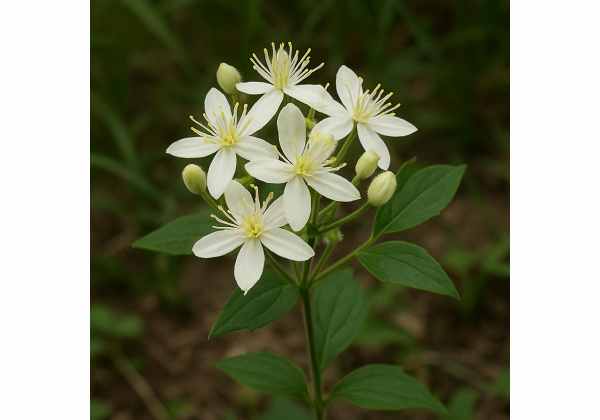
Virgin’s bower, Clematis virginiana, is a native North American vine from the buttercup family that has a striking dual reputation. In garden and wildflower settings, it is admired for its cloudlike white flowers and feathery seed heads. In herbal history, it has been used in small, carefully prepared forms for skin complaints, nerve-related discomfort, urinary irritation, and other traditional purposes. At the same time, fresh plant material is irritating and potentially toxic, which means this is not a casual kitchen herb and not a plant for unsupervised experimentation.
That tension is what makes virgin’s bower interesting. Its traditional medical use suggests real biological activity, and the broader Clematis genus contains compounds such as protoanemonin, anemonin, flavonoids, triterpenoid saponins, and volatile constituents that may help explain its counterirritant, antimicrobial, and anti-inflammatory reputation. Still, the evidence for Clematis virginiana itself is limited, and modern human dosing data are weak. The most responsible way to understand virgin’s bower is as a historically important but high-caution medicinal vine. This guide explains its likely compounds, plausible benefits, traditional uses, dosage limits, and the very real safety concerns that should shape any discussion of this herb.
Key Facts
- Virgin’s bower has a traditional history of topical and low-dose internal use for irritation, neuralgic pain, and urinary discomfort.
- The herb’s most plausible actions are counterirritant, antimicrobial, and anti-inflammatory, but direct human evidence is limited.
- There is no well-established modern therapeutic dose, and historical preparations were typically very dilute rather than concentrated.
- Fresh plant material can irritate the skin and mouth and should not be used casually.
- Pregnant people, children, and anyone with sensitive skin or digestive disease should avoid self-treating with this plant.
Table of Contents
- What Virgin’s Bower Is and Why It Requires Caution
- Key Ingredients and Medicinal Properties
- Possible Health Benefits and Where They Are Most Realistic
- Traditional Uses and How the Herb Was Approached
- Dosage, Forms, and Why Modern Dosing Is Uncertain
- Safety, Side Effects, and Who Should Avoid It
- How to Think About Virgin’s Bower Today
What Virgin’s Bower Is and Why It Requires Caution
Virgin’s bower, Clematis virginiana, is a perennial climbing vine native to central and eastern North America. It belongs to the Ranunculaceae, or buttercup family, a group that includes several plants known for both medicinal interest and irritant chemistry. The vine can grow quickly, twining by its leaf stalks and covering shrubs, fences, and woodland edges with masses of small white flowers in late summer. It is attractive, fragrant to some people, and ecologically useful. But medicinally, it is a plant that demands respect.
Traditional North American uses are documented for the roots and stems, especially among Native communities and later in American herbal practice. Reports mention use for backache, stomach trouble, nerves, kidney complaints, and certain skin or sore-related conditions. Older eclectic and folk traditions also describe it as a vesicant or rubefacient, meaning it was used to redden or irritate the skin in a controlled way. That kind of use was once common in herbal medicine, especially when practitioners believed that creating surface irritation could redirect deeper pain or inflammation.
This is where modern readers need context. Many older herbs with a reputation for “drawing,” “blistering,” or “stimulating” are not gentle remedies. Virgin’s bower appears to be one of them. Fresh clematis species can contain irritating compounds that cause burning in the mouth, severe taste aversion, skin irritation, and digestive upset. Some of that harshness may lessen when the plant is dried or processed, but the risk does not disappear simply because an herb has traditional uses.
It is also important not to confuse virgin’s bower with a broadly safe tonic. It is not comparable to common culinary herbs, and it is not a good plant for self-prescribed tea blends. A better mental model is to see it as a historically important but potent medicinal vine whose uses were often narrow, dilute, and carefully chosen.
This risk-benefit tension is not unique in herbal medicine. Plants can be medicinal and irritating at the same time. For example, arnica’s topical pain-relief tradition also shows how a plant can be valued therapeutically while still demanding tight limits on dose, form, and route of use. Virgin’s bower belongs in that same high-caution category.
In practical terms, anyone reading about this herb today should begin with safety, not enthusiasm. Its history matters. Its chemistry matters more. And the most honest article about virgin’s bower is one that acknowledges both its traditional use and its potential to harm when handled carelessly.
Key Ingredients and Medicinal Properties
Virgin’s bower has not been studied as deeply as some Asian Clematis species, but the broader genus offers useful clues about the kinds of compounds likely to matter. Reviews of Clematis chemistry consistently point to several major classes of constituents, including triterpene saponins, flavonoids, alkaloids, lignans, steroids, coumarins, phenolic glycosides, volatile oils, and the characteristic irritant-related compounds protoanemonin and anemonin. These compounds help explain why clematis species can act as both medicinal agents and irritants.
The single most important safety-related compound family here involves ranunculin breakdown products, especially protoanemonin. In fresh ranunculaceous plants, protoanemonin is often the major irritant of concern. It can blister skin, inflame mucous membranes, and cause burning if chewed or swallowed. As the plant dries or ages, protoanemonin may polymerize into anemonin, which is generally less irritating and has drawn interest for anti-inflammatory activity in experimental research.
That shift matters because many historical herbal systems distinguished between fresh, strong, and dangerous material versus dried, weaker, and more manageable material. Still, weaker is not the same as harmless. Virgin’s bower should not be treated as safe simply because dried preparations were once used.
The most relevant medicinal properties associated with clematis chemistry include:
- Counterirritant action: A controlled external irritant effect that may have been used to distract from or alter deeper pain signals.
- Anti-inflammatory potential: Experimental work on anemonin and other clematis-related compounds suggests inflammation-modulating activity, though much of this work is not specific to Clematis virginiana.
- Antimicrobial potential: Protoanemonin and related compounds have shown inhibitory effects against certain microbes in laboratory settings.
- Analgesic and neuralgic interest: Traditional use often focused on pain, especially nerve-related discomfort, toothache, headaches, and rheumatic complaints.
- Urinary and glandular applications: Older literature sometimes places virgin’s bower in formulas for urinary irritation, orchitic discomfort, and swollen glands.
The phrase “medicinal properties” needs careful handling here. It is fair to say the herb has biologically active constituents and a long medicinal record. It is not fair to present it as a modern evidence-based treatment with predictable outcomes. Most of its apparent effects come from one of three things: tissue irritation, broader genus chemistry, or traditional observation.
That is why formulation matters so much. A very dilute tincture made from dried material, a topical preparation, and fresh bruised plant matter are not remotely equivalent. The effect profile changes with freshness, extraction method, and dose.
For readers who are comparing potentially harsh botanicals, white willow’s pain-relief profile shows a very different model: less counterirritant, more chemistry-driven, and better aligned with modern herbal reasoning. Virgin’s bower is more old-style, more reactive, and less forgiving.
In summary, the plant’s likely “key ingredients” support a limited medicinal rationale, but they also explain why virgin’s bower sits much closer to the line between medicine and poison than many herbs discussed in general wellness writing.
Possible Health Benefits and Where They Are Most Realistic
Any discussion of virgin’s bower benefits has to begin with a limit: the best-supported claims are traditional and pharmacologic, not clinical. In other words, the herb is interesting because its chemistry and historical uses point in certain directions, but modern human trials do not establish it as a proven remedy for everyday self-care.
With that caution in place, the plant’s most realistic potential benefits fall into a few categories.
1. Topical counterirritant use for localized pain
Historically, virgin’s bower was often valued not because it soothed tissue, but because it stimulated it. In older herbal practice, a rubefacient or vesicant herb could increase surface blood flow, create warmth, and produce a distracting stimulus that changed how pain was felt underneath. This makes the herb historically relevant to neuralgia, joint pain, headaches, and rheumatic complaints.
Modern readers should not imitate that approach casually, but it helps explain why the herb acquired a reputation for pain relief.
2. Anti-inflammatory potential
Experimental data on clematis-related compounds, especially anemonin, suggest possible anti-inflammatory activity. This does not prove that Clematis virginiana tea or tincture will reduce inflammation in a predictable way, but it does support the idea that the genus contains compounds worth studying for inflammatory disorders.
3. Mild antimicrobial action
Protoanemonin has been studied for antimicrobial and antifungal effects. In traditional medicine, this may have contributed to the herb’s use on certain sores, eruptions, or skin complaints. Still, laboratory inhibition is not the same thing as safe clinical treatment.
4. Traditional support for urinary and nerve complaints
Ethnobotanical records mention use of root infusions for stomach trouble, nerves, kidney problems, and venereal sores. Later American herbal literature also describes the herb for painful urinary irritation and glandular inflammation. These uses are part of the plant’s history, but they should be described as traditional rather than proven.
5. Possible role in very narrow practitioner-guided formulas
Because virgin’s bower appears to have a strong, reactive profile, it may have had value in older formulas where stimulation, irritation, or precise symptomatic targeting were the goal. This is a very different use model from modern wellness herbs taken daily for general support.
Where the benefits are least realistic is just as important:
- It is not a good general immune herb.
- It is not a gentle sleep herb.
- It is not a safe home remedy for sores, ulcers, or skin lesions without guidance.
- It is not a substitute for treating urinary infection or severe pelvic pain.
- It is not a plant to experiment with fresh.
For comparison, scullcap’s calming and nerve-focused use represents the opposite end of the herbal spectrum: gentler, more appropriate for self-care, and far less reliant on irritant chemistry. Virgin’s bower is more plausible for specialized, traditional pain-focused use than for broad wellness.
The most honest bottom line is that virgin’s bower may offer real medicinal effects, but its risks narrow the situations where those effects are worth pursuing. In a modern context, the safer choice is often to learn from its history rather than to use it directly.
Traditional Uses and How the Herb Was Approached
Virgin’s bower was not historically approached as a casual household tea herb. That point deserves emphasis because the old uses only make sense when seen inside the logic of traditional medicine. Practitioners used it for specific complaints, usually in specific forms, and often with the understanding that it was strong, irritating, and potentially dangerous if mishandled.
Ethnobotanical records point to several internal uses of the root, especially as an infusion. These include stomach trouble, nerves, kidney concerns, and treatment of certain sores. In some Indigenous traditions, the plant also had ceremonial significance. That broader context matters. Traditional use did not always aim at the same narrowly biomedical targets modern readers expect. A plant could be medicinal, spiritual, symbolic, and situational all at once.
Later American herbal traditions expanded the profile. Virgin’s bower was sometimes recommended for:
- neuralgic pain
- rheumatic headache
- toothache
- cystitic or urethral irritation
- orchitic pain
- enlarged glands
- itching and eruptive skin complaints
- nervous agitation or reflex irritability
Some older sources even described it as helpful when reproductive or urinary irritation seemed to trigger nervous symptoms. Whether those old symptom categories map neatly onto modern diagnoses is another question. Often they do not.
External use appears especially important in the herb’s history. Some traditions applied the plant as a liniment or used it to produce redness, warmth, or blistering over an affected area. This was a common strategy in earlier medicine, particularly for chronic pain, deep aches, or stubborn inflammation. The principle was not gentle nourishment. It was controlled provocation.
That historical style is worth understanding because it keeps modern interpretation honest. If a herb gained fame partly by blistering the skin, then presenting it today as a simple anti-inflammatory botanical would be misleading. The pain-relief reputation may have come from the very irritation that now makes the herb risky.
Drying, dilution, and limited dosing were probably central to safer historical use. Many strong herbs became more manageable after processing, and practitioners often relied on weak preparations rather than concentrated extracts. That suggests a practical lesson for modern readers: the older systems that used virgin’s bower also built in constraints. They did not assume that more was better.
If you want a clearer example of how strong traditional herbs were often reserved for skilled handling, lobelia’s narrow therapeutic window offers a good parallel. Both plants illustrate an older herbal mindset in which potency was respected, not romanticized.
Virgin’s bower’s traditional uses are fascinating, but they should not be copied out of context. They are best read as evidence that the herb had real effects, not as a green light for home experimentation. Tradition here supports interest, but not casual use.
Dosage, Forms, and Why Modern Dosing Is Uncertain
Virgin’s bower is one of those herbs for which dosage is less a matter of finding the “right amount” and more a matter of recognizing the limits of modern knowledge. There is no well-established, evidence-based standard dose for Clematis virginiana in current clinical herbal practice. That alone should keep expectations modest.
Historically, the plant appears to have been used in forms such as:
- weak infusions of the root
- tincture-like extracts
- liniments
- external applications designed to stimulate the skin
- highly diluted internal doses in practitioner-guided medicine
What you do not see is a strong tradition of generous culinary use or daily nutritive dosing. That absence matters. It suggests that virgin’s bower was always treated as a plant to be handled carefully.
A few practical rules follow from that history.
Fresh plant use is the riskiest
Fresh clematis material is most likely to contain unstable irritant compounds. Chewing, juicing, crushing, or directly applying fresh plant matter is the highest-risk approach and should be avoided.
Dried forms may be less harsh, but not inherently safe
As protoanemonin changes over time, dried material may be less blistering than fresh material. Even so, that does not make it safe for general self-treatment. Drying can reduce one risk without solving the larger problem of limited human evidence.
Modern concentrated extracts are especially hard to interpret
A tincture, fluid extract, capsule, or standardized product may sound precise, but without robust clinical data, precision can be deceptive. A concentrated extract may magnify risk faster than it magnifies benefit.
There is no reliable modern self-care dose
Some older sources refer to drop-level dosing of tinctures, while others emphasize weak infusion methods. Because source material varies and safety data are limited, it is more responsible to say that no reliable self-care dose can be recommended than to offer a number that sounds authoritative but lacks a strong evidence base.
For topical use, the same caution applies. A liniment strong enough to create redness may also create blistering, dermatitis, or delayed skin injury. That is one reason modern herbalists often prefer less reactive alternatives.
If someone insists on exploring a historical clematis preparation despite these cautions, the only sensible principles are:
- avoid fresh plant material
- avoid internal use without professional guidance
- avoid concentrated extracts from uncertain sources
- start with the mildest form possible
- stop at the first sign of irritation
These are not dosage instructions. They are safety boundaries.
For contrast, witch hazel’s topical-use profile shows how a much safer astringent herb can be used externally with clearer modern expectations. Virgin’s bower simply does not offer that same margin for error.
So when readers search for “Virgin’s bower dosage,” the best answer is slightly unsatisfying but important: the herb has historical dose patterns, yet not enough modern safety evidence to justify a routine self-treatment range. In practical terms, uncertainty is itself part of the dosage guidance.
Safety, Side Effects, and Who Should Avoid It
Safety is the central issue with virgin’s bower. Any article that treats this plant mainly as a gentle medicinal vine is getting the balance wrong. The buttercup family contains several irritating and toxic plants, and Clematis virginiana belongs in that conversation.
Likely side effects
Fresh or poorly handled material may cause:
- burning in the mouth
- severe bitter taste and oral irritation
- nausea or vomiting
- abdominal cramps
- diarrhea
- hypersalivation
- skin redness
- itching
- blistering or contact dermatitis
These effects fit what is known about protoanemonin-containing plants more broadly. Even when serious poisoning is uncommon, the herb’s immediate irritant effect can be intense.
Skin risks
Virgin’s bower is especially unsuitable for casual topical use on broken or sensitive skin. Traditional counterirritant use involved intentional surface provocation, but that same feature can easily cross into harm. People with eczema, contact dermatitis, thin skin, or fragrance and plant sensitivity should assume a higher risk of reaction.
Internal-use risks
Internal use is where caution needs to be strongest. Mouth and throat burning may discourage large intake, but relying on aversion as a safety mechanism is not wise. Someone using a strong extract or fresh material could still end up with major irritation and gastrointestinal distress.
Who should avoid it
Virgin’s bower should generally be avoided by:
- pregnant people
- breastfeeding people
- children
- older adults with frailty or polypharmacy
- anyone with active stomach ulcers or inflammatory bowel disease
- people with chronic kidney disease
- individuals with reactive skin conditions
- anyone taking multiple herbs for pain or inflammation without supervision
Interactions
No well-defined interaction profile exists for Clematis virginiana, but uncertainty is not reassurance. A plant with irritating, biologically active compounds could complicate other therapies, especially where the digestive tract, urinary tract, or skin are already inflamed.
Poisoning perspective
The practical poisoning risk is often limited by intense bitterness and irritation, which discourage large ingestion. Still, “rarely fatal” does not mean “safe to experiment with.” A plant can be too unpleasant and reactive for sensible self-care long before it becomes medically catastrophic.
For a more established example of a medicinal plant that still needs respect but offers clearer safety boundaries, dandelion’s safety profile is much easier to work with. Virgin’s bower is not in that category. It carries more uncertainty and much more potential for immediate irritation.
The safest conclusion is straightforward: virgin’s bower is a real medicinal plant, but it is not a beginner’s herb, not a food herb, and not a sensible self-treatment option for most people.
How to Think About Virgin’s Bower Today
The modern value of virgin’s bower lies less in widespread use and more in what it teaches about herbal medicine. It is a reminder that not all medicinal plants are nourishing, broad, and easy to recommend. Some are narrow, reactive, and historically important precisely because they are potent enough to change physiology in unpleasant ways.
Seen through that lens, virgin’s bower remains meaningful for three reasons.
First, it preserves an older category of plant medicine: the counterirritant herb. Much of modern wellness language favors soothing, balancing, and supporting. Earlier traditions also valued stimulation, drawing, blistering, and redirection of symptoms. Virgin’s bower belongs to that older logic. Understanding it helps readers interpret historical herbal texts more accurately.
Second, the plant highlights the gap between ethnobotanical record and clinical proof. It absolutely has a documented medicinal history. That does not automatically make it a good modern herb. Good history can justify research interest without justifying broad consumer use.
Third, it shows why processing matters. Fresh, dried, weak, strong, internal, external, and topical counterirritant preparations may all behave differently. This makes virgin’s bower a poor fit for simplified herb charts that list one-line “benefits” without form, context, or warning.
So how should most readers think about it today?
- as a plant of historical and ethnobotanical interest
- as a cautionary example of strong herbal chemistry
- as a vine with plausible medicinal actions but limited modern usability
- as an herb best left to scholarly study or experienced professional guidance
For most practical needs, safer alternatives now exist. Pain, inflammation, urinary discomfort, and skin irritation can be approached with better-known herbs and far more predictable risk profiles. In that sense, virgin’s bower may be more useful as a teacher than as a remedy.
If what interests you most is the broad question of strong herbs that were once used for pain and inflammation, devil’s claw’s research-based pain support offers a much more contemporary model for how a medicinal plant can transition into clearer modern use.
Virgin’s bower still deserves a place in the herbal conversation, but it is a specialized place. The plant is beautiful, historically rich, and pharmacologically intriguing. It is also irritating, uncertain in dose, and ill-suited to unsupervised use. Holding all of those truths together is the most responsible way to understand it.
References
- The genus Clematis (Ranunculaceae): chemical and pharmacological perspectives 2012 (Review)
- Protoanemonin content variation between Clematis spp.: leaf, stem and root 2013
- Ranunculin, Protoanemonin, and Anemonin 2024 (Review)
- Clematis virginiana (Devil’s Darning Needles, Old Man’s Beard, Virgin’s-Bower, Woodbine) | North Carolina Extension Gardener Plant Toolbox 2026
- Clematis virginiana 2021
Disclaimer
This article is for educational purposes only and is not medical advice. Virgin’s bower is a potentially irritating and poisonous plant, especially when fresh, and it should not be used as a casual home remedy. Do not ingest or apply this herb medicinally without guidance from a qualified healthcare professional or a clinician experienced in botanical medicine. Seek prompt medical care for severe pain, mouth burning, blistering, vomiting, urinary symptoms, or any suspected plant poisoning.
If you found this article useful, please consider sharing it on Facebook, X, or another preferred platform.