Bodyweight training is one of the simplest ways to start exercising for weight loss because it removes the biggest friction points: no gym commute, no machines, no setup time, and no need to know how to use equipment. You can train in a small living room, a hotel room, a park, or the corner of your bedroom and still get a serious workout. That makes consistency much easier, and consistency matters more than having a perfect program on paper.
A smart bodyweight routine can raise your heart rate, train major muscle groups, and help you keep or build lean mass while you lose fat. It will not magically melt fat from one area, and it does not replace good nutrition, but it can become the reliable backbone of a practical weight-loss plan. This guide explains how bodyweight workouts help, how to set them up safely, the exact no-equipment routine to use, how to progress it, and how to combine it with walking, recovery, and food habits for better results.
Table of Contents
- Why bodyweight training works
- How to start safely
- The no-equipment routine
- Form and progression options
- Weekly plan for better results
- Mistakes and progress tracking
Why bodyweight training works
A bodyweight workout helps with weight loss in three useful ways at the same time. First, it burns calories during the session. Second, it gives your body a reason to keep muscle while you are eating for fat loss. Third, it improves movement quality and work capacity, which often makes it easier to stay active the rest of the day instead of feeling sluggish.
That third point is easy to overlook. A hard run can burn more calories than a short bodyweight session, but many people cannot recover from frequent high-impact cardio when they are busy, deconditioned, or carrying extra body weight. A bodyweight plan is often easier to repeat three or four times per week. That repeatability is what turns a good workout into real progress.
Bodyweight training is especially helpful when your main goal is fat loss rather than pure muscle size. Moves like squats, lunges, push-ups, bridges, planks, and fast step-based intervals train large muscle groups and create a meaningful training effect without equipment. When you organize them into circuits with limited rest, you get both muscular work and a cardio effect.
It also fits well with the basic mechanics of fat loss. You still need a sustainable energy deficit, whether you create it through food, movement, or both. A good calorie deficit does the heavy lifting for scale loss, while training helps shape what kind of weight you lose and how you feel during the process.
What bodyweight training does not do is target fat loss from one specific area. Doing more crunches will not selectively burn belly fat. What it can do is strengthen the muscles under that area and improve your overall training volume while your body loses fat over time. If you want more detail on that idea, core training and fat loss is worth understanding early.
The biggest advantage, though, may be psychological. A no-equipment routine lowers the barrier to entry. When starting a workout requires only shoes, a timer, and a patch of floor, you are far more likely to do it on a stressful Tuesday, while traveling, or during a busy month. That makes bodyweight workouts one of the best “default” training options for people who want results without building their life around the gym.
How to start safely
The best bodyweight workout for weight loss is not the hardest one you can survive today. It is the hardest one you can recover from and repeat next week. That means starting one step easier than your ego wants, especially if you are new to exercise, returning after a long break, or dealing with knee, hip, back, or shoulder discomfort.
Before the main workout, spend about 5 minutes warming up. The goal is not to feel exhausted. The goal is to raise your temperature, loosen stiff joints, and rehearse the patterns you will use in the session. A simple warm-up looks like this:
- March in place for 60 seconds
- Arm circles and shoulder rolls for 30 seconds each
- Hip hinges with hands on thighs for 10 slow reps
- Bodyweight squats to a comfortable depth for 10 reps
- Alternating reverse lunges or split-stance weight shifts for 8 reps per side
- Wall push-ups or incline push-ups for 8 to 10 reps
- Plank hold on a counter, chair, or floor for 20 to 30 seconds
You should finish that sequence feeling more awake, not wiped out. If a movement hurts sharply, swap it. If it feels stiff but improves as you go, that is usually a sign the warm-up is doing its job.
A few practical rules make bodyweight training safer and more productive:
- Stop two or three reps before your form falls apart.
- Use pain as information, not a challenge.
- Keep impact optional. Jumping is not mandatory for fat loss.
- Choose stable surfaces and enough space to move without tripping.
- Breathe continuously instead of holding your breath through every rep.
- When in doubt, slow the movement down rather than forcing extra reps.
For many beginners, the fastest route to consistency is using low-impact versions first. That might mean chair-assisted squats, incline push-ups against a wall or countertop, step-back mountain climbers instead of fast ones, and split squats with a shallow range of motion. Those versions still count. They are training, not “practice for real training.”
After the session, cool down for 3 to 5 minutes with easy walking around the room, slow breathing, and a few gentle stretches for calves, hips, chest, and upper back. Recovery does not need to be elaborate, but it should be deliberate. A little mobility work goes a long way, and a structured approach to warm-up, mobility, and recovery can help you stay more consistent.
Finally, get medical guidance before starting if you have chest pain, uncontrolled blood pressure, dizziness with exertion, recent injury, are recovering from surgery, or have a condition that changes what kinds of exercise are safe for you. That is not a sign that exercise is off-limits. It is just smart preparation.
The no-equipment routine
This routine is designed for weight loss, general fitness, and beginner-to-intermediate strength endurance. It uses full-body movements, minimal rest, and no jumping requirement. The full session takes about 30 minutes.
Workout structure
- Warm-up: 5 minutes
- Main circuit: 18 minutes
- Finisher: 4 minutes
- Cool-down: 3 minutes
Main circuit
Set a timer for 45 seconds of work and 15 seconds to transition. Perform all 6 exercises in order. Rest 60 seconds after the last exercise, then repeat for 3 total rounds.
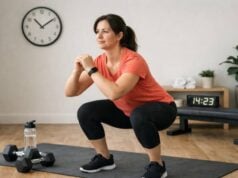
- Squat to reach
Sit the hips back, stand up strongly, and reach overhead at the top. - Push-up variation
Use a wall, countertop, couch edge, knees, or full floor push-up depending on ability. - Reverse lunge or split squat
Alternate sides. Move slowly enough to stay balanced. - Glute bridge
Pause for 1 second at the top and keep ribs down. - Fast march or mountain climber
Beginners can march in place with strong arm drive. More advanced exercisers can use floor mountain climbers. - Forearm plank or plank shoulder taps
Choose the version that lets you keep your trunk steady.
That gives you 18 minutes of structured work that hits legs, chest, shoulders, core, and conditioning in one block.
4-minute finisher
Use 20 seconds of work and 10 seconds of rest for 8 rounds, alternating between these two moves:
- High-knee march or quick feet
- Squat hold or bodyweight good morning
The goal here is not to collapse. It is to finish the session breathing hard while keeping technique controlled.
How hard should it feel?
Aim for an effort of about 7 out of 10 by the end of each round. You should feel challenged, warm, and out of breath, but still able to recover enough to continue with solid form. If round one feels like a 10 out of 10, the exercise choice is too hard.
How often to do it
Start with 3 days per week on nonconsecutive days. If you recover well and your joints feel good, you can build to 4 sessions per week by alternating harder and easier days. On non-workout days, walking and general movement help more than complete inactivity.
A few small details make this routine work better:
- Keep transitions short, but do not rush setup.
- Record how many good reps you get in the first round for each move.
- Use the same workout for at least 3 to 4 weeks before changing everything.
- When it starts to feel manageable, progress one variable at a time.
If you need an even simpler entry point, begin with 30 seconds of work and 30 seconds of rest for the same movements, or do only 2 rounds. Completing a shorter plan consistently beats quitting a perfect plan after four days.
Form and progression options
The fastest way to make a bodyweight routine more effective is not adding random exercises. It is making the current exercises cleaner, deeper, steadier, or denser over time. Here is how to think about each main movement in the routine.
Squat to reach
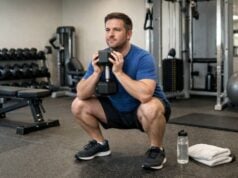
Focus on sitting down between your hips, keeping your whole foot on the floor, and standing tall without leaning far forward.
- Easier: squat to a chair or couch cushion
- Harder: slower lowering phase, pause at the bottom, or squat jumps if your joints tolerate impact
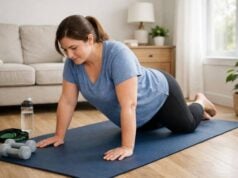
Push-up variation
Keep the body in a straight line from shoulders to knees or heels. Lower with control and press the floor or wall away.
- Easier: wall push-up or higher incline
- Harder: lower incline, full floor push-up, or tempo reps with a 3-second lowering phase
Reverse lunge or split squat
Step back far enough that both knees can bend comfortably. Think “down and up,” not “forward and backward.”
- Easier: hold a wall or chair for balance and use a smaller range of motion
- Harder: add a knee drive at the top or use jump lunges only if you already move well and pain-free
Glute bridge
Drive through the heels and stop when hips are fully extended without arching the lower back.
- Easier: shorter sets or a shorter top range
- Harder: single-leg bridge or 2-second pauses at the top
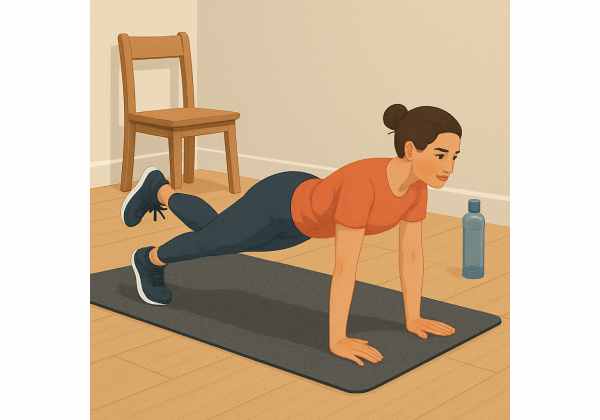
Fast march or mountain climber
The purpose is to drive heart rate, not to look dramatic. Fast marching can be surprisingly effective when done with purpose.
- Easier: march in place
- Harder: mountain climbers, skaters, or step-back burpees without the push-up
Plank or shoulder taps
Brace the midsection as if someone is about to poke your stomach. Hips should stay level.
- Easier: elevated plank on a bench, couch, or counter
- Harder: longer lever plank, shoulder taps, or slow body saws on a towel
Your main progression tools are simple:
- Add reps within the work interval
- Increase work time slightly
- Reduce rest a little
- Increase range of motion
- Use a harder variation
- Add an extra round
You do not need to use all six. In fact, that is a common mistake. Choose one. For example, stay with 45 seconds of work and aim to improve rep quality and total reps for two weeks. Then reduce the transition rest from 15 seconds to 10. Or keep the rest the same and progress your push-up from wall to countertop.
If you are carrying more body weight, elevated push-ups, chair squats, controlled split squats, and bridges are often more practical than high-impact circuits. They still train hard. They also scale better. If you need joint-friendly cardio options on top of this routine, low-impact cardio for bad knees can help you build volume without beating yourself up.
Weekly plan for better results
One bodyweight workout can help, but a weekly system is what drives weight loss. The most effective setup for most people is not daily punishment. It is a repeatable mix of strength-oriented bodyweight sessions, walking, and enough recovery to perform well again.
A practical weekly template looks like this:
- Monday: Bodyweight routine
- Tuesday: 30 to 45 minutes of brisk walking
- Wednesday: Bodyweight routine
- Thursday: Easy walk, mobility, or full rest
- Friday: Bodyweight routine
- Saturday: Longer walk, bike ride, or light recreational activity
- Sunday: Rest or easy movement
That structure works because it spreads stress across the week. You get three meaningful training exposures, several chances to increase calorie burn through everyday movement, and recovery built in instead of treated as failure.
Walking matters more than many people think. It adds calorie burn with low recovery cost, and it helps keep total daily activity up while dieting. Many people also find that a bodyweight plan works much better when it sits on top of a consistent walking routine rather than replacing it.
Nutrition matters too. Exercise alone can improve body composition, but fat loss usually moves faster when training is paired with a modest calorie deficit and enough protein. A useful starting point is planning meals around lean protein, high-fiber foods, and predictable portions. Hitting a steady protein intake for weight loss can help protect lean mass and improve fullness.
Outside formal workouts, pay attention to daily movement. Taking the stairs, standing more, doing short chores, walking during calls, and adding mini movement breaks can make a meaningful difference over months. This is the kind of low-drama movement that raises energy output without feeling like another workout, and NEAT is often the hidden advantage in successful long-term fat loss.
Two final scheduling notes matter:
- Do not stack your hardest sessions back to back when you are new.
- Plan at least one lighter day after a demanding session.
Many people assume that more is always better, then end up sore, tired, and inconsistent by week two. A smarter approach is to use 3 strong sessions, 2 to 4 days of walking, and a realistic recovery plan. If you are unsure how many days off to keep, rest days per week should be based on performance and recovery, not guilt.
Mistakes and progress tracking
The most common reason bodyweight workouts stop working is not that bodyweight training “doesn’t burn enough.” It is that people stop progressing, underestimate food intake, or mistake exhaustion for effectiveness.
Here are the mistakes that matter most:
- Doing the same easy routine forever.
If the workout feels exactly the same after four weeks, your body has adapted. - Turning every session into a max-effort cardio test.
Weight loss training should challenge you, not destroy your joints and recovery. - Ignoring technique.
Sloppy reps make counting easy but training less effective. - Only measuring scale weight.
Bodyweight workouts may help you keep more lean mass, so waist size, photos, and workout performance matter too. - Skipping recovery basics.
Poor sleep, low protein, and too little movement between workouts make fat loss harder.
A better way to track progress is using a simple scorecard once per week:
- Body weight average for the week, not one random day
- Waist measurement at the navel
- Number of workouts completed
- Average daily steps
- Best rep count or hardest variation used in the main exercises
- Energy, sleep, and soreness notes
That scorecard shows whether your plan is working even when the scale is temporarily noisy. For example, if your weight is flat for 10 days but your waist is down, your steps are up, and your push-ups improved, the plan is probably still moving in the right direction.
Expect visible improvement in fitness before dramatic body-shape change. Many people notice that stairs feel easier, recovery improves, and movements look cleaner within 2 to 3 weeks. Scale and waist changes often become clearer after 4 to 8 weeks of steady adherence.
When progress slows, adjust one variable at a time:
- Add 1,000 to 2,000 daily steps
- Upgrade one or two exercise variations
- Add one extra round to the circuit
- Tighten food consistency instead of slashing calories
- Keep recovery strong for another two weeks before changing more
That last point matters. Weight loss is rarely a straight line. Water retention, menstrual cycle changes, harder training weeks, and sodium swings can hide real progress. Use trends, not emotion, to judge the plan. A bodyweight program works best when it becomes boring in the best possible way: scheduled, repeatable, and easy to return to after a busy week.
References
- WHO guidelines on physical activity and sedentary behaviour 2020 (Guideline)
- Aerobic Exercise and Weight Loss in Adults: A Systematic Review and Dose-Response Meta-Analysis 2024 (Systematic Review and Meta-Analysis)
- Physical Activity and Excess Body Weight and Adiposity for Adults. American College of Sports Medicine Consensus Statement 2024 (Consensus Statement)
- Resistance training effectiveness on body composition and body weight outcomes in individuals with overweight and obesity across the lifespan: a systematic review and meta-analysis 2022 (Systematic Review and Meta-Analysis)
- Physical activity 2024 (Fact Sheet)
Disclaimer
This article is for general educational purposes only. It does not replace personalized medical advice, diagnosis, or treatment. If you have a medical condition, significant joint pain, recent surgery, chest symptoms with exercise, or concerns about starting a new routine, speak with a qualified clinician before beginning.
If this article helped you, please share it on Facebook, X, or any platform your friends, clients, or family use most.